

Less than 5% of the 600,000 manufacturing companies in the United States have achieved ISO 9001 certification; yet, for those who have, the ongoing maintenance often creates more friction than the initial achievement. Many leaders find the ISO 9001 surveillance audit process to be a source of operational anxiety, fearing that a single non-conformity might disrupt the momentum of their digital transformation or governance initiatives. It’s common to feel a sense of confusion regarding the shifting requirements between annual surveillance and full recertification, especially as new standards approach.
We understand that your priority is to maintain a high-performance culture without the burden of administrative confusion. This article provides a sophisticated roadmap to help you master the ISO 9001 surveillance audit process through a strategic executive checklist. By aligning your Quality Management System with the 2024 climate change amendments and the upcoming ISO 9001:2026 standards, you’ll secure continuous compliance while driving tangible results. We will explore the essential steps to navigate the 3-year cycle, ensuring your organization remains a resilient architect of its own success.
Key Takeaways
- Transition from viewing audits as compliance hurdles to recognizing them as strategic tools for organizational stability and long-term growth.
- Master the timing and scope of the three-year cycle to ensure your team remains prepared for annual oversight without disrupting daily operations.
- Identify the critical differences in man-day requirements and scope between the ISO 9001 surveillance audit process and full recertification.
- Implement a five-step preparation phase that integrates quality management into your existing leadership and digital transformation efforts.
- Convert minor non-conformities and opportunities for improvement into catalysts for operational excellence through structured root cause analysis.
Defining the ISO 9001 Surveillance Audit: Purpose and Strategic Value
The ISO 9001 surveillance audit process represents a critical checkpoint in an organization’s journey toward sustainable excellence. Rather than a comprehensive overhaul of your systems, this periodic review by an external certification body ensures that your Quality Management System (QMS) remains aligned with the ISO 9001 standard requirements. The primary objective is to maintain the validity of your existing certificate by verifying that the standards established during initial certification continue to drive daily operational behavior. It’s a mechanism designed to ensure that quality is woven into the fabric of the company rather than treated as a temporary project.
Why Surveillance Audits Exist in the ISO Framework
ISO standards demand ongoing compliance to ensure that quality isn’t a one-time event. These audits protect the integrity of the ISO 9001 brand globally, ensuring that every certified entity maintains a baseline of excellence. Your Registrar plays a vital role here; they act as an objective observer to verify that your QMS hasn’t drifted from its intended path. This scrutiny prevents the compliance fatigue that often leads to internal shortcuts. It ensures that the organization remains a steady hand in an ever-changing market, grounded in practical application and international benchmarks.
The ROI of Continuous Compliance
Maintaining a state of audit readiness offers a significant return on investment that extends far beyond a framed certificate. Regular reviews help leadership identify process inefficiencies and bottlenecks before they escalate into costly operational failures. This third-party validation provides stakeholders, from investors to board members, with documented proof of your organization’s performance. Engaging deeply with the ISO 9001 surveillance audit process ensures that your team stays focused on transformation rather than just reaction. A robust ISO 9001 Quality Management Certification framework directly correlates with superior customer satisfaction. When processes are optimized and risks are managed, the consistency of your output naturally improves, fostering deeper trust and long-term loyalty in the marketplace.
The 3-Year Certification Cycle: Timing and Scope
Maintaining a world-class Quality Management System (QMS) requires a commitment to a structured, three-year certification cycle. This journey begins with the Initial Certification, which involves a comprehensive Stage 1 and Stage 2 assessment. Once certification is granted, the ISO 9001 surveillance audit process commences, consisting of two annual visits—Surveillance 1 and Surveillance 2. These audits serve as strategic pulse checks before the cycle concludes with a full Recertification audit in the third year. This rhythmic approach ensures that compliance isn’t a frantic, once-every-three-years event but a steady, integrated part of your organizational governance.
Audit visits typically occur at 12-month intervals, providing a consistent cadence for performance review. It’s vital to recognize that surveillance audits are notably different from the initial Stage 2 assessment. While the initial audit is an exhaustive review of every requirement, a surveillance audit is shorter and more targeted. Auditors typically sample between 30% and 50% of the QMS during these visits. This focused scope allows for a deeper dive into specific operational areas while ensuring the core pillars of the standard remain robust. Understanding the nuances of ISO Surveillance Audits is essential for leaders who wish to maintain a state of perpetual readiness and avoid the disruption of last-minute preparations.
Surveillance Year 1 vs. Year 2
The focus of the audit often evolves as your system matures. During the first surveillance year, auditors frequently prioritize the implementation of new processes or changes made since the initial certification. They look for evidence that the team has successfully adopted the QMS into their daily workflows. By the second year, the scrutiny shifts toward data analysis and trend monitoring. The auditor expects to see sophisticated use of metrics to drive decision-making. They may also rotate their focus to sample different departments or production lines, ensuring that every facet of the organization eventually comes under review during the three-year cycle.
Critical Components Evaluated in Every Visit
Certain elements are so fundamental to organizational health that they’re reviewed during every visit. Auditors will consistently verify the maintenance of QMS documentation to ensure it accurately reflects current operations. They place heavy emphasis on the effectiveness of your internal audit programs and the depth of your management review meetings. Furthermore, they’ll scrutinize your progress on quality objectives and the practical application of the Plan-Do-Check-Act (PDCA) cycle. This persistent focus on core governance helps prevent “process drift” and keeps the organization aligned with its strategic goals. If you’re seeking to refine your leadership’s approach to these standards, you can connect with our expert advisors for a tailored consultation.
Comparing Audit Types: Surveillance vs. Recertification vs. Internal Audits
The hierarchy of evaluation within quality management distinguishes between internal self-governance and external validation. Understanding the specific nuances of the ISO 9001 surveillance audit process compared to a full recertification is essential for resource allocation and strategic planning. While a recertification audit requires a 100% review of the Quality Management System (QMS), surveillance audits typically sample only 30% to 50% of the processes. This difference in scope significantly impacts the duration of the visit. Surveillance audits require fewer auditor man-days, focusing on high-risk areas and core governance rather than every single clause of the standard.
Internal audits provide the foundation for this entire structure. Unlike surveillance or recertification visits, which are conducted by independent third-party registrars, internal audits are self-led exercises. They function as your primary early warning system, identifying potential non-conformities before external eyes can document them. A robust internal program doesn’t just find errors; it builds significant auditor confidence. When an external auditor sees that your team has already identified and addressed internal gaps, it demonstrates a mature, self-correcting culture that values structural integrity.
The Strategic Role of Internal Audits
Completing your internal audits well before the scheduled external surveillance visit is a non-negotiable requirement for success. These internal reviews should be deep and critical, mimicking the rigor of the registrar. Leveraging professional ISO 9001 auditing services allows leadership to identify subtle process drifts that internal staff might overlook due to familiarity. This proactive approach ensures that the formal ISO 9001 surveillance audit process becomes a validation of your excellence rather than a discovery of your failures.
What Happens During Recertification?
Every third year, the organization undergoes a full system re-evaluation known as recertification. This is a holistic assessment that mirrors the intensity of the initial Stage 2 audit, covering every requirement of the standard. Upon successful completion, the certification cycle resets, and a new certificate is issued to the organization. It’s vital to remember that performance during surveillance years directly impacts this outcome. A failure to address minor non-conformities during a surveillance visit can escalate, jeopardizing the organization’s ability to achieve recertification and maintain its global standing.
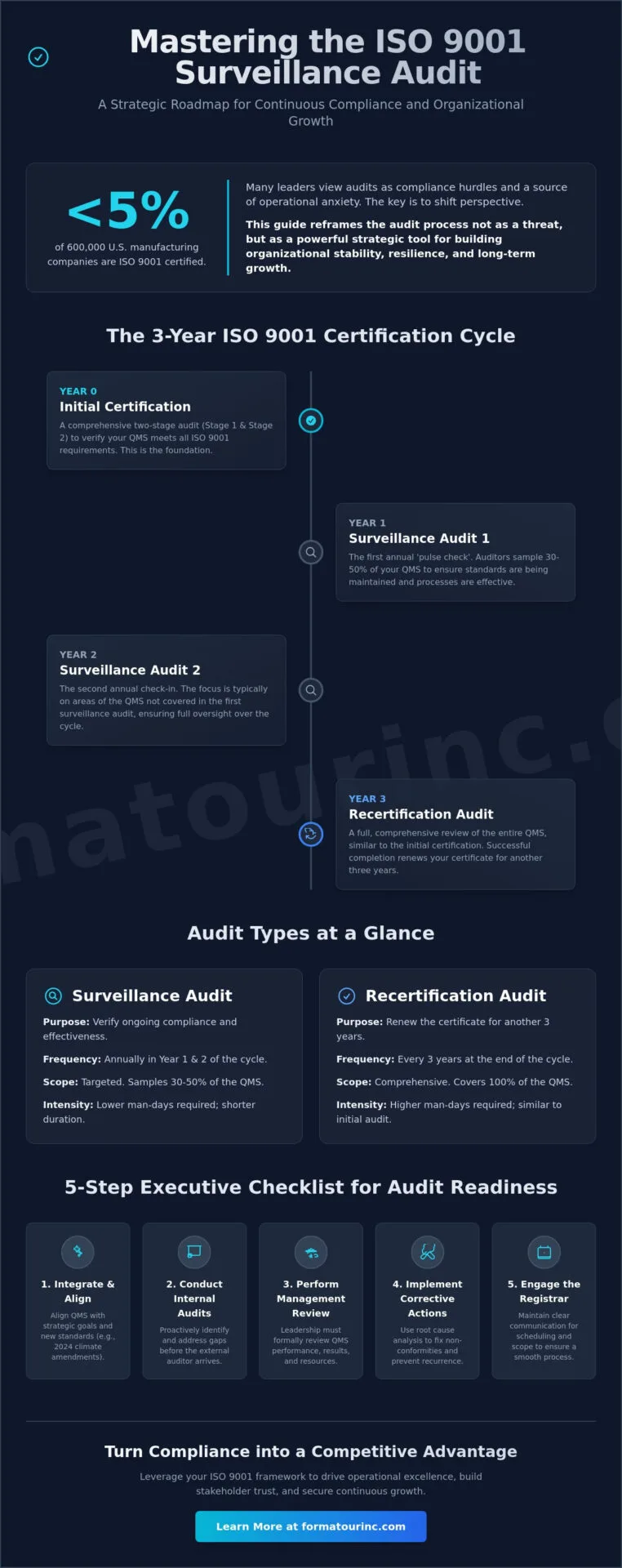
The ISO 9001 Surveillance Audit Preparation Checklist
Preparation for a successful audit shouldn’t be a last-minute scramble that pulls your team away from their core responsibilities. Instead, viewing the ISO 9001 surveillance audit process as a continuous cycle of refinement allows you to maintain operational momentum while demonstrating compliance. A structured approach minimizes disruption by integrating quality checks into daily workflows, ensuring that the audit feels like a natural validation of your existing excellence. High-level leadership visibility is also paramount; your presence during the opening and closing meetings signals to the auditor that quality is a strategic priority, not just a middle-management task.
To ensure a seamless experience, follow this five-step executive checklist designed to fortify your Quality Management System (QMS) and project confidence to external assessors. If your organization is still in the early stages of building its QMS foundation, our detailed guide on how to implement ISO 9001 provides a strategic roadmap for establishing the systems that make surveillance audits a natural validation rather than a stressful event.
Step 1: Document Control and Record Verification
Precision in documentation is the bedrock of any successful audit. You must verify that all quality manuals, procedures, and work instructions reflect your current operational reality. It’s not enough to have the documents; records such as meeting minutes, training logs, and calibration reports must be easily retrievable to avoid awkward delays. Finally, check that your Quality Policy is understood throughout the organization, as auditors often interview staff to gauge how well the policy is communicated and lived.
Step 2: Review Internal Audit and Management Review Outputs
Auditors look for evidence of a self-correcting system. Confirm that at least one full cycle of internal audits has been completed since the last registrar visit. Management Review minutes should clearly document decisions regarding QMS improvements and resource allocation. It’s essential to demonstrate that “closed-loop” corrective actions are being utilized, as the auditor’s primary interest lies in how you identify, address, and prevent the recurrence of issues.
Step 3: Evaluate Objectives and KPIs
Data should tell the story of your progress. Gather documented evidence showing your performance against established quality objectives. If targets have been missed, be prepared to explain the “why” and the corrective actions taken to get back on track. Ensure that your Key Performance Indicators (KPIs) remain relevant to the firm’s current strategic direction, proving that your QMS evolves alongside your business goals.
Step 4: Conduct a ‘Mock’ Surveillance Walkthrough
Step 5: Logistics and Auditor Coordination
Smooth logistics reflect a well-managed organization. Confirm the audit plan, dates, and scope with your Certification Body (CB) well in advance. Assign dedicated “guides” or “scribes” to accompany the auditor and document their observations in real-time. Prepare a “War Room” equipped with necessary digital access and physical documentation to facilitate a swift and professional review process. If you need assistance streamlining these preparation steps, contact our strategic consultants to ensure your leadership team is fully prepared.
Leveraging Audit Findings for Strategic Transformation
The conclusion of the ISO 9001 surveillance audit process is often met with relief, but the true value lies in the data gathered during the closing meeting. Executives should view audit findings as high-fidelity feedback on the organization’s structural health. Findings generally fall into three categories: Major Non-conformities, which indicate a significant system failure; Minor Non-conformities, representing isolated lapses; and Opportunities for Improvement (OFIs). While Major findings require immediate attention to protect your certification, OFIs are often the most valuable for forward-thinking leaders. They offer a third-party perspective on how to refine processes that are compliant but not yet optimized.
Adopting a “Root Cause Analysis” mindset is what separates visionary architects from those merely seeking a “Quick Fix.” Instead of patching a symptom, leaders should use the audit report to identify underlying systemic weaknesses. Engaging quality management system consulting expertise can help transform this data-driven roadmap into the foundation for the next fiscal year’s strategic projects, ensuring that resources are allocated where they’ll have the most significant impact on operational performance.
Turning Non-Conformities into Process Innovations
Partnering with Formatour for Long-Term Resilience
Achieving sustainable growth requires more than just passing an annual check. Premium advisory services go beyond simple compliance, helping organizations leverage their Quality Management System to drive digital transformation and human capital development. There’s a natural synergy between maintaining ISO 9001 quality standards and investing in executive leadership development programs. For organizations seeking to fortify their global footprint, integrating multiple standards is a logical next step. We invite you to explore our ISO 27001 implementation services to harmonize your information security with your quality management goals. To ensure your organization remains a leader in its field, contact Formatour Incorporated for expert ISO 9001 auditing and advisory support.
Strategic Excellence Beyond the Audit Cycle
As you look toward the 2026 standards and the formal integration of climate change considerations, having a steady, expert hand to guide your progress is essential. Formatour Incorporated brings over a decade of international advisory experience, offering the boutique agility needed to adapt to your specific organizational landscape while maintaining big-firm consulting standards. We specialize in developing integrated management systems that harmonize ISO 9001 and ISO 27001 requirements, creating a unified framework for security and quality.
Secure Your Certification with Formatour’s Expert ISO 9001 Auditing Services to transform your compliance journey into a competitive advantage. Your organization possesses the potential for profound transformation; let’s build that future together.
Frequently Asked Questions
What is the difference between a surveillance audit and a recertification audit?
A surveillance audit is a partial review focusing on core governance and specific operational samples, whereas a recertification audit is a comprehensive 100% assessment of the entire system. While surveillance visits ensure the certificate remains valid during the three-year cycle, the recertification audit in the third year results in the issuance of a brand-new certificate. This distinction allows the registrar to verify ongoing compliance without the exhaustive duration of a full system reset.
How long does an ISO 9001 surveillance audit typically take?
The duration of an ISO 9001 surveillance audit typically ranges from one to three days for small to mid-sized organizations. This timeframe depends heavily on your headcount, the complexity of your processes, and the number of physical or digital sites being assessed. It’s designed to be significantly shorter than the initial Stage 2 audit, focusing on high-risk areas and core pillars identified in previous cycles.
What happens if we fail an ISO 9001 surveillance audit?
If an organization fails to meet requirements, the auditor issues non-conformities that must be addressed through a formal corrective action process. A major non-conformity can lead to the suspension of your certificate if it’s not resolved within the registrar’s specified timeframe. Minor issues usually require a documented plan for improvement, but they don’t typically jeopardize your certification status if handled with a root-cause mindset.
Can a surveillance audit be conducted remotely in 2026?
Remote and hybrid audits are fully supported in 2026, thanks to advanced IT infrastructure and digital-first business models. Many registrars utilize cloud-based document reviews and video interviews to conduct the ISO 9001 surveillance audit process efficiently. This approach is particularly effective for service-based industries or organizations with decentralized teams, though some on-site verification may still be required for manufacturing environments.
How many surveillance audits are required in a three-year cycle?
Exactly two surveillance audits are required within a standard three-year certification cycle. These visits occur at approximately 12-month intervals following the initial certification date. They serve as strategic checkpoints to ensure the Quality Management System remains robust before the organization undergoes the full recertification process in the third year. This cadence helps maintain a steady hand on organizational health and process integrity.
Do we need to audit every single process during a surveillance visit?
No, auditors don’t review every single process during a surveillance visit; instead, they utilize a strategic sampling approach. They consistently review fundamental elements like management reviews and internal audits while rotating through other departments or clauses of the standard. This ensures that every facet of the Quality Management System is eventually examined over the course of the three-year cycle without overwhelming the organization’s daily operations.
What are the most common non-conformities found during surveillance audits?
Common non-conformities often involve gaps in document control, inconsistent training records, or ineffective internal audit programs. Auditors frequently find that organizations fail to properly document “closed-loop” corrective actions, which are essential for preventing problem recurrence. During the ISO 9001 surveillance audit process, assessors also look closely at how well quality objectives are being tracked and whether leadership is actively driving the Plan-Do-Check-Act cycle.
How much does an ISO 9001 surveillance audit cost?
The financial investment for an annual audit varies based on the size of the company, the number of sites, and the complexity of the industry. Factors such as auditor man-days and travel requirements will influence the final cost. Because these variables are unique to every organization, it’s best to consult directly with your certification body or registrar to receive a precise quote tailored to your specific operational landscape.
