

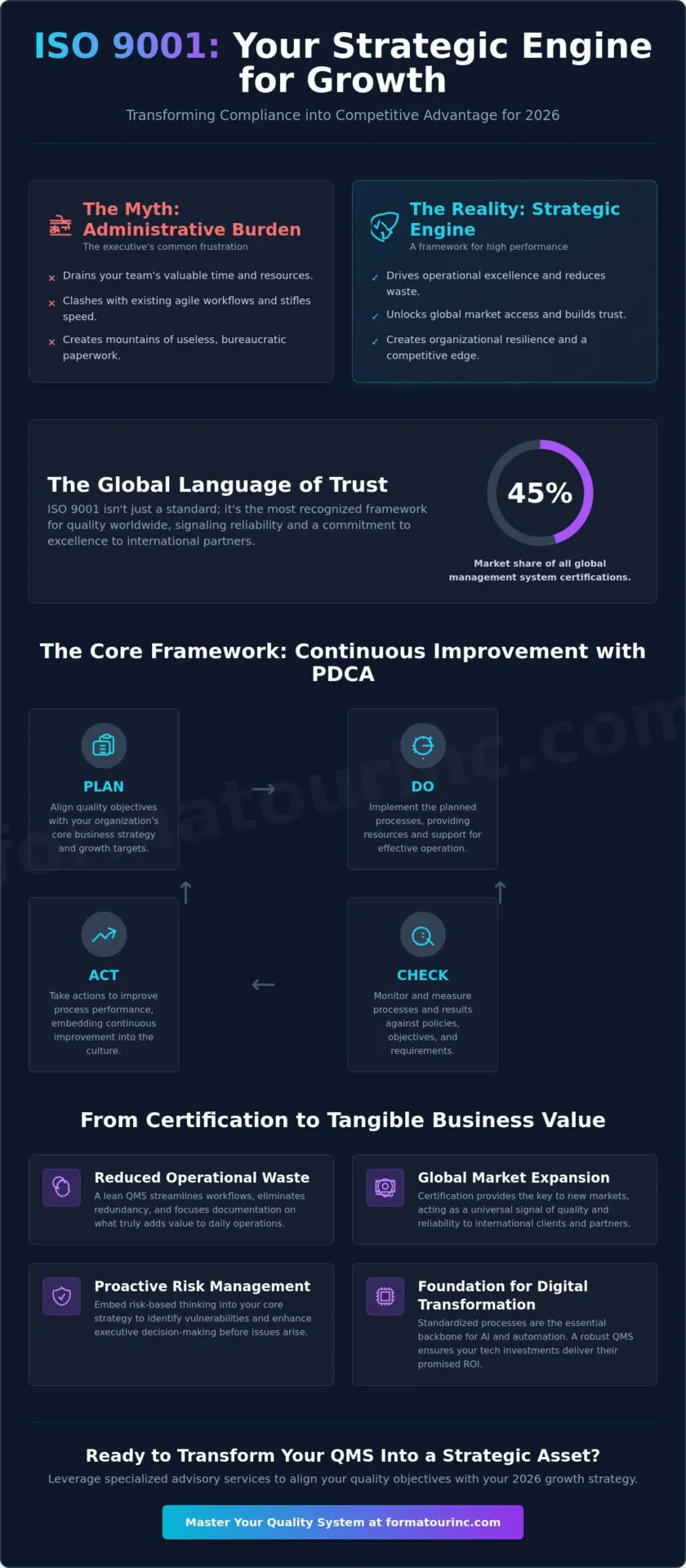
Most executives view international standards as a burden of administrative paperwork, yet ISO 9001 commands a 45% market share of all global certifications because it functions as a high-performance engine for growth. You’re likely concerned that learning how to implement ISO 9001 or transitioning to the new 2026 standard will drain your team’s time or clash with your existing agile workflows. It’s a common frustration to feel that compliance might stifle the very speed that makes your organization successful. We understand that your priority is maintaining momentum while achieving the structural integrity required for international expansion.
This guide provides a sophisticated, executive-led roadmap to mastering your quality management system as a strategic asset rather than a bureaucratic hurdle. By aligning your operations with modern digital transformation and governance principles, you can transform a simple compliance requirement into a driver of operational excellence. We’ll explore the evolutionary shift toward climate-conscious quality culture and the specific steps to secure global market access through a resilient, certified system that clarifies internal accountability without sacrificing your competitive edge.
Key Takeaways
- Transform your quality management system from a compliance checklist into a strategic framework for organizational resilience and long-term stability.
- Adopt risk-based thinking as a core executive tool to enhance decision-making and streamline complex operational processes.
- Master how to implement ISO 9001 by conducting a high-impact gap analysis that identifies your current maturity and builds momentum from existing internal successes.
- Secure a clear executive mandate to align your quality objectives with your organization’s 2026 business strategy and growth targets.
- Leverage specialized advisory services to mentor your leadership team and facilitate a seamless cultural transition toward operational excellence.
Beyond the Certificate: Why Strategic ISO 9001 Implementation Matters in 2026
The decision of how to implement ISO 9001 shouldn’t be viewed as a pursuit of a wall hanging, but as the construction of a strategic architecture for long-term growth. In the current global economy, the standard serves as a sophisticated framework for sustained operational excellence and heightened customer satisfaction. As we approach the release of the ISO 9001:2026 update in September 2026, the focus has shifted decisively from “compliance for compliance sake” toward strategic organizational resilience. This evolution requires leaders to view quality management as a dynamic system capable of absorbing market shocks and adapting to rapid technological shifts.
The 2026 business landscape demands a level of precision that only a structured management system can provide. Quality management has become the essential backbone of digital transformation; without standardized processes, investments in AI and automation often fail to deliver their promised returns. By grounding your operations in the ISO 9000 family of standards, you create a stable foundation where data integrity and process consistency flourish. This structural integrity is what allows a modern enterprise to scale without losing the quality that defined its initial success.
The return on investment for a strategic implementation is tangible and multi-faceted. Organizations that prioritize a robust Quality Management System (QMS) see a marked reduction in operational waste and a more proactive approach to risk management. Beyond internal efficiency, certification provides the key to global market expansion. With ISO 9001 commanding a 45% market share of all ISO certifications globally, it remains the most recognized language of trust between international partners. It’s a signal to the world that your organization is built on reliability and a commitment to continuous improvement.
The Business Value of a Quality Management System (QMS)
A high-performance QMS provides a single source of truth for your organizational processes, ensuring that every team member operates from the same playbook. This clarity is vital for maintaining customer trust in competitive global markets, where consistency is the primary differentiator. When you understand how to implement ISO 9001 with a focus on operational performance, the system becomes a tool for executive decision-making rather than a separate administrative task. You can explore how professional Digital Transformation Consulting can further align these quality goals with your broader technological roadmap.
Debunking the “Administrative Burden” Myth
Many executives fear that certification will bury their teams under mountains of useless paperwork. Modern implementation strategies prove the opposite by focusing on documented information that adds actual value to the daily workflow. We’ve moved past the era of massive, dusty manuals in favor of lean, digitalized records that support real-time optimization. A lean QMS focuses on high-impact documentation that streamlines workflows while eliminating the redundant logs that historically slowed down progress.
Decoding the ISO 9001:2015 Framework: A Leadership Perspective
Viewing the ISO 9001 quality management standard through a purely technical lens often obscures its true purpose. It’s not a legal checklist; it’s a logical business cycle designed to ensure every decision aligns with your strategic vision. At its heart lies the Plan-Do-Check-Act (PDCA) cycle, a rhythm that transforms static processes into engines for continuous improvement. When you understand how to implement ISO 9001 from the top down, the standard becomes a powerful executive decision-making tool. This perspective shifts the focus from managing documents to managing results.
Central to this framework is the “Process Approach” and “Risk-Based Thinking.” These aren’t just industry terms. They’re methodologies that allow leaders to identify vulnerabilities before they become failures. Clause 4, which focuses on the “Context of the Organization,” is where this alignment begins. It requires you to identify the internal and external issues that affect your strategic direction. By doing so, you ensure that your quality objectives aren’t isolated from your corporate strategy, but are instead the very mechanism that delivers it.
Clauses 4–6: Strategic Planning and Leadership
The roadmap for how to implement ISO 9001 relies heavily on Clause 5, which addresses Leadership. Top management commitment is the primary predictor of implementation success. It’s not enough to simply authorize the project; leaders must actively foster a quality culture and ensure that the QMS is integrated into the business’s core processes. Clause 6 then moves the organization from reactive problem-solving to proactive risk and opportunity management. This strategic planning phase ensures that you aren’t just fixing errors, but are actively designing systems to prevent them from occurring in the first place.
Clauses 7–10: Execution, Evaluation, and Evolution
Execution requires the robust resource management and operational controls outlined in Clauses 7 and 8. These sections ensure that your delivery remains consistent, even as your organization scales or undergoes digital transformation. Once these controls are in place, Clause 9 uses internal audits and management reviews to measure the “health” of the system rather than just “compliance.” These evaluations provide the data necessary for Clause 10, which focuses on improvement. To maintain this momentum, leaders should understand the ISO 9001 surveillance audit process as a tool for ongoing evolution. If you’re ready to align your leadership team with these international benchmarks, you might consider exploring our Executive Leadership Development Programs or reaching out for a strategic consultation.
Conducting a High-Impact Gap Analysis: The Foundation of Implementation
Before an organization can determine how to implement ISO 9001 effectively, it must first establish an honest baseline of its current operational maturity. A gap analysis isn’t merely a checklist of missing documents; it’s a strategic audit of your existing business health. We often encourage leadership teams to assume they’re already performing 75% of what the standard requires. Most established firms possess inherent quality habits that simply lack the formal structure or consistency the standard demands. Recognizing these existing strengths builds immediate momentum and prevents the implementation process from feeling like an alien imposition on the workforce.
A successful gap analysis uncovers the “hidden processes” that actually drive your business. These are the informal rituals and tribal knowledge that employees rely on to solve problems when official manuals fail. To capture this reality, you must assemble a multidisciplinary team. Relying solely on a Quality Manager often leads to a narrow, technical view of the organization. By involving representatives from operations, human resources, and information technology, you ensure the resulting roadmap reflects the complexities of the entire enterprise. For a structured look at this journey, NC State University’s ISO 9001 Implementation Guide provides an excellent academic perspective on bridging these organizational voids.
Mapping Existing Workflows to ISO Requirements
Uncovering the operational reality of your firm requires direct engagement with department heads. These interviews often reveal “process silos” where critical information is trapped within a single team, hindering overall quality and communication. Once these silos are identified, you can clearly document the “Current State” versus the “ISO-Compliant State.” This comparison highlights exactly where your existing workflows need refinement to meet the rigorous expectations of the international standard.
Leveraging Process Automation for Compliance
Closing the gaps identified in your analysis doesn’t always require more manual labor. Strategic Digital Transformation Consulting can help you integrate “Compliance by Design” into your existing IT infrastructure. By utilizing process automation, you can replace manual logs for Clause 7 and Clause 8 with automated data captures. This approach ensures that how to implement ISO 9001 becomes a discussion about technological optimization rather than administrative overhead. Automated workflows provide real-time evidence of compliance, allowing your team to focus on innovation instead of record-keeping.
The 7-Step Roadmap to ISO 9001 Certification
Mastering how to implement ISO 9001 requires a disciplined progression that transforms strategic intent into operational reality. This journey begins with Step 1: Secure an Executive Mandate. This phase is about more than just budget approval; it’s the critical alignment of quality objectives with your 2026 business plan. When leadership treats certification as a core strategic pillar, the rest of the organization follows with the necessary urgency and focus. Without this high-level commitment, the project risks becoming a peripheral administrative task rather than a driver of excellence.
Once the mandate is established, Step 2 involves creating a multidisciplinary implementation team. You must define clear roles, responsibilities, and authorities to ensure that every department has a voice and a stake in the outcome. This team then leads Step 3: Documenting the QMS. We recommend a lean, digital-first documentation hierarchy. By focusing on high-value information rather than volume, you ensure that your processes are both compliant and actually useful for the people performing the work. This approach prevents the “paperwork trap” that often plagues less sophisticated implementations.
Step 4 is the Launch and Train phase, where the system is introduced to the wider workforce. Success here depends on ensuring every employee understands their specific role within the quality cycle. Following the launch, Step 5 is the Internal Audit. This is a rigorous stress test of your new system. It serves as a vital dress rehearsal, allowing you to identify and resolve non-conformities in a controlled environment before an external registrar ever sets foot in your facility. It’s the ultimate validation of your preparation.
Step 6: Management Review and Course Correction
The management review is the bridge between implementation and “business as usual.” This session focuses on data-driven decision making, using the findings from your internal audits to trigger corrective actions. It’s a time for leadership to evaluate the system’s effectiveness and ensure it remains aligned with the organization’s strategic direction. This step ensures that the QMS is a living, breathing system that evolves alongside your business needs.
Step 7: Selecting a Registrar and The Certification Audit
Choosing the right certification body is a strategic decision. You should select a registrar with deep experience in your specific industry and geographic region, such as Canada, to ensure the audit provides genuine value. The process typically involves Stage 1, a documentation review to confirm readiness, and Stage 2, the formal on-site audit. For organizations looking to build even greater structural integrity, our ISO 27001 implementation services offer a path toward an integrated management system. If you’re ready to begin your journey toward world-class quality, contact our team for a strategic consultation.
Optimizing Your QMS: Leveraging Advisory for Sustained Excellence
Choosing how to implement ISO 9001 often leads organizations to a critical fork in the road between generic, off-the-shelf templates and bespoke strategic advisory. While standardized templates might offer a veneer of compliance, they rarely capture the intricate operational nuances of a complex enterprise. A boutique advisory approach ensures that your Quality Management System is tailored to your specific organizational DNA. It transforms the standard from a rigid set of rules into a flexible strategic asset that supports your unique long-term goals. This level of customization is essential for firms that refuse to settle for superficial certification.
When organizations evaluate how to implement ISO 9001 as a strategic shift, the role of an expert advisor extends far beyond technical guidance. It involves mentoring your leadership through a profound cultural transformation. Implementation isn’t a project with a fixed end date; it’s a fundamental change in how your team perceives quality, risk, and accountability. A seasoned partner provides the steady hand needed to navigate the friction that often accompanies organizational change. They help translate high-level governance concepts into the daily language of your workforce, ensuring that the new systems are embraced rather than resisted. Working with a specialized firm that offers quality management system consulting can bridge the gap between mandatory compliance requirements and sustainable long-term growth.
The most effective implementation strategies rely on multidisciplinary expertise that combines quality management with digital transformation and corporate strategy. Formatour positions itself as the premium partner for firms that view ISO 9001 as a launchpad for growth rather than a final destination. By aligning international standards with your broader business objectives, we help you build a resilient structure that thrives in volatile markets. This holistic approach ensures that your QMS is a driver of efficiency and a catalyst for global expansion. To make the most informed decision when selecting a partner, reviewing a comprehensive ISO 9001 certification consulting buyer’s guide can help you identify the critical criteria that separate transformative advisors from cookie-cutter solution providers.
The Value of Multidisciplinary Advisory
Formatour bridges the gap between abstract standards and operational reality. We view certification as a vehicle for organizational transformation. By integrating process automation and optimization directly into the QMS architecture, we ensure your system is digital-ready and built for rapid scale. This approach pairs a sophisticated global mindset with the local agility required to solve specific operational bottlenecks. We help you move beyond the certificate to achieve measurable gains in organizational performance and customer trust.
Maintaining Momentum After Certification
The true test of a Quality Management System begins after the registrar leaves. Preventing “QMS decay” requires a proactive strategy that keeps the system relevant and high-performing as your business evolves. Continuous executive education serves as the fuel for this endurance, ensuring that leadership remains the primary advocate for a culture of quality. By fostering this ongoing engagement, you secure the stability and growth that the standard was designed to deliver. Partner with Formatour for your ISO 9001 journey to ensure your certification translates into lasting excellence and a permanent competitive advantage.
Securing Your Future Through Strategic Quality Governance
A world-class Quality Management System is much more than a collection of documented procedures; it’s the structural foundation for organizational resilience and global expansion. By prioritizing leadership commitment and risk-based thinking, you transform compliance into a powerful engine for operational excellence. Understanding how to implement ISO 9001 with a focus on digital integration ensures that your organization remains agile and competitive in an increasingly complex international market. This strategic approach clarifies internal accountability while fostering a culture of continuous improvement that persists long after the initial certification audit.
Formatour brings over a decade of multidisciplinary advisory experience to your transformation journey. We combine boutique agility with big-firm consulting standards, specializing in the seamless integration of ISO 9001, ISO 27001, and ISO 22301. Our experts mentor your leadership team to ensure that your quality framework drives tangible business growth and efficiency. Schedule a Strategic Transformation Consultation with Formatour today to begin building your roadmap to excellence. You’ll find that with the right partner, achieving world-class standards is a sustainable reality for your enterprise.
Frequently Asked Questions
How long does it typically take to implement ISO 9001?
Implementation typically requires six to twelve months for most organizations to reach a state of audit readiness. This timeline fluctuates based on your firm’s current operational maturity and the resources dedicated to the transition. Establishing a robust system requires enough time for cultural adoption and the generation of evidence through at least one full management cycle.
Can a small business implement ISO 9001 without a dedicated Quality Manager?
Small businesses can successfully navigate the requirements by distributing quality responsibilities across the existing leadership team. You don’t necessarily need a full-time Quality Manager if you leverage structured advisory to guide your internal staff. This approach ensures that quality becomes an integrated part of daily operations rather than a siloed administrative function.
What is the difference between ISO 9001 implementation and certification?
Implementation refers to the internal strategic process of designing and deploying your Quality Management System to meet international standards. Certification is the final validation performed by an independent registrar to confirm your system’s effectiveness. While learning how to implement ISO 9001 focuses on operational optimization, certification provides the formal recognition needed for global market access.
How much does ISO 9001 implementation cost for a mid-sized firm?
The total investment for implementation depends on several variables, including the complexity of your processes and the number of sites involved. Costs generally encompass internal resource allocation, digital tool integration, and external advisory support. You should also account for the registrar’s fees for the initial audit and subsequent annual surveillance assessments required to maintain your standing. For a detailed breakdown of what to look for when evaluating external support, our strategic guide to ISO 9001 certification consulting outlines the key investment criteria and selection factors for 2026.
Is it possible to integrate ISO 9001 with ISO 27001 or ISO 14001?
Integration is highly efficient because modern ISO standards share a Harmonized Structure that allows for a unified management system. Combining quality with information security or environmental management reduces documentation redundancy and streamlines internal audits. This holistic approach provides a comprehensive view of organizational health and risk management across multiple disciplines simultaneously.
Do I need an external consultant to implement ISO 9001 successfully?
While you can manage the process internally, an external consultant provides the specialized expertise and objective perspective needed to avoid common pitfalls. Professional advisors act as mentors to your leadership team, accelerating the timeline and ensuring the system adds genuine strategic value. This partnership often results in a more resilient and digital-ready framework than a solo effort could achieve.
What are the most common mistakes during the ISO 9001 implementation process?
The most frequent errors include a lack of visible leadership commitment and the creation of excessive, non-value-added paperwork. Organizations often fail when they treat the standard as a separate compliance task rather than integrating it into their core business strategy. Success requires moving beyond a simple checklist mentality to embrace a genuine culture of continuous improvement across all departments.
How often do we need to perform internal audits after certification?
Most organizations conduct internal audits at least once per year to ensure continued compliance and system effectiveness. However, a risk-based approach might require more frequent reviews of critical processes that significantly impact customer satisfaction or operational stability. Regular auditing serves as a vital health check that prepares your firm for the annual surveillance audits conducted by your registrar.
