

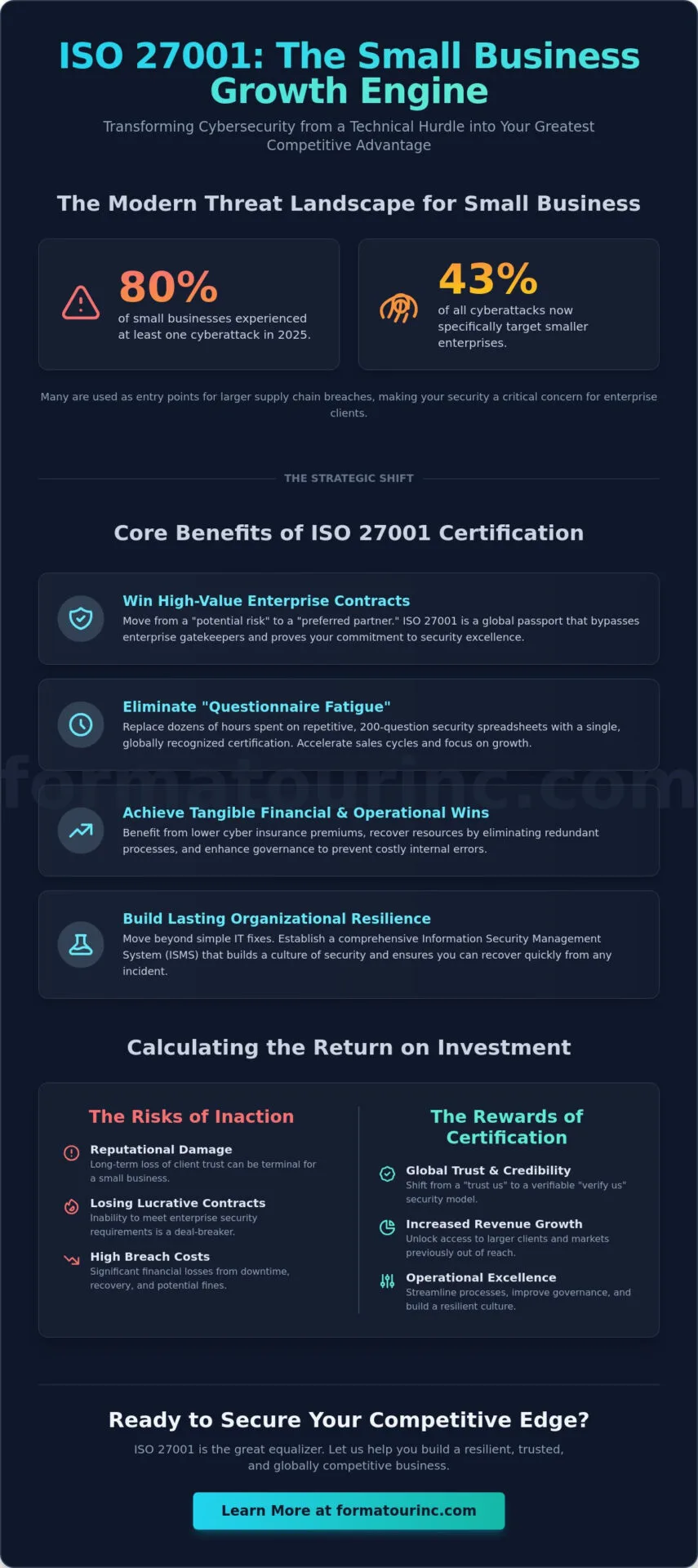
Eighty percent of small businesses experienced at least one cyberattack in 2025, with nearly half of all digital threats now specifically targeting smaller enterprises. You likely feel the pressure of this reality, often finding yourself overwhelmed by complex technical jargon or losing lucrative contracts to larger competitors who carry the right certifications. Understanding the strategic benefits of ISO 27001 for small business is the first step toward reclaiming your competitive edge. It’s a common frustration to view security as a mere cost center or a source of hidden implementation expenses.
This certification transforms your security posture into a powerful engine for global growth and operational excellence. By adopting the ISO/IEC 27001:2022 standard, you can effectively bridge the trust gap with enterprise clients and streamline your internal processes. This article explores how this framework serves as the great equalizer, helping you win larger contracts, automate compliance, and build a resilient culture of security that requires minimal daily management.
Key Takeaways
- Reframe security as a strategic business enabler that secures your position within the global supply chain rather than viewing it as a technical hurdle.
- Leverage the benefits of ISO 27001 for small business to secure high-value enterprise contracts and eliminate the burden of repetitive security questionnaires.
- Evaluate the true return on investment by balancing potential revenue growth against the significant financial and reputational risks of remaining uncertified.
- Adopt a boutique agility approach to implementation, ensuring your Information Security Management System focuses exclusively on your most critical business assets.
- Integrate strategic transformation with international standards to build lasting organizational resilience and a culture of continuous improvement.
Beyond Cybersecurity: Why ISO 27001 is a Strategic Mandate for Small Business
Small businesses often view digital security as a defensive technicality rather than a strategic asset. This perspective is shifting as the global supply chain becomes increasingly interconnected and demanding. The ISO/IEC 27001 standard provides a rigorous framework that moves beyond simple IT fixes to establish a comprehensive Information Security Management System (ISMS). An ISMS serves as a strategic governance tool that ensures organizational resilience by aligning security objectives with broader business goals. Understanding the benefits of ISO 27001 for small business is now essential for any leader aiming to compete in high-value markets.
The transition from reactive security to proactive management isn’t just about stopping hackers; it’s about building a foundation for sustainable growth. While traditional IT security focuses on firewalls and passwords, ISO 27001 addresses the human, physical, and organizational layers of your company. This holistic approach ensures that security isn’t a bottleneck but a facilitator for efficient operations.
The Evolution of Trust in the Digital Economy
Enterprise procurement has undergone a fundamental shift. Large corporations and government agencies no longer accept “trust us” as a security policy; they require third-party validation before signing contracts. In this environment, ISO 27001 acts as a global passport for international business expansion. It replaces endless security questionnaires with a single, accredited certification that proves your commitment to excellence. By moving to a “verify us” model, you demonstrate the institutional rigor that Tier 1 clients expect from their partners.
The Myth of the “Small Target”
Many entrepreneurs believe they’re too small to be noticed by cybercriminals. Statistics from 2025 prove otherwise, showing that 80% of small businesses experienced at least one attack, and 43% of all cyberattacks now target smaller enterprises. These organizations are frequently used as the entry point for larger supply chain breaches. The benefits of ISO 27001 for small business include a structured response plan that mitigates the hidden costs of a breach. While immediate financial loss is painful, the long-term reputation damage can be terminal; ISO 27001 provides the resilience needed to survive and recover quickly.
The Core Benefits: Competitive Dominance and Operational Excellence
ISO 27001 isn’t just about protection; it’s about strategic positioning. Small firms often struggle to prove their reliability to global giants when competing for high-value contracts. The strategic benefits of ISO 27001 extend far into the commercial arena, allowing you to bypass the gatekeepers of enterprise procurement. By meeting the stringent security requirements of Tier 1 clients, you transform your business from a potential risk into a preferred, trusted partner.
One of the most immediate benefits of ISO 27001 for small business is the drastic reduction in “Security Questionnaire Fatigue.” Instead of spending dozens of hours answering repetitive, 200-question spreadsheets for every new lead, you present a single, globally recognized certification. This efficiency accelerates sales cycles and frees up your leadership team to focus on core growth activities. Beyond the sales floor, this certification offers tangible financial and operational wins:
- Lower Insurance Costs: Many providers offer reduced cyber insurance premiums to organizations that demonstrate a mature risk management posture.
- Resource Recovery: Identifying and eliminating redundant processes and data silos that drain your team’s energy.
- Enhanced Governance: Establishing a clear hierarchy of data ownership that prevents costly internal errors.
The framework forces a level of organizational clarity that few small businesses achieve on their own. It provides a structured environment where strategy and results are inextricably linked, ensuring that every security measure serves a specific business outcome.
Capturing Market Share from Uncertified Competitors
In competitive bidding and RFPs, certification serves as a powerful differentiator. The “Formatour mindset” encourages you to view compliance as a marketing asset rather than a regulatory burden. The presence of the ISO seal has a profound psychological impact on C-suite decision-makers, offering them the peace of mind required to choose a boutique firm over a larger, less agile competitor. For those ready to elevate their market position, consulting with experts can help translate these standards into a compelling value proposition.
Operational Performance and Process Optimization
The link between ISO 27001 Annex A controls and overall business efficiency is direct and measurable. By implementing rigorous asset management and access controls, you reduce employee downtime caused by lost data or unauthorized system changes. Standardized documentation within the ISMS framework significantly reduces onboarding time for new staff by providing clear, accessible guidelines for data handling and security protocols. This structural integrity ensures your team operates with precision and confidence as you scale.
Calculating the ROI of ISO 27001 for Small Business
Measuring the financial impact of certification requires a shift from viewing compliance as an expense to recognizing it as a strategic investment. The ROI of ISO 27001 is realized through both immediate revenue gains and the avoidance of catastrophic losses. For instance, the average cost of a data breach for companies with fewer than 500 employees reached $3.31 million in 2025. This “Cost of Inaction” represents a terminal risk for many boutique firms. By contrast, the benefits of ISO 27001 for small business include a fortified defense that protects against these financial shocks while simultaneously increasing company valuation during funding rounds or M&A activities.
Strategic value also manifests in long-term savings through the prevention of regulatory fines. As data protection laws like GDPR and PIPEDA become more stringent, the structured approach of an ISMS ensures you remain compliant by design. This proactive stance eliminates the need for expensive, last-minute legal interventions or the heavy penalties associated with non-compliance. It positions your organization as a mature entity capable of managing risk with institutional precision.
Tangible Gains: Revenue Enablement
One of the most powerful benefits of ISO 27001 for small business is its role as a revenue catalyst. You can track this by measuring the percentage of new revenue that required security certification as a prerequisite. Certification significantly reduces the sales cycle length by pre-empting deep-dive security audits from prospects, allowing your team to close deals faster. Additionally, this framework supports digital transformation consulting initiatives by providing the secure foundation necessary to adopt and integrate new tech stacks with confidence.
Intangible Gains: Culture and Resilience
The indirect benefits of certification often provide the most sustainable long-term value. By building a “security-first” culture, you drastically reduce human error, which remains the primary cause of breaches globally. Leadership gains immense peace of mind knowing that governance is automated and regularly audited. For a holistic approach to organizational health, many firms choose to integrate ISO 27001 with ISO 9001 Quality Management. This synergy ensures that security and quality aren’t siloed departments but are instead woven into the very fabric of your daily operations, creating a resilient and high-performing enterprise.
Scaling the Standard: A Boutique Approach to Implementation
Implementation often scares boutique firms because they fear losing their agility to a wall of red tape. The “Boutique Agility” method reframes this by implementing controls that fit the business instead of forcing the business to follow a generic template. This tailored approach is one of the primary benefits of ISO 27001 for small business, as it allows for institutional rigor without sacrificing the speed that defines your success. It’s about building a system that supports growth rather than one that creates friction.
Success begins with a strategic four-step sequence. First, you must scope the ISMS to focus exclusively on critical business assets, ensuring resources aren’t wasted on low-risk areas. Second, conduct a risk assessment that prioritizes business continuity over rigid checkboxes. This exercise identifies real-world threats to your specific operations, ensuring your defenses are practical. Third, develop a lean documentation suite designed to avoid bureaucratic bloat. If a document doesn’t add value to security or operational clarity, it doesn’t belong in your system. Finally, you can leverage ISO 27001 lead auditor training to empower internal champions who will sustain the system long after the initial audit. This focus on utility is what makes the benefits of ISO 27001 for small business so sustainable over the long term.
Avoiding the Bureaucracy Trap
Policies only work if employees actually follow and understand them. You should design “right-sized” controls that reflect your limited IT resources rather than attempting to mimic the infrastructure of a global bank. By utilizing process automation and optimization, you can handle repetitive compliance tasks without increasing headcount. This ensures that your security measures remain invisible but effective, protecting your data without slowing down your team’s daily output.
The Role of Executive Leadership
Certification is a leadership project, not just a technical one. The “Tone at the Top” determines whether compliance becomes a living part of the culture or a forgotten folder on a server. Leaders must actively participate in the governance process to ensure sustainable success and long-term resilience. For more detailed leadership best practices, refer to the Executive Guide to ISO 27001 Implementation. This commitment ensures the standard remains a strategic asset as your business scales.
Ready to scale your security with boutique agility? Contact our strategic consultants today to begin your journey toward certification.
Partnering for Resilience: The Formatour Implementation Framework
Achieving international standards doesn’t require the rigid, impersonal approach often associated with global consultancy firms. Our framework delivers big-firm standards with boutique agility, providing the personalized attention your organization deserves. The benefits of ISO 27001 for small business are most effectively realized through a partnership that values deep organizational insight over superficial compliance. We provide a steady, expert hand to guide you through complex requirements, ensuring your security strategy aligns perfectly with your growth objectives.
Our roadmap is designed for clarity and impact, moving methodically from an initial gap analysis to a successful certification audit. We begin by identifying your immediate security priorities and structural vulnerabilities. This is followed by the co-development of a tailored Information Security Management System (ISMS) that reflects your specific operational realities. Long-term success is secured through continuous improvement and the development of internal auditors, empowering your team to maintain excellence independently. This multidisciplinary advantage ensures that security becomes a permanent pillar of your organizational health.
The Formatour Difference: Strategic Advisor vs. Checklist Auditor
We believe that compliance should never be a standalone project. Our experts act as strategic mentors, co-developing solutions that integrate seamlessly with your unique operational flow. By focusing on digital transformation and process optimization alongside security, we help you eliminate inefficiencies while hardening your defenses. This approach makes ISO 27001 a platform for your next decade of growth, transforming a regulatory requirement into a catalyst for institutional maturity and market dominance.
Next Steps for Small Business Leaders
The journey toward resilience begins with a clear understanding of your current standing. Booking a preliminary gap analysis allows you to identify your most critical security priorities without the guesswork. Many leaders also find significant value in exploring the synergy between ISO 27001 and other resilience standards, such as ISO 22301 Business Continuity. Integrating these frameworks creates a holistic shield for your business, ensuring you can withstand both digital threats and operational disruptions. Your path to global trust and operational excellence is a deliberate choice that starts with a single strategic conversation.
Ready to transform your security into a competitive engine for growth? Schedule a consultation with Formatour Incorporated to begin your transformation and secure your future in the global marketplace.
Elevating Your Organization Through Strategic Resilience
Transitioning from reactive security to a proactive governance model positions your firm as a trusted leader in the global supply chain. By embracing the benefits of ISO 27001 for small business, you move beyond mere technical compliance to foster a culture of continuous improvement and operational efficiency. This transformation ensures your boutique agility is supported by the institutional rigor required to capture high-value market share and win enterprise-level contracts. It’s about turning a necessary standard into a platform for long-term commercial excellence.
At Formatour Incorporated, we bring over a decade of multidisciplinary advisory experience to your implementation journey. We specialize in strategic transformation and organizational resilience, combining boutique agility with big-firm consulting standards to ensure your specific needs are met with precision. Our expert team acts as a dedicated partner, guiding you through every pillar of organizational health to create a sustainable and secure future. Your commitment to these international standards today builds the foundation for a decade of secure, sustainable growth.
Secure your future with Formatour’s premium ISO 27001 implementation services.
Frequently Asked Questions
Is ISO 27001 too expensive for a small business?
Certification is a strategic investment rather than a simple expense. While implementation involves upfront costs, the financial protection provided by a mature Information Security Management System is substantial. Considering the average cost of a data breach for companies with fewer than 500 employees reached $3.31 million in 2025, the standard acts as a critical insurance policy against terminal financial loss and reputational damage.
How long does it take for a small business to get ISO 27001 certified?
Implementation timelines vary based on organizational complexity and resource availability. Most small businesses achieve certification within 3 to 12 months. Startups with lean operations often complete the process in 3 to 6 months, while growing small to medium sized enterprises typically require 6 to 10 months to establish their framework and complete the necessary internal audits before the final certification stage.
Do I need ISO 27001 if I already have SOC 2?
SOC 2 and ISO 27001 address different market requirements. SOC 2 is primarily recognized in North America; however, ISO 27001 is the global benchmark for information security. Small businesses aiming for international expansion often find that ISO 27001 provides wider market access and satisfies global procurement teams that may not recognize SOC 2 as a substitute for an international standard.
Can a small business implement ISO 27001 without a dedicated IT team?
What are the most common mistakes small businesses make during implementation?
One major error is over-scoping the system to include non-critical assets. This leads to bureaucratic bloat and policies that employees find impossible to follow. Another common mistake is treating certification as a one-time IT project rather than a continuous leadership commitment. Successful firms avoid these traps by focusing on boutique agility and integrating security into their existing business processes from day one.
How does ISO 27001 help with GDPR or PIPEDA compliance?
The standard provides a structured approach to data protection that directly supports global regulatory requirements. By implementing the 2022 version’s controls, you establish the due diligence necessary to satisfy the privacy mandates of GDPR or PIPEDA. One of the key benefits of ISO 27001 for small business is this ability to map technical security measures to complex legal obligations seamlessly.
Does ISO 27001 certification expire for small businesses?
Certification follows a mandatory three-year cycle. After the initial successful audit, your organization must undergo annual surveillance audits in years two and three to maintain its status. A full recertification audit is then required every three years to ensure the Information Security Management System remains effective. This cycle ensures your security posture evolves alongside new technological threats and changing business landscapes.
What is the difference between ISO 27001 and Cyber Essentials?
Cyber Essentials focuses on basic technical security controls to prevent common internet based threats. ISO 27001 is far more comprehensive, covering people, processes, and physical security alongside technology. It offers broader benefits of ISO 27001 for small business by providing a strategic management system that scales with your company’s growth and meets the sophisticated requirements of enterprise level clients.
