

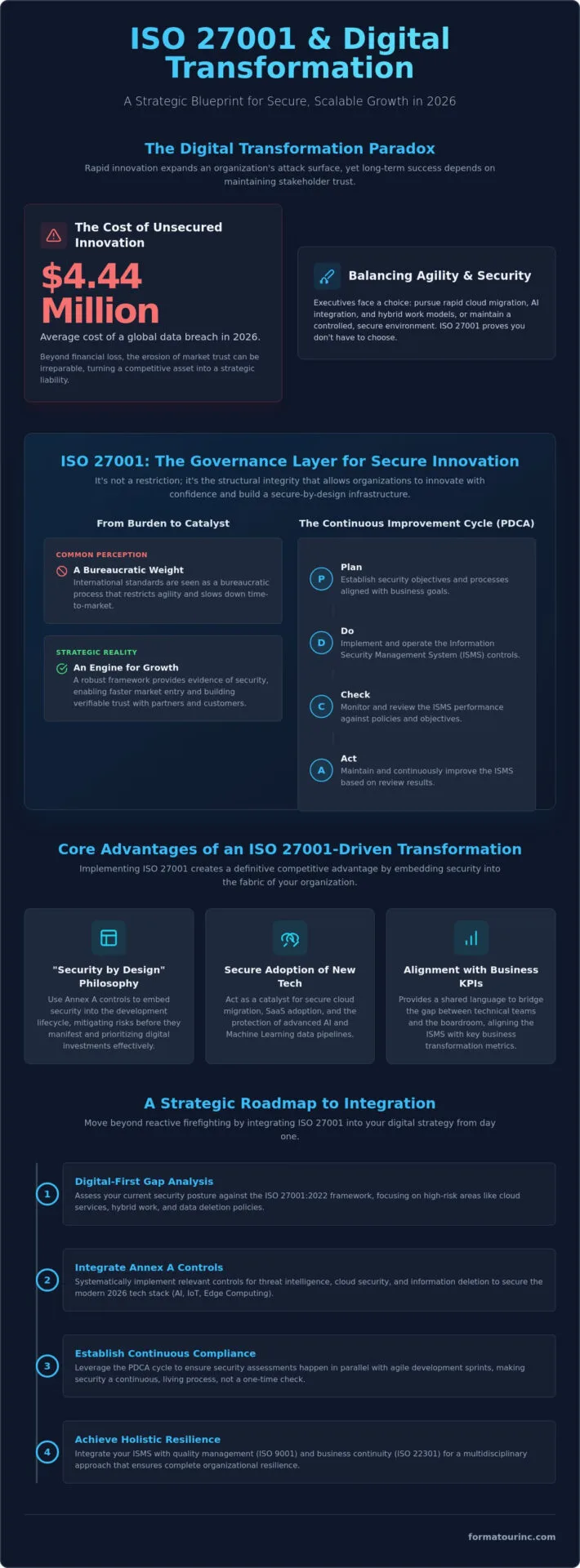
The average cost of a global data breach has reached $4.44 million in 2026, transforming information security from a technical requirement into a primary pillar of corporate strategy. Many executives still perceive international standards as a bureaucratic weight that restricts agility during rapid scaling. However, the strategic role of ISO 27001 in digital transformation actually provides the structural integrity necessary to innovate with confidence. By establishing a robust governance model, organizations can move beyond reactive firefighting and build a foundation where security accelerates rather than impedes progress.
It’s natural to feel the tension between the need for rapid cloud migration and the complexity of securing a distributed, hybrid workforce. You want to ensure your organization is resilient without creating friction for your teams. This guide demonstrates how the ISO/IEC 27001:2022 framework serves as a blueprint for a secure-by-design infrastructure that supports scalable growth. We’ll examine the shift toward continuous compliance, the integration of 2024 climate action amendments, and how a mature security posture creates a definitive competitive advantage in the 2026 business landscape.
Key Takeaways
- Understand how to resolve the digital transformation paradox by establishing a governance layer that balances rapid innovation with a controlled attack surface.
- Explore the role of ISO 27001 in digital transformation as a catalyst for secure cloud adoption and the protection of advanced AI and machine learning pipelines.
- Implement a “Security by Design” philosophy using Annex A controls to prioritize digital investments and mitigate risks before they manifest.
- Follow a strategic roadmap to align your Information Security Management System with business transformation KPIs through targeted, digital-first gap analyses.
- Discover the advantages of a multidisciplinary approach that integrates security standards with quality management and business continuity for holistic organizational resilience.
The Strategic Intersection: Why Digital Transformation Requires ISO 27001
Modern organizations face a fundamental contradiction known as the Digital Transformation Paradox. Rapid innovation inherently expands an organization’s attack surface, yet long-term success depends entirely on maintaining high levels of stakeholder trust. Without a structured approach, digital growth becomes a strategic liability rather than a competitive asset. This is why the role of ISO 27001 in digital transformation is indispensable. It acts as the primary governance layer, ensuring every new digital initiative is built upon a bedrock of verified security and operational integrity.
By 2026, the shift from perimeter-based security to data-centric models is complete. In a world of hybrid work and decentralized cloud environments, the traditional “firewall” approach is obsolete. The ISO/IEC 27001 standard provides the necessary framework to protect data at its source, regardless of where it lives. The 2022 updates to the standard specifically address these modern risks, introducing controls for cloud services, threat intelligence, and information deletion that align with current digital realities.
The Information Security Management System (ISMS) Explained
An Information Security Management System (ISMS) isn’t a static collection of documents gathering dust on a shelf. It’s a living ecosystem designed to evolve alongside your business. Central to this is the Plan-Do-Check-Act (PDCA) cycle. In the context of agile digital projects, this cycle ensures that security assessments happen in parallel with development sprints. This shared framework provides a common language that bridges the gap between technical IT teams and the boardroom. It allows executives to view security not as a technical hurdle, but as a measurable component of organizational health.
Bridging the Gap Between Innovation and Compliance
A common misconception suggests that international standards stifle creativity or slow down market entry. The reality is quite the opposite. A robust framework allows for “safe failure” by establishing clear boundaries where teams can iterate rapidly without risking the entire enterprise. When security is baked into the process, you don’t have to pause for “compliance checks” at the end of a project.
Unsecured innovation carries a heavy price in 2026. Beyond the $4.44 million average breach cost, the loss of market trust can be irreparable. Organizations that embrace the role of ISO 27001 in digital transformation find they can enter new markets faster. They don’t just hope they’re secure; they have the evidence to prove it to partners, regulators, and customers alike. This proactive stance transforms compliance from a burden into a powerful engine for sustainable growth.
ISO 27001 as a Catalyst for Digital Innovation and Agility
The perception of ISO 27001 is shifting from a restrictive compliance exercise to a dynamic engine for organizational growth. While many executives view standards as a brake on momentum, the role of ISO 27001 in digital transformation is actually to provide the structural confidence required for high-speed innovation. By establishing a clear, risk-based framework, organizations can accelerate cloud migration and SaaS adoption without the typical delays caused by security uncertainty. This structured approach ensures that security is an integrated feature of new digital services rather than a late-stage hurdle.
In the high-stakes environment of mergers and acquisitions (M&A), a certified Information Security Management System (ISMS) serves as a vital strategic asset. It provides a common denominator for security maturity, significantly reducing the time and complexity of technical due diligence. When both parties operate under a shared international standard, the integration of digital assets becomes a predictable, streamlined process. This standardization allows leadership to focus on value creation and synergy rather than uncovering hidden technical debt or security vulnerabilities.
Securing the 2026 Tech Stack: AI, IoT, and Edge Computing
The 2026 technological landscape is defined by decentralized architectures and autonomous systems. Applying principles of information security design in digital transformation ensures that AI pipelines maintain data integrity during training and deployment. ISO 27001 controls provide the necessary oversight for managing the sprawling risks associated with IoT device networks, where traditional perimeter defenses fail. As processing moves to the edge, the standard offers a blueprint for securing data at the point of origin, protecting the entire decentralized ecosystem from sophisticated threats.
Market Agility and the Power of Certified Trust
Certification acts as a “trust passport” that facilitates frictionless entry into new global markets. It drastically reduces the burden of vendor security assessments, as partners can rely on a third-party verification of your security posture. This efficiency is a massive competitive advantage in a digital supply chain that demands both speed and transparency. Trust is the currency that accelerates the sales cycle for digital services by removing the primary objections of risk-averse enterprise buyers.
To explore how these frameworks can be tailored to your specific organizational goals, you may consult with our strategic advisors regarding your transformation roadmap. A proactive security culture doesn’t just protect your current assets; it creates the necessary space for your teams to experiment, iterate, and lead in an increasingly digital world.
Mitigating Transformation Risk: Security by Design and ISO 27001
Strategic digital transformation requires more than just migrating workloads to the cloud or adopting AI tools. It demands a fundamental shift toward “Security by Design,” a concept that is perfectly mirrored in the ISO 27001 Annex A controls. By integrating security requirements at the inception of every digital project, organizations prevent the accumulation of technical debt and security vulnerabilities. The role of ISO 27001 in digital transformation is to provide the rigorous risk assessment framework needed to prioritize these digital investments effectively.
A common executive concern is that international standards might impede the velocity of DevOps or Agile methodologies. In reality, ISO 27001 acts as the policy engine that powers modern DevSecOps. It defines the security objectives that automated pipelines must achieve. Instead of slowing down development, the standard provides clear guardrails that allow developers to move quickly without compromising the organization’s integrity. This operationalization transforms abstract security principles into repeatable, automated processes.
Proactive Risk Management vs. Reactive Incident Response
The financial argument for proactive compliance is undeniable. With the average cost of a data breach reaching $4.44 million in 2026, the expense of building a robust Information Security Management System (ISMS) is a fraction of the potential loss. ISO 27001 is particularly effective at identifying “shadow IT,” the unauthorized software and services that often proliferate during rapid digital shifts. By implementing continuous monitoring as part of a 2026 security posture, leadership gains real-time visibility into the organization’s risk profile, shifting the focus from firefighting to strategic resilience.
Addressing the Human Element: Culture and Leadership
Successful transformation is 80% about people and only 20% about technology. A framework is only as effective as the individuals who manage it. ISO 27001 training programs are essential for cultivating a “security-first” mindset across every department, ensuring that every employee understands their role in protecting corporate assets. This cultural shift requires a commitment from the top. Strategic development through Leadership Training for Digital Transformation ensures that executives possess the vision to integrate security into the very fabric of their digital strategy, fostering an environment where innovation and compliance coexist seamlessly.
The Executive Roadmap: Integrating ISO 27001 into Your Digital Strategy
Transitioning from a reactive security posture to a strategically resilient one requires a methodical approach that aligns technical controls with business vision. The role of ISO 27001 in digital transformation is most effective when it is treated as a core business strategy rather than an isolated IT project. Successful integration begins with aligning your Information Security Management System (ISMS) objectives directly with your transformation KPIs. This ensures that every security measure taken supports broader goals such as market expansion or customer trust.
The roadmap continues with a digital-first gap analysis. This specific assessment identifies risks unique to your new technology stack, such as API vulnerabilities or cloud configuration errors. Once these risks are prioritized, organizations can leverage professional ISO 27001 implementation services to build a framework that scales alongside their digital growth. This framework must be integrated into the standard project management lifecycle, ensuring that security is considered at every stage of development. Finally, establishing a governance committee that bridges the gap between the CISO and the Digital Transformation Officer creates a unified leadership front.
Measuring Success: KPIs for Secure Transformation
Executive leadership needs concrete metrics to evaluate the health of their digital initiatives. Key performance indicators should move beyond simple “compliance pass” metrics to include operational data such as the time required for secure deployment and the success rate of third-party vendor audits. Reporting these figures to the Board of Directors provides a clear picture of the ROI. By quantifying the value of avoided breaches and the efficiency gained through streamlined compliance, you demonstrate how security directly contributes to the bottom line.
Selecting the Right Advisory Partner
Choosing a partner for this journey is a critical decision that influences your long-term success. It’s essential to differentiate between “checkbox consultants” who focus solely on documentation and strategic advisors who understand the complexities of organizational change. A multidisciplinary partner brings expertise in both security standards and digital optimization. For Canadian firms seeking to compete on a global stage, specialized ISO 27001 certification consulting provides the localized knowledge and international perspective required for sustainable growth.
If you are ready to define your organization’s path toward a secure and scalable future, contact our strategic advisors today to begin your transformation journey.
Formatour’s Approach: Ensuring Resilience Through Strategic Transformation
At Formatour, we operate with a philosophy of “Big-Firm Standards, Boutique Agility.” This unique positioning allows us to deliver the rigorous excellence of global consultancy while maintaining the personalized, responsive partnership that modern executives require. We recognize that the role of ISO 27001 in digital transformation extends far beyond technical compliance; it’s a foundational element of organizational maturity. Our approach focuses on co-developing solutions that integrate seamlessly into your existing operations, ensuring that security becomes an organic part of your corporate DNA.
Resilience is rarely achieved through a single standard. We utilize a multidisciplinary strategy that links your Information Security Management System with ISO 9001 Quality Management and ISO 22301 Business Continuity protocols. This integration ensures that your digital initiatives aren’t only secure but also high-performing and capable of withstanding significant market disruptions. By aligning these frameworks, we help you build a comprehensive governance model that supports sustainable growth and operational excellence.
Beyond Certification: Building a Resilient Future
Obtaining a certificate is a significant milestone, but it’s only the beginning of a long-term journey. To ensure internal sustainability, we emphasize the value of ISO 27001 lead auditor training for your internal teams. This empowers your staff to maintain and optimize the framework long after the initial implementation is complete. We invite you to schedule a strategic consultation to assess your current digital transformation readiness and explore how a robust security posture can accelerate your 2026 objectives.
The Canadian Advantage: Local Expertise, Global Standards
Formatour is deeply rooted in the Canadian business landscape, providing us with a nuanced understanding of local regulatory requirements and cultural expectations. We don’t offer generic, one-size-fits-all templates. Instead, we act as a visionary architect, designing bespoke strategies that reflect the unique goals of each client. Our commitment to leadership development ensures that your executive team is equipped to guide the organization through the complexities of the 2026 digital environment. Secure governance isn’t just a defensive necessity; it is the ultimate catalyst for visionary leadership and transformative innovation.
Architecting a Resilient Future in the 2026 Digital Landscape
Formatour brings over a decade of expertise in strategic transformation to guide your organization through this critical evolution. We provide boutique agility paired with big-firm consulting standards, offering comprehensive advisory services that span from the initial audit to executive leadership development. Our team acts as a dedicated partner in co-developing solutions that fit your unique corporate culture and operational needs. We invite you to partner with Formatour for Strategic ISO 27001 Implementation and secure your organization’s digital legacy. With the right governance in place, your journey becomes a predictable path to long-term growth and global leadership.
Frequently Asked Questions
Does ISO 27001 slow down digital transformation projects?
ISO 27001 actually accelerates projects by providing a clear framework for “Security by Design.” It eliminates the friction of late-stage security reviews that often derail deployment timelines. By integrating security into the initial planning phase, teams can innovate with the confidence that their work meets international standards from the start. This proactive approach prevents the costly rework associated with fixing vulnerabilities after a product has launched.
How does ISO 27001:2022 differ from previous versions regarding cloud security?
The 2022 version introduces specific controls targeted at cloud service management and threat intelligence. It acknowledges the shift toward decentralized data environments by emphasizing the shared responsibility model between the organization and the cloud provider. This update ensures that your security posture remains relevant as you adopt increasingly complex SaaS and PaaS solutions. It provides a more granular look at how data is protected across distributed digital infrastructures.
Can ISO 27001 help with GDPR or Canadian privacy law (PIPEDA) compliance during transformation?
Yes, ISO 27001 provides the technical and organizational measures required to satisfy both GDPR and PIPEDA. While it isn’t a privacy law itself, its risk-based approach helps identify and protect personal data throughout its lifecycle. This alignment is a critical role of ISO 27001 in digital transformation, as it ensures that data privacy is maintained during rapid technological shifts. It simplifies the reporting requirements for multiple regulatory frameworks.
Is ISO 27001 certification necessary for small to medium-sized digital startups?
Certification is often a prerequisite for startups seeking to partner with enterprise-level clients or enter global markets. It serves as a verified proof of trust that can significantly shorten the vendor due diligence process. For a growing firm, the standard provides a scalable foundation that prevents security from becoming a bottleneck as the organization expands. It signals to investors and partners that the firm is built on professional, stable governance.
What is the role of executive leadership in ISO 27001 implementation?
Executive leadership is responsible for establishing the Information Security Policy and ensuring that the ISMS is integrated into the organization’s strategic processes. Success depends on the boardroom’s commitment to providing adequate resources and fostering a culture of security. Without active executive sponsorship, an implementation risks becoming a siloed IT exercise rather than a business enabler. Leaders must champion the standard to ensure widespread adoption across all departments.
How often should we update our ISMS during a multi-year digital transformation?
You should treat your ISMS as a living system that requires updates whenever a significant change occurs in your digital architecture. In an agile, multi-year transformation, this means conducting regular risk reassessments and continuous monitoring of new assets. Staying current ensures that your controls evolve at the same pace as your technological innovation. This iterative approach maintains the integrity of the framework as your business model shifts.
What are the most common security risks during a cloud migration?
The most frequent risks include misconfigured cloud storage, insecure APIs, and the unauthorized use of SaaS tools, often called shadow IT. ISO 27001 addresses these through specific access controls and supplier relationship management policies. Understanding the role of ISO 27001 in digital transformation helps leadership identify these vulnerabilities before they can be exploited during a migration. It provides the oversight needed to manage third-party risks effectively.
How does ISO 27001 integrate with other standards like ISO 9001?
These standards share a common High-Level Structure, making it straightforward to build an Integrated Management System (IMS). This approach allows your organization to manage quality and information security through a unified set of processes. Integration reduces documentation redundancy and provides a holistic view of organizational health and resilience. It ensures that security and quality are treated as complementary components of the same strategic vision.
