

A 2026 global survey of over 850 C-suite executives reveals that organizations with strong executive alignment on transformation goals have more than three times higher confidence in achieving positive performance outcomes. Despite this, many leaders find that their initiatives stall when digital processes meet high employee resistance or lack a structured framework. When seeking strategic transformation consulting Canada, the challenge isn’t just finding a roadmap; it’s finding a partner who can align high-level strategy with the rigorous demands of ISO security and quality requirements.
You’ve likely felt the tension of trying to innovate while maintaining compliance in an increasingly complex regulatory environment. We understand that sustainable growth requires more than just new software. It demands a sophisticated blend of international standards and empathetic leadership. This guide provides the framework you need to integrate ISO governance with human-centric development to drive lasting change in the 2026 Canadian market.
We’ll examine how the introduction of Bill C-36 and the upcoming ISO 9001:2026 standards are reshaping organizational health. You’ll learn how to leverage federal resources like the BDC LIFT program to fund your evolution and ensure your strategic vision results in tangible, long-term success.
Key Takeaways
- Understand how ISO standards serve as essential operational guardrails to maintain structural integrity and prevent drift during high-velocity organizational shifts.
- Discover why executive leadership alignment is the primary predictor of success when addressing employee resistance to new digital processes and workflows.
- Access a specialized 5-step framework for strategic transformation consulting Canada that harmonizes rigorous governance with human-centric leadership.
- Learn to navigate the 2026 Canadian regulatory environment by aligning your digital strategy with upcoming privacy laws and updated international quality benchmarks.
- Explore how integrating process automation reduces manual friction while simultaneously strengthening organizational resilience and data security.
Navigating the 2026 Landscape of Strategic Transformation Consulting in Canada
Organizations across the country are no longer asking if they should change, but how to do it without compromising their core stability. Within the Canadian multidisciplinary advisory context, Business Transformation is the fundamental rethinking of how an enterprise delivers value. This is where strategic transformation consulting Canada serves its primary purpose. It isn’t just a high-level advisory service. It’s a structured methodology that bridges the gap between a visionary future and the rigid requirements of modern governance.
The 2026 market is defined by three powerful drivers. First, the rapid adoption of AI requires consulting partners who can scale embedded solutions while maintaining ethical oversight. Second, the introduction of Bill C-36 (the Protecting Privacy and Consumer Data Act) has fundamentally changed how Canadian enterprises manage data privacy and AI-driven decision systems. Third, Environmental, Social, and Governance (ESG) mandates have moved from optional reporting to a core requirement for institutional investment and operational integrity. These factors demand a “governance-first” approach. Large-scale transitions often fail when they lack structural guardrails to prevent operational drift during periods of high-velocity change.
The Evolution of OCM in the Canadian Market
Canadian firms have transitioned from reactive problem-solving to a model of proactive strategic evolution. In the past, organizational change management (OCM) was often treated as a peripheral task. Today, multidisciplinary advisory is essential for managing complex, multi-site operations. Localized expertise in hubs like Montreal and Toronto is critical for national success. These cities represent distinct regulatory and cultural environments. Understanding these nuances ensures that a transformation strategy remains effective from coast to coast.
Why “Soft” Change Management is No Longer Sufficient
Relying solely on “soft” change management-focusing only on employee sentiment without structural support-often leads to project failure. Without rigorous governance, executive visions rarely translate into tangible operational performance metrics. Formatour Incorporated bridges this gap by integrating international ISO standards with human-centric leadership. This approach ensures that strategic goals aren’t just abstract ideas; they’re embedded into the daily operational reality of the business to drive sustainable results.
The Structural Anchor: Why ISO Standards are Critical to Transformation Success
High-velocity change often leads to operational drift. When organizations dismantle legacy systems without a replacement framework, they risk losing the very quality and security that built their reputation. ISO standards act as the essential guardrails for this journey. They provide a predictable structure that prevents chaos during large-scale transitions. Effective strategic transformation consulting Canada recognizes that these international benchmarks aren’t just compliance checkboxes. They’re the structural anchors that ensure your evolution is both disciplined and sustainable.
There is a powerful synergy between ISO 9001 quality management implementation and business process re-engineering. While re-engineering seeks to optimize workflows, ISO 9001 ensures those new processes remain consistent and customer-focused. This alignment prevents the “performance dip” that often occurs when teams struggle to adapt to new digital tools. By embedding quality standards into the DNA of the transformation, leaders can guarantee that efficiency gains don’t come at the expense of excellence.
Sustainability is no longer a peripheral concern for Canadian enterprises. Integrating ISO 14001 certification into your transformation roadmap allows you to embed environmental management directly into your core strategy. This proactive approach satisfies the increasing ESG mandates from investors and regulators alike. When examining Digital Transformation in Canadian Enterprises, it’s clear that the most successful organizations are those that treat governance as a competitive advantage rather than a burden.
ISO 27001: Protecting the Digital Transformation Journey
Information security is the primary risk factor during any major organizational shift. As you migrate data and adopt AI-driven systems, your attack surface expands significantly. Integrating ISO 27001 implementation services into your roadmap provides the resilience needed to protect your intellectual property. ISO 27001 acts as a secure framework for enterprise-wide change by establishing a standardized environment where data integrity is maintained even as legacy systems are dismantled. To explore how these standards can be tailored to your specific operational needs, speak with our advisory team.
ISO 9001 and Sustained Operational Performance
Maintaining quality standards while fundamentally altering business processes is a delicate balance. We use internal audits as a vital feedback loop to measure how well your team is adopting new transformation protocols. These audits identify friction points early, allowing for rapid adjustments before they impact the bottom line. This methodical approach ensures that your strategic transformation consulting Canada leads to measurable efficiency gains, rather than just adding layers of structural complexity to your daily operations.
Addressing Resistance through Executive Leadership and Organizational Resilience
Transformation initiatives often encounter an invisible wall of resistance. In Canadian corporate culture, this friction frequently stems from a deep-seated value for stability and a cautious approach to risk. Employees aren’t just resisting new technology; they’re protecting the operational consistency they’ve worked hard to build. Expert strategic transformation consulting Canada identifies these root causes early, reframing the evolution as a path toward operational excellence rather than a disruptive event that threatens job security.
C-suite alignment remains the single greatest predictor of success. A 2026 global survey of over 850 executives found that organizations with strong executive alignment on transformation goals have more than three times higher confidence in achieving positive outcomes. When engaging in strategic transformation consulting Canada, the focus must shift from mere technical implementation to the cultivation of executive synergy. When the leadership team speaks with a unified voice, it creates the psychological safety necessary for the workforce to adapt.
Building a resilient workforce requires moving beyond surface-level engagement. It involves providing teams with practical tools to manage the shift. Resources such as the Digital Transformation Guide for Canadian Entrepreneurs offer foundational insights, but true resilience is forged through the integration of structural governance and empathetic leadership. This combination allows firms to maintain focus during the inevitable challenges of large-scale change.
Executive Leadership as the Transformation Catalyst
The success of any digital shift depends on the executive team’s ability to act as mentors. Investing in leadership training for digital transformation helps executives develop the “Visionary Architect” persona. This role is essential for leading teams through uncertainty with quiet confidence. For 2026 Canadian transformation leads, executive education isn’t a luxury; it’s a critical investment that ensures the leadership team possesses the specific skills needed to scale and govern complex AI-driven solutions.
Building Resilience with ISO 22301
Transitions are rarely linear, and the “messy middle” of a project is where most initiatives fail. Utilizing ISO 22301 business continuity consulting provides a safety net during these periods of high vulnerability. Whether you’re navigating a merger, an acquisition, or a major tech migration, ISO 22301 ensures your organization remains functional and secure. By treating resilience as a competitive advantage, Canadian businesses can thrive in a volatile market, turning potential disruptions into opportunities for structural optimization.
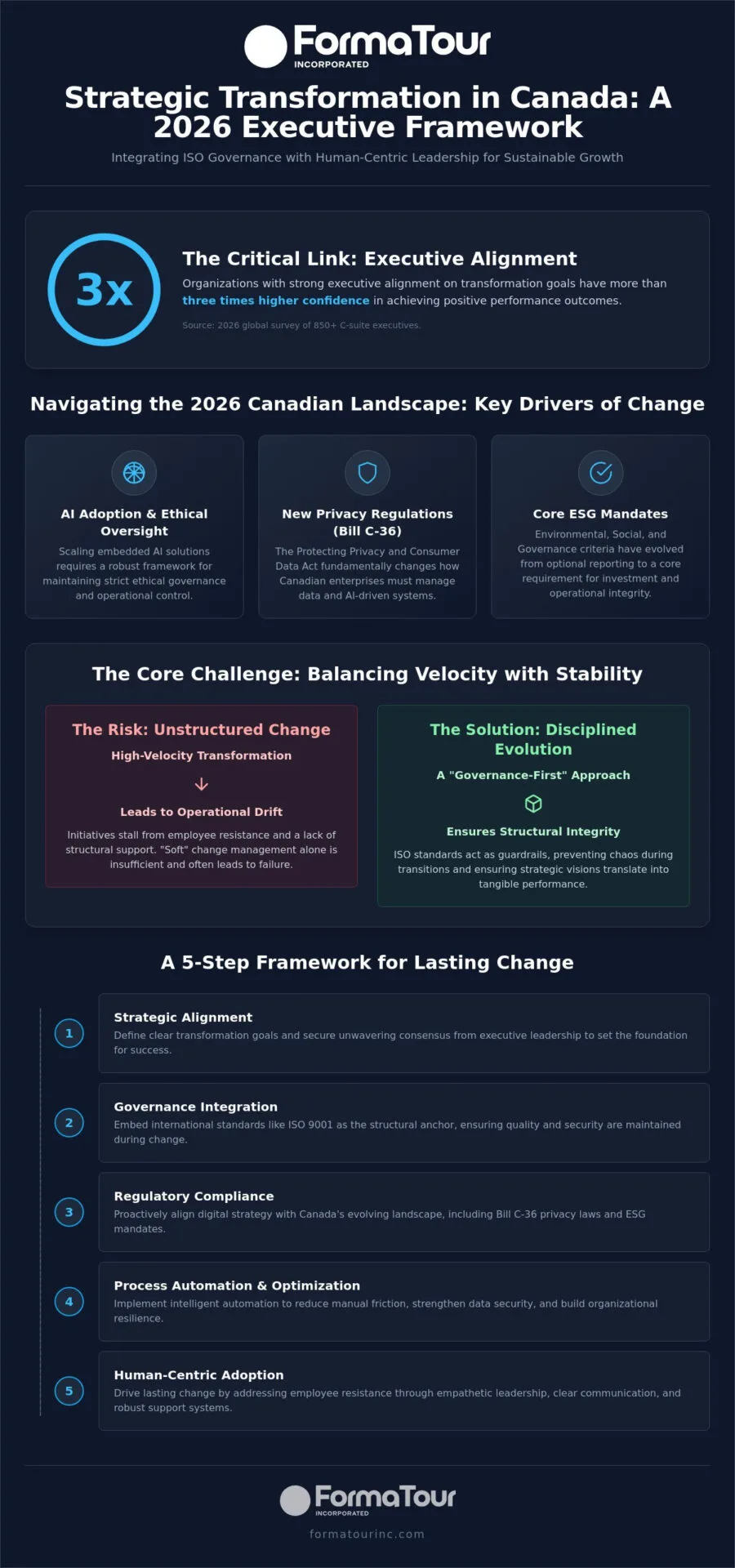
A Strategic Framework for Digital Transformation in Canadian Enterprises
Execution without a structured framework often leads to fragmented technology stacks and frustrated teams. To achieve sustainable results, Canadian enterprises require a governance-led approach that prioritizes structural integrity over superficial speed. This five-step framework for strategic transformation consulting Canada ensures that every digital investment aligns with both international standards and local regulatory requirements. By centering the journey on governance, organizations can minimize the friction typically associated with large-scale change.
Process automation plays a pivotal role in this evolution by reducing manual friction and improving employee buy-in. When repetitive, low-value tasks are automated, teams can focus on higher-level strategic objectives, which directly addresses the resistance discussed in previous sections. However, automation must be grounded in data integrity. Selecting a digital transformation strategy firm that understands the nuances of Canadian compliance, particularly regarding ISO 27001, is essential. This ensures that your automation lifecycle remains secure and privacy-compliant under the evolving Canadian legal landscape. To begin building your customized roadmap, contact our senior advisory team today.
Steps 1 & 2: Strategic Alignment and ISO Gap Analysis
Success begins by defining the strategic “Why” behind the transformation. Before selecting any technology solutions, we identify the governance gaps that could undermine your progress. An initial audit is the most cost-effective starting point for any project, as it prevents expensive mid-course corrections. In the 2026 Canadian landscape, a rigorous governance gap analysis is the only way to ensure that your digital evolution remains compliant with both emerging privacy laws and updated international quality benchmarks.
Steps 3 to 5: Implementation, Automation, and Certification
The middle stages of the framework focus on leveraging process optimization to remove legacy hurdles. This isn’t just about software; it’s about rethinking how work gets done. We utilize international seminars and professional development programs to upskill internal teams, ensuring they have the competence to manage new systems. The final step is achieving ISO certification. This serves as the ultimate validation of a successful, secure transformation, providing stakeholders with the assurance that your organization is built for long-term resilience and excellence.
The Formatour Approach: Premium Multidisciplinary Advisory for Sustained Growth
Formatour Incorporated stands as a premier architect of organizational resilience. In the sphere of strategic transformation consulting Canada, we bridge the gap between technical compliance and high-level executive vision. Our “Big-Firm Standards, Boutique Agility” model ensures you don’t have to choose between deep expertise and personalized service. We provide the structural rigor of international benchmarks while maintaining the flexibility to pivot as your market conditions evolve. This approach allows us to act as a steady, expert hand, guiding you through the complexities of modern enterprise evolution.
We recognize that transformation isn’t a one-time event; it’s a continuous process of optimization. By combining technical ISO auditing with high-level executive coaching, we empower leaders to maintain their strategic focus even during periods of intense change. This dual approach addresses both the “hard” systems and the “soft” human elements of the organization. It ensures that new processes are not only adopted but also sustained long after the initial implementation phase. Our goal is to co-develop custom solutions that ensure your long-term operational performance remains unshakeable.
Integrated ISO and Transformation Services
Our multidisciplinary expertise covers the full spectrum of organizational health. We provide comprehensive implementation, auditing, and certification support for ISO 9001 (Quality Management), ISO 27001 (Information Security), and ISO 22301 (Business Continuity). Furthermore, our ISO 14001 certification services are essential for organizations looking to anchor their ESG-driven change initiatives in a globally recognized environmental management system. This integrated service model allows us to manage complex digital shifts while simultaneously focusing on the workforce development needed to support them.
Your Partner in Canadian Strategic Growth
To begin your journey toward sustained growth, you can engage our team for a comprehensive strategic transformation study or dedicated project management advisory. We invite you to explore how our specialized strategic transformation consulting Canada can turn your vision into a resilient, high-performing reality. Let’s build an organization that isn’t just ready for the future but is actively shaping it.
Mastering the Evolution of Your Enterprise
Sustainable growth in 2026 requires more than just technological adoption. It demands a rigorous integration of international governance standards with visionary leadership to overcome employee resistance and regulatory complexity. By anchoring your digital journey in ISO frameworks, you ensure that operational excellence becomes a permanent fixture of your corporate culture. Choosing the right partner for strategic transformation consulting Canada is the first step toward building this resilience.
Formatour Incorporated brings over a decade of multidisciplinary advisory experience to your organization. As a Canadian-owned firm, we offer the premium boutique agility and specialized expertise across ISO 9001, 27001, 22301, and 14001 required to manage your most complex transitions. We invite you to Partner with Formatour Incorporated for Strategic Transformation and ISO Excellence. Your organization’s next chapter of growth is within reach; let’s build a secure and high-performing future together.
Frequently Asked Questions
What is the role of a strategic transformation consultant in Canada?
A strategic transformation consultant acts as a visionary architect and implementation partner who bridges the gap between high-level executive strategy and daily operational execution. They provide the structural framework needed to align organizational culture with rigorous governance standards. By integrating strategic transformation consulting Canada, firms can navigate complex shifts in technology and regulation while maintaining a steady focus on long-term growth and stability.
How much does strategic transformation consulting cost for Canadian enterprises?
Investment levels for consulting services vary based on the scale of the organization, the complexity of existing legacy systems, and the specific ISO certifications required. Fees are generally structured around project milestones or long-term advisory retainers rather than a fixed industry rate. Organizations should evaluate their specific needs for leadership development and process automation to determine a precise budget that reflects their unique operational goals.
Why is ISO 27001 important for digital transformation projects?
ISO 27001 provides a secure framework that protects data integrity and organizational resilience as legacy systems are dismantled and replaced. With the introduction of Bill C-36 in 2026, maintaining high standards for information security is now a critical regulatory requirement for Canadian enterprises. It ensures that digital shifts don’t expand the organization’s attack surface or compromise sensitive consumer data during the transition.
How do we measure the ROI of organizational change management?
Return on investment is measured through tangible metrics such as reduced project cycle times, lower employee turnover during transitions, and the rapid adoption of new digital processes. We also track the reduction of manual friction achieved through successful process automation. High ROI is realized when the workforce moves from resistance to active participation, resulting in sustained operational efficiency and a stronger competitive position.
What is the difference between process optimization and strategic transformation?
Process optimization focuses on refining existing workflows to improve efficiency and reduce waste within the current business model. In contrast, strategic transformation involves a fundamental rethinking of how the organization delivers value to its stakeholders. While optimization is often a component of the journey, transformation requires a comprehensive alignment of leadership, governance, and technology to achieve a new state of organizational health.
How long does a typical strategic transformation engagement last?
A typical engagement ranges from six months to two years depending on the depth of the required cultural change and the complexity of the digital implementation. The initial gap analysis and strategic alignment phases usually take several weeks to complete. The overall duration is influenced by the organization’s readiness for change and the specific timelines required to achieve international ISO certification benchmarks.
Can strategic transformation consulting help with ISO 9001 compliance?
Yes, strategic transformation consulting Canada naturally incorporates ISO 9001 compliance as a structural anchor for quality management. By aligning business process re-engineering with these international standards, consultants ensure that new workflows meet rigorous quality benchmarks from the start. This integration prevents the operational drift and performance dips that often occur when organizations attempt to innovate without established structural guardrails.
What are the common mistakes Canadian companies make during digital transformation?
One primary error is treating transformation as a purely technical project while neglecting the human element and structural governance. Many firms also fail to secure C-suite alignment before launching initiatives, which leads to fragmented execution and high employee resistance. Neglecting the 2026 regulatory environment, particularly the data privacy requirements of Bill C-36, can also result in significant compliance risks and financial penalties.
