

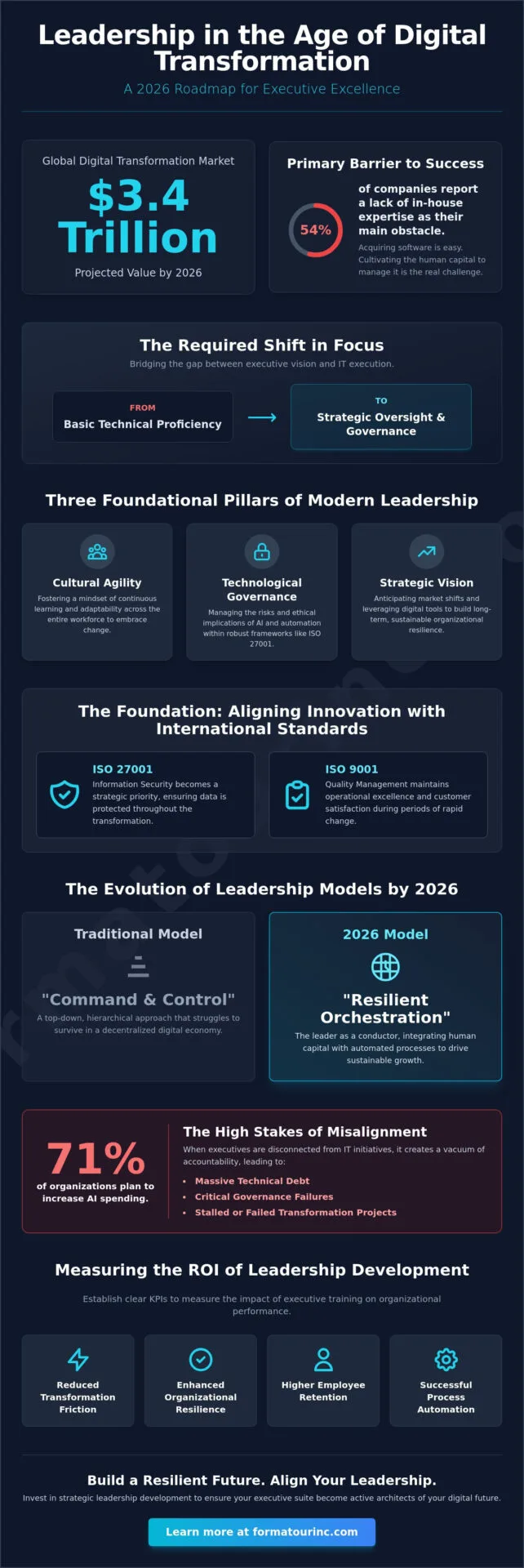
While the global digital transformation market is projected to reach $3.4 trillion in 2026, 54% of companies report that a lack of in-house expertise remains their primary barrier to success. It’s clear that acquiring software is far simpler than cultivating the human capital required to manage it effectively. You’ve likely felt the tension between aggressive IT initiatives and the need for stable, compliant governance. Selecting the right leadership training for digital transformation is the only way to ensure your executive vision aligns with operational reality while maintaining rigorous international standards.
You recognize that true progress requires more than just technical literacy; it demands a sophisticated approach to organizational resilience and structural integrity. This article provides a clear roadmap for evaluating 2026 leadership programs, focusing on how they integrate AI fluency with established ISO frameworks. We’ll compare top-tier organizational development models to help you select a partner that fosters both innovation and security. You’ll discover how to upskill your leadership team to move beyond technical jargon and toward a future of sustainable, process-driven growth.
Key Takeaways
- Shift your focus from basic technical proficiency to strategic oversight to bridge the gap between executive vision and IT execution.
- Learn how to evaluate leadership training for digital transformation based on its ability to align innovation with international standards like ISO 27001.
- Discover the importance of integrating ISO 9001 Quality Management into your digital strategy to maintain operational excellence during periods of rapid disruption.
- Compare the benefits of academic generalist programs versus specialized advisory models to determine which structure best supports your organizational goals.
- Establish clear KPIs to measure the ROI of executive development, focusing on reduced transformation friction and enhanced organizational resilience.
What is Leadership Training for Digital Transformation?
Digital transformation isn’t just a software upgrade; it’s a fundamental shift in how an organization creates value through the seamless integration of technology and human talent. Consequently, leadership training for digital transformation is a structured, strategic development process designed to equip executives with the cognitive and operational tools needed to guide this evolution. By 2026, the standard for executive excellence has shifted. It’s no longer sufficient for a CEO or Director to be “tech-savvy.” Instead, the market demands “strategic oversight,” which is the ability to govern complex digital ecosystems while ensuring they remain aligned with core business objectives and international compliance standards.
This level of expertise is built upon three foundational pillars:
- Cultural Agility: The capacity to foster a mindset of continuous learning and adaptability across the workforce.
- Technological Governance: Managing the risks and ethical implications of automation and AI, particularly within frameworks like ISO 27001.
- Strategic Vision: Anticipating market shifts and leveraging digital tools to build long-term organizational resilience.
The connection between executive education and long-term performance is measurable. Organizations that prioritize this specialized training report higher employee retention and more successful implementation of process automation. When leaders understand the “why” behind the “how,” they can communicate change more effectively, reducing the friction that typically stalls large-scale digital shifts.
The Evolution of Executive Education in 2026
Traditional executive education often focused on “command and control” hierarchies that struggle to survive in a decentralized digital economy. In 2026, we see a distinct shift toward “resilient orchestration.” This model treats the leader as a conductor of various automated and human assets rather than a top-down decision-maker. Modern Transformational leadership now requires a deeper understanding of how data flows through an organization. Digital leadership is the ability to integrate human capital with automated processes to drive sustainable growth. Effective leadership training for digital transformation must address these nuances to be relevant in the current global market.
Why Digital Transformation Fails Without Leadership Alignment
One of the most frequent causes of project failure is the misconception that transformation is a purely IT-driven endeavor. When executives treat digital initiatives as something for the CTO to handle, they create a vacuum of accountability. This disengagement leads to a misalignment between technical capabilities and the organization’s cultural reality. As 71% of organizations plan to increase spending on AI technologies in 2026, the risk of technical debt and governance failure increases if the board remains disconnected. Investing in strategic leadership development consulting serves as a vital corrective measure. It ensures that the executive suite isn’t just a group of spectators, but active architects of the digital future.
Core Competencies of Modern Organizational Leadership Programs
Mastering the human element of change management is equally vital. As process automation replaces manual workflows, leaders must navigate the resulting cultural shifts with precision. Currently, 55% of companies report struggling with talent gaps in digital transformation, highlighting the urgent need for capability building. Research shows that achieving success in digital transformations depends heavily on having leaders who can bridge the gap between technical potential and human capability. This transition requires a shift toward data-driven decision making, where evidence-based governance replaces intuition. Clarity drives results.
Resilience and Business Continuity as Leadership Skills
In an era of rapid disruption, ISO 22301 (Business Continuity) has become an essential competency for the modern executive. Leadership training now emphasizes the ability to maintain stability and operational integrity during technological transitions. Understanding global resilience perspectives is a key outcome of attending international business seminars, where leaders share best practices for navigating complex global systems. This knowledge allows executives to build organizations that don’t just survive change but thrive within it. Stability is the precursor to innovation.
The Intersection of Compliance and Innovation
Many organizations mistakenly view compliance as a hurdle to speed. In reality, international standards provide the necessary guardrails that allow for faster, safer innovation. Comprehensive leadership training for digital transformation helps executives balance risk with digital opportunity by providing a clear framework for experimentation. It’s essential for non-technical C-suite members to develop an awareness of IT certification training programs and governance structures. This shared language between the executive board and the IT department fosters a culture of trust and strategic alignment. When leaders understand the technical benchmarks their teams are striving for, they can provide more effective support. If you’re ready to strengthen your organization’s governance, you can consult with our strategic advisors to tailor a development plan for your team.
Comparing Organizational Leadership Programs: Academic vs. Advisory Models
Selecting the appropriate vehicle for executive growth is a critical decision for any board. While many institutions offer leadership training for digital transformation, the structural differences between academic and advisory models lead to vastly different organizational outcomes. University programs typically adopt a generalist stance, focusing on broad theories and historical case studies over a semester. Conversely, advisory-led models utilize a specialist approach, compressing learning into intensive strategic seminars that prioritize immediate operational implementation. The choice depends on whether your organization requires foundational knowledge or a direct catalyst for change.
Outcomes also vary significantly between these two paths. Academic models emphasize knowledge acquisition and the prestige of a university credential. While valuable for individual resumes, these programs often lack the specific alignment with ISO 27001 or ISO 9001 required for modern governance. Professional, advisory-led training focuses on the co-development of solutions that integrate directly with your existing workflows. This ensures that the leadership team doesn’t just understand the theory of digital change but possesses the practical tools to execute it within a compliant framework.
When to Choose a University-Based Certificate
Broad academic foundations are particularly beneficial for mid-level managers who require a wide-angle view of the digital economy. These programs foster significant networking opportunities within diverse cohorts, allowing for a broad exchange of ideas across industries. However, they frequently fall short when an organization needs to address specific firm-level ISO compliance or unique technical bottlenecks. A university syllabus is generally fixed, making it difficult to tailor the curriculum to the immediate, high-stakes needs of a senior executive team.
The Case for Advisory-Led Executive Programs
Senior executive teams often require boutique agility, which is the ability to pivot training content in real-time to address current strategic threats. These programs excel because they integrate education with active strategic transformation consulting. Unlike the static nature of a university course, an advisory-led seminar is designed around your specific operational pillars and governance requirements. This ensures that leadership training for digital transformation becomes a practical tool for optimization rather than a separate academic exercise. By focusing on your unique structural integrity, advisors help you bridge the gap between high-level strategy and daily execution.
Measuring the ROI of Leadership Training for Digital Transformation
Justifying the expenditure on high-level executive development requires a shift in perspective; it’s an investment in the structural integrity of the firm. Effective leadership training for digital transformation provides a measurable impact on the bottom line by reducing the friction often associated with large-scale change. When leaders are equipped with strategic oversight, project failure rates drop because the executive vision is finally aligned with technical execution. This alignment mitigates the risk of costly operational delays and ensures that digital initiatives deliver their intended value within the projected timeline. Efficiency is the natural result of clarity.
Improved compliance through international standards like ISO 27001 and ISO 9001 directly influences market trust and, by extension, revenue. A leadership team that understands these frameworks can navigate audits more efficiently and secure certifications faster than those relying on trial and error. The primary objection to high-level advisory training is often its upfront cost. However, the cost of a failed digital project or a significant security breach far outweighs the price of specialized executive education. Investing in a tailored development program ensures your leadership team can protect the organization’s assets while driving innovation. Strategic foresight is always more cost-effective than crisis management.
Tangible Metrics: Efficiency, Security, and Compliance
Organizations can quantify ROI through several specific operational channels. A reduction in audit findings and faster ISO certification cycles are clear indicators of a leadership team that has mastered technological governance. Additionally, you should measure the speed of process automation adoption across different departments. High-quality leadership training reduces the hidden costs of digital silos by ensuring cross-departmental data integrity and strategic alignment. These efficiencies translate directly into lower operational overhead and improved service delivery. Results are found in the data.
Intangible Metrics: Cultural Readiness and Retention
While harder to place on a balance sheet, the shift in cultural readiness is a vital indicator of success. You’ll notice a distinct “innovation mindset” shift within the leadership tier as they move from fear of obsolescence to proactive orchestration. Professional development also plays a significant role in executive retention; high-performing leaders stay where they feel supported and challenged. This commitment to growth strengthens the overall organizational resilience of the firm, allowing it to withstand external market shocks with greater stability. A resilient culture is your most valuable asset.
The Formatour Approach: Resilience-First Leadership Development
Formatour represents the pinnacle of executive development through its multidisciplinary advisory model. In 2026, where the margin for error in digital shifts is non-existent, our approach serves as the gold standard for organizations seeking stability and growth. Unlike rigid academic curricula, our leadership training for digital transformation is built upon the practical application of international standards. We integrate ISO 27001 and ISO 9001 directly into the executive learning path, ensuring that every strategic decision is anchored in security and quality. This methodology transforms leaders into architects of resilience who can navigate complex global systems with confidence. Precision is our baseline.
Our firm’s Canadian roots provide a unique vantage point, combining North American innovation with a deep, global perspective on strategic transformation. We value boutique agility, which allows us to provide tailored, project-specific coaching that addresses the unique technical and cultural bottlenecks of your firm. This personalized attention ensures that the training isn’t just an external addition but a catalyst for internal optimization. By focusing on the co-development of solutions, we help you build a leadership team that is both authoritative and adaptable. We don’t just teach strategy; we help you implement it.
Beyond Theory: Real-World Implementation and Auditing
Transitioning from classroom concepts to operational reality requires more than just a lecture. Our seminars are led by active practitioners who bring years of experience in ISO standards implementation and auditing directly to the boardroom. This provides a distinct advantage; leaders learn from the very experts who understand how digital systems are evaluated for compliance. By bridging the gap between theory and the audit room, we empower executives to build systems that are compliant by design rather than by correction. Practical expertise is the only way to ensure long-term success.
Next Steps: Designing Your Custom Leadership Roadmap
The path to organizational maturity begins with a diagnostic evaluation of your current leadership capabilities. We encourage a methodical approach to identifying skill gaps, focusing on the intersection of technological governance and human capital. Designing your custom leadership roadmap involves aligning your digital strategy with your long-term cultural goals and international benchmarks. If you’re prepared to elevate your executive suite through high-level leadership training for digital transformation, we invite you to schedule a strategic consultation with our advisory team. Together, we can build a resilient foundation for your digital future. Success is a deliberate choice.
Architecting a Resilient Digital Future
The complexity of the 2026 digital landscape demands more than just a passing familiarity with new tools; it requires a deep commitment to strategic governance. You’ve seen that effective leadership training for digital transformation is the primary catalyst for aligning executive vision with operational reality. By prioritizing international standards like ISO 27001 and ISO 9001, your organization can turn compliance into a competitive advantage that fosters both security and innovation. Moving beyond academic generalism toward a specialized advisory model ensures that your development path is as agile as the technology you seek to master. Clarity is the foundation of progress.
Formatour provides the steady, expert hand needed to guide your team through these transitions. As a Canadian premium multidisciplinary advisory firm, we bring over a decade of expertise in ISO implementation and auditing to every engagement. We combine boutique agility with big-firm consulting standards to co-develop solutions that are tailored to your specific operational pillars. It’s time to transition from reacting to disruption to proactively orchestrating your digital future. Empower your leadership team with Formatour’s Strategic Advisory Services and build the structural integrity your organization deserves. Your path to excellence starts with a single strategic decision.
Frequently Asked Questions
What is the best leadership training for digital transformation in 2026?
The most effective programs in 2026 are those that move beyond technical literacy to focus on strategic governance and international benchmarks. High-level leadership training for digital transformation should offer a multidisciplinary approach, blending executive coaching with practical ISO framework application. This ensures that leaders aren’t just learning theory but are actively building the structural integrity required to manage complex digital ecosystems. Specialist advisory models typically outperform generalist academic certificates in this regard.
How does ISO certification relate to digital leadership training?
ISO certifications serve as the strategic guardrails that allow for secure and high-quality innovation. Leadership training equips executives with the knowledge to manage these standards, such as ISO 9001 for quality or ISO 27001 for security, during rapid technological changes. Without this alignment, digital initiatives often bypass critical governance, leading to increased risk and operational instability. Training bridges the gap between high-level vision and compliant execution.
Can leadership training help with ISO 27001 implementation?
Executive training is essential for a successful ISO 27001 implementation because it defines the leadership’s role in information security governance. When the C-suite understands the strategic value of security frameworks, they can better allocate resources and foster a culture of compliance. This top-down support reduces implementation friction and ensures that security remains a core component of the organization’s digital strategy rather than a technical afterthought.
What is the difference between academic and advisory leadership programs?
Academic programs generally offer a broad, theoretical foundation through semester-based learning and peer networking. Advisory programs focus on boutique agility and immediate operational impact. These specialist seminars are tailored to your firm’s specific technical and cultural needs, often integrating training with active consulting. While universities provide general knowledge, advisory models deliver the practical tools needed for direct, project-specific execution within your unique governance structure.
How long does a typical executive leadership development program take?
The duration of a program depends on its structure and the depth of the curriculum. University-based certificates often span eight to twelve weeks, requiring a significant time commitment over a semester. In contrast, intensive advisory seminars are typically designed as three to five-day high-impact sessions. These are often followed by ongoing leadership coaching to ensure that the strategic concepts are successfully integrated into the organization’s daily operations.
Why is organizational resilience critical for digital transformation?
Transformation naturally creates disruption, and organizational resilience provides the stability needed to survive these shifts. By focusing on business continuity standards like ISO 22301, leaders can ensure that core operations remain functional while new technologies are integrated. This resilience allows a firm to withstand market shocks and internal changes without compromising its structural integrity. It is the foundation upon which sustainable digital growth is built.
Is IT certification necessary for C-suite executives?
While C-suite executives don’t need deep technical IT certifications, they do require a sophisticated understanding of technological governance. Leaders must be able to speak the language of international standards to bridge the gap between executive vision and IT execution. This level of awareness allows them to oversee digital initiatives effectively and ensure that all technical projects remain aligned with the organization’s broader strategic and compliance goals. Understanding how IT certification training programs align with ISO standards can help executives make more informed decisions about workforce development investments.
How do I measure the success of a leadership development initiative?
Success is measured through a combination of tangible operational metrics and intangible cultural shifts. You should track KPIs such as reduced project failure rates, faster ISO certification cycles, and a decrease in audit findings. Additionally, evaluating the innovation mindset and retention rates within the executive tier provides insight into the program’s long-term impact. Effective leadership training for digital transformation results in a measurable improvement in both organizational agility and security.
