

What if the technical density of the new ISO 9001:2026 standard wasn’t a barrier to your growth, but a diagnostic lens to reveal hidden operational waste? Most leadership teams view the prospect of a formal audit as a high-stakes gamble, leading to significant anxiety regarding resource allocation and the risk of failure. It’s a valid concern in a global market projected to reach $25.24 billion by 2033. Engaging professional ISO gap analysis services allows you to move past this hesitation by transforming abstract standards into a concrete, actionable roadmap. This strategic diagnostic doesn’t just prepare you for a certificate; it identifies the specific holes in your current management system and justifies your investment to the board. In this article, we’ll examine how a structured gap analysis accelerates your path to international certification while uncovering inefficiencies that hinder your scale. You’ll gain a clear executive checklist to navigate the 2026 revisions and secure your organization’s future with confidence.
Key Takeaways
- Understand how a strategic diagnostic bridges the gap between your current management systems and the rigorous requirements of international standards.
- Learn to distinguish between documented policies and operational reality through a two-phase assessment involving rigorous document reviews and personnel interviews.
- Evaluate potential partners using an executive checklist that prioritizes methodological transparency and industry-specific expertise in ISO gap analysis services.
- Prepare your organization for success by identifying key stakeholders and centralizing essential documentation before the formal assessment begins.
- Discover how integrating quality, security, and resilience into a single vision transforms compliance from a technical obligation into a strategic competitive advantage.
What are ISO Gap Analysis Services? A Strategic Definition for Executives
Strategic leaders recognize that compliance isn’t a destination but a continuous state of operational excellence. At its core, a professional engagement with ISO gap analysis services provides a high-level diagnostic comparison between your current organizational framework and the rigorous benchmarks set by international standards. This process visualizes the delta between your existing status quo and the requirements of the standard. By utilizing a formal gap analysis, executives can pinpoint exactly where internal controls falter before investing significant capital into full-scale implementation.
The year 2026 marks a pivotal shift in the global compliance landscape. With the expected publication of ISO 9001:2026 in September and the release of ISO 14001:2026 in April, the focus has moved toward digital-first integration and ESG alignment. Organizations can’t afford a reactive stance. Professional ISO gap analysis services act as a strategic catalyst for organizations aiming to integrate multiple standards into a cohesive management system. A proactive diagnostic distinguishes itself from a formal internal audit by focusing on discovery rather than verification. While an audit confirms adherence to existing rules, a gap analysis reveals the rules you haven’t yet written.
The ROI of Early Diagnostic Assessments
Early diagnostics protect your teams from ‘certification fatigue’ by prioritizing high-impact remediation over minor clerical adjustments. This surgical precision allows for more accurate budgeting; it ensures you don’t over-spend on generalized consulting that fails to address your specific operational risks. A professional gap analysis serves as a data-driven project management roadmap that provides the board with the necessary justification for ISO investment. Leading organizations often partner with expert advisors like Formatour to facilitate these assessments, ensuring the results align with broader digital transformation goals.
Standard-Specific Nuances: 9001, 27001, and 22301
Each standard requires a unique lens during the diagnostic phase. The specific focus areas typically include:
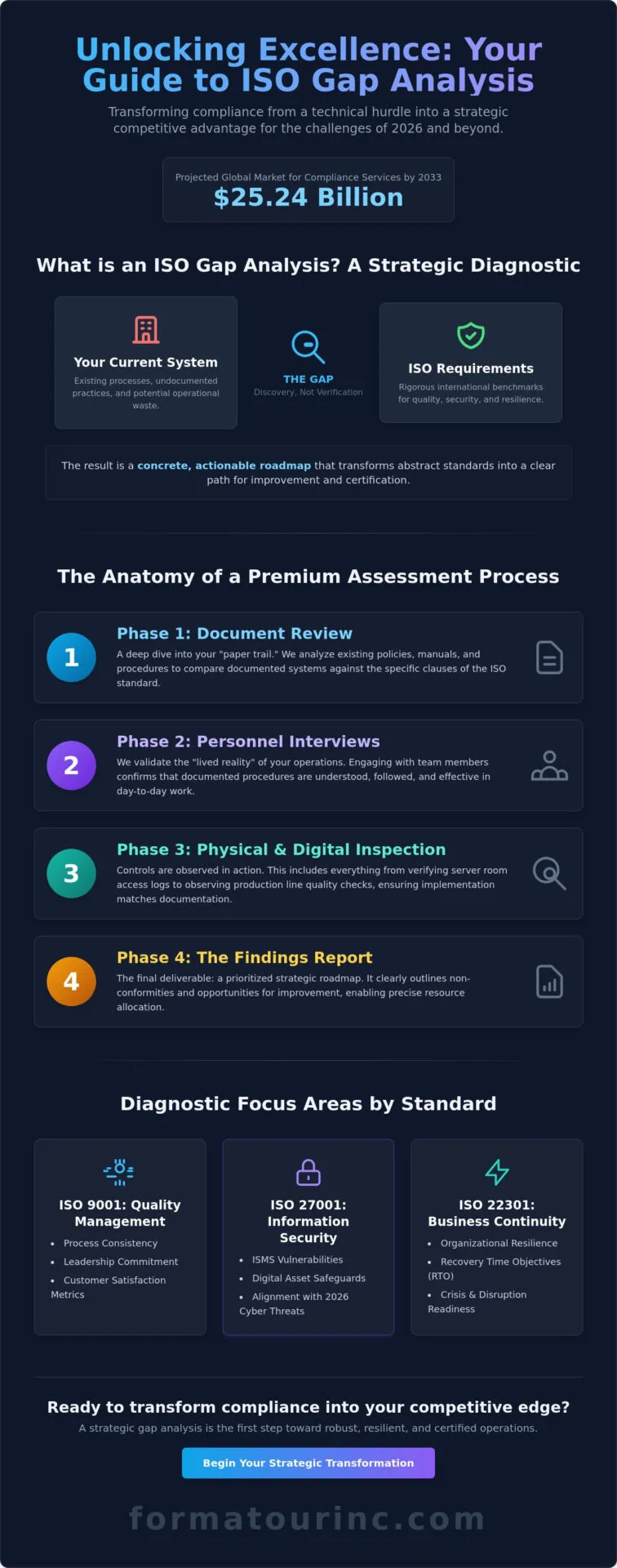
- ISO 9001: The assessment focuses on process consistency, leadership commitment, and the gaps in customer satisfaction metrics.
- ISO 27001: The service identifies vulnerabilities within your Information Security Management System (ISMS) to safeguard digital assets against evolving 2026 cyber threats.
- ISO 22301: Evaluates gaps in organizational resilience and recovery time objectives, ensuring the business remains operational during a crisis.
By identifying these nuances early, executives can allocate resources to the areas that offer the greatest return on stability and growth.
The Anatomy of a Premium ISO Gap Assessment Process
Executives often mistake a gap assessment for a simple “pass/fail” exercise. In reality, premium ISO gap analysis services function as a high-fidelity audit of organizational health. The process is methodical, moving from abstract policies to tangible operational evidence through four distinct phases. This structured approach ensures that every vulnerability is identified before it can jeopardize a formal certification audit.
Phase 1 begins with a comprehensive Document Review. This stage analyzes the existing “paper trail” to ensure that policies, manuals, and procedures align with the specific requirements of the chosen standard. According to the American Society for Quality (ASQ), these standards provide the necessary framework for consistent quality and organizational stability. Phase 2 transitions into Personnel Interviews. This is where the “lived reality” of the organization is validated. Auditors engage with team members to confirm that the procedures documented in Phase 1 are actually understood and executed in daily operations.
Phase 3 involves Physical and Digital Inspection. Controls are observed in action across the operational landscape, whether that involves verifying server room access logs or observing production line quality checks. Finally, Phase 4 culminates in The Findings Report. This deliverable provides a prioritized list of non-conformities and opportunities for improvement. It serves as your strategic roadmap, categorizing gaps so you can allocate resources with precision and confidence.
Documentation vs. Implementation Gaps
A common pitfall, particularly among Canadian firms, is the “implementation gap.” Having a policy is rarely enough for certification; you must provide objective evidence of its application. Many organizations suffer from over-documentation, creating complex manuals that aren’t actually used by staff. Premium advisors look for the “sweet spot” where documentation is lean but evidence of compliance is robust. They distinguish between minor non-conformities, which are isolated incidents, and major non-conformities, which indicate a systemic failure in your management system. Identifying these distinctions early prevents the costly mistake of over-engineering solutions for minor issues.
The Role of the Lead Auditor in Gap Analysis
The value of your assessment depends heavily on the expertise of the person conducting it. A checklist-checker might find errors, but a strategic advisor finds solutions. Your lead auditor must understand the Canadian regulatory landscape, including how PIPEDA interacts with data privacy requirements. Once the gaps are identified, the transition to ISO 27001 implementation services becomes the logical next step for building long-term resilience. To maintain that resilience over time, organizations should also consider how ISO internal audit services can transform the ongoing compliance cycle into a continuous performance improvement engine. If you’re ready to evaluate your current standing against international benchmarks, you might consider reaching out for a preliminary consultation to discuss your specific operational goals.
The Executive Checklist: Evaluating ISO Gap Analysis Providers
Choosing the right provider for ISO gap analysis services is a decision that dictates the trajectory of your entire certification journey. It’s a high-stakes selection process that requires more than a cursory review of a firm’s portfolio. A premium partner doesn’t just identify non-conformities; they act as a seasoned strategic mentor, providing a roadmap that aligns with your long-term growth and organizational culture. You need an advisor who understands that compliance is a tool for transformation, not merely a hurdle to clear.
Industry-specific expertise is the first pillar of evaluation. Does the firm understand the unique operational constraints of your sector? A provider familiar with the Canadian regulatory environment, such as PIPEDA or local environmental mandates, will offer far more value than one applying a generic global template. Methodological transparency is equally vital. Your chosen advisor should utilize a validated, repeatable framework that ensures consistency across different departments. This structured approach guarantees that the results are reliable and can be used to justify resource allocation to the board.
The quality of the final deliverable often separates mediocre consultants from visionary architects. You should expect a strategic roadmap rather than a generic report. This document must categorize findings by risk level and impact, allowing your leadership team to prioritize remediation efforts effectively. Many organizations find that boutique firms offer a distinct advantage over larger competitors. While big firms provide established names, they often suffer from “big-firm rigidity.” Boutique partners deliver big-firm standards with the agility and personalized mentorship required to integrate high-level concepts into your daily operations seamlessly.
Critical Questions for Your Potential Advisory Partner
- What is your experience with integrated management systems (IMS)? Managing multiple standards simultaneously requires a sophisticated understanding of how quality, security, and environmental controls overlap.
- How do you handle the transition between gap analysis and implementation support? A seamless handoff ensures that the momentum generated during the diagnostic phase isn’t lost.
- Can you provide case studies of Canadian firms in our sector? Concrete examples of previous success demonstrate a deep understanding of local operational realities.
Red Flags to Avoid in ISO Consulting
- The ‘One-Size-Fits-All’ Template: Avoid consultants who sell generic manuals or pre-packaged policies that don’t reflect your unique processes.
- Lack of Post-Assessment Support: A gap analysis should never be a dead-end document; it must lead directly to actionable implementation steps.
- Surface-Level Interviews: If a provider only speaks with senior management and ignores the staff executing the processes, the resulting report will lack the necessary depth.
A ‘free’ gap analysis often hides a lack of depth and expertise, acting primarily as a lead-generation tactic rather than a rigorous organizational diagnostic. Investing in a professional assessment ensures you receive the precision and intelligence required for sustainable development.
Preparing Your Organization: An Internal Readiness Checklist
Preparation for a professional diagnostic engagement is as critical as the assessment itself. When organizations engage ISO gap analysis services, the goal is to obtain a clear, unvarnished view of the current management system. Achieving this requires internal alignment and a commitment to transparency across all levels of leadership. Without a structured preparation phase, the diagnostic risks being superficial or failing to capture the lived reality of the organization’s processes. Successful readiness ensures that the advisory team can focus on high-level strategy rather than searching for basic information.
To ensure a productive engagement, executives should prioritize the following readiness steps:
- Identify Key Stakeholders: Ensure that department heads and process owners are available for interviews; their insights are vital for validating operational reality.
- Consolidate Documentation: Centralize all existing policies, manuals, and records to provide the advisory team with immediate access to the organizational “paper trail.”
- Communicate the Objective: Frame the assessment as a strategic support tool designed to empower staff, rather than a performance review that penalizes errors.
- Define the Scope: Clearly outline which business units, physical locations, or digital environments are included in the assessment to avoid operational ambiguity.
The Pre-Assessment ‘Clean Up’: What to Do and What to Avoid
A common temptation during preparation is to “clean up” records or invent evidence where gaps exist. This approach is counterproductive; it masks the very vulnerabilities the assessment is designed to solve. Total honesty regarding your “as-is” state leads to a more robust strategic roadmap and prevents major non-conformities during the formal certification audit. If you’re uncertain about how to define the boundaries of your project, reaching out to Formatour Incorporated for a professional consultation on scoping can provide the necessary clarity before the assessment begins.
Setting Realistic Timelines for Certification
The findings from your diagnostic will dictate the pace of your journey toward certification. Executives must account for a “remediation window,” which is the period between receiving the gap report and the stage 1 audit. This window allows your team to implement the recommended optimizations and close identified gaps. In the 2026 landscape, this process is increasingly accelerated through digital process automation and cloud-based management systems. By leveraging these technologies, organizations can move from diagnostic to certification with greater speed and structural integrity. If you’re ready to establish an authoritative timeline for your organization’s growth, contact our advisory team today to begin your readiness evaluation.
Navigating Strategic Transformation with Formatour’s Advisory Excellence
Strategic transformation requires more than a checklist; it demands a partner who functions as both a visionary architect and a steady mentor. Formatour delivers big-firm standards through a lens of boutique agility, ensuring that our ISO gap analysis services are tailored to the unique pulse of your organization. We don’t believe in rigid, pre-packaged solutions. Instead, we focus on the seamless integration of international benchmarks into your daily operations, fostering a culture of continuous improvement and unwavering reliability. This approach allows us to provide high-level authority while remaining accessible to your team’s specific needs.
Our multidisciplinary approach transcends simple compliance by integrating quality, security, and resilience into a single, cohesive vision. We turn gap findings into tangible operational performance gains, identifying inefficiencies that hinder your scale. By choosing a partner that prioritizes operational performance consulting and strategic project management, Canadian firms can navigate the entire ISO lifecycle with quiet confidence. This process ensures that every identified vulnerability becomes an opportunity for optimization, positioning your organization for long-term stability and global competitiveness. We focus on the co-development of solutions, reinforcing our role as an active participant in your progress.
The 2026 regulatory landscape, characterized by rapid digital transformation and evolving ESG criteria, makes a generic diagnostic insufficient. Our advisory excellence provides the precision required to navigate these complex global systems. We help you translate technical density into executive-level insights, providing the justification needed for board-level buy-in. Each engagement is a guided tour through your organizational health, building logically toward a holistic picture of excellence.
Why Canadian Enterprises Choose Formatour Incorporated
With a decade of experience in strategic transformation, Formatour has established itself as a premium partner for organizations seeking organizational resilience. Our expertise spans a comprehensive range of standards, including ISO 9001 for quality management, ISO 27001 for information security, ISO 22301 for business continuity, and ISO 14001 for environmental management. We’re committed to co-developing solutions that fit your specific organizational culture, ensuring that compliance feels like a natural extension of your brand’s values rather than an external imposition. Our focus remains on transformation, optimization, and the assurance of success.
Next Steps: From Diagnostic to Certification
Initiating your journey toward international certification begins with a strategic discovery call. This initial conversation allows us to align our diagnostic tools with your specific business objectives and operational scope. Once the gap assessment is complete, we provide a structured transition into implementation and ISO internal audit services support, guiding your team through every milestone of the certification cycle. We invite you to schedule your ISO Gap Analysis discovery session with Formatour Incorporated today to secure your path toward strategic excellence.
Securing Your Strategic Advantage in 2026
Securing an international certificate is a significant milestone, but building a resilient, optimized organization is the ultimate strategic goal. Professional ISO gap analysis services provide the necessary diagnostic lens to transform complex standards into a clear roadmap for sustainable growth. By identifying implementation gaps early, you prevent certification fatigue and ensure your resources are allocated with maximum precision. This proactive approach allows your leadership team to move beyond simple compliance toward a state of continuous operational excellence.
Formatour Incorporated brings over a decade of advisory expertise as specialists in ISO 27001 and 9001, offering boutique agility alongside premium consulting standards. We act as a seasoned strategic mentor, dedicated to co-developing solutions that integrate seamlessly into your unique organizational culture. Our multidisciplinary focus ensures that your management systems are not only compliant but also serve as a foundation for operational performance consulting that drives digital transformation and long-term stability. Secure your organization’s future with a strategic ISO Gap Analysis from Formatour Incorporated. Your path to international certification is a journey toward excellence, and we’re ready to help you navigate it with confidence.
Frequently Asked Questions
How long does a typical ISO gap analysis take to complete?
A typical engagement usually spans between two and five business days for the active assessment phase, depending on the size and complexity of your organization. This timeline includes the initial document review, personnel interviews, and operational inspections. Following the assessment, the delivery of the final strategic report typically requires an additional week to ensure a thorough analysis of findings and prioritization of remediation steps.
Can we perform an ISO gap analysis internally without a consultant?
Organizations can perform an internal assessment using existing staff, though this approach often lacks the objective rigor required for high-level certification. Internal teams may overlook systemic inefficiencies due to operational familiarity or unconscious bias. Professional ISO gap analysis services provide an impartial, expert perspective that ensures every vulnerability is identified through the lens of international standards, significantly reducing the risk of failure during a formal audit.
What is the difference between an ISO gap analysis and an internal audit?
A gap analysis serves as a strategic discovery tool to identify what is missing from your management system, whereas an internal audit verifies adherence to a system that’s already in place. The gap analysis acts as a preliminary roadmap for development and implementation. In contrast, the internal audit is a mandatory requirement of the ISO standard itself, designed to confirm that your established processes are functioning as documented.
Will an ISO gap analysis guarantee that we pass our certification audit?
No diagnostic tool can provide an absolute guarantee of success, as the final certification decision rests solely with the external registrar. However, a comprehensive gap assessment identifies and addresses the specific non-conformities that typically lead to audit failure. By resolving these issues during the remediation window, you significantly increase the probability of a successful outcome and demonstrate a high level of organizational readiness.
What kind of report should I expect at the end of the service?
You should expect a detailed strategic roadmap that categorizes findings into major non-conformities, minor non-conformities, and opportunities for improvement. This report doesn’t just list failures; it provides actionable recommendations for remediation aligned with your operational goals. A premium deliverable includes an executive summary that justifies the necessary investments to the board and outlines a clear timeline for the subsequent implementation and certification phases.
How much does an ISO gap analysis service cost in Canada?
The investment for a professional assessment varies based on the specific ISO standard selected, the number of organizational sites, and the total employee headcount. Larger enterprises with complex digital environments typically require a more extensive diagnostic than small firms with centralized operations. To obtain an accurate figure for your organization, you should consult with an advisory partner to define the project scope and identify any opportunities for integrated management system efficiencies.
Does ISO gap analysis cover multiple standards simultaneously?
Identifying numerous non-conformities is a positive outcome of the diagnostic process because it allows you to address vulnerabilities before they result in a failed audit. A high number of gaps simply indicates that your remediation window will require more intensive resource allocation and a more deliberate implementation timeline. Your advisory partner will help you prioritize these findings, focusing first on the major gaps that pose the greatest risk to your certification goals.
