

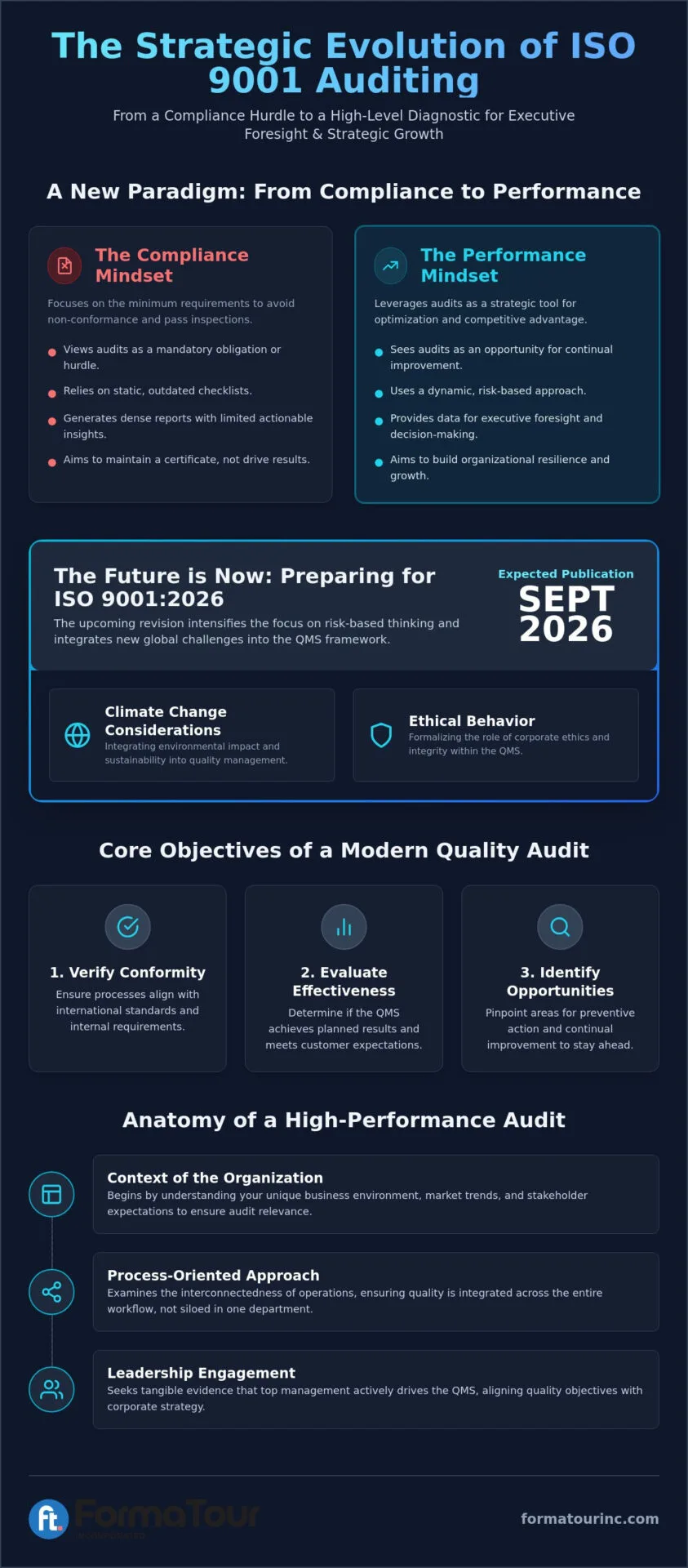
The most resilient global organizations recognize that a quality audit is not a hurdle to clear, but a high-level diagnostic for executive foresight. While many leadership teams struggle with audit fatigue and the frustration of inconsistent findings, elite firms use ISO 9001 auditing services to bridge the gap between technical compliance and long-term strategic growth. With the publication of the ISO 9001:2026 standard approaching this September, the role of the auditor has evolved from a mere checklist monitor to a visionary architect of operational excellence.
You’ve likely felt the friction of translating dense audit reports into actionable board-level decisions. This guide demonstrates how a risk-based Quality Management System (QMS) empowers your organization to navigate the three-year transition period to the 2026 standard with confidence. We explore how professional auditing provides the data necessary for seamless certification renewal and transforms your internal processes into a powerful engine for organizational resilience and sustainable development.
Key Takeaways
- Shift your organizational perspective from a compliance-heavy mindset to a performance-driven strategy that accelerates business growth and operational maturity.
- Discover how modern audits prioritize the specific context of your organization over static, outdated checklists to deliver more relevant and actionable insights.
- Master the strategic distinctions between internal, supplier, and third-party ISO 9001 auditing services to ensure a seamless transition to the upcoming 2026 certification standards.
- Empower your leadership team to foster a culture of audit readiness; this approach transforms the quality management process into a reliable driver for executive decision-making.
- Learn how to utilize gap analysis and professional audits as the essential foundation for broader digital transformation and process optimization within your firm.
What are ISO 9001 Auditing Services and Why Do They Matter in 2026?
Professional ISO 9001 auditing services represent a systematic, independent, and documented examination of an organization’s Quality Management System (QMS). These services provide a rigorous evaluation of how effectively a company adheres to the ISO 9000 family of standards. In the current economic climate, the value of an audit has shifted. It’s no longer just about maintaining a certificate on the wall; it’s about validating the structural integrity of your entire operational framework. High-level auditing ensures that your processes don’t just exist on paper but actually drive the results your leadership team expects.
Risk-based thinking remains the cornerstone of the ISO 9001:2015 framework, and this emphasis has only intensified with the upcoming ISO 9001:2026 revision. The new standard, expected in September 2026, formally integrates climate change considerations and ethical behavior into the QMS. Auditing now serves as a critical tool for navigating global supply chain volatility. It provides executives with the visibility needed to anticipate disruptions before they impact the bottom line. When you invest in premium auditing, you’re not just checking boxes; you’re building organizational resilience.
The Core Objectives of a Quality Audit
- Verifying Conformity: Ensuring that every process aligns with both international standards and your specific internal requirements.
- Evaluating Effectiveness: Determining if the QMS is actually capable of achieving its planned results and meeting customer expectations.
- Identifying Opportunities: Pinpointing areas for preventive action and continual improvement to stay ahead of market shifts.
The Business Case for Premium Auditing
Selecting a partner like Formatour Incorporated ensures your audit delivers more than a list of errors. Premium auditing reduces operational waste by identifying redundancies that drain resources. It enhances customer trust by providing a verified commitment to excellence that can be marketed to stakeholders. Most importantly, it offers a factual basis for executive-level strategic planning. Data-driven insights from a professional audit allow leaders to make informed decisions about resource allocation and digital transformation initiatives.
The Anatomy of a High-Performance ISO 9001 Audit
A high-performance audit transcends the traditional boundaries of a simple compliance check. In the past, many auditors relied on static checklists that often failed to capture the nuances of a complex business environment. Today, elite ISO 9001 auditing services have transitioned to a dynamic, process-oriented approach. This methodology examines the interconnectedness of your operations, ensuring that quality isn’t siloed within a single department but is integrated into the very fabric of your organization’s workflow.
Central to this modern approach is the “Context of the Organization,” a critical requirement of the official ISO 9001:2015 standard. Auditors now begin by understanding your unique business environment, including market trends, regulatory shifts, and stakeholder expectations. This context determines the audit scope, focusing resources on the areas that truly impact your strategic objectives. It ensures the audit remains relevant to your specific challenges rather than applying a generic, one-size-fits-all template that adds little value to the executive team.
Effective auditing also probes deeper into leadership engagement. Documentation alone is no longer sufficient; auditors now look for tangible evidence that top management is actively driving the Quality Management System (QMS). They evaluate how leadership communicates quality goals and how these objectives align with the broader corporate strategy. The primary output of this rigorous process is “Actionable Intelligence.” These are not just findings of fault, but high-level insights that empower executives to make informed decisions about growth, efficiency, and long-term resilience.
Risk-Based Auditing Methodologies
Modern auditors prioritize identifying high-risk processes that could threaten your organizational stability. By evaluating how risk management is integrated into daily operational workflows, the focus shifts from merely finding “non-conformities” to identifying “strategic vulnerabilities.” This foresight allows you to address potential failures before they manifest as costly operational disruptions. For organizations looking to refine these internal mechanisms, it’s often beneficial to consult with a strategic advisor who understands these global benchmarks.
Evidence-Based Decision Making
Data analytics now play a pivotal role in ISO 9001 auditing services. Auditors verify the reliability of your internal metrics to ensure that the data you use for strategic planning is accurate and representative of reality. They look for a logical link between data collection, analysis, and the resulting management actions. Evidence-based auditing is the bedrock of objective quality assessment. This objective approach ensures that your QMS remains a reliable tool for continuous improvement and sustainable success.
Internal vs. External Audits: Navigating the Certification Landscape
A clear understanding of the three distinct audit tiers is essential for any executive overseeing quality management systems. First-party audits are internal evaluations conducted by your own team or on your behalf to verify the health of your operations. Second-party audits involve assessing your suppliers to mitigate risk and ensure consistency across your procurement chain. Finally, third-party audits are performed by independent certification bodies, known as registrars, to provide the formal accreditation required for global market access. Integrating professional ISO 9001 auditing services at each of these stages ensures that your organization remains resilient and compliant.
Strategic success often begins with a gap analysis. This diagnostic tool identifies the distance between your current operational state and the rigorous requirements of the standard. It acts as a roadmap, highlighting specific areas that require investment or refinement before a formal assessment begins. Following this, a mock audit serves as a comprehensive dress rehearsal. It builds organizational confidence by simulating the pressures of the final certification cycle, allowing your team to resolve potential issues in a controlled, low-stakes environment.
The Strategic Advantage of Outsourced Internal Audits
Many leading Canadian firms choose to outsource their internal ISO 9001 auditing services to specialized advisory groups. This decision eliminates the inherent bias and “blind spots” that occur when staff members are tasked with auditing their own colleagues or departments. External auditors provide a level of multidisciplinary expertise that internal teams often lack, especially when linking quality findings to broader strategic transformation consulting. This objective perspective ensures that quality reporting remains a reliable tool for executive oversight rather than a secondary administrative task.
Preparing for the Third-Party Certification Audit
The path to certification involves a methodical relationship with your registrar. The process typically unfolds in two phases. Stage 1 is a high-level documentation review where the auditor ensures your system’s design meets the standard’s criteria. Stage 2 is the implementation audit, a deep-dive where the registrar verifies that your daily operations align with your documented procedures. It’s vital to ensure all previous internal findings are addressed and closed before the registrar arrives. Demonstrating a proactive approach to closing these loops signals to the auditor that your leadership is committed to the principles of continual improvement.
Preparing Your Organization for Audit Success: An Executive Checklist
Executives often view the arrival of an auditor with trepidation, yet this anxiety usually stems from a lack of systemic integration. Establishing a culture of audit readiness ensures that quality standards are lived daily rather than performatively dusted off once a year. When you utilize professional ISO 9001 auditing services, the goal is to validate existing strengths rather than scramble to hide weaknesses. This shift requires a top-down mandate where quality is recognized as a fundamental business driver rather than a secondary administrative burden.
The Quality Manager’s role must evolve from a technical gatekeeper to a facilitator of strategic change. They shouldn’t spend their time chasing signatures; instead, they should be identifying how process improvements can enhance customer satisfaction and operational speed. By aligning quality metrics with executive KPIs, the Quality Manager becomes a vital link in the chain of command. This ensures that the QMS supports the organization’s broader mission and provides the board with reliable data for decision-making.
Lean documentation is the hallmark of a mature system. Modern workflows should prioritize accessibility and digital integration over voluminous, static manuals. Before any formal assessment begins, a pre-audit briefing for the C-suite is essential. This session aligns leadership on quality objectives and prepares them to discuss how the QMS informs their strategic decisions. It’s a moment to ensure that every executive can speak confidently about the organization’s commitment to excellence.
Leadership Commitment and Resource Allocation
Leadership commitment is the most critical success factor for ISO 9001 compliance. Executives must verify that quality objectives align with the overall strategic direction of the firm. This involvement includes ensuring that human and technical resources are consistently available to maintain the QMS. Without visible support from the top, quality initiatives often stall, leading to a system that meets the letter of the law but fails to deliver tangible business value.
Process Ownership and Employee Engagement
Process owners must be empowered to articulate their specific risks and controls during an interview. Training staff to understand their direct impact on organizational goals fosters a sense of accountability and pride in their work. Many firms leverage leadership training for digital transformation to equip their teams with the skills needed to manage quality in an increasingly automated environment. If you’re ready to move beyond simple compliance and towards strategic growth, book a consultation with our advisory team to discuss your audit preparation strategy.
Formatour’s Approach: Boutique Agility with Big-Firm Auditing Standards
Formatour Incorporated stands as a premier advisor for Canadian organizations navigating the complexities of global standards. We provide ISO 9001 auditing services that combine the rigorous benchmarks of global consulting with the personalized attention of a boutique firm. Our approach ensures that your audit is not a detached administrative event but a core component of your broader ISO 9001 quality management implementation strategy. We view ourselves as strategic mentors, co-developing solutions that strengthen your organizational resilience while maintaining absolute objectivity.
Our expertise extends beyond quality management alone. We analyze your systems through a multidisciplinary lens, integrating insights from ISO 27001 information security and ISO 14001 environmental management. This holistic perspective ensures that your quality processes aren’t just compliant, but are also secure and sustainable. By identifying the intersections between these standards, we help you build a unified governance framework that supports long-term stability and growth. This architectural approach to auditing allows us to spot vulnerabilities that single-focus firms often miss.
Beyond Compliance: Driving Operational Performance
We transform audit findings into clear roadmap items for process automation and digital maturity. Our team identifies specific bottlenecks that hinder efficiency and suggests optimizations that drive tangible results. To support this journey, we offer several specialized resources for leadership:
- International Seminars: Global perspectives on emerging quality trends and regulatory changes.
- Executive Education: Programs designed to foster a culture of sustained quality within the C-suite.
- Process Optimization: Converting audit data into actionable strategies for operational waste reduction.
In one recent engagement, a mid-sized manufacturer achieved significant resilience by integrating their quality and business continuity audits. This strategic alignment resulted in a 15% reduction in operational downtime within the first twelve months of implementation.
Your Partner in Strategic Transformation
Working with a Canadian firm like Formatour provides the advantage of local expertise grounded in global benchmarks. We understand the specific regulatory and market conditions facing Canadian businesses today. Whether you require a comprehensive gap analysis to prepare for the 2026 standard or a rigorous internal audit to refine your current systems, we are ready to facilitate your success. Our process is methodical and deliberate, ensuring that every operational pillar is aligned with your high-level vision. Partner with Formatour for your ISO 9001 auditing needs and transform your quality management into a reliable engine for strategic advantage.
Advancing Towards a Future of Resilient Excellence
Shifting your organizational focus from basic compliance to strategic performance is the defining challenge for leaders in 2026. By treating quality assessments as high-level diagnostics, you transform the QMS into a reliable engine for growth and operational maturity. Professional ISO 9001 auditing services provide the objective data needed to bridge the gap between technical requirements and executive-level strategy. This approach ensures your firm doesn’t just survive the transition to the new 2026 standard but thrives through it.
Formatour Incorporated offers a unique multidisciplinary edge, integrating expertise in ISO 9001, 27001, and 22301 to build comprehensive resilience. As a Canadian-based firm grounded in global standards, we specialize in co-developing solutions that optimize your operational performance and long-term stability. We invite you to move beyond the checklist and embrace a partnership built on precision and strategic foresight. Secure your organization’s future with Formatour’s expert ISO 9001 auditing services. Your journey toward sustained excellence starts with a single strategic step.
Frequently Asked Questions
What is the primary difference between a gap analysis and a full ISO 9001 audit?
A gap analysis is a preliminary diagnostic tool used to identify missing elements in your current system before formal implementation. In contrast, a full ISO 9001 audit is a formal verification process that evaluates whether your established Quality Management System (QMS) effectively meets every requirement of the standard. While the gap analysis provides a roadmap for development, the audit confirms that your processes are operational and yielding the intended results.
How often should our organization conduct internal ISO 9001 audits?
Most organizations conduct internal audits at least once per year to maintain compliance and prepare for registrar visits. However, a risk-based approach might dictate more frequent reviews for high-stakes processes or departments experiencing significant operational shifts. Regular scheduling ensures that your QMS remains a living system that adapts to market changes rather than a static document that only receives attention during certification cycles.
Can ISO 9001 auditing services help with digital transformation initiatives?
How long does a typical ISO 9001 audit take for a mid-sized Canadian firm?
A typical audit for a mid-sized Canadian organization generally spans two to five days, depending on the complexity of the processes and the number of operational sites. This timeframe includes the opening meeting, on-site interviews, document reviews, and the closing presentation of findings. Larger firms with multiple locations or highly specialized technical requirements may require additional time to ensure a thorough examination of their entire management framework.
What happens if the auditor identifies a major non-conformance?
Identifying a major non-conformance indicates a significant breakdown in your QMS that prevents it from meeting the standard’s requirements. If this occurs during a certification audit, the registrar cannot issue or renew your certificate until you provide evidence of effective corrective action. Your team must conduct a root-cause analysis and implement systemic changes to prevent recurrence, which the auditor will verify before finalizing the certification process.
Is it possible to integrate ISO 9001 audits with ISO 27001 or ISO 14001 audits?
Integrating ISO 9001 audits with ISO 27001 for information security or ISO 14001 for environmental management is a highly efficient strategy known as an Integrated Management System (IMS) audit. This approach reduces audit fatigue by streamlining overlapping requirements, such as management reviews and document control. By evaluating multiple standards simultaneously, your organization gains a holistic view of its governance, risk management, and operational resilience through a single, coordinated process.
Why should we hire an external advisory firm for our internal audits?
Hiring an external advisory firm for internal audits provides an objective perspective that internal staff often lose due to departmental familiarity. Professional auditors bring multidisciplinary expertise and knowledge of global benchmarks that help identify “blind spots” in your operations. This external oversight ensures your internal reporting remains rigorous and provides leadership with a transparent, unbiased view of the organization’s true quality performance and strategic readiness.
How much do professional ISO 9001 auditing services cost in Canada?
The investment for ISO 9001 auditing services in Canada varies significantly based on the size of the organization, the number of employees, and the complexity of the industry. Factors such as the geographic spread of facilities and the maturity of the existing QMS also influence the total scope of work. Organizations should consult with strategic advisors to receive a tailored assessment that reflects their specific operational requirements and certification goals.
