

A surveillance audit isn’t a “lite” version of your initial certification; it’s a strategic stress test designed to verify your organization’s resilience in an evolving threat landscape. Many executives treat this period as a frantic sprint to gather evidence, yet the most successful firms view it as a validation of their daily operational excellence. By utilizing a structured ISO 27001 surveillance audit checklist, you can transition from reactive panic to a state of continuous compliance. This approach ensures that your Information Security Management System remains robust and aligned with the mandatory ISO/IEC 27001:2022 requirements.
We understand that the pressure to maintain zero major non-conformities while managing core business functions is a significant burden for any leadership team. This guide provides a clear, actionable roadmap to master the 12-month maintenance cycle without exhausting your internal resources. You’ll discover how to address the 11 new controls and the 2024 climate-action amendment while integrating security into your daily workflows. We will examine the specific evidence auditors expect in 2026, including the updated context from the ISO/IEC 27000:2026 overview, and provide the strategic foresight needed to secure your certification for the long term.
Key Takeaways
- Understand the shift from initial certification to a perpetual cycle of ISMS maturity and performance verification.
- Utilize a comprehensive ISO 27001 surveillance audit checklist to capture essential evidence of operation across all mandatory 2022 controls.
- Replace the high-stress “audit sprint” with a structured 12-month maintenance roadmap that preserves core business continuity.
- Identify the nuances between major and minor non-conformities to proactively address gaps before they impact your certification status.
- Discover how strategic partnership and professional guidance facilitate seamless compliance while driving organizational resilience and optimization.
The ISO 27001 Surveillance Audit: Shifting from Certification to Maintenance
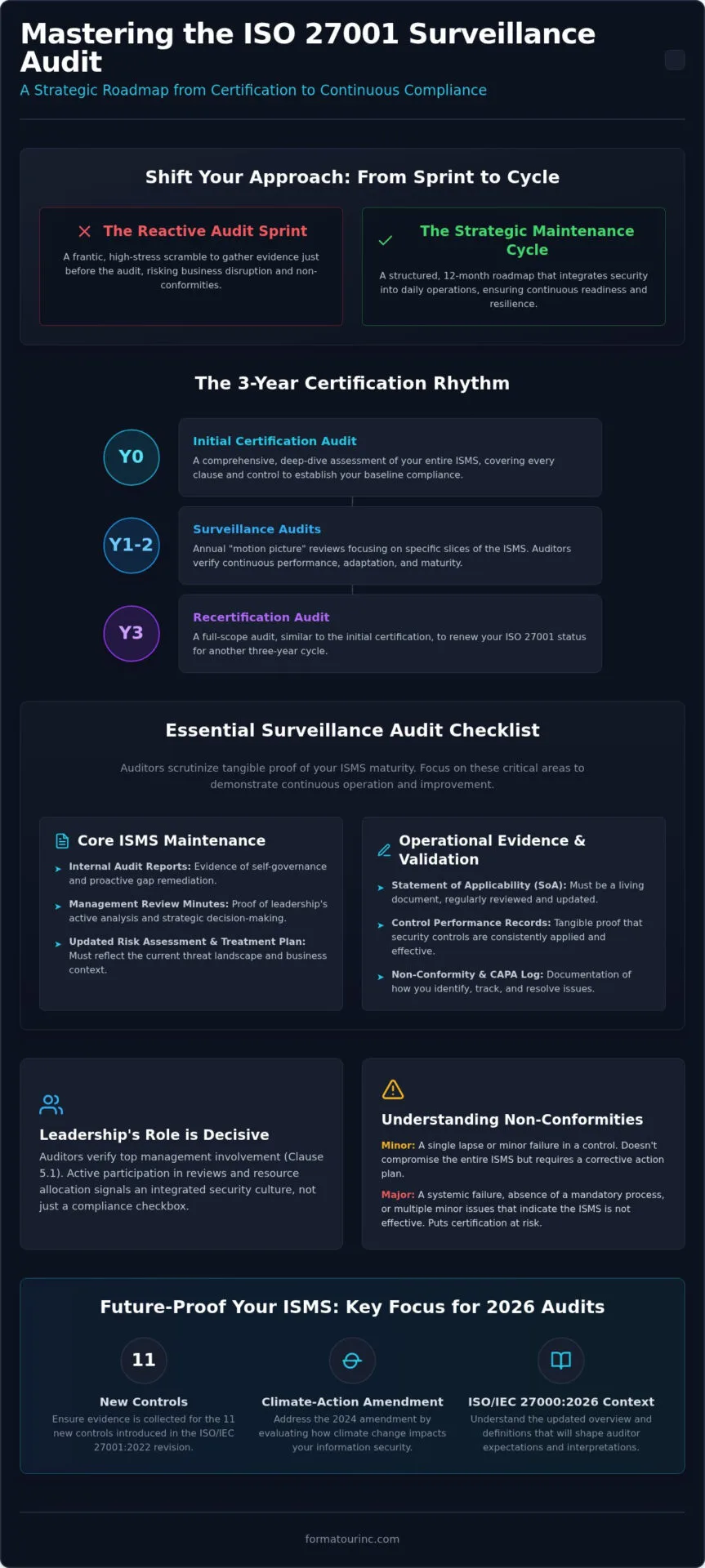
The surveillance audit represents a mandatory annual review conducted by your certification body to ensure your Information Security Management System (ISMS) remains functional. While the initial certification audit acts as a high-resolution snapshot of your compliance at a single point in time, the surveillance audit is more akin to a motion picture. It captures the continuous performance, adaptation, and improvement of your security posture over the preceding twelve months. Its primary objective is to verify that the system doesn’t just exist on paper but actively protects organizational assets. A surveillance audit is a strategic tool for organizational resilience that identifies vulnerabilities before they escalate into systemic failures.
To prepare effectively, many firms rely on a professional ISO 27001 surveillance audit checklist to monitor their progress against the ISO/IEC 27001 standard. This ensures that the transition from implementation to maintenance doesn’t result in a degradation of security controls or a loss of momentum.
The Three-Year Certification Cycle
The journey toward sustained compliance follows a structured three-year rhythm. Year 0 marks the initial certification, which is a comprehensive assessment of every clause and control. Years 1 and 2 are surveillance years. During these visits, auditors focus on specific “slices” of the ISMS, such as internal audits, management reviews, and the treatment of non-conformities. They don’t re-examine the entire system. Instead, they look for evidence that the ISMS is maturing and adapting to new threats. Finally, Year 3 culminates in a full recertification milestone. This cycle ensures that security remains a living process rather than a static achievement.
Leadership’s Role in Continuous Compliance
Auditors look for tangible evidence of top management involvement as required by Clause 5.1. They want to see that leadership doesn’t view security as a siloed IT issue but as a core business driver. Executive oversight is often the deciding factor between a successful audit and a major non-conformity. When leadership actively participates in management reviews and resource allocation, it signals to the auditor that the ISMS is integrated into the corporate culture. At Formatour Incorporated, we emphasize that a well-governed ISMS should drive strategic transformation. It’s about optimizing processes and building trust with global partners, not merely checking boxes to satisfy a requirement.
The Essential ISO 27001 Surveillance Audit Checklist
Auditors in 2026 aren’t merely reviewing your policies; they’re scrutinizing the tangible proof of your system’s maturity. A professional ISO 27001 surveillance audit checklist serves as your operational blueprint, ensuring that your security posture hasn’t degraded since your initial certification. The shift from certification to maintenance requires a move away from static documentation toward a culture of active evidence collection. If your foundation was established through expert ISO 27001 implementation services, you possess the structural integrity required to excel during these annual reviews. The following pillars represent the critical focus areas for the 2026 audit cycle.
Core ISMS Maintenance Obligations
The internal audit report is perhaps the most vital piece of evidence. It demonstrates that your organization possesses the self-governance necessary to identify and remediate gaps before a third party intervenes. Similarly, management review minutes provide proof that leadership is actively analyzing ISMS performance data to make informed strategic decisions. Your risk assessment and treatment plan must also be updated to reflect the 2026 threat landscape. This includes addressing the 2024 climate-action amendment, which requires organizations to evaluate how environmental changes might impact their information security infrastructure and business continuity plans.
Operational Evidence and Control Validation
Operational performance is validated through the consistent application of controls. Your Statement of Applicability (SoA) must accurately reflect the 93 controls defined in the 2022 version of the standard, including the 11 new additions such as threat intelligence and data leakage prevention. Auditors will look for security awareness training records to verify that your “human firewall” is regularly updated against modern social engineering tactics. Furthermore, incident management logs are scrutinized to see how your organization responds to and learns from security events. It’s not about achieving perfection; it’s about demonstrating a methodical, recorded response to every challenge your system encounters.
To ensure your organization remains audit-ready, prioritize these ten critical items in your 2026 cycle:
- Finalized internal audit reports covering all relevant ISMS “slices.”
- Executive-signed management review minutes with actionable outcomes.
- Updated risk assessment incorporating 2026 cyber-threat intelligence.
- Climate-action impact assessment as per recent ISO amendments.
- Documented evidence for cloud service security (Control 5.23).
- Verified records of ICT readiness for business continuity (Control 5.30).
- Comprehensive security training logs for all staff levels.
- Access review logs for high-privilege administrative accounts.
- Physical security monitoring evidence for critical infrastructure.
- Post-incident reports demonstrating root cause analysis and remediation.
Maintaining this level of detail can be complex, but it shouldn’t distract you from your core business objectives. If you need to refine your current evidence collection process, you can consult with our advisory team for a tailored gap analysis.
Managing the 12-Month Maintenance Cycle: Avoiding the Audit Sprint
The “audit sprint” is a high-risk phenomenon where organizations compress a year’s worth of compliance activity into the final weeks before an external review. This reactive approach is the primary driver of major non-conformities. It fails to demonstrate the continuous operational history that auditors require. When you cram evidence collection, you often discover gaps too late to remediate them effectively. A sustainable ISMS relies on a steady, methodical rhythm of data collection and review. By utilizing a rolling ISO 27001 surveillance audit checklist, leadership can ensure that security remains an integrated business function rather than a seasonal burden.
Centralization is the key to preventing this operational burnout. Maintaining a centralized evidence repository with strict version control allows your team to capture security artifacts in real time. This systematic distribution of tasks aligns with the expectations set out in the IAF Mandatory Documents, which govern how certification bodies assess the ongoing effectiveness of your management system. For organizations managing an integrated management system, these cycles often overlap with other standards. Consulting a professional ISO 9001 implementation guide can provide additional insights into harmonizing these overlapping requirements across your enterprise.
A Quarterly Roadmap for ISMS Health
Dividing the 12-month cycle into manageable quarters ensures that no single period becomes overwhelming. Maintaining a quarterly ISO 27001 surveillance audit checklist prevents the accumulation of technical debt and keeps the ISMS aligned with the 2026 threat landscape.
- Q1: Policy Alignment and Risk Updates. Review all core security policies and update the risk assessment to reflect current organizational changes or new technological deployments.
- Q2: Internal Audits and Remediation. Conduct internal audits on specific ISMS “slices” and track corrective actions to ensure all identified gaps are closed.
- Q3: Training and Supplier Governance. Execute security awareness training and perform reviews of external suppliers to verify they meet your updated security requirements.
- Q4: Management Review and Final Compilation. Present ISMS performance data to leadership and compile the final evidence package for the upcoming surveillance visit.
Leveraging Internal Audits as a Dry Run
Internal audits shouldn’t be viewed as a mere formality; they’re the ultimate dry run for your external surveillance visit. By investing in ISO 27001 lead auditor training, you can empower your internal team to identify “weak signals” before they escalate into significant issues. These signals are often minor inconsistencies in logs or slight deviations from policy that, if left unaddressed, indicate a lack of system maturity. Turning these findings into opportunities for process optimization demonstrates to the external auditor that your organization possesses a robust culture of continuous improvement and strategic resilience.
Common Audit Non-Conformities and How to Pre-empt Them
Discovering a gap during an audit is a common executive concern, yet it’s your organization’s response to that gap that determines your certification status. Auditors don’t anticipate perfection; they look for a system that possesses the intelligence to identify and remediate its own weaknesses. Findings are typically categorized into three distinct levels. A Major Non-Conformity indicates a systemic failure to fulfill a requirement of the standard, which can jeopardize your certification. A Minor Non-Conformity represents an isolated incident that doesn’t compromise the ISMS as a whole. Finally, Opportunities for Improvement (OFI) are observations that suggest ways to enhance your system’s efficiency. By maintaining a rigorous ISO 27001 surveillance audit checklist, you can identify these categories during your internal reviews. Transparency is your greatest asset. Presenting a known gap alongside a formalized remediation plan demonstrates a level of maturity that auditors highly respect.
Top 3 Audit Pitfalls in 2026
The transition to the 2022 version of the standard is now mandatory, and failing to update your Statement of Applicability (SoA) to reflect the 93 restructured controls is a frequent source of major non-conformities. Another common issue is inconsistent evidence of continuous operation. If your incident logs or access reviews are missing for a three-month period, it suggests that security is a seasonal task rather than a daily reality. Finally, a lack of documented follow-up on internal audit findings remains a significant hurdle. If you’ve identified issues but haven’t recorded the corrective actions taken, you’re signaling a breakdown in your ISMS governance.
The Power of the Corrective Action Plan
Internal discovery is a hallmark of a mature ISMS. Documenting a non-conformity internally before the external auditor arrives transforms a potential failure into a demonstration of effective oversight. Auditors respect organizations that find and fix their own errors because it proves the internal audit process is functioning as intended. A robust corrective action plan turns compliance hurdles into wins for organizational resilience. It shows that your management system is a living, self-correcting entity capable of protecting assets in a volatile environment. This proactive stance shifts the narrative from “defending a failure” to “demonstrating a solution.”
If you’re concerned about hidden gaps in your system or need support in refining your remediation strategies, schedule a professional pre-audit assessment with our multidisciplinary experts to secure your certification status.
Strategic Resilience: Partnering with Formatour for Seamless Compliance
Formatour Incorporated serves as the premium advisory partner for Canadian and global organizations navigating the complexities of international standards. We deliver big-firm expertise with the boutique agility required to tailor an ISMS maintenance program to your specific operational needs. While a certification body provides the final assessment, we provide the steady, expert hand that guides you through the technical and strategic preparation. Our approach ensures that your use of an ISO 27001 surveillance audit checklist is not a superficial exercise but a meaningful contribution to your firm’s structural integrity. By bridging the gap between high-level governance and daily operational detail, we empower leadership teams to view compliance as a catalyst for growth.
To achieve true organizational resilience, it’s essential to align security with broader business objectives. We invite you to explore our guide on digital transformation strategy to see how ISO standards complement your technological advancement goals. This integration ensures that your security posture evolves alongside your digital infrastructure, creating a seamless environment for sustainable development.
Advisory Beyond the Audit
Our multidisciplinary expertise extends across ISO 9001, ISO 22301, and ISO 14001, allowing us to create a holistic resilience framework for our clients. We recognize that a security-first culture begins at the top. Through our executive leadership development programs, we help mentors and architects within your organization foster an environment where compliance is a shared responsibility. Beyond audit preparation, Formatour Incorporated provides specialized support in strategic project management and studies, ensuring that every transformation initiative is grounded in global benchmarks and practical application. This comprehensive perspective helps you optimize processes while maintaining the highest standards of quality and continuity.
Next Steps for Audit Readiness
Preparation is the foundation of confidence. Before your certification body arrives, we recommend conducting a comprehensive pre-surveillance gap analysis to identify any hidden vulnerabilities in your documentation or processes. This proactive review allows you to refine your ISO 27001 surveillance audit checklist and remediate findings with precision. Booking a consultation for ISO 27001 certification support provides your team with the strategic foresight needed to navigate the 2026 audit cycle with zero major non-conformities. Our consultants work alongside your team to ensure that security becomes a natural extension of your daily operations.
Partner with Formatour Incorporated for your ISO 27001 surveillance success and transform your compliance obligations into a competitive advantage.
Advancing Toward Sustained Organizational Resilience
Maintaining a robust ISMS requires a strategic shift from initial implementation to perpetual performance optimization. By integrating a structured ISO 27001 surveillance audit checklist into your quarterly operations, you ensure that security remains an active driver of business value rather than a periodic compliance burden. This methodical approach allows your leadership team to pre-empt non-conformities and demonstrate the continuous maturity that auditors expect in 2026. True resilience is achieved when governance, technological advancement, and human capital align to protect your most critical assets. It’s about building a system that doesn’t just meet standards but excels beyond them.
As Canadian ISO certification experts, Formatour Incorporated provides premium advisory standards and multidisciplinary operational excellence to support your growth. Our team bridges the gap between complex regulatory requirements and your core business functions, ensuring a seamless audit experience. Secure Your ISO 27001 Compliance with Formatour Advisory and empower your organization with the strategic foresight needed for long-term success. We’re ready to help you transform compliance into a competitive advantage.
Frequently Asked Questions
How often do ISO 27001 surveillance audits occur?
Surveillance audits occur once every twelve months following your initial certification. They represent mandatory check-ins during the first and second years of your three-year certification cycle. These reviews ensure your Information Security Management System (ISMS) remains functional and adapts to organizational changes. Maintaining a consistent schedule prevents technical debt and ensures your security posture aligns with current international benchmarks, providing a steady hand for organizational growth and stability.
Must we conduct an internal audit before every surveillance audit?
Yes, Clause 9.2 of the standard mandates that you conduct internal audits at planned intervals. You must provide evidence that you have audited your own system before the certification body arrives for a surveillance visit. This process allows you to identify and remediate gaps using your ISO 27001 surveillance audit checklist. It demonstrates to the external auditor that your organization possesses effective self-governance and a commitment to continuous improvement.
What is the difference between a surveillance audit and a recertification audit?
A surveillance audit is a targeted review of specific ISMS components, such as management reviews and internal audit results, while a recertification audit is a comprehensive assessment of the entire system. Surveillance visits occur in years one and two to verify ongoing compliance. In contrast, the recertification audit happens every three years and involves a full re-evaluation of every clause and control to renew the certificate for another cycle.
Can we lose our ISO 27001 certification during a surveillance audit?
Yes, it’s possible to lose your certification if the auditor identifies major non-conformities that aren’t remediated within the required timeframe. A major non-conformity indicates a systemic failure to meet the requirements of the standard. While minor issues usually require a corrective action plan without immediate suspension, failing to address critical gaps or refusing to participate in the audit can lead to the suspension or withdrawal of your ISO 27001 certificate.
Do we need to review all ISO 27001 controls during the surveillance visit?
No, you don’t need to review all 93 controls from the 2022 version during a single surveillance visit. Auditors typically focus on a representative sample of your controls alongside mandatory management clauses. However, your internal ISO 27001 surveillance audit checklist should eventually cover all controls over the full three-year cycle. The auditor will prioritize areas they deem high-risk or those that have undergone significant change, such as cloud security or threat intelligence.
How long does a typical ISO 27001 surveillance audit take?
The duration typically ranges from one to three days, depending on the size and complexity of your organization. Factors such as the number of employees, the scope of your ISMS, and the number of physical sites influence the audit time. Larger firms with multidisciplinary operations generally require more time for the auditor to verify evidence across different departments. Your certification body will calculate the exact audit days based on international rules.
What happens if the auditor identifies a minor non-conformity?
Your certification remains valid, but you must provide a corrective action plan to address the issue. A minor non-conformity represents an isolated incident rather than a systemic failure. You will typically have a specific timeframe, often 90 days, to document the root cause and implement remediation. The auditor will then verify these actions during your next scheduled visit to ensure the gap has been closed effectively and won’t recur in the future.
Should we update our Statement of Applicability (SoA) every year?
Yes, you must review and update your SoA annually or whenever significant changes occur in your risk landscape. Auditors expect to see that your selection of controls remains relevant to your current operations. In 2026, this includes ensuring your SoA reflects the transition to the 2022 Annex A controls and any adjustments made following the 2024 climate-action amendment. A current, accurate SoA is a primary piece of evidence for successful certification maintenance.
