

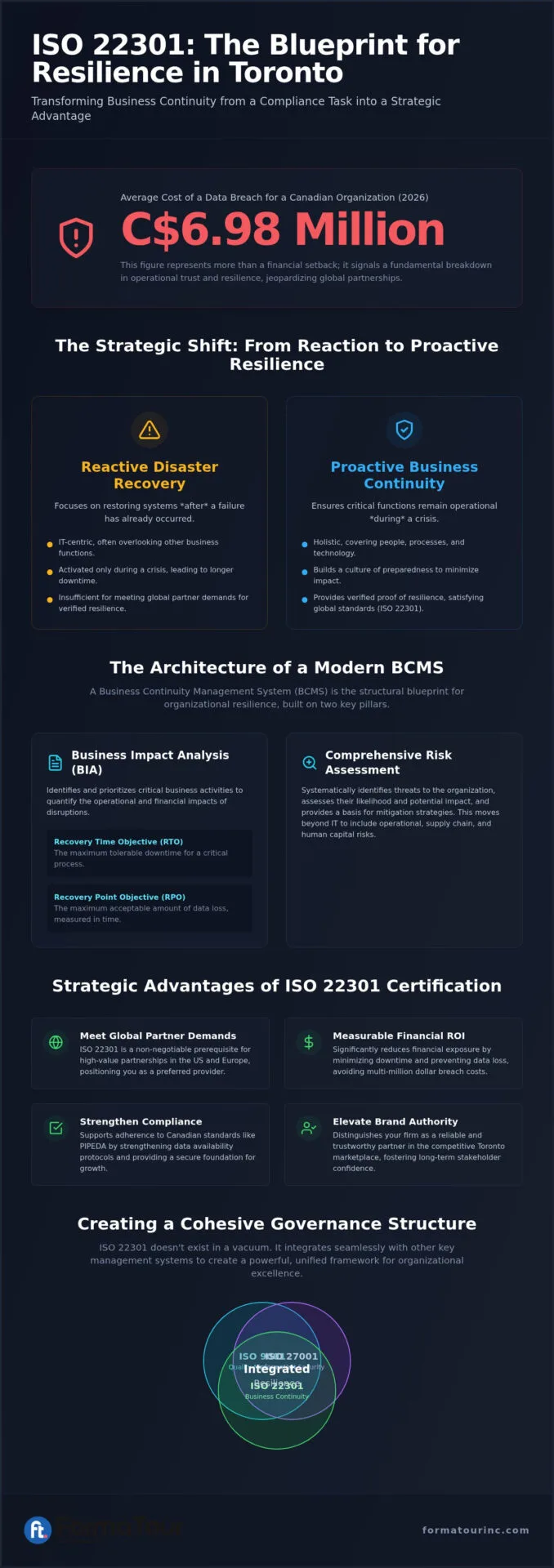
In 2026, the average cost of a data breach for a Canadian organization has reached C$6.98 million. This figure represents more than just a financial setback; it signals a fundamental breakdown in operational trust. Most executives in the Greater Toronto Area recognize that traditional recovery plans are no longer sufficient to satisfy global partners who demand verified proof of resilience. You’ve likely felt the increasing pressure to meet these rigorous standards without stalling your daily operations or overcomplicating your existing ISO 9001 or 27001 management systems.
Securing your ISO 22301 certification Toronto doesn’t have to be a journey through bureaucratic red tape. You’ll learn how to transform this compliance requirement into a strategic engine for growth and significant market differentiation. This guide provides a methodical roadmap to a seamless implementation process. We’ll explore how to build a culture of preparedness that protects your human capital and optimizes your structural integrity; this ensures your organization remains an authoritative, steady hand in an increasingly volatile global landscape.
Key Takeaways
- Transform your approach to resilience by shifting from reactive disaster recovery to a proactive strategy that secures your position in Toronto’s competitive tech and financial sectors.
- Master the foundational architecture of a Business Continuity Management System through precise Business Impact Analysis and comprehensive risk assessments.
- Follow a clear, executive-led roadmap to achieve ISO 22301 certification Toronto without disrupting your daily operations or creating unnecessary documentation.
- Identify the strategic advantages of choosing boutique agility over institutional complexity to ensure your resilience framework is both practical and scalable.
- Discover how integrating continuity with your existing ISO 9001 and ISO 27001 systems creates a cohesive and powerful organizational governance structure.
The Strategic Value of ISO 22301 Certification in the Toronto Marketplace
Toronto serves as the second-largest financial center in North America and a primary technology incubator. This concentration of economic power demands a level of stability that exceeds basic regulatory compliance. Pursuing ISO 22301 certification Toronto allows organizations to transition from reactive disaster recovery to a holistic, proactive management style. While disaster recovery focuses on restoring IT systems after a failure, business continuity ensures that every critical function remains operational during the crisis itself. This strategic alignment supports adherence to Canadian standards and strengthens the data availability protocols required under PIPEDA, providing a secure foundation for digital growth.
International markets, particularly in the United States and Europe, increasingly view ISO 22301 as a non-negotiable prerequisite for high-value partnerships. By adopting this framework, GTA firms demonstrate a sophisticated commitment to global benchmarks. This transparency reduces the friction of due diligence during the procurement process and positions your business as a preferred provider in complex global supply chains. It’s a clear signal that your organization prioritizes structural integrity over temporary fixes. Don’t wait for a crisis to test your systems.
Toronto as a Resilience Leader
Ontario’s unique geography presents distinct challenges, ranging from severe weather events to the logistical complexities of the Ontario-Quebec manufacturing corridor. A robust BCMS provides the structural integrity needed to manage these disruptions effectively without sacrificing service quality. Local organizations utilize these systems to map supply chain dependencies and mitigate the volatility of resource availability. This level of foresight transforms a potential operational collapse into a manageable event, securing the flow of commerce across the province and protecting your reputation among regional stakeholders.
The ROI of Organizational Resilience
Investing in resilience yields measurable financial returns. According to research by IBM, the average cost of a data breach for a Canadian organization has reached C$6.98 million in 2026. Strategic planning significantly reduces these financial exposures by minimizing operational downtime and preventing the loss of critical data. Beyond cost avoidance, certification through an expert partner like Formatour Inc. elevates your brand authority. It distinguishes your firm as a reliable partner in the GTA marketplace, fostering long-term trust with stakeholders. By uncovering hidden risks during the implementation process, you also optimize daily performance and enhance overall efficiency.
The Architecture of Resilience: Defining a Modern BCMS
A Business Continuity Management System (BCMS) represents the structural blueprint for maintaining operations when the unexpected occurs. It is recognized as the international standard for business continuity, providing a rigorous methodology to protect, respond to, and recover from disruptive incidents. For an organization to truly thrive, this framework must be integrated with ISO 9001 Quality Management for holistic success. Quality and continuity are two sides of the same coin; one ensures excellence in delivery while the other ensures that delivery remains possible. This synergy requires deep leadership commitment to foster a resilient culture that values foresight over reaction.
The Business Impact Analysis (BIA) as a Strategic Tool
The Business Impact Analysis (BIA) serves as the engine of your resilience strategy. It goes beyond simple checklists to identify the specific critical activities that drive revenue for your Toronto-based firm. By setting precise Recovery Time Objectives (RTO) and Recovery Point Objectives (RPO), you quantify exactly how much downtime your business can sustain before impact becomes terminal. Formatour specializes in uncovering the complex operational dependencies that generic consultants often overlook. This level of precision ensures that your resources are allocated where they matter most, protecting your bottom line during a crisis.
Risk Assessment Beyond the IT Department
Effective risk management extends far beyond the server room. A modern BCMS evaluates vulnerabilities across personnel, physical facilities, and third-party vendor networks. This comprehensive view is particularly effective when combined with ISO 27001 implementation, which secures the digital assets supporting your continuity plans. Many firms struggle with bureaucratic bloat, creating mountains of paperwork that no one reads. Formatour focuses on streamlining documentation to ensure your system is lean, actionable, and ready for ISO 22301 certification Toronto.
Building this architecture requires a partner who understands the nuance of the Canadian market and the specific pressures of the GTA. If you’re ready to move beyond basic checklists, you can consult with our strategic advisors to begin your organizational transformation.
Selecting an ISO 22301 Consultant: Boutique Agility vs. Institutional Complexity
Choosing the right partner for your ISO 22301 certification Toronto journey is a decision that dictates whether your resilience plan becomes a strategic asset or a bureaucratic burden. Many organizations fall into the trap of ‘certification mills’ that offer low-cost, template-based solutions. While these packages promise a quick path to compliance, they often result in significant hidden costs when generic plans fail to address specific operational risks during a real disruption. On the other end of the spectrum, the ‘Big Four’ institutional approach frequently introduces excessive documentation that slows progress and alienates internal teams. These large-scale models often lack the personalized execution required to align continuity with your unique business goals.
Boutique agility offers a superior alternative by providing high-level strategic oversight paired with a hands-on, focused implementation. This approach ensures your resilience framework isn’t just a checklist but a core component of your broader digital transformation strategy. You need multidisciplinary advisors who see the connections between technology, people, and processes. This holistic view prevents the silos that typically emerge during complex organizational changes. It’s about building a system that works for your people, not making your people work for the system.
What to Look for in a Toronto Advisory Partner
A local presence is vital for conducting meaningful on-site audits and physical facility assessments across the Greater Toronto Area. Your partner should demonstrate multidisciplinary expertise that spans Quality, Security, and Resilience to ensure your systems work in harmony. Look for a firm that prioritizes executive education; the goal is to empower your leadership team with the knowledge to maintain the system long after the initial certification is complete. A mentor who understands the specific economic pressures of Ontario will provide far more value than a remote technical specialist.
The Formatour Difference: Quiet Confidence
Formatour Inc. delivers the rigorous standards of a global firm with the speed and agility of a boutique advisory. We act as a strategic mentor, guiding you through the complexities of the certification journey with unwavering reliability. Our methodology focuses on co-developing solutions that feel modern and deeply established. For example, we recently partnered with a Toronto-based logistics firm to integrate their fragmented continuity plans into a unified system. This transformation didn’t just satisfy auditors; it enhanced their operational performance and secured their position as a reliable partner in the global supply chain. We help you build a legacy of stability and growth.
The Path to Certification: A Strategic Roadmap for Ontario Executives
Achieving ISO 22301 certification Toronto requires a methodical progression from initial assessment to final validation. We begin with a Gap Analysis to map your current posture against the international standard, ensuring strategic alignment with your specific business objectives. This foundation leads into a rigorous Business Impact Analysis (BIA) and Risk Assessment to quantify the financial and operational costs of potential disruptions. Following this, we co-develop your Resilience Playbook, which is a streamlined set of strategies and documentation designed for practical execution. The fourth phase involves training and exercising, where we test your plans through realistic simulations to ensure your team is prepared for high-pressure scenarios. Finally, we guide you through the Stage 1 and Stage 2 certification audits with a steady, expert hand to ensure a successful outcome.
Navigating the Audit Process with Confidence
Toronto auditors prioritize a mature Business Continuity Management System that demonstrates active executive involvement rather than a passive collection of digital folders. During the Stage 2 audit, leadership team members must be prepared for interviews that probe their understanding of resilience strategy and resource allocation. If non-conformities arise, your consultant’s response strategy becomes critical; we focus on rapid, structural corrections that satisfy auditors while improving organizational health. This proactive stance transforms the audit from a hurdle into a validation of your strategic foresight and operational readiness.
Sustaining Resilience Post-Certification
Long-term success depends on continuous improvement through regular internal audits and sustained governance. By integrating leadership training into your corporate culture, you ensure that resilience remains a core competency as your organization grows. The Annual Exercise serves as the heartbeat of a living BCMS, providing the essential platform for validating and refining your response capabilities in an ever-changing market. This ongoing commitment protects your investment and maintains your status as a reliable partner in the GTA.
If you’re ready to begin your journey toward a more resilient future, schedule a strategic roadmap session with our senior advisors today.
Formatour: Elevating Business Continuity into Strategic Advantage
Formatour Incorporated serves as a visionary architect for organizations that view resilience as a catalyst for growth rather than a mere compliance checkbox. We provide a multidisciplinary approach that bridges the gap between high-level strategy and daily operations, ensuring your management systems are both robust and adaptable. Toronto’s leading firms trust our ‘global citizen’ perspective because we understand how international benchmarks translate into local success. By integrating ISO 22301 certification Toronto with our Executive Leadership Development Programs, we empower your team to lead through volatility with quiet confidence. This combination of structural integrity and human capital optimization creates a formidable competitive advantage in the 2026 marketplace.
Our methodology focuses on the seamless integration of high-level concepts into the daily operations of your organization. We act as an active participant in your progress, selecting verbs and actions that emphasize transformation and optimization. This results-oriented atmosphere feels both modern and deeply established, providing the assurance of success that premium partners require. We don’t just deliver a certificate; we deliver a sustainable framework for excellence.
A Partnership Built on Trust and Precision
Navigating complex regulatory landscapes requires a steady, expert hand that prioritizes precision and reliability. We provide the unwavering support needed to manage the nuances of the 2026 business environment, where disruptions are increasingly frequent and costly. Our commitment to sustainable growth ensures that your Business Continuity Management System (BCMS) evolves alongside your organization. We co-develop solutions that enhance operational performance and foster a sense of security for your stakeholders. This partnership is built on a foundation of trust and a shared vision for long-term stability and structural integrity.
Next Steps: Securing Your Organization’s Future
The most effective time to build a resilient framework is before the next major disruption occurs. Waiting for a crisis to test your capabilities often leads to the high financial and reputational costs we’ve analyzed throughout this guide. By starting your journey now, you secure your organization’s future and establish your firm as a reliable pillar of the GTA economy. Our Toronto-based advisory team is ready to help you navigate this transformation with clarity and purpose. We invite you to book a strategic consultation to explore how we can align your continuity goals with your broader organizational vision.
Partner with Formatour for Strategic ISO 22301 Excellence
Architecting a Future of Unwavering Stability
Resilience in 2026 transcends mere disaster recovery to become a core strategic pillar for every ambitious organization. We’ve explored how a modern BCMS protects your critical activities while integrating seamlessly with your quality and security standards. By choosing a partner that offers boutique agility and big-firm standards, you ensure your continuity plan is lean, actionable, and perfectly aligned with your executive vision. This methodical approach transforms a compliance requirement into a formidable engine for market differentiation and long-term growth.
Securing your ISO 22301 certification Toronto marks the definitive transition from reactive planning to proactive leadership. As a premium Canadian multidisciplinary advisory firm, Formatour Inc. provides the steady, expert hand needed to navigate complex global benchmarks. Our deep expertise across ISO 9001, 27001, and 22301 ensures your governance framework is both comprehensive and efficient. You have the opportunity to turn potential volatility into a proven track record of reliability and success.
Secure your organization’s future with Formatour’s premium ISO 22301 advisory. Let’s work together to build a resilient legacy that protects your people, your assets, and your reputation for years to come.
Frequently Asked Questions
How much does ISO 22301 certification cost for a Toronto-based business?
The total investment for certification depends on several factors, including the size of your organization, the complexity of your operational processes, and your existing level of preparedness. Primary expenses typically involve internal resource allocation, the formal audit conducted by an accredited certification body, and annual surveillance fees. Engaging a strategic advisor helps optimize these costs by eliminating redundant documentation and ensuring your Business Continuity Management System is built efficiently for long term performance.
How long does the ISO 22301 implementation process typically take in Ontario?
The timeline for achieving ISO 22301 certification Toronto usually ranges from six to twelve months. Smaller firms with established management systems may reach readiness sooner, while larger enterprises require more time for comprehensive Business Impact Analysis and cross departmental training. A methodical approach ensures that resilience strategies are deeply embedded into your corporate culture. This steady pace allows for the thorough testing of response plans through realistic simulations before the final audit.
What is the difference between Disaster Recovery (DR) and Business Continuity (BC)?
Disaster Recovery is a technical subset focused on restoring IT infrastructure and data systems after a failure. Business Continuity is a holistic strategic framework that ensures all critical organizational functions remain operational during any disruption. While DR addresses the digital backbone, BC encompasses personnel safety, supply chain integrity, and stakeholder communication. It provides the architectural blueprint for maintaining service delivery and protecting your brand’s reputation regardless of the specific crisis encountered.
Is ISO 22301 certification mandatory for financial institutions in Canada?
While not universally mandated by a single law, certification is considered a global best practice that aligns with regulatory expectations. Organizations like the Office of the Superintendent of Financial Institutions (OSFI) place heavy emphasis on operational resilience and robust continuity planning. Many Toronto firms pursue certification to provide verified proof of stability to partners, shareholders, and regulators. It serves as a sophisticated benchmark that demonstrates your commitment to protecting critical financial activities.
Can we integrate ISO 22301 with our existing ISO 9001 quality system?
Integration is highly effective because both standards utilize the Annex SL high level structure. This shared framework allows you to align leadership responsibilities, document control, and internal audit processes into a single, cohesive governance model. Combining quality management with business continuity reduces administrative complexity and prevents operational silos. This unified approach ensures that your commitment to service excellence remains uninterrupted even during periods of significant market volatility or unexpected operational challenges.
Do I need a local Toronto consultant for the on-site audit phase?
Engaging a local advisor is highly beneficial for conducting accurate physical facility assessments and identifying regional infrastructure risks. A Toronto based consultant understands the specific logistical dependencies of the Ontario market and can provide hands on support during the certification audit. This local presence ensures that your Business Impact Analysis is grounded in reality. Having an expert physically present during the audit provides your leadership team with the confidence needed for successful executive interviews.
What are the most common reasons for failing an ISO 22301 audit?
Audit failures often result from a lack of demonstrable leadership commitment or an incomplete Business Impact Analysis. Auditors look for evidence that the resilience framework is an active part of organizational governance rather than a static set of documents. Other common pitfalls include insufficient staff training and failing to conduct regular plan exercises. Success requires a living system that is continuously refined based on the results of internal audits and realistic testing scenarios.
How often does an ISO 22301 certified company need to be re-audited?
Certified organizations must undergo annual surveillance audits to verify that the management system remains effective and compliant with the standard. Every three years, a comprehensive recertification audit is required to validate the entire framework against current business objectives. This cycle of continuous evaluation ensures that your resilience strategies evolve alongside your organization. It encourages ongoing optimization and helps maintain your status as a reliable partner in the increasingly complex global supply chain.
