

What if the next major disruption isn’t a threat to your operations, but a definitive testament to your organization’s strength? For many leaders, the increasing frequency of climate-related events and shifting stakeholder expectations have made traditional contingency plans feel insufficient. You’ve likely felt the pressure to prove your resilience through more than just internal policy. Securing ISO 22301 certification Canada isn’t just about checking a compliance box; it’s about building an agile operational framework that protects your long-term stability.
In this guide, we’ll show you how to navigate the complexities of international standards to secure your organization’s future with a strategic roadmap tailored for the Canadian market. We’ll explore the specific steps to integrate business continuity with your existing management systems and demonstrate how to reduce downtime during unforeseen incidents. By the end, you’ll have a clear path to transforming a technical requirement into a powerful competitive advantage that resonates with your stakeholders and secures your legacy.
Key Takeaways
- Analyze the critical role of ISO 22301 in fortifying organizational resilience against the supply chain volatility and economic shifts projected for the 2026 Canadian market.
- Identify the essential components of a Business Continuity Management System, focusing on the integration of Business Impact Analysis and the Plan-Do-Check-Act cycle.
- Leverage ISO 22301 certification Canada to move beyond mere compliance, transforming your continuity framework into a driver for process optimization and digital transformation.
- Implement a structured roadmap that prioritizes a detailed gap analysis and the documentation of clear, measurable business continuity objectives.
- Evaluate how a boutique, multidisciplinary advisory partnership can align international standards with your unique organizational goals for sustainable growth.
Navigating the Resilience Landscape: ISO 22301 Certification in Canada
ISO 22301 serves as the definitive international standard for establishing a Business Continuity Management System (BCMS). It provides a structured framework that enables organizations to identify potential threats, assess their impact, and build a response capability that protects the interests of key stakeholders. By 2026, obtaining ISO 22301 certification Canada will be a baseline expectation for firms operating in volatile global markets. Organizations are rapidly moving away from reactive disaster recovery models. They’re embracing proactive organizational resilience as a core business strategy to ensure long-term stability.
In Canada, this evolution is particularly critical for the finance, energy, and telecommunications sectors. These industries form the backbone of national infrastructure. Their ability to maintain operations during a crisis isn’t just a matter of profit; it’s a matter of national stability. Pursuing ISO 22301 certification Canada allows these organizations to demonstrate a commitment to reliability that goes beyond internal policy. It signals to the market that the business can withstand and recover from significant disruptions with minimal impact on service delivery.
The Canadian Context: Climate and Cyber Resilience
Canadian firms operate in a geography prone to diverse localized risks. From extreme wildfires to severe winter storms, the frequency of climate-related disruptions requires a robust response strategy. Within Canadian operational standards, a BCMS acts as a holistic management process that identifies potential impacts and provides a framework for building organizational resilience with the capability of an effective response. Beyond environmental threats, the intersection of business continuity and cybersecurity has become a top priority for Canadian executives. By integrating ISO 22301 with cyber resilience strategies, firms ensure that their operational recovery plans are as sophisticated as their digital defenses.
Regulatory Expectations for Canadian Organizations
Compliance is no longer a static requirement. Federal and provincial regulators increasingly look for evidence of mature resilience frameworks to protect consumers and the economy. ISO 22301 helps satisfy these expectations by providing a verifiable standard of excellence. It often serves as a prerequisite for securing high-value government contracts or partnerships with large enterprises that demand proven stability from their vendors. For leaders seeking to navigate these requirements, Formatour’s strategic advisory services provide the expert guidance needed to align compliance with long-term growth. This approach transforms a regulatory obligation into a strategic asset that improves organizational efficiency and market trust.
The Core Pillars of ISO 22301: Implementation Requirements
Successful implementation of the standard requires a disciplined adherence to its foundational components. At the heart of this framework lies the Plan-Do-Check-Act (PDCA) cycle, which ensures that your Business Continuity Management System (BCMS) remains a living, breathing entity. The “Plan” stage establishes the policy and objectives, while the “Do” phase focuses on implementation. “Check” involves monitoring performance against those objectives, and “Act” drives the continuous improvement necessary to maintain ISO 22301 certification Canada. This iterative process prevents stagnation and guarantees that your resilience strategies evolve alongside shifting market demands.
Leadership and commitment represent the non-negotiable success factors for any resilience initiative. Executive buy-in isn’t merely about signing off on budgets; it’s about fostering a culture where continuity is prioritized at every organizational level. Leaders must ensure that the necessary resources are allocated and that roles are clearly defined. Without this top-down support, even the most technically sound plans will lack the authority needed during a real-world crisis. Establishing robust support structures, including competency training and awareness programs, ensures that your team is prepared to execute their responsibilities with precision.
Conducting a Robust Business Impact Analysis (BIA)
The Business Impact Analysis serves as the bedrock of your resilience framework. It allows you to identify critical business functions and determine the Recovery Time Objectives (RTO) for each. To perform a robust BIA, start by mapping your core processes and identifying the resources required to maintain them. You must prioritize these activities based on their impact on your Canadian stakeholders, considering both financial and reputational consequences. For organizations requiring deeper technical expertise, engaging in ISO 22301 business continuity consulting provides a structured methodology to navigate these complex evaluations.
Risk Assessment and Mitigation Strategies
A comprehensive risk assessment identifies threats specific to your Canadian operations, such as infrastructure dependencies or regional environmental hazards. This isn’t a theoretical exercise. It’s a practical evaluation of how localized failures could cascade through your supply chain. Once risks are identified, you must develop response and recovery plans that are actionable and measurable. Testing and exercising these plans is essential to ensure they remain effective for the 2026 landscape. If you’re ready to strengthen your organizational foundations, consulting with a resilience specialist can help you bridge the gap between planning and operational excellence.
Beyond Compliance: Strategic ROI of ISO 22301 for Canadian Firms
Visionary leaders recognize that ISO 22301 certification Canada acts as a powerful catalyst for profound organizational transformation. It shifts the focus from mere survival to systematic process optimization. By identifying critical pathways, firms can eliminate redundant steps and implement process automation where it delivers the highest impact. This clarity doesn’t just protect the business during a crisis; it enhances daily operational efficiency by refining the core of how work is performed. When resilience is woven into the corporate fabric, it improves long-term operational performance by ensuring that every asset is utilized effectively.
A common misconception suggests that international standards slow down organizational agility. In reality, a well-implemented Business Continuity Management System (BCMS) accelerates decision-making by providing a pre-validated roadmap for crisis response. When an incident occurs, executives don’t waste precious time debating the next move. They execute a strategy that has already been stress-tested and approved. This level of preparedness offers a significant competitive advantage in the Canadian RFP landscape. Procurement officers for major infrastructure projects and government contracts increasingly prioritize partners who can provide documented proof of their resilience frameworks.
Enhancing Operational Performance Through Resilience
Standardizing continuity plans forces a deep audit of existing workflows, often revealing hidden inefficiencies that have persisted for years. This rigorous evaluation creates a natural synergy with ISO 9001 quality management implementation, as both standards demand a high degree of process clarity and accountability. When these frameworks operate in tandem, they provide a holistic view of organizational health that supports sustainable growth. Comprehensive resilience planning also accelerates digital transformation by highlighting the urgent need for cloud-based redundancies and automated failover systems.
Building Trust with Global Partners and Stakeholders
Certification serves as a definitive trust signal for international trade and investment. It reassures global partners that your organization is a reliable link in their supply chain, capable of maintaining service delivery despite external shocks. Within the domestic market, obtaining ISO 22301 certification Canada can lead to more favorable risk ratings and potential reductions in insurance premiums. Underwriters recognize the reduced likelihood of prolonged business interruption in certified firms. For organizations handling sensitive data, pairing this framework with ISO 27001 implementation services adds a vital layer of cybersecurity, creating a comprehensive shield against both physical and digital threats.
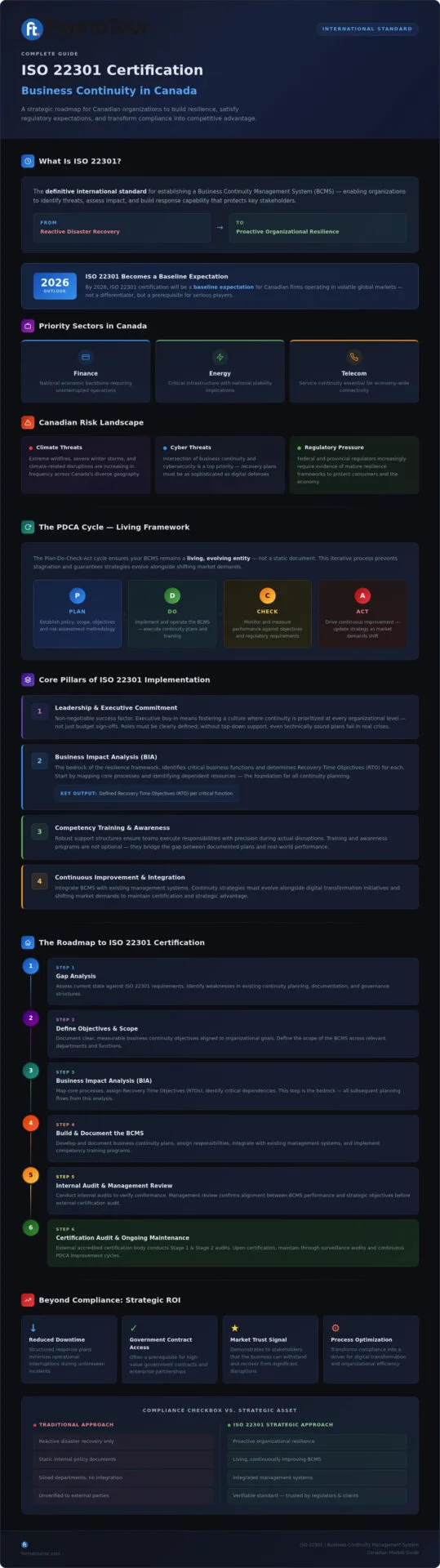
The Roadmap to ISO 22301 Certification in Canada
Achieving ISO 22301 certification Canada requires more than technical compliance; it demands a structured, phased approach that aligns with your strategic vision. This journey transforms your organization’s resilience from a vague concept into a measurable asset. You’ll follow a methodical roadmap to ensure that every resource spent contributes directly to a more stable future. It’s not just a checklist. It’s a strategic evolution of your entire operational philosophy.
- Step 1: Conduct a comprehensive Gap Analysis. This phase identifies the specific shortfalls between your current resilience posture and the requirements of the 2026 standard.
- Step 2: Develop and document BCMS policy and objectives. These documents serve as the constitutional foundation for your resilience framework, defining your organization’s commitment to continuity.
- Step 3: Implement the system and train personnel. You’ll roll out new protocols and ensure every team member understands their specific responsibilities during an operational disruption.
- Step 4: Perform internal audits. These objective evaluations verify compliance and identify areas for improvement before the final external assessment takes place.
- Step 5: Undergo the formal certification audit. An accredited body will conduct a two-stage review to validate your system and award the official certification.
The Role of Internal Auditing and Management Review
Internal audits act as your primary defense against certification failure. They provide an objective, evidence-based look at how well your systems actually function under pressure. For these audits to be effective, you must engage the C-suite in a formal management review process. This involvement ensures that leadership remains fully accountable for the system’s health and provides the necessary authority for corrective actions. When you’re selecting a certification body, look for organizations that demonstrate a deep understanding of the Canadian economic and regulatory landscape.
Training and Professional Development for Resilience
Empowering your internal teams is vital for the long-term sustainability of your BCMS. You can strengthen your organizational capacity by investing in leadership training for digital transformation, which prepares managers to lead through complex changes. Business continuity managers also require continuous professional development, including IT certification training, to keep pace with evolving threats. A truly resilient organization treats its BCMS as a living system that evolves through regular testing and feedback loops. If you’re ready to define your path toward excellence, contact our advisory team to schedule a preliminary consultation.
Elevating Resilience with Formatour’s Strategic Advisory
Formatour Incorporated operates as a steady, expert hand for organizations navigating the complexities of the 2026 Canadian market. While large consulting firms often provide a rigid, transactional experience, our boutique agility allows us to deliver big-firm standards with a personalized, inclusive touch. We understand that achieving ISO 22301 certification Canada isn’t an isolated event; it’s a critical milestone in a broader journey toward strategic stability. By choosing a Canadian partner with national coverage, you gain access to advisors who possess a deep, localized understanding of our unique operational and regulatory environment. We bridge the gap between technical compliance and strategic transformation, ensuring your organization is prepared for whatever the future holds.
Our firm brings over a decade of experience in organizational resilience to every partnership. We don’t just provide a roadmap. We walk the path with you, acting as a visionary architect for your continuity framework. This collaborative approach fosters a feeling of security through strategic foresight and professional excellence. By focusing on empowerment and the assurance of success, we help you transform potential vulnerabilities into definitive competitive advantages. Our goal is to provide the quiet confidence and unwavering reliability your stakeholders expect from a premium resilience partner.
Multidisciplinary Expertise for Complex Initiatives
Our approach transcends technical compliance by integrating business continuity with process automation and optimization. This synergy ensures that your resilience framework doesn’t just sit on a shelf; it actively improves your daily operations by eliminating inefficiencies. We also recognize that a system is only as strong as the people who lead it. By offering executive leadership development alongside our certification support, we empower your team to manage transformation with confidence. Formatour Incorporated plays a pivotal role in helping you refine your digital transformation strategy, ensuring that your technological advancements are protected by robust continuity protocols. This multidisciplinary perspective allows us to co-develop solutions that are both expert and practical.
Your Journey to ISO 22301 Success
The Formatour Incorporated audit preparation process is designed to ensure a zero-surprise experience during the formal certification phase. We work alongside your team to verify every control and document every policy, providing the assurance of success before the external auditors arrive. Our commitment extends beyond the initial award. We provide the ongoing support necessary to maintain and optimize your BCMS as your organization grows and the global landscape shifts. Transitioning from a state of vulnerability to one of strategic stability requires a partner dedicated to your long-term progress. You can consult with Formatour Incorporated for ISO 22301 Certification Support to begin developing your custom roadmap to resilience.
Securing Your Organizational Legacy in 2026
The evolution of the Canadian economic landscape demands a shift from simple contingency planning to a comprehensive culture of resilience. By viewing business continuity as a strategic driver rather than a technical hurdle, your organization can effectively navigate the disruptions projected for 2026. Securing ISO 22301 certification Canada is the definitive step in this journey, providing a verified framework for operational stability and stakeholder trust. This standard ensures that your critical functions remain protected, allowing your leadership to focus on sustainable growth and innovation rather than crisis management.
Formatour Incorporated serves as your visionary architect in this transformation, bridging the gap between high-level governance and daily operational excellence. Our multidisciplinary expertise in ISO 9001, 27001, and 22301, combined with specialized process automation, provides a holistic shield for your organization’s future. We invite you to Partner with Formatour Incorporated for Premium ISO 22301 Advisory Services and establish a resilient foundation that endures. Your commitment today defines the strength of your organization’s legacy tomorrow.
Frequently Asked Questions
Is ISO 22301 certification mandatory for businesses in Canada?
While ISO 22301 certification Canada is not a universal legal requirement for all businesses, it is increasingly becoming mandatory through industry-specific regulations and contractual obligations. Critical sectors such as finance, energy, and telecommunications often face federal or provincial oversight that necessitates proven resilience frameworks. Many large enterprises and government bodies also require this certification as a prerequisite for participating in high-value procurement processes and complex supply chain partnerships.
How long does the ISO 22301 certification process typically take for a Canadian firm?
The timeline for achieving certification typically ranges from six to twelve months, depending on the current maturity of your organizational processes and the scale of the enterprise. This period includes the initial gap analysis, documentation development, internal training, and the mandatory two-stage external audit process. Smaller firms with existing management systems may move faster, while complex organizations require more time to ensure deep integration across all departments and diverse geographic locations.
What is the difference between a Disaster Recovery Plan and ISO 22301?
A Disaster Recovery Plan (DRP) focuses specifically on the technical recovery of IT systems and data after an incident occurs. In contrast, ISO 22301 establishes a comprehensive Business Continuity Management System that encompasses the entire organization, including human resources, supply chains, and physical assets. It moves beyond mere recovery by emphasizing proactive resilience and the ability to maintain critical functions during a disruption, rather than just restoring them after the fact.
Can ISO 22301 be integrated with ISO 27001 or ISO 9001?
ISO 22301 is designed for seamless integration with other international standards like ISO 27001 for information security and ISO 9001 for quality management. These standards share a common high-level structure known as Annex SL, which allows organizations to use shared policies, documentation, and audit processes. This integrated approach reduces administrative redundancy, optimizes resource allocation, and provides a holistic view of organizational health, risk management, and long-term strategic stability.
What are the costs associated with ISO 22301 certification in Canada?
How often do we need to perform audits to maintain ISO 22301 certification?
To maintain your ISO 22301 certification Canada, your organization must undergo annual surveillance audits conducted by an accredited third-party body. These assessments ensure that the management system remains effective and continues to meet the standard’s requirements as the business evolves. Additionally, a comprehensive recertification audit is required every three years to renew the certificate. Organizations also perform internal audits at regular intervals to identify areas for continuous improvement.
Does ISO 22301 help with Canadian climate-related risk reporting?
ISO 22301 provides a structured methodology that directly supports Canadian climate-related risk reporting requirements by quantifying potential operational impacts. The Business Impact Analysis (BIA) and risk assessment phases allow organizations to identify the specific effects of extreme weather events on their core functions. This data-driven approach enables leaders to provide transparent, evidence-based disclosures to stakeholders and regulators regarding their readiness for environmental disruptions and their sustainable development strategies.
What are the specific leadership requirements for ISO 22301?
Leadership requirements for ISO 22301 demand that executive management demonstrates active commitment to the Business Continuity Management System. This includes establishing a clear continuity policy, ensuring that objectives are aligned with the organization’s strategic direction, and allocating the necessary resources for implementation. Leaders must also foster an internal culture of resilience and participate in regular management reviews to evaluate the system’s performance and drive the transformation of continuity protocols.
