

What if your business impact analysis spreadsheet collects plenty of information but still leaves recovery priorities unclear? An effective ISO 22301 business impact analysis template should do more than capture data. It should help decision-makers connect operational impacts, dependencies, and recovery timeframes to practical continuity priorities.
A clear list of what to record is useful, especially when a generic template may not reflect how your organization operates. ISO 22301 doesn’t prescribe one specific BIA template, so the structure needs to fit your context and support the decisions your continuity plans depend on.
This guide explains the purpose and boundaries of a BIA, the information a useful template should capture, and how to turn findings into recovery priorities and planning inputs. It also covers how to update the analysis as risks and organizational circumstances change, including climate-related factors addressed by the 2024 amendment to ISO 22301:2019. The goal is a decision-ready analysis, not a spreadsheet completed for its own sake.
Key Takeaways
- Use an ISO 22301 business impact analysis template to connect disruption impacts with recovery priorities, not simply to collect operational data.
- Distinguish BIA from risk assessment: assess how disruption affects activities over time, then examine the threats and vulnerabilities that could cause it.
- Capture accountable owners, dependencies, resources, and impact categories so findings can inform realistic recovery needs.
- Compare template formats by how well they support consistent scoring, evidence, clear ownership, and approval across your organization.
- Validate findings with relevant teams and use approved results to shape continuity strategies, plans, responsibilities, and exercises.
What an ISO 22301 business impact analysis template is designed to establish
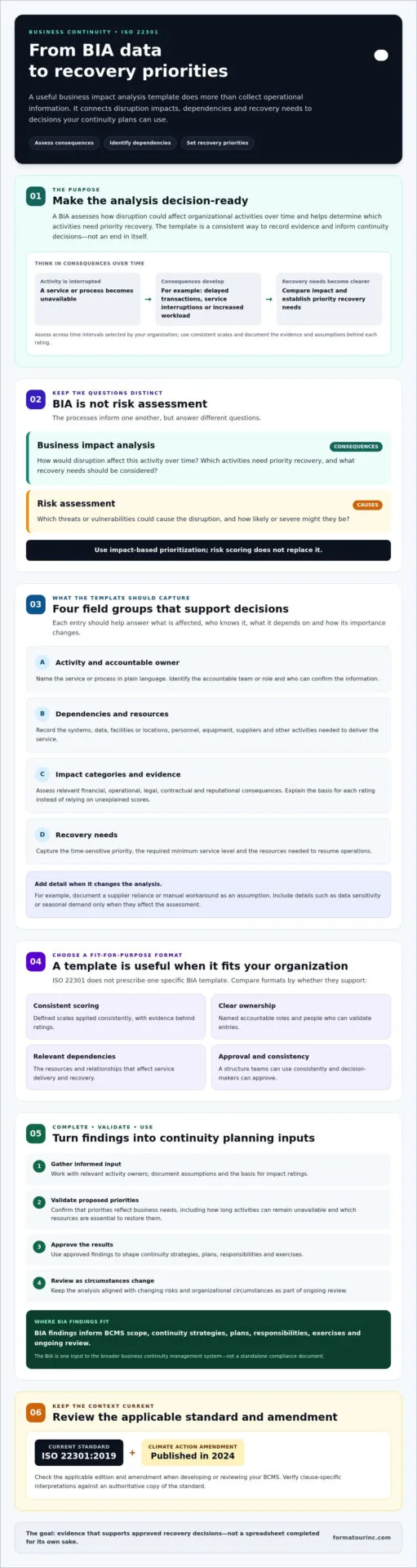
A business impact analysis (BIA) is a structured process for assessing how disruption could affect an organization’s activities over time and determining which activities need priority recovery. An ISO 22301 business impact analysis template gives teams a consistent way to record impacts, dependencies, and recovery needs, then use that information to guide continuity decisions.
The focus is consequence, not prediction. If a payment processing activity becomes unavailable, for example, a BIA considers how the effects could develop over time, from delayed transactions to service interruptions or increased workload. A risk assessment addresses a different question: which threats or vulnerabilities could cause the disruption, and how likely or severe might they be? The two processes inform one another, but their findings shouldn’t be confused.
How business impact analysis fits within ISO 22301
A BIA is one input to the broader business continuity management system (BCMS), not a standalone compliance document. Its findings help an organization understand which activities fall within its BCMS scope and inform continuity strategies, plans, responsibilities, exercises, and ongoing review. The Business Impact Analysis (BIA) is commonly described as a foundational part of continuity planning because it connects disruption consequences with recovery needs.
The current standard is ISO 22301:2019, with the climate action amendment published in 2024. Check the applicable edition and amendment when developing or reviewing your BCMS, and verify any clause-specific interpretation against an authoritative copy of the standard.
What a BIA can and cannot tell decision-makers
A BIA can compare the consequences of interrupted activities, identify dependencies, and help establish recovery priorities over time. It cannot predict every disruption, prove that a particular threat will occur, or make management decisions on the organization’s behalf. Its value depends on informed input and clear assumptions.
Review the analysis with relevant activity owners and confirm that proposed priorities reflect business needs. Validate assumptions such as how long an activity can remain unavailable and which resources are essential to restore it. Risk scoring may help evaluate threats, but it shouldn’t replace impact-based prioritization. The template is useful when its evidence supports approved continuity strategies and planning, not simply when every field is filled.
Which BIA fields turn operational information into recovery priorities
A useful ISO 22301 business impact analysis template makes each entry traceable to a decision: what activity is affected, who understands it, what it depends on, and how disruption changes its importance over time. Start with consistent core fields, then add organization-specific details only when they help assess impact or plan recovery.
- Activity and owner: Name the service or process in plain language, identify the accountable team or role, and record who can confirm the information.
- Dependencies and resources: Note key systems, data, facilities or locations, personnel, equipment, suppliers, and other activities needed to deliver the service.
- Impact categories: Assess relevant financial, operational, legal, contractual, and reputational consequences. Record the basis for each rating rather than relying on unexplained scores.
- Recovery needs: Capture the time-sensitive priority, required minimum service level, and resources needed to resume operations.
Document activities, dependencies, and impact over time
Describe what the activity delivers and whom it serves. Then assess how disruption could affect it across time intervals selected by your organization. A delay, for instance, may initially create a backlog, then affect customer service or contractual commitments if it continues. Ready.gov’s guidance describes how a BIA predicts the consequences of a disruption to support recovery planning.
Use defined rating scales consistently, but don’t assume one set of intervals or impact thresholds suits every organization. Explain the evidence and assumptions behind each rating, such as reliance on a supplier or a manual workaround. Add fields for details such as data sensitivity or seasonal demand only if they affect the analysis.
Record recovery requirements without confusing the terms
The maximum tolerable period of disruption (MTPD) is the point beyond which an activity’s consequences are unacceptable to the organization. The recovery time objective (RTO) is the targeted time for resuming an activity or restoring a resource after disruption. Set and validate these measures for the specific activity. The RTO should support recovery before the organization reaches its tolerance limit.
This fictional example shows how the fields connect. The times below are illustrative only, not recommended thresholds.
Fictional scenario: online retailer order fulfilment
- Owner: Operations manager
- Dependencies: Order platform, warehouse staff, delivery supplier
- Impact over time: Orders queue; continued disruption delays dispatch and may affect customer commitments
- Recovery requirement: Restore order processing within the organization-approved RTO; document a minimum manual service level and required staff
Confirm fields and terminology against your organization’s needs and the applicable ISO 22301 edition. If you need help connecting BIA outputs to ISO 22301 business continuity implementation, you can discuss your continuity requirements.
How to compare an ISO 22301 BIA template with your organization’s needs
The right format helps people provide consistent, reviewable information and gives decision-makers a clear basis for setting recovery priorities. An ISO 22301 business impact analysis template may be a spreadsheet, a guided document, a facilitated workshop, or a digital workflow. The format alone doesn’t make the analysis sound. Assess whether it captures the evidence, ownership, and approvals needed for your organization’s continuity decisions.
Ready.gov describes a Business Impact Analysis (BIA) as a way to understand disruption consequences and inform recovery strategies. Use that purpose to compare options, rather than choosing a tool simply because it offers dashboards or automation.
| Format | Strengths | Limitations to assess | May suit |
|---|---|---|---|
| Blank spreadsheet | Flexible, familiar, and easy to adapt. | Can lead to inconsistent scoring, uncontrolled copies, and unclear ownership. | A focused analysis with a manageable number of activities and a clear review process. |
| Guided template | Prompts users through fields and supports more consistent responses. | May include irrelevant questions or constrain organization-specific needs. | Teams that need a shared structure but can manage reviews outside the template. |
| Facilitated workshop | Enables discussion across process owners and relevant support teams. | Requires coordination and may need a separate record of decisions and evidence. | Complex dependencies or differences in how departments interpret impacts. |
| Digital workflow tool | Can centralize submissions, review status, and approvals. | Assess access controls, information handling, usability, and how the workflow fits existing processes. | Distributed operations or a recurring analysis involving many contributors. |
When a spreadsheet is enough, and when it is not
A controlled spreadsheet can work well when the scope is clear, contributors can access the same approved version, and someone is responsible for consolidating and reviewing responses. Establish who may edit it, how changes are recorded, and where the current version is stored. Reconsider the approach if departments interpret scoring differently, supplier dependencies are missed, or multiple locations maintain conflicting copies. ISO 22301 conformity doesn’t require buying software or hiring a consultant.
A practical checklist for evaluating template quality
Check that the format connects activities to impacts, dependencies, recovery needs, and accountable owners. It should also provide space for evidence, assumptions, approval, and review dates. Match its complexity to your scope and operating model. If teams span locations, suppliers, or information security boundaries, confirm who can see and update sensitive information and how inputs will be validated. Choose a template that supports sound decisions without adding fields users cannot maintain.
How to complete and validate the BIA without treating the template as the answer
A polished form can make information look complete without making the analysis reliable. The value of an ISO 22301 business impact analysis template depends on informed input, tested assumptions, and management decisions. Treat the document as a controlled record of the analysis, not a substitute for it.
A repeatable workflow for collecting and assessing information
Use a consistent process so teams can compare findings and trace decisions to their source:
- Define the scope and purpose. Identify the organizational activities, locations, and services covered, along with the criteria for assessing impacts and recovery needs. Assign an accountable coordinator and set expectations for handling sensitive information.
- Identify contributors. Ask process owners to describe how work is delivered and what disruption would affect. Involve IT for systems and data, facilities for premises and equipment, and suppliers where external services or materials are dependencies. Leadership provides direction on priorities and decision authority.
- Gather evidence. Use interviews or workshops alongside relevant records, existing plans, service information, and supplier arrangements. Different sources can reveal gaps that a single respondent may miss.
- Assess impacts and dependencies. Apply the agreed criteria consistently. Record supporting evidence, assumptions, and unresolved questions rather than presenting estimates as confirmed facts.
- Challenge and reconcile findings. Compare responses when teams give different estimates. A process owner, for example, may expect a workaround to sustain service, while IT identifies a system dependency that limits it. Clarify the conditions, document the evidence, and escalate unresolved differences.
- Approve, connect, and review. Ask accountable business owners to validate their entries, then submit significant trade-offs or conflicting priorities to the appropriate management decision-makers. Record decisions and use approved findings to inform continuity strategies and plans. Set a review point so the analysis can be revisited when activities or dependencies change.
Validate priorities and turn findings into decisions
Validation means more than checking that every field contains text. Confirm that proposed recovery requirements are feasible, dependencies are represented, and impact ratings follow the agreed method. If two activities compete for the same people, system, or supplier, make the conflict visible. Leadership can then determine the priority and accept relevant assumptions rather than allowing an unresolved estimate to become an implicit decision.
Record who reviewed the analysis, what evidence informed material ratings, which issues remain open, and who approved the resulting priorities. This gives continuity planners a clear basis for selecting strategies, assigning responsibilities, and developing plans. The template supports this work, but it cannot establish organizational priorities or demonstrate conformity on its own.
For support validating BIA findings and connecting them to ISO 22301 implementation, discuss your business continuity needs.
How ISO 22301 support can connect BIA findings to continuity implementation
An approved BIA becomes valuable when its priorities shape how the organization prepares to maintain or restore important activities. The analysis should inform decisions about continuity strategies, plans, responsibilities, and exercises. A template records those decisions; completing it alone doesn’t establish conformity with ISO 22301 or ensure that continuity arrangements will work in practice.
From approved analysis to a maintained continuity management system
Keep the BIA active. Changes to operations, technology, locations, or supplier arrangements may affect dependencies and recovery needs. Exercise results may also show that an assumption was unrealistic or a plan is incomplete. Use those findings to review the relevant analysis and update strategies and plans where needed. The ISO 22301 business impact analysis template is a starting point for traceable decisions, not a substitute for maintaining them.
When implementation or audit support may add value
Some organizations can coordinate the analysis internally. Additional expertise may help when the scope spans multiple sites, activities rely on complex or critical dependencies, departments disagree on priorities, or internal capacity is limited. Support can help structure the methodology, facilitate cross-functional validation, and check that approved BIA outputs connect coherently to continuity implementation.
Formatour Incorporated provides ISO 22301 business continuity services, including implementation, auditing, and certification support. The appropriate support depends on your organization’s needs. It should reinforce internal ownership and decision-making, not replace them. A focused discussion can clarify where your analysis stands, which findings need validation, and how to move from priorities to continuity arrangements.
Once your BIA findings are approved, identify the next practical actions: assign owners to address planning gaps, confirm resources and dependencies, and select exercises that test key strategies. If you’re assessing how to connect your analysis with ISO 22301 implementation, discuss your organization’s requirements with Formatour Incorporated.
Turn BIA findings into continuity action
A decision-ready business impact analysis connects disruption consequences to recovery priorities. The right ISO 22301 business impact analysis template helps organize information about activities, owners, dependencies, and recovery needs, but informed review and management approval make those findings meaningful. Choose a format your teams can maintain, document the basis for key assessments, and revisit assumptions as operations change.
Use approved priorities to shape continuity strategies, plans, responsibilities, and exercises. This turns analysis into practical preparation and helps keep the wider business continuity management system aligned with current needs. A template supports the process; it doesn’t establish conformity on its own.
Formatour provides ISO 22301 business continuity implementation support, along with ISO standards auditing and certification support. If you’re ready to validate your analysis or connect BIA results with implementation, discuss your ISO 22301 business continuity needs. Take the next step by contacting Formatour to discuss how your BIA findings can inform continuity implementation.
Frequently Asked Questions
What should an ISO 22301 business impact analysis template include?
An ISO 22301 business impact analysis template should capture activities, accountable owners, dependencies, resources, disruption impacts, and recovery requirements. Include relevant impact categories, such as operational, financial, contractual, legal, and reputational consequences, and assess how these may change over time. The template should also record evidence, assumptions, approval, and review information. Tailor additional fields to your organization’s scope rather than collecting details that won’t inform continuity decisions.
Is a business impact analysis required for ISO 22301?
Yes, a business impact analysis is part of the business continuity management system requirements in ISO 22301. The standard doesn’t prescribe one universal BIA form or spreadsheet. Organizations determine a suitable method for their context, then use the analysis to inform continuity priorities and arrangements. Check the current edition and applicable amendments when assessing your approach, and verify any clause-specific interpretation against an authoritative copy of the standard.
What is the difference between a BIA and a risk assessment?
A BIA evaluates how disruption could affect activities and the organization over time, helping determine recovery priorities. A risk assessment identifies and evaluates potential threats and vulnerabilities that could cause disruption. A BIA might establish the consequences of an unavailable ordering system, while a risk assessment considers causes such as system failure or a supplier issue. The two processes inform continuity planning, but answer different questions.
How do you determine an RTO in a business impact analysis?
Determine a recovery time objective (RTO) by assessing how quickly an activity or resource needs to resume after disruption to support organizational priorities. Consider the consequences of downtime over time, dependencies, available workarounds, and the resources needed for recovery. Validate the proposed target with accountable activity owners and relevant support teams, such as IT. The RTO should be realistic and approved, not selected simply because a template provides a field for it.
Can a spreadsheet be used as an ISO 22301 BIA template?
Yes. A spreadsheet can support a BIA if it captures the information needed for decisions and has a clear process for ownership, consistent assessment, review, and approval. Control access and versions so teams don’t work from conflicting copies. For a focused analysis, this format may be practical; distributed operations or complex dependencies may call for additional coordination. ISO 22301 doesn’t require organizations to use dedicated software.
How often should a business impact analysis be reviewed?
Review the BIA at planned intervals and when relevant organizational changes could affect activities, dependencies, or recovery needs. Changes to systems, suppliers, locations, services, or operating arrangements may prompt reassessment. Exercise results can also reveal outdated assumptions or gaps that warrant review. Set a review approach suited to your organization, document updates and approvals, and don’t treat an unchanged calendar schedule as a substitute for responding to material change.
Does an ISO 22301 BIA template guarantee certification?
No. A template helps structure and document analysis, but completing it doesn’t guarantee certification or establish conformity with ISO 22301. The organization must apply the standard across its business continuity management system, validate its analysis, make and approve decisions, and connect findings to continuity arrangements. Formatour Incorporated provides ISO 22301 implementation, auditing, and certification support, but the template itself remains a tool, not a certification outcome.
