

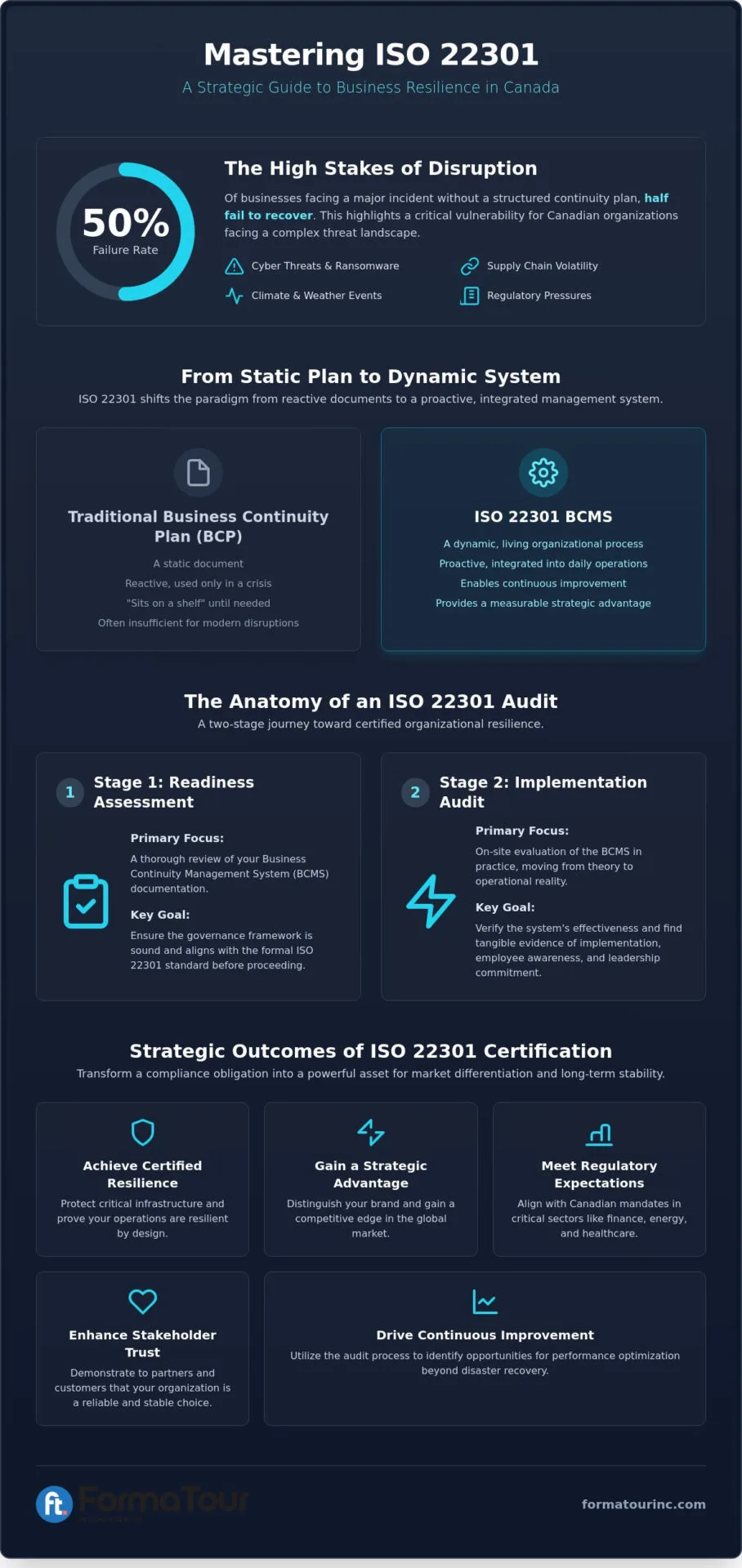
Did you know that 50% of businesses facing a major incident without a structured business continuity plan fail to recover? For Canadian executives, this isn’t just a distant statistic; it’s a compelling reason to secure the structural integrity of their operations through professional ISO 22301 audit services Canada. You likely recognize that the complexity of regulatory expectations and the persistent threat of operational downtime can feel like a significant burden. It’s natural to feel anxious about the resource drain of a certification process or the potential for audit failure when your organization’s reputation is on the line.
This guide empowers you to master the nuances of ISO 22301 auditing, transforming a compliance hurdle into a strategic architect for long-term agility. We’ll explore how to navigate current Canadian requirements, optimize your Business Continuity Management System, and leverage international standards to protect your critical infrastructure. By the end of this article, you’ll have a clear roadmap to achieve certified resilience and distinguish your brand in a competitive global market.
Key Takeaways
- Identify why ISO 22301 serves as the definitive benchmark for managing operational risks like cyber threats and supply chain volatility in the Canadian market.
- Distinguish between the diagnostic insights of a gap analysis and the formal validation provided by a comprehensive certification audit.
- Master the two-stage audit framework to ensure both your documentation and on-site implementation meet rigorous international standards.
- Utilize professional ISO 22301 audit services Canada to transform your continuity planning from a compliance obligation into a strategic asset for market differentiation.
- Establish an internal oversight program that empowers your leadership team to pre-empt external findings and maintain long-term structural integrity.
The Canadian Resilience Landscape: Why ISO 22301 Matters in 2026
Canadian executives face a unique set of pressures in 2026. From the increasing frequency of extreme weather events to sophisticated ransomware attacks, the margin for error has narrowed significantly. Adopting the ISO 22301 standard provides a globally recognized framework to manage these disruptions effectively. By utilizing specialized ISO 22301 audit services Canada, organizations move beyond mere survival to build a foundation for sustained performance. This standard serves as the gold benchmark, ensuring that every facet of the organization aligns with international best practices for stability and growth.
The shift from passive disaster recovery to proactive organizational resilience is now a strategic imperative. Climate volatility, such as the increased frequency of wildfires and flooding, has shown that supply chain disruptions are no longer “black swan” events. They’re predictable variables. Organizations that invest in these systems gain the foresight needed to protect their human capital and technological assets before a crisis peaks. This transition reflects a sophisticated understanding of modern governance, where stability is co-developed through rigorous planning and strategic foresight.
Critical Infrastructure and Regulatory Expectations in Canada
Regulatory bodies within the finance, energy, and healthcare sectors no longer view business continuity as optional. The federal Directive on Security Management already mandates high standards for government departments, setting a precedent that private sector critical infrastructure must follow. Compliance with these mandates is essential for maintaining operational licenses in telecommunications and other vital sectors. Failure to comply doesn’t just result in potential fines; it leads to a catastrophic loss of stakeholder trust and reputational damage that can take years to repair. Proactive adherence to these standards ensures that your organization remains a reliable partner in the Canadian economy.
ISO 22301 vs. Traditional Business Continuity Planning
Many organizations rely on a static “plan” that sits on a shelf until a crisis occurs. This approach is often insufficient for the rapid-fire disruptions of the modern economy. ISO 22301 replaces these reactive documents with a dynamic Business Continuity Management System (BCMS). A Business Continuity Management System is a living organizational process that integrates risk assessment, strategic response, and continuous improvement into the daily fabric of the business. For global Canadian firms, this auditable framework offers a measurable strategic advantage. It proves to international partners that your operations are resilient by design, not by chance. This methodology allows leaders to optimize their processes while simultaneously fortifying them against unforeseen volatility.
The Anatomy of an ISO 22301 Audit: A Strategic Framework
An audit is far more than a checklist of technical requirements. It represents a sophisticated diagnostic of your organization’s health and its capacity to sustain operations under pressure. When engaging ISO 22301 audit services Canada, leaders should view the process as a two-stage journey toward structural integrity. The Stage 1 audit serves as a readiness assessment, where the focus remains on the structural alignment of your documentation with the official ISO 22301 standard. This initial phase ensures that the governance framework is sound before moving into deeper operational scrutiny.
The Stage 2 audit transitions from theory to practice. During this phase, auditors evaluate the actual implementation and effectiveness of your Business Continuity Management System (BCMS). They seek tangible evidence that the processes described in your documentation are active and understood across the organization. Success here depends heavily on leadership commitment. Auditors look for clear signs of executive oversight, as a resilience strategy without top-down support often lacks the necessary resources to survive a genuine crisis. This rigorous evaluation identifies specific opportunities for performance optimization, allowing you to refine your operations even in areas unrelated to disaster recovery.
If you’re looking to align your current systems with these high-level benchmarks, you might consider how a strategic partnership can streamline your path to certification.
Business Impact Analysis (BIA) as the Audit Foundation
The Business Impact Analysis is the core pillar of any resilient organization. Within the Canadian context, this means identifying time-critical activities that could be jeopardized by regional risks like extreme weather or localized infrastructure failure. Auditors will scrutinize your Recovery Time Objectives (RTOs) to determine if they’re realistic and backed by adequate resources. A well-executed BIA links these findings directly to strategic project management, ensuring that capital and human capital are allocated to the areas of highest impact during a disruption.
Integrating Digital Resilience into the BCMS Audit
Modern resilience is inseparable from technological advancement. Process automation and digital transformation don’t just increase efficiency; they create redundant systems that protect data and service delivery. A comprehensive audit also examines the “human element,” evaluating leadership programs and employee awareness to ensure the culture is as robust as the software. For organizations seeking a unified approach to security, integrating ISO 27001 Implementation Services ensures that information security and business continuity work in tandem. This multidisciplinary approach creates a seamless shield for your organization’s digital and physical assets.
Gap Analysis vs. Certification Audit: Choosing Your Path
Selecting the appropriate engagement level requires a clear understanding of your organization’s current maturity. While the ultimate goal is often formal validation, the path you take determines the efficiency of your resource allocation. Many Canadian firms find that jumping directly into a certification audit leads to unnecessary friction and potential failure. Instead, a strategic diagnostic phase allows for the quiet correction of systemic weaknesses before they become public liabilities. Choosing the right path ensures that ISO 22301 audit services Canada deliver maximum value to your specific operational context.
The gap analysis functions as a low-stakes diagnostic tool. It compares your existing practices against the ISO 22301:2019 Requirements to identify where your Business Continuity Management System (BCMS) currently stands. This is an advisory process, not a formal assessment. It provides the psychological security of knowing exactly where you fall short without the risk of an official non-conformity. Conversely, the certification audit is a formal validation intended for external stakeholders, clients, and regulators. It proves that your resilience is not just a claim but a verified capability.
Internal audits serve as the bridge between these two paths. By conducting a rigorous internal review, you create a “dress rehearsal” that prepares your team for the scrutiny of an external registrar. This proactive step minimizes the risk of audit failure and empowers your staff to speak confidently about their roles in the resilience framework. Leveraging professional ISO 22301 audit services Canada for these internal assessments provides an objective perspective that internal teams often lack.
The ROI of a Preliminary Gap Analysis
In the Canadian context, supply chain dependencies are often the most overlooked vulnerabilities. A gap analysis identifies these blind spots, ensuring that your resilience strategy accounts for third-party volatility. A gap analysis serves as a strategic roadmap that translates technical requirements into actionable priorities for executive leadership. By addressing these issues early, you significantly reduce the long-term costs associated with comprehensive certification support and avoid the “firefighting” mentality often seen during rushed certifications.
Maintenance and Surveillance Audits: Sustaining Resilience
Certification is the beginning of a journey, not the destination. The standard operates on a three-year cycle, requiring annual surveillance audits to ensure the BCMS remains effective. This ensures the system evolves alongside your organization’s digital transformation strategy. Organizations that view these audits as a continuous improvement mechanism often integrate them with ISO 9001 Quality Management Implementation to foster a culture of holistic excellence and operational integrity.
Preparing Your Organization for an ISO 22301 Audit in Canada
Preparation for a formal assessment requires more than a cursory review of existing files. It demands a methodical alignment of your organizational culture with the rigorous expectations of international standards. When engaging ISO 22301 audit services Canada, the most successful firms are those that treat the preparatory phase as a strategic optimization exercise. This involves assembling a multidisciplinary resilience team where roles and responsibilities are not just documented but actively practiced. Executive oversight is the cornerstone of this structure, providing the authority needed to integrate continuity protocols into every department.
Establishing a robust internal audit program is your most effective defense against unexpected external findings. This program acts as a continuous feedback loop, identifying minor non-conformities before they escalate into significant hurdles during the certification process. Documentation management also plays a critical role. Your Business Continuity Management System (BCMS) must be supported by clear, accessible, and version-controlled records. If your team cannot locate a recovery procedure during a simulated disruption, they certainly won’t find it during a genuine crisis. Training and international seminars further empower your staff, ensuring they possess the competence and confidence to own their specific roles within the resilience framework.
Leadership’s Role in Audit Success
The efficacy of your BCMS is directly proportional to the visible commitment of senior management. Auditors prioritize evidence that leadership views resilience as a core business value rather than a peripheral compliance task. Demonstrating this commitment often involves participation in Leadership Training for Digital Transformation, which helps executives align continuity objectives with the firm’s broader strategic vision. This alignment ensures that resources are allocated effectively and that the organization’s long-term growth is protected against volatility.
Common Pitfalls in Canadian ISO 22301 Audits
Many organizations struggle during the audit process because they overlook the complexity of their external dependencies. In the Canadian market, failing to rigorously assess third-party and vendor risks is a frequent point of failure. Additionally, some firms maintain extensive documentation but fail to conduct adequate testing and exercising of their business continuity plans. A plan that hasn’t been stress-tested is merely a theory. Finally, failing to update the BCMS after significant organizational changes or digital shifts can render your entire resilience strategy obsolete. This is why professional ISO 22301 audit services Canada focus heavily on the “Check” and “Act” phases of the improvement cycle.
To ensure your organization is fully prepared for its next assessment, consult with our expert advisory team today to schedule a comprehensive readiness review.
Formatour Incorporated: Your Premium Partner for ISO 22301 Excellence
Formatour Incorporated stands at the intersection of rigorous international standards and personalized strategic mentorship. While global firms often offer scale without nuance, we provide the boutique agility necessary to navigate the specific complexities of the Canadian market. Our ISO 22301 audit services Canada are designed to be more than a compliance exercise; they act as a catalyst for organizational transformation. By blending big-firm standards with a supportive, collaborative approach, we ensure that your Business Continuity Management System is both robust and practical. We don’t just identify gaps; we co-develop the solutions required to bridge them.
Our multidisciplinary advisory model links ISO standards directly to digital transformation and process optimization. This approach ensures that your investment in resilience also drives operational performance and structural integrity. With over a decade of experience in strategic transformation, we understand how to integrate high-level governance concepts into the daily operations of diverse Canadian industries. From the initial readiness assessment to the final certification audit, we provide a seamless journey that prioritizes your organization’s long-term stability and growth. Our expertise in the Canadian regulatory landscape ensures that your operations meet both federal mandates and international benchmarks.
Why Canadian Executives Choose Formatour Incorporated
Executives partner with us because we prioritize sustainable growth alongside compliance. Our customized advisory services are designed to respect your daily operations, minimizing disruption while maximizing the effectiveness of your continuity protocols. We bring a proven track record across ISO 22301, 27001, and 9001, offering a unified perspective on organizational health. This breadth of expertise allows us to provide a comprehensive shield for your human and technological capital. We function as a visionary architect for your resilience, ensuring every pillar of your business is fortified against volatility.
Next Steps: Securing Your Organizational Future
Securing your organization’s future begins with a clear understanding of your current resilience posture. We invite you to initiate a resilience diagnostic with our advisory team to identify immediate opportunities for fortification and optimization. A long-term partnership with Formatour Incorporated ensures that your management systems remain living, evolving assets that adapt to new threats and technological shifts. This steady, expert guidance provides the quiet confidence needed to lead in an unpredictable global economy.
Partner with Formatour Incorporated for ISO 22301 Excellence and take the first step toward achieving international resilience standards for your Canadian operations.
Building a Resilient Future for Canadian Enterprise
Formatour Incorporated brings boutique agility and premium consulting standards to every engagement. As a multidisciplinary advisory firm with over a decade of experience, we specialize in the unique demands of Canadian critical infrastructure resilience. Our expert team guides you through the complexities of international standards while focusing on your long-term operational performance. We’re dedicated to helping you transform compliance into a foundation for sustainable growth and structural integrity.
Partner with Formatour Incorporated for ISO 22301 Excellence to secure your organization’s legacy today. Your path to international resilience standards is within reach.
Frequently Asked Questions
What are the specific requirements for ISO 22301 audit services in Canada?
Requirements for these services center on the ISO 22301:2019 framework, which demands a formal Business Impact Analysis and a comprehensive risk assessment. Organizations must demonstrate a structured response to disruptions through documented procedures and clear evidence of regular testing. ISO 22301 audit services Canada verify that these elements align with international benchmarks and specific Canadian regulatory expectations for critical infrastructure sectors.
How long does the ISO 22301 certification process typically take for Canadian firms?
The certification process typically spans three to six months, depending on an organization’s initial readiness and operational complexity. This timeframe includes the Stage 1 documentation review and the subsequent Stage 2 implementation assessment. Factors such as the size of your workforce and the geographical distribution of your facilities can influence the total duration required to achieve formal validation.
Is ISO 22301 mandatory for businesses operating in Canada?
ISO 22301 is mandatory for federal government departments under the Directive on Security Management. While it isn’t legally required for every private business, it’s become a standard regulatory expectation in sectors like finance, healthcare, and telecommunications. Many organizations adopt the standard as a contractual requirement to prove their reliability to global partners and stakeholders in a volatile market.
What is the difference between a business continuity plan and an ISO 22301 BCMS?
A business continuity plan is a static document outlining specific recovery steps, whereas an ISO 22301 BCMS is a comprehensive management system. It follows the Plan-Do-Check-Act cycle to ensure continuous improvement and strategic alignment across the entire organization. This distinction allows your business to adapt to evolving risks rather than relying on a fixed response that may become obsolete.
How much do ISO 22301 audit services cost in Canada?
The investment required for ISO 22301 audit services Canada varies based on an organization’s scale and the complexity of its existing framework. Total costs encompass specialized advisory support, staff training, and the formal fees charged by an accredited certification body for the assessment. Each engagement is unique, reflecting the specific risks and operational requirements of the business seeking to achieve international resilience standards.
Can ISO 22301 be integrated with ISO 27001 for information security?
Organizations can seamlessly integrate these standards because both follow the same High-Level Structure known as Annex SL. This integration creates a unified framework for managing both information security and operational continuity under a single governance model. It allows leadership to optimize resources and provide a comprehensive shield against cyber threats and physical disruptions simultaneously, enhancing overall structural integrity.
What happens if an organization fails an ISO 22301 audit?
If an organization doesn’t meet the requirements, the auditor identifies specific non-conformities that must be addressed before certification can be granted. The firm then develops a corrective action plan to resolve these gaps within a defined timeframe. Formal certification is issued once the auditor verifies that the necessary improvements have been effectively implemented and integrated into the daily operations.
