

An ISO 14001 certificate can strengthen environmental reporting, but it can’t replace a disclosure framework or substantiate every claim on its own. For organizations considering ISO 14001 certification Canada, the value lies in a structured environmental management system (EMS) that connects policies and operational controls with monitoring, corrective actions and traceable evidence.
It’s reasonable to want that structure without creating unnecessary workload. Build an EMS around your organization’s actual environmental impacts and priorities so it can support both day-to-day decisions and stakeholder reporting. ISO 14001:2026, published on April 15, 2026, is now the current version; certificates to the 2015 edition may remain valid until April 14, 2029, at the latest.
This practical guide explains the Canadian certification pathway, what certification demonstrates and where its limits lie. You’ll learn how to prepare useful evidence, distinguish an EMS from sustainability disclosure frameworks, and choose an implementation approach suited to your operations. Formatour Incorporated supports ISO 14001 implementation, auditing and certification, integrating environmental management into established processes.
Key Takeaways
- Understand what ISO 14001 certification Canada demonstrates about an organization’s environmental management system, and what it doesn’t establish.
- Connect environmental priorities to objectives, operational controls, monitoring and records to make performance evidence more traceable.
- See how an environmental management system can support sustainability reporting without automatically meeting disclosure or legal reporting requirements.
- Use a practical readiness roadmap to set the system’s scope, assess current practices and prepare for audit and certification.
- Explore how Formatour’s implementation, auditing and certification support can help integrate environmental management into organizational processes.
What ISO 14001 Certification in Canada Demonstrates, and What It Does Not
ISO 14001 sets requirements for an environmental management system (EMS), the policies, responsibilities, processes and records an organization uses to manage its environmental impacts. It isn’t a product ecolabel and doesn’t certify that a particular product is environmentally preferable. The ISO 14001 standard provides a management framework, rather than a fixed set of environmental performance results every organization must achieve.
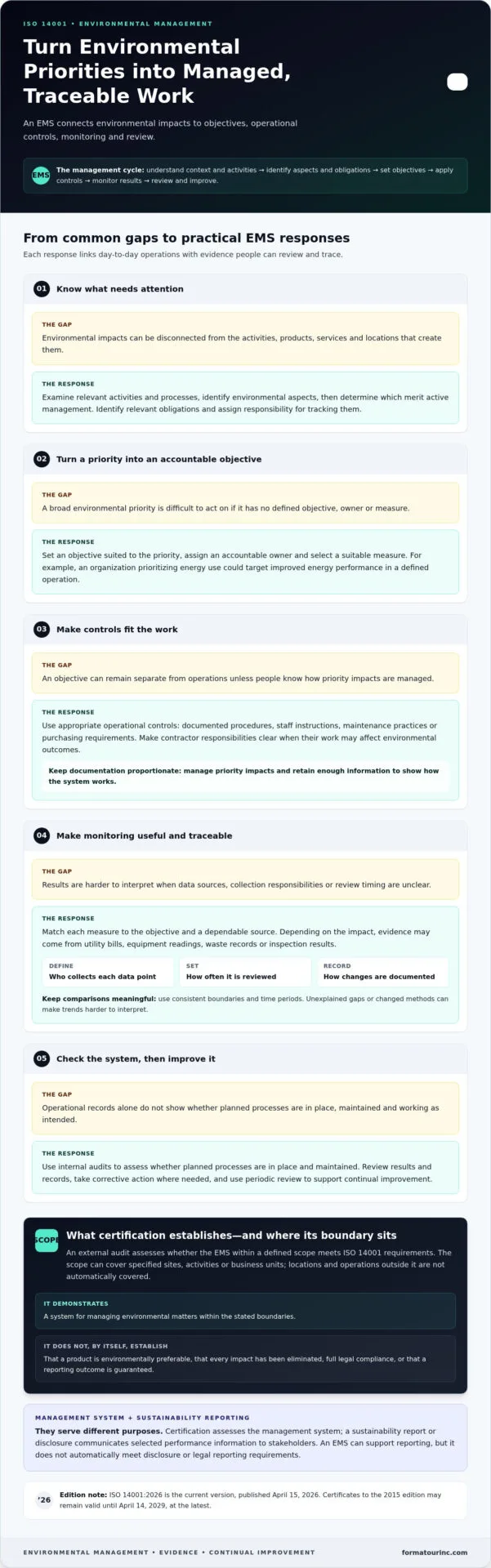
Certification applies to a defined organizational scope, such as specified sites, activities or business units. An external audit assesses whether the EMS within that scope meets the standard’s requirements. The certificate therefore indicates that the organization has established and maintains a system for managing environmental matters within the stated boundaries. It doesn’t automatically cover locations or operations outside that scope.
Management-system certification shows how an organization manages environmental impacts; a sustainability report or disclosure communicates selected performance information to stakeholders. The two can support one another, but they serve different purposes. Certification alone doesn’t prove full legal compliance, guarantee a reporting outcome or establish environmental perfection. It assesses the system, not whether every environmental impact has been eliminated.
What an environmental management system covers
An EMS starts by identifying environmental aspects connected to an organization’s activities, products or services, then determining which ones need active management. A manufacturer, for example, might track energy use and production waste. It can set objectives, assign responsibilities, establish operating controls, monitor results and review whether actions are working. Records help trace decisions and performance, while corrective action and periodic review support continual improvement.
Why Canadian organizations consider certification
Organizations may pursue ISO 14001 certification Canada to respond to customer or supply-chain expectations, strengthen governance, or bring greater consistency to environmental management. The reasons differ by organization, and certification doesn’t guarantee new contracts or improved results. Its value depends on how well the EMS connects environmental priorities to operational decisions and produces reliable evidence about the organization’s actions.
Environmental obligations can vary with an organization’s activities and operating locations across federal, provincial, territorial and municipal contexts. An EMS can help identify relevant obligations, assign responsibility for tracking them and retain evidence of the processes used. However, ISO 14001 is a management framework, not legal advice, regulatory approval or a substitute for determining which requirements apply. Organizations should verify applicable obligations with qualified advisers and treat certification as one part of a broader management approach.
How ISO 14001 Turns Environmental Priorities into Measurable Management
An environmental priority becomes manageable when it’s translated into decisions, responsibilities and evidence. Within an EMS, this is a connected cycle: understand the organization’s context and activities, identify environmental aspects and relevant obligations, set objectives, apply controls, monitor results and review what needs to change. Each stage informs the next, helping environmental management become part of operations rather than a separate reporting exercise.
From environmental aspects to objectives and controls
Start by examining how activities, products and services interact with the environment across relevant processes and locations. Then determine which aspects merit attention based on the organization’s context and its approach to evaluating significance. For example, if energy use is a priority, an organization could set an objective to improve energy performance in a defined operation, assign an accountable owner and select a suitable measure.
Objectives become actionable through operational controls. These might include documented procedures, staff instructions, maintenance practices or purchasing requirements. Controls can also address relevant work performed by contractors, so responsibilities and expectations are clear when work may affect environmental outcomes. The aim isn’t to create paperwork for every task. It’s to establish appropriate ways to manage priority impacts and retain enough information to show how the system works.
Monitoring, audits, and management review
Monitoring is useful when measures match the objective and have a dependable source. An organization might use utility bills, equipment readings, waste records or inspection results, depending on the impact being managed. Define who collects each data point, how often it’s reviewed and how changes are documented. Consistent boundaries and time periods make comparisons more meaningful. Unexplained gaps or changed methods can make trends harder to interpret.
Monitoring records turn operational activity into evidence leaders can use to make decisions and reporting teams can trace back to its source. Internal audits provide another check by assessing whether planned processes are in place and maintained, and by identifying gaps that need correction. They test how the system is implemented, not simply whether the organization has assembled a set of records.
Management review brings the evidence together. Leaders can consider progress against objectives, audit findings, changing activities and emerging risks, then decide whether controls or priorities need adjustment. For ISO 14001 certification Canada, this disciplined review helps demonstrate that the EMS is active and responsive. It can also provide operational inputs for sustainability reporting, but disclosure frameworks may require different indicators, boundaries, calculations or explanations. Map EMS data to each reporting requirement rather than assuming the records satisfy it automatically.
To make the system practical, link each priority to its owner, the control in place, the evidence collected and the review decision. Formatour’s ISO 14001 implementation and auditing support can help organizations build these connections into established processes. Discuss your ISO 14001 implementation needs and how to make environmental evidence useful for management.
ISO 14001 Certification and Sustainability Reporting: How the Approaches Compare
Environmental management and sustainability reporting often draw on related information, but they answer different questions. ISO 14001 certification assesses whether an environmental management system (EMS) meets the standard’s requirements within a defined scope. A sustainability disclosure communicates information selected and organized for an audience, such as investors, customers or other stakeholders. Legal reporting concerns information an organization must provide under applicable laws or regulations.
These approaches differ in purpose, scope and output:
- ISO 14001 certification: Assesses the management system and its processes within the stated scope. The output is certification of that system, not verification of every environmental claim or metric.
- Sustainability disclosure: Reports information according to a framework, audience or organizational commitment. Its content and boundaries depend on the requirements being followed.
- Legal reporting: Addresses applicable reporting duties and their prescribed information, processes and deadlines. Requirements depend on the organization and the rules that apply to it.
ISO 14001 versus sustainability disclosure frameworks
IFRS Sustainability Disclosure Standards are designed to structure sustainability-related information for users of general-purpose financial reports. The Canadian Sustainability Standards Board (CSSB) develops Canadian sustainability disclosure standards. These frameworks focus on disclosure; ISO 14001 focuses on managing environmental aspects through an EMS. Before relying on a framework or describing who must apply it, verify current Canadian adoption, applicability and effective-date details against authoritative sources. Requirements can change, and a standard’s publication doesn’t, by itself, establish that it applies to every organization in Canada.
Reporting applicability can depend on the organization’s circumstances, stakeholder expectations and current rules. A customer may request information for supplier assessment, while an investor-focused disclosure framework may call for different information and boundaries. Neither request is automatically fulfilled by holding an ISO 14001 certificate. Certification also doesn’t guarantee that investors, customers or regulators will accept a particular statement or metric.
Where certification and reporting can work together
An EMS can provide a disciplined source of operational information. For example, records of energy use, waste streams, environmental objectives and corrective actions may inform selected disclosures when definitions, organizational boundaries and measurement periods align. Before using an EMS record in a report, document its source and method, identify the responsible data owner, and confirm that the reporting framework calls for comparable information.
Keep the assurance boundary clear. An audit of a management system evaluates whether the system meets relevant requirements; it isn’t automatically assurance of each number or statement later published in a sustainability report. Traceable ownership, consistent measurement methods and documented changes help reporting teams explain where figures came from and how they were prepared.
A Canadian ISO 14001 Readiness Roadmap for Environmental Reporting
A structured readiness process connects ISO 14001 certification Canada with practical environmental management and usable reporting evidence. Begin with leadership decisions about the system’s purpose and boundaries. Then assess current practices, close priority gaps, evaluate the system through internal audits and management review, and prepare for certification assessment. Assign ownership for reporting data from the outset, rather than leaving it until documentation is nearly complete.
Set scope and assess the starting point
Leadership should define which sites, activities and organizational boundaries the EMS will cover, who needs to be considered as an interested party, and what the organization intends to include in its certification scope. Clear boundaries help teams understand which processes and records must support the system. They also prevent the assumption that certification covers operations outside the defined scope.
Next, take stock of existing environmental processes, records, risks and objectives. Identify relevant obligations for each operating location, since requirements may differ across federal, provincial, territorial and municipal contexts. Qualified advisers can help verify which obligations apply. Compare current practices with the management-system requirements to identify gaps, such as missing process ownership, inconsistent records or objectives that aren’t linked to significant environmental impacts.
Build, evaluate, and prepare the system
Turn the assessment into an implementation plan. Assign accountable owners for environmental objectives, operational controls, monitoring and records. For each reporting input, name who gathers and reviews the information, document its source and measurement method, and establish how changes or corrections are recorded. This makes evidence easier to trace from an operational activity to an internal report or relevant disclosure.
Put appropriate controls into practice, then use internal audits to assess whether planned processes are implemented and maintained. Management review gives leaders a structured opportunity to consider audit findings, objective progress and system gaps, and decide what needs attention. Certification assessment is conducted against the defined scope. Readiness means the system and supporting evidence are available for that assessment, not that certification is guaranteed.
Use this checklist to organize preparation:
- Scope: Sites, activities, boundaries and intended certification scope are defined.
- Responsibilities: Owners are assigned for objectives, controls, monitoring and reporting data.
- Records: Evidence sources, measurement methods and record controls are established.
- Objectives: Environmental objectives have owners, measures and a review process.
- Audit preparation: Internal audits and management review have identified gaps and follow-up actions.
Keep the sequence proportionate to your operations, and address gaps before the certification assessment rather than building a parallel reporting system. Formatour’s ISO 14001 implementation, auditing and certification support can help align readiness with organizational processes. Discuss your ISO 14001 readiness approach.
How Formatour Supports ISO 14001 Certification in Canada
ISO 14001 implementation is most effective when it strengthens how an organization operates, not just how it prepares for an audit. Formatour supports Canadian organizations with environmental management system implementation, auditing and certification, bringing standards guidance together with organizational and operational priorities. The work can be tailored to the organization’s scope, existing management practices, maturity and objectives.
Connect environmental management with organizational priorities
Each engagement starts with understanding what the organization needs its EMS to accomplish. The scope, governance structure, activities and improvement goals shape how the system is designed and integrated. An organization with established procedures may focus on aligning responsibilities and records, while one building its approach may first need to define core processes and ownership. In both cases, environmental management should fit the work people already do.
That means connecting responsibilities to existing management routines, such as operational reviews, objective tracking, internal audits and leadership decision-making. Clear integration can help teams manage environmental priorities without creating unnecessary parallel processes. It can also make relevant operational information easier to retrieve for internal or external reporting. Reporting evidence is a useful outcome of a well-structured system, but certification doesn’t guarantee that a disclosure meets every framework or stakeholder requirement.
Organizations pursuing ISO 14001 certification Canada can also consider whether environmental and quality management processes share useful governance or documentation practices. Where appropriate, an integrated approach with ISO 9001 quality management may help coordinate system activities while preserving each standard’s distinct requirements. Formatour’s ISO 14001 management system support connects standards implementation with broader organizational performance.
Plan a focused conversation about certification support
A productive discussion begins with a practical picture of the organization. Outline the sites and activities under consideration, current environmental processes, existing management systems, reporting objectives and the outcomes leadership wants to achieve. These details help frame a structured conversation about scope, readiness, implementation priorities, audit support and preparation for certification assessment.
Formatour supports the management-system journey through implementation, auditing and certification. The appropriate approach depends on the organization’s current state and priorities. Certification is assessed against a defined scope, and support can help prepare the system and evidence for that assessment without promising a certification outcome.
Bring forward the questions that matter most to your team: which processes need clearer ownership, where records are difficult to trace, and how environmental priorities should connect with operational goals. A focused review can clarify practical next steps and establish a path that fits the organization.
Discuss ISO 14001 certification support in Canada and your organization’s objectives with Formatour.
Turn Your Environmental Priorities into a Practical Starting Point
Decide what your organization wants its environmental management system to make possible. Before committing to a broad implementation plan, align leaders on the business objective, the intended scope and how progress will inform decisions. A focused starting point can direct effort toward meaningful operational change while establishing a foundation for ISO 14001 certification Canada.
Bring those priorities into one working discussion: identify the decision-makers, clarify where the organization wants stronger environmental management, and define what a useful outcome would look like for operations and stakeholders. This gives the readiness process direction without assuming every organization needs the same approach. It also creates a clearer basis for deciding where implementation support, audit preparation or organizational change should begin.
Formatour can help shape that discussion around your organization’s objectives and practical next steps. Discuss your ISO 14001 certification objectives and take a confident first step toward a management system that supports your organization’s priorities.
Frequently Asked Questions
What is ISO 14001 certification in Canada?
ISO 14001 certification in Canada is an independent assessment of whether an organization’s environmental management system meets the standard’s requirements within a defined scope. The scope may cover specified operations or sites, so organizations should ensure it reflects the activities they want assessed. For example, a certificate covering one facility shouldn’t be presented as evidence about every operation the organization runs. Certification evaluates the system, not the elimination of environmental impacts.
Is ISO 14001 certification mandatory for Canadian businesses?
No, ISO 14001 certification isn’t universally mandatory for Canadian businesses. It may become commercially important if a customer, procurement process, contract or internal policy calls for it. That expectation is separate from environmental laws and reporting obligations, which depend on an organization’s activities and locations. A business can assess certification as a management or market decision while separately determining which legal requirements apply to its operations.
Does ISO 14001 certification prove that a company is environmentally sustainable?
No. Certification indicates that the environmental management system within its stated scope has been assessed against ISO 14001 requirements. It doesn’t establish that the organization has no environmental impacts, that all its products are sustainable, or that it has achieved a particular environmental result. For example, a certificate shouldn’t be used as standalone proof that a product has a lower environmental impact than alternatives. Claims about performance need evidence suited to the claim.
Can ISO 14001 help with corporate sustainability reporting in Canada?
Yes, ISO 14001 can provide useful inputs for corporate sustainability reporting by helping teams organize data, clarify ownership and retain supporting records. A company might use facility-level energy records in a disclosure, provided the data boundaries and calculation method match the reporting requirement. The certificate itself doesn’t assure each reported figure. Before preparing a disclosure, identify its intended audience and verify the current framework requirements and applicability to your organization.
How long does it take to get ISO 14001 certified in Canada?
There’s no standard timeline for ISO 14001 certification in Canada. The work can depend on the number and complexity of operations in scope, existing environmental practices, record quality and the changes needed before assessment. Map dependencies, such as who must approve objectives, when operational records become available and how audit findings will be addressed. This produces a more realistic project sequence than relying on a generic estimate.
What is the difference between ISO 14001 and sustainability reporting standards?
ISO 14001 sets requirements for managing environmental issues through an environmental management system. Sustainability reporting standards guide how information is prepared for disclosure to defined audiences. An organization may use EMS information in a report, but certification doesn’t mean the report has been prepared or assured against a disclosure framework. For Canadian reporting, check the current status and applicability of relevant frameworks before selecting metrics or setting reporting expectations.
Can a small business in Canada get ISO 14001 certified?
Yes. ISO 14001 can be applied to organizations of different sizes, and a small business can define a scope suited to its activities and environmental impacts. The system should be proportionate, not unnecessarily complex. For instance, one employee may coordinate records alongside other duties, while managers remain accountable for relevant decisions. The business still needs effective processes and evidence that its system meets the standard’s requirements within the chosen scope.
