

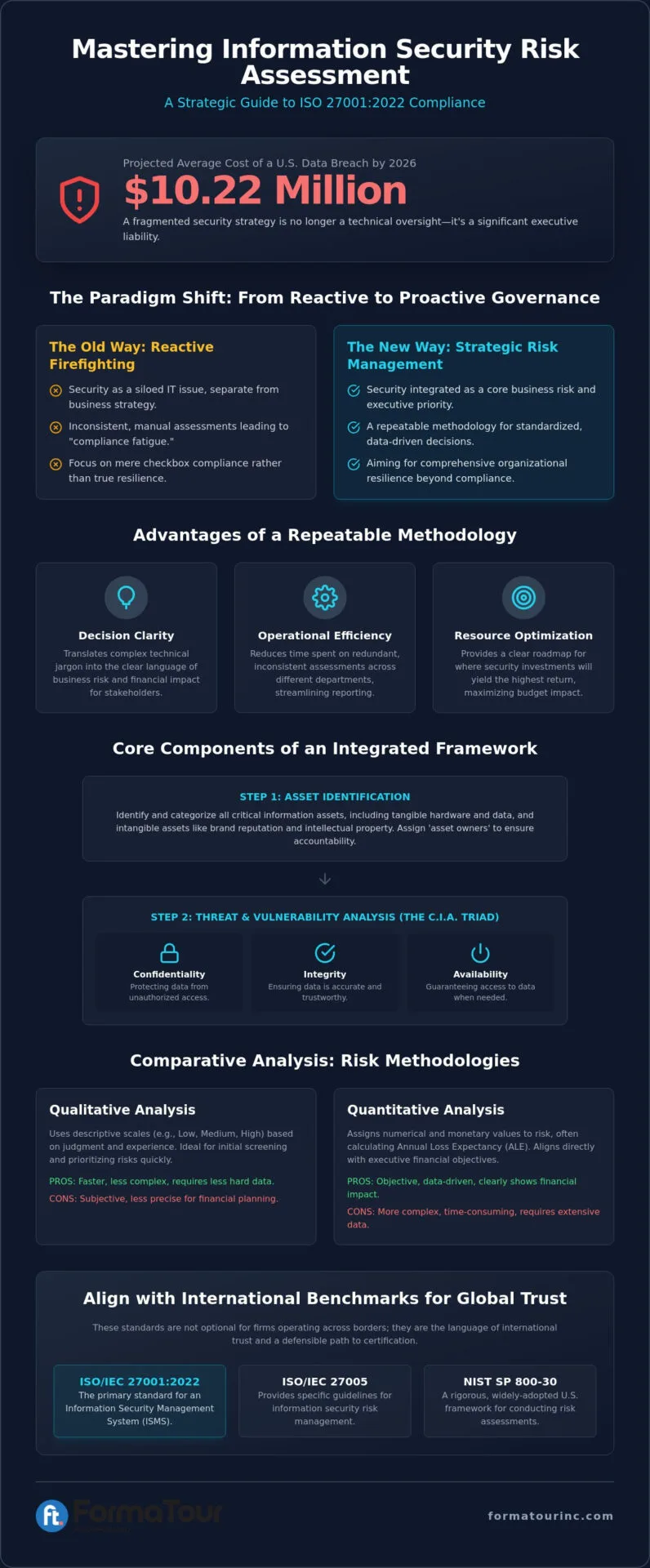
With the average cost of a U.S. data breach reaching a record $10.22 million in 2026, a fragmented security strategy is no longer a technical oversight; it’s a significant executive liability. Many leaders struggle with the dense complexity of regulatory language and the persistent fear of failing an ISO audit due to inconsistent risk reporting across departments. You likely recognize that a clear, defensible framework is essential for maintaining trust in a volatile global market. This guide empowers you to master a sophisticated information security risk assessment methodology that aligns perfectly with ISO 27001:2022 standards.
By adopting this strategic approach, you’ll gain the tactical steps required to optimize organizational governance and achieve successful certification. We’ll examine the impact of the EU AI Act, the requirements of the NIS2 “all-hazards” mandate, and the specific ways to transform risk management into a core pillar of digital growth. This methodical progression ensures your security posture is not only compliant but also a clear reflection of your organization’s commitment to excellence and international standards.
Key Takeaways
- Adopt a proactive, risk-based governance model that shifts security from a reactive technical function to a strategic executive priority.
- Construct a resilient information security risk assessment methodology that harmonizes asset protection with your organization’s long-term digital transformation goals.
- Select between qualitative and quantitative analysis to align risk reporting with executive investment priorities and complex financial objectives.
- Establish a defensible path to ISO 27001:2022 certification through a systematic approach to risk identification and rigorous scope definition.
- Integrate security frameworks with business continuity planning to foster comprehensive organizational resilience that extends beyond simple regulatory compliance.
Defining the 2026 Information Security Risk Assessment Landscape
An information security risk assessment methodology serves as a sophisticated, structured framework for identifying, evaluating, and mitigating threats to an organization’s critical assets. By 2026, the paradigm has shifted from reactive “firefighting” to a proactive, risk-based governance model. It’s a transformation driven by the realization that security is not a siloed IT issue but a fundamental business risk that impacts every facet of organizational health. Modern methodologies now integrate technological vulnerabilities with human capital and process-oriented risks to create a holistic view of the firm. Executive leadership plays a pivotal role in this evolution. By championing the methodology across the firm, leaders ensure that risk awareness permeates every level of the hierarchy. This executive-led approach is central to effective ISO 27001 implementation services, which prioritize strategic foresight over mere checkbox compliance.
The Strategic Value of a Repeatable Methodology
A consistent methodology empowers board members to make informed, data-driven decisions regarding the firm’s security posture. When risk is reported through a standardized lens, it removes the guesswork and provides a clear narrative for stakeholders. This systematic approach effectively combats “compliance fatigue” by streamlining reporting requirements and reducing the burden of manual, inconsistent assessments. By adopting recognized IT risk management methodologies, organizations can apply standardized risk scoring to evaluate disparate threats on a level playing field.
A repeatable methodology offers three primary advantages for the executive suite:
- Decision Clarity: It translates technical jargon into the language of business risk and financial impact.
- Operational Efficiency: It reduces the time spent on redundant assessments across different departments.
- Resource Optimization: It provides a clear roadmap for where security investments will yield the highest return.
Regulatory Drivers and International Benchmarks
Market credibility in 2026 is inextricably linked to an organization’s ability to demonstrate alignment with international benchmarks. Frameworks like NIST SP 800-30 and ISO/IEC 27005 provide the necessary rigor to satisfy global regulators and discerning clients alike. These standards are no longer optional for firms operating across borders; they are the language of international trust. The ultimate objective of an information security risk assessment methodology has moved beyond simple protection toward the goal of organizational resilience. This focus ensures that the business can maintain operations through environmental, technical, or human-induced disruptions. By anchoring their strategy in these established benchmarks, firms project a sense of quiet confidence and unwavering reliability, positioning themselves as leaders in a complex global landscape.
Core Components of an Integrated Risk Assessment Framework
An integrated information security risk assessment methodology relies on a precise understanding of an organization’s ecosystem. At its core, this framework identifies information assets as the bedrock of security strategy. These assets include tangible hardware and data alongside human capital, which represents a critical yet often overlooked variable in the security equation. To build a resilient structure, you must define the impact of threats on the confidentiality, integrity, and availability of these assets. This CIA triad provides the necessary metrics to evaluate how a disruption affects organizational stability. Strategic success depends on the seamless integration of these components into a unified governance model.
Asset Identification and Categorization
Asset criticality is defined by the severity of the business impact resulting from a loss of control or access. A mature methodology accounts for intangible assets like brand reputation and proprietary intellectual property, as these often carry higher long-term value than physical infrastructure. Assigning “asset owners” is a non-negotiable step in this process. These individuals provide the operational context required to assess risk accurately and ensure that protection levels align with actual business needs.
Threat Modeling and Vulnerability Analysis
The 2026 landscape introduces sophisticated challenges, such as AI-driven social engineering and deep supply chain interdependencies. It’s vital to distinguish between a threat source, such as a coordinated cyber-criminal group, and a threat event, such as a targeted ransomware deployment. Organizations frequently focus on software bugs while ignoring vulnerabilities within business processes. The NIST risk assessment guide provides a rigorous structure for mapping these relationships and identifying where technical weaknesses meet procedural gaps.
Control Evaluation and Residual Risk
Internal controls act as the primary defense mechanism against identified threats. Assessing the effectiveness of existing administrative policies and technical safeguards allows you to calculate residual risk, which is the level of threat remaining after mitigation efforts. This final figure must align with the organization’s risk appetite. This threshold dictates whether the leadership team will accept, transfer, or further treat a specific risk. Refining these components requires a nuanced understanding of your unique operational landscape, and our team is available to discuss your strategic security goals to ensure your framework is both defensible and efficient.
Comparative Analysis: Qualitative vs. Quantitative Risk Methodologies
Choosing the appropriate information security risk assessment methodology requires a nuanced understanding of organizational maturity and the specific decisions at hand. Leaders often find themselves at a crossroads between the descriptive speed of qualitative analysis and the mathematical precision of quantitative modeling. While both approaches aim to illuminate the path toward resilience, they serve different strategic purposes. A sophisticated governance framework doesn’t necessarily choose one over the other; instead, it applies the right level of rigor to the right category of risk. This balance ensures that the executive team receives actionable insights without becoming mired in unnecessary technical density.
When to Use Qualitative Assessment
Qualitative assessments categorize risks using descriptive scales such as high, medium, and low. This approach offers immediate speed-to-value, making it an excellent tool for initial scoping and establishing broad cultural alignment across departments. It relies on expert judgment and the collective experience of your senior leadership team to identify where the most significant threats lie. This descriptive style is frequently the primary driver for ISO 9001 quality management implementation, as it fosters the necessary cultural buy-in before moving to more complex metrics. It’s a practical starting point that builds momentum for more rigorous security initiatives.
The Rigor of Quantitative Analysis
Quantitative analysis translates security threats into the language of the balance sheet. By utilizing formulas like Annual Loss Expectancy (ALE) and Single Loss Expectancy (SLE), organizations can assign a specific dollar value to their risk exposure. A comprehensive Cybersecurity risk assessment utilizing these formulas is often a prerequisite for securing favorable cyber insurance terms or justifying the budget for a multi-year digital transformation. The primary challenge remains data quality. Accurate modeling requires historical incident data and a significant investment of time, which may not be feasible for every threat event. However, for high-stakes decisions involving millions in capital, this level of precision is indispensable.
The Hybrid Standard: Semi-Quantitative Approaches
The semi-quantitative model has emerged as the premium standard for established Canadian firms. This methodology uses numerical scales, such as 1 to 10, to bridge the gap between subjective intuition and pure mathematics. It provides the granularity that auditors and regulators expect without the prohibitive overhead associated with full financial quantification. By assigning weights to different asset classes and threat levels, leaders can generate a prioritized list of risks that is both defensible and easy to communicate. We recommend this hybrid approach for organizations that have moved beyond basic compliance and are seeking a more mature, results-oriented information security risk assessment methodology.
To select the right approach for your firm, consider these three pillars of decision-making:
- Data Availability: Do you have the historical logs and financial metrics required for full quantification?
- Decision Urgency: Does the board need a rapid overview of the threat landscape or a detailed investment business case?
- Regulatory Pressure: Does your specific industry mandate a certain level of mathematical rigor for compliance?
Implementing the Methodology: A Roadmap to ISO 27001 Compliance
Implementing an information security risk assessment methodology is a rigorous journey that moves beyond theoretical planning into operational discipline. For an organization to achieve ISO 27001:2022 certification, the methodology must be applied through a structured five-step roadmap. This begins with establishing the context and scope to define the boundaries of the Information Security Management System (ISMS). Following this, teams conduct risk identification, analysis, and evaluation to determine which threats require immediate attention. The process culminates in the creation of a Risk Treatment Plan and the critical Statement of Applicability (SoA), followed by a commitment to continuous monitoring and review.
Defining the Scope for Canadian Operations
Canadian firms often face unique challenges regarding multi-jurisdictional data residency requirements. Defining the scope requires a precise understanding of where data lives and how it flows across provincial and international borders. It’s essential to align these boundaries with your strategic business objectives to ensure the methodology supports, rather than hinders, organizational growth. Success in this phase often hinges on executive readiness. Engaging in leadership training for digital transformation is a vital prerequisite to ensure the management team can champion the scope effectively and navigate the complexities of a modern digital ecosystem.
Risk Evaluation and Treatment Options
Once risks are analyzed, leadership must select one of four treatment paths: mitigate the risk through controls, transfer it via insurance, avoid it by changing business processes, or accept it when it falls within the established risk appetite. Documenting the rationale for risk acceptance is particularly vital for satisfying external auditors. The CISO must provide formal sign-off on these decisions, establishing a clear line of executive accountability. This documentation demonstrates a mature governance posture and proves that the organization is making conscious, informed choices about its security investments.
Preparing for the ISO Certification Audit
The formal certification audit focuses heavily on “evidence of operation.” Auditors don’t just look for a written policy; they look for proof that your information security risk assessment methodology is being used consistently across the organization. A common pitfall is failing to document the specific rationale behind control selections within the Statement of Applicability. Conducting a comprehensive gap analysis before the official audit allows you to identify and remediate these non-conformities in a controlled environment. If you’re ready to move from planning to execution, we invite you to contact our multidisciplinary advisory team to discuss a tailored roadmap for your certification journey.
Beyond Compliance: Building Organizational Resilience through Strategic Advisory
A mature information security risk assessment methodology serves as more than a prerequisite for an audit; it acts as the strategic foundation for long-term survival. In a global market where trust is a primary currency, the ability to demonstrate a resilient and defensible security posture is a powerful competitive differentiator. Organizations that view risk through a narrow, technical lens often miss the broader implications for their stability and growth. By integrating security findings into a comprehensive Enterprise Risk Management (ERM) strategy, leaders can transform vulnerability data into actionable business intelligence. Boutique advisory firms play a critical role in this transition, offering the agile, expert guidance necessary to align high-level standards with the daily realities of a fast-paced firm.
Integrating ISO 27001 and ISO 22301
The synergy between information security and business continuity is the cornerstone of modern organizational resilience. When you utilize a shared information security risk assessment methodology, you effectively eliminate operational redundancies that often plague larger, siloed organizations. This unified discipline ensures that if a security incident occurs, the response isn’t just about technical recovery but about maintaining critical business functions. This integrated approach is a central pillar of ISO 22301 business continuity consulting. By aligning these two standards, firms create a robust shield that protects both digital assets and the operational heart of the company.
The Future of Risk: AI and Strategic Foresight
As we look toward the horizon of 2026, the tools we use to manage risk are evolving at an unprecedented pace. Methodologies must now expand to support the initiatives of digital transformation strategy firms, ensuring that innovation doesn’t outpace safety. Artificial Intelligence is already automating the collection of evidence and the identification of routine vulnerabilities, yet the human element remains irreplaceable. While AI can process vast amounts of data, it lacks the strategic context and nuanced judgment that experienced consultants provide. Human experts are essential for interpreting AI-generated insights and applying them to the unique cultural and structural landscape of your organization.
The journey toward a resilient future requires a partner who understands the intricate balance between technological advancement and structural integrity. Whether you’re seeking to secure your first certification or looking to optimize an existing framework, our team provides the steady, expert hand needed to guide you through these complex landscapes. We invite you to partner with Formatour for strategic ISO excellence and build a foundation for sustainable development and global market leadership.
Charting Your Path to Strategic Resilience
A sophisticated information security risk assessment methodology is no longer a technical luxury; it’s the defining pillar of modern organizational governance. Throughout this guide, we’ve examined how the integration of the CIA triad, the balance of qualitative and quantitative analysis, and a rigorous roadmap to ISO 27001 compliance create a defensible shield for your most critical assets. By shifting from reactive firefighting to proactive, risk-based foresight, you empower your leadership team to make high-stakes decisions with quiet confidence and unwavering reliability. This strategic alignment ensures that your firm remains agile and secure in an increasingly volatile global market.
Formatour Incorporated specializes in redefining operational performance through international standards. We provide agile boutique consulting with global expertise, ensuring that your security framework is both resilient and results-oriented. Our seasoned mentors are dedicated to your collaborative success, guiding you through the complexities of digital transformation and regulatory evolution. Secure your organization’s future with Formatour’s strategic ISO 27001 advisory services. You now possess the architectural blueprint to transform risk into a sustainable advantage and lead your organization toward a secure, prosperous future.
Frequently Asked Questions
What is the most common information security risk assessment methodology?
ISO/IEC 27005 and NIST SP 800-30 are the most widely adopted standards for assessing organizational risk. These frameworks provide a structured approach that aligns perfectly with international benchmarks and regulatory expectations. Many organizations prefer ISO 27005 because it integrates seamlessly with the broader ISO 27001 management system. NIST is often favored by organizations with strong ties to federal requirements or those seeking a highly granular technical guide for their security operations.
How does ISO 27001 define risk assessment requirements?
ISO 27001:2022 requires an organization to establish and apply an information security risk assessment methodology that produces consistent, valid, and comparable results. The standard mandates that you identify risks associated with the loss of confidentiality, integrity, and availability. It also requires the identification of risk owners and the application of specific criteria to evaluate the significance of each identified threat before moving to the formal risk treatment phase.
Can a small business use a qualitative risk assessment methodology for certification?
Yes, small businesses can successfully achieve ISO 27001 certification using a qualitative approach. This methodology uses descriptive scales like high, medium, and low to evaluate impact and likelihood, which is often more practical for organizations with limited historical data. Auditors accept this descriptive style as long as the process is documented, repeatable, and provides a clear rationale for how risks are prioritized and treated across the business.
How often should an information security risk assessment be updated?
You should update your risk assessment at least annually or whenever significant changes occur within the organization’s technical or operational environment. This includes the introduction of new technologies, changes in business processes, or the discovery of emerging external threats. Regular updates ensure that your security posture remains aligned with the actual risk landscape rather than relying on a static, point-in-time snapshot that may become obsolete as the firm evolves.
What is the difference between a risk assessment and a vulnerability scan?
A risk assessment is a high-level strategic exercise that evaluates the business impact of threats, whereas a vulnerability scan is a technical tool used to identify specific weaknesses in software or hardware. While a scan provides raw data about technical flaws, the assessment provides the context needed to understand if those flaws actually pose a significant threat to the organization’s goals. Both are essential components of a mature and resilient security strategy.
Is quantitative risk assessment better than qualitative for ROI analysis?
Quantitative risk assessment is generally superior for ROI analysis because it expresses risk in financial terms, such as Annual Loss Expectancy. This monetary data allows executives to compare the cost of a security control directly against the potential financial loss it prevents. While qualitative methods are faster to implement, they lack the mathematical precision required to build a detailed business case for large-scale security investments or complex cyber insurance premiums.
What role does executive leadership play in the risk assessment process?
Executive leadership is responsible for defining the organization’s risk appetite and providing the necessary resources for mitigation efforts. Without active involvement from the board and C-suite, the assessment remains a technical exercise rather than a true governance tool. Leaders must also act as the final authority for risk acceptance, ensuring that the chosen information security risk assessment methodology aligns with the firm’s broader commercial objectives and long-term resilience goals.
How much does it cost to implement a formal risk assessment methodology?
The cost of implementation varies significantly based on organizational complexity, the scope of the assessment, and the chosen level of mathematical rigor. Factors influencing the total investment include internal staff time, the acquisition of specialized risk management software, and the engagement of external advisory experts. Organizations should view these costs as a strategic investment in stability, as a mature methodology helps prevent the multi-million dollar losses associated with modern data breaches.
