

In 2026, the average cost of a single data breach has climbed to a record $4.63 million. For an executive, this figure represents more than a financial risk; it is a direct threat to the structural integrity of your organization. Many leaders feel overwhelmed by technical jargon when determining how to write an information security policy that actually protects their assets. You need a framework that meets ISO 27001:2022 standards without creating a document that simply sits unused on a digital shelf.
It’s common to feel that strict security measures might stifle the very agility that drives your growth. We understand your goal is to foster a culture of safety that empowers your team rather than restricting them. This article provides a strategic roadmap to master the policy creation process, ensuring your documentation serves as a catalyst for organizational performance. We will examine how to align your internal governance with international benchmarks and transform your security posture into a competitive advantage.
Key Takeaways
- Establish a high-level governance framework that serves as the strategic constitution for your organization’s digital resilience and structural integrity.
- Identify the essential core elements required to balance rigorous international security standards with the operational agility necessary for growth.
- Master the methodical five-step process of how to write an information security policy that aligns with ISO 27001:2022 and Canadian regulatory benchmarks.
- Transition from static documentation to a living governance lifecycle that integrates security into your organizational culture and executive leadership strategy.
What is an Information Security Policy and Why Does Strategy Matter?
An Information Security Policy (ISP) is not a mere technical manual; it’s a high-level governance framework that dictates how an organization protects its most valuable assets. While many technical teams focus on the granular details of firewalls or encryption, the ISP provides the overarching Security Policy Definition that guides these choices. Think of the policy as the constitution of your security posture. It establishes the fundamental principles and laws that every employee, partner, and executive must follow. When learning how to write an information security policy, it’s vital to distinguish between strategic directives and technical controls. Directives set the “what” and “why,” while controls handle the “how.” This strategic clarity builds organizational resilience, allowing the business to withstand shocks while maintaining operational integrity. Without this foundation, technical tools often fail to address the human and procedural risks that lead to the most significant breaches.
The Shift from IT Checklist to Business Strategy
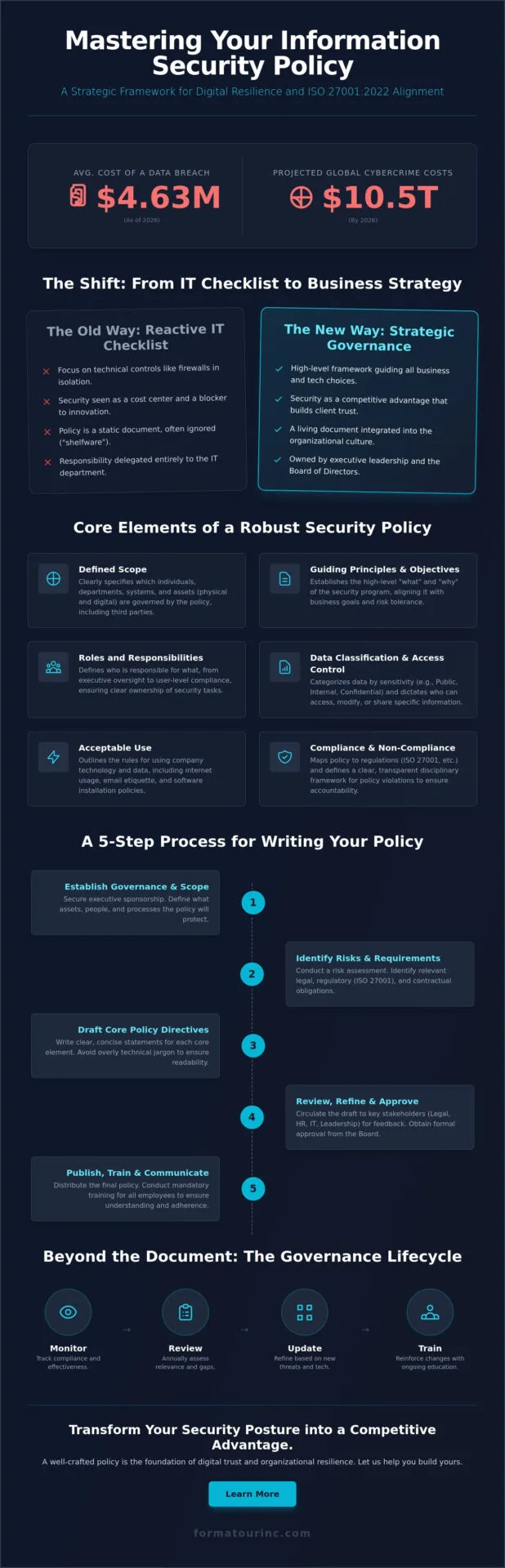
The days of viewing security as a reactive IT checklist are over. In 2026, with global cybercrime costs projected to reach $10.5 trillion, poor policy alignment has become a significant financial and reputational liability. Modern policies must actively support digital transformation goals by ensuring that new technologies, such as AI-driven automation and cloud-native systems, are integrated safely. Organizations that treat security as a strategic asset gain a distinct competitive advantage in the global market. They build deeper trust with clients and partners who demand rigorous data protection before entering into high-value contracts. A well-crafted policy ensures that security doesn’t hinder speed but instead provides the steady, expert hand necessary for safe, rapid innovation. It transforms security from a cost center into a pillar of structural integrity.
The Role of Executive Leadership in Policy Ownership
Effective security starts at the top. The ISP is a leadership mandate, not just an “IT project” delegated to technical staff. Executive leadership and the Board of Directors hold the ultimate responsibility for policy approval and oversight. This involvement ensures that security objectives are inextricably linked to corporate risk management and long-term business health. When executives take ownership, they signal to the entire organization that compliance and vigilance are core values. This top-down approach is essential when determining how to write an information security policy that carries weight and drives actual behavioral change. Organizations often find that Executive Leadership Development Programs provide the necessary foresight to govern these complex frameworks effectively. Leaders who champion these frameworks position their firms for sustainable success and predictable excellence in an increasingly complex global environment.
Core Elements of a Robust Information Security Policy
A resilient policy is built upon a foundation of non-negotiable pillars that ensure every member of the organization understands their role in protecting data. When determining how to write an information security policy, executives must prioritize clarity over technical density. A policy that is too complex becomes “shelfware” that employees ignore; a concise document drives actual adherence. This foundation should begin with a clearly defined scope that specifies exactly which individuals, departments, and physical or digital assets the policy governs. This clarity eliminates ambiguity and ensures that third-party contractors and remote staff are held to the same rigorous standards as on-site personnel. To provide a comprehensive framework, many organizations reference the NIST Introduction to Information Security to align their core elements with globally recognized benchmarks.
The effectiveness of these directives relies heavily on the definition of consequences for non-compliance. Without clear accountability, a policy remains a suggestion rather than a mandate. Establishing a transparent disciplinary framework reinforces the importance of security and ensures that the organization maintains its structural integrity. If you’re looking to refine these governance structures within your own leadership team, you might consider how expert advisory services can help tailor these elements to your specific operational needs.
Data Classification and Access Control
Acceptable Use and Asset Management
Modern policies must address the realities of a distributed workforce by setting explicit expectations for how employees interact with company technology. This includes robust directives for “Bring Your Own Device” (BYOD) scenarios and remote work environments where the traditional perimeter no longer exists. Integrating asset lifecycle management into your security directive ensures that hardware is tracked from procurement to secure disposal. When you master how to write an information security policy that covers the entire asset lifecycle, you prevent data leaks from decommissioned equipment and maintain a clear inventory of your digital footprint. This holistic approach transforms individual responsibility into a collective shield for the enterprise.
Aligning with ISO 27001 and Canadian Regulatory Standards
A strategic information security policy serves as the bedrock for international certification and regulatory compliance. Under ISO 27001:2022, Clause 5.2 mandates that leadership establish a policy that’s appropriate to the organization’s purpose and provides a framework for setting security objectives. This document isn’t just internal paperwork; it’s a high-level statement of commitment to your stakeholders. Aligning your policy with the Canadian Centre for Cyber Security (CCCS) guidelines ensures that your framework meets national defense standards. This alignment is critical for firms seeking to demonstrate a robust duty of care in the eyes of regulators and insurance providers. It transforms your security posture from a defensive necessity into a verified organizational asset.
ISO 27001: The Gold Standard for Policy Frameworks
Mapping specific policy requirements to ISO 27001 Annex A controls provides a structured approach to risk mitigation. These controls cover essential areas such as access management, physical security, and supplier relationships. Professional ISO 27001 implementation services bridge the gap between high-level policy and daily practice, ensuring that your documentation creates a verifiable audit trail. This trail is essential for auditors to confirm that your security posture is active rather than aspirational. When you analyze how to write an information security policy, remember that organizations certified under the 2013 version must transition to the 2022 version by October 31, 2025. This transition requires a precise update to your policy framework to reflect modern cybersecurity and privacy protection requirements.
Navigating the Canadian Regulatory Landscape
Canadian firms operating globally must navigate a complex web of federal and provincial mandates. PIPEDA currently governs private sector data, but the proposed Consumer Privacy Protection Act (CPPA) introduces stricter rules and significantly higher penalties for non-compliance. Your policy must also integrate provincial mandates from Quebec, Alberta, and British Columbia, which are considered substantially similar to PIPEDA but often contain unique requirements. A unified policy simplifies compliance and reduces the risk of oversight. Staying informed through international seminars is a proactive way to remain updated on these evolving global standards. It ensures your leadership team maintains the foresight needed to manage complex organizational landscapes and maintain structural integrity. By mastering how to write an information security policy that respects these boundaries, you protect your organization from the record-high $4.63 million average cost of a data breach.
A 5-Step Process to Writing Your Security Policy
Crafting a resilient policy requires a methodical progression that transcends the limitations of generic templates found online. While some sources suggest using standardized forms, these often fail to reflect the unique cultural and operational nuances of a sophisticated enterprise. When you approach how to write an information security policy, you must prioritize boutique agility. This involves customizing high-level international standards to fit your specific industry and risk profile. The process is inherently collaborative; it requires a cross-functional team comprising HR, Legal, and IT leaders to ensure that directives are legally sound and operationally feasible. This collective approach ensures that the policy isn’t viewed as a technical constraint but as a strategic enabler of growth.
The tone of the document is a critical factor in its eventual adoption. You should shift your language from prohibitive “thou shalt not” statements to enabling directives that explain how to conduct business safely. This empowers employees to become active participants in the company’s defense rather than passive observers of a list of rules. If you require expert guidance to facilitate this collaborative drafting process, our strategic consulting team can provide the steady hand needed to align your vision with practical application.
Discovery and Gap Analysis
Before writing a single word, you must conduct a thorough assessment of your current practices against international benchmarks. This phase is the time to identify “shadow IT,” which includes those unofficial cloud services or processes that departments use without formal oversight. A gap analysis serves as the essential diagnostic phase that reveals the distance between an organization’s current security posture and its strategic resilience goals. By formalizing these unofficial workflows, you bring them under the umbrella of corporate governance and reduce the vulnerabilities associated with unmanaged technology.
Drafting, Review, and Stakeholder Buy-in
Refining the policy language is an iterative task that requires precision and patience. Each draft should be reviewed for clarity to ensure that even non-technical staff can understand their obligations without confusion. Securing executive sign-off is the pivotal moment when the policy transforms from a working draft into an official corporate mandate. This buy-in ensures that the Board and C-suite are committed to the resources and cultural shifts required for implementation. Once approved, the document moves into the distribution phase, signaling a new era of organizational health and predictable excellence.
Governance and the Policy Lifecycle: Beyond the Document
The finalization of your document is only the beginning of a robust governance lifecycle. A policy must be viewed as a living document that evolves alongside emerging threats and technological shifts. While understanding how to write an information security policy is the first step, maintaining its relevance requires a structured approach to regular auditing and oversight. This ensures that the directives you’ve established remain effective in a real-world operational context. When deviations occur, you need a formal process for handling exceptions. This process should document the business justification for the deviation, the specific risks accepted, and the duration of the exception. By formalizing these occurrences, you maintain the structural integrity of your security posture without sacrificing the agility needed for innovation.
Formatour Incorporated serves as a premium partner for organizations seeking this level of strategic transformation. We provide the expert hand needed to guide your leadership through complex organizational landscapes, ensuring that your security framework drives sustainable growth and resilience.
Annual Reviews and Continuous Optimization
Empowering Your Team through Education
Policy adherence is deeply linked to the culture of your organization. Integrating these security directives into executive leadership development programs ensures that your top-tier managers understand the strategic importance of compliance. This top-down awareness fosters a sense of collective responsibility. For those tasked with enforcing these rules, specialized IT certification training provides the technical depth required to manage complex systems securely. Education transforms your policy from a set of rules into a shared mission of organizational health. To elevate your strategic security posture and ensure your team is prepared for the challenges of 2026, contact Formatour today to discuss our comprehensive consulting and development solutions.
Transforming Security from a Constraint into a Strategic Catalyst
A robust policy serves as the structural foundation of your digital enterprise. It bridges the gap between high-level executive vision and daily operational pillars, ensuring that your organization remains stable in an increasingly complex global landscape. By integrating the core elements of ISO 27001:2022 and respecting Canadian regulatory benchmarks, you move beyond a mere technical checklist to establish a true governance constitution. Mastering how to write an information security policy is the definitive first step toward achieving long-term organizational health and predictable excellence.
Success in this transformation requires a partner who understands the nuances of global benchmarks and local mandates. With over a decade of advisory experience, Formatour Incorporated provides the premium Canadian multidisciplinary expertise necessary to guide your firm through these intricate systems. We are specialists in strategic transformation and organizational resilience, helping you turn compliance into a tangible competitive advantage. Partner with Formatour for Strategic ISO 27001 Implementation to secure your path toward sustainable growth. Your organization possesses the potential for remarkable resilience; it’s time to build the framework that empowers it.
Frequently Asked Questions
How long should an information security policy be?
An effective policy should be concise, typically ranging from three to five pages for the core governance document. It focuses on strategic directives rather than technical minutiae. This brevity ensures that the document remains accessible to leadership and serves as a clear constitution for the organization. Detailed technical specifications are better suited for supporting procedural documents that sit beneath this high-level framework.
Who is responsible for writing the information security policy?
Executive leadership holds the ultimate responsibility for the policy’s approval and strategic alignment. While technical teams and cross-functional groups from HR and Legal contribute to the drafting process, the C-suite must own the final mandate. This top-down ownership ensures that security objectives are integrated into the broader corporate risk management framework. When determining how to write an information security policy, the focus must remain on leadership’s vision for organizational resilience.
How often should a security policy be updated?
Organizations should review and update their security policies at least annually or following significant operational changes. For instance, firms certified under older standards must transition to ISO 27001:2022 by October 31, 2025. Regular updates ensure the framework remains resilient against evolving threats such as AI-powered attacks and deepfake fraud. This cadence maintains the document’s relevance as a living guide for the organization’s security posture.
What is the difference between a security policy and a security procedure?
A security policy establishes the “what” and “why” by defining high-level governance and organizational expectations. In contrast, a security procedure details the “how” through step-by-step instructions for technical implementation. When determining how to write an information security policy, it’s vital to maintain this distinction. This prevents the core document from becoming overly technical, which can hinder executive oversight and employee comprehension.
Is an information security policy legally required in Canada?
While Canadian federal law does not explicitly use the term “information security policy,” PIPEDA requires organizations to protect personal information with appropriate security safeguards. The proposed Consumer Privacy Protection Act (CPPA) further emphasizes the need for robust data governance and accountability. A formal policy is the primary evidence that an organization has met its legal duty of care under these evolving regulatory standards.
Can we use a template for our ISO 27001 policy?
Templates can serve as a foundational starting point, but they require significant customization to reflect your unique organizational landscape. A generic document often fails to address specific industry risks or internal cultural nuances. For a successful ISO 27001 audit, the policy must demonstrate a precise alignment with your actual business processes. Customization ensures the document provides the boutique agility required for modern strategic transformation.
How do we ensure employees actually read the policy?
Ensuring adherence requires moving beyond simple distribution to active engagement and cultural integration. Incorporating policy highlights into executive leadership development programs and regular training sessions fosters a sense of collective responsibility. You can also utilize process automation tools to track acknowledgments and verify that the policy has been reviewed by all relevant stakeholders. This methodical approach transforms a static document into an active pillar of organizational health.
