

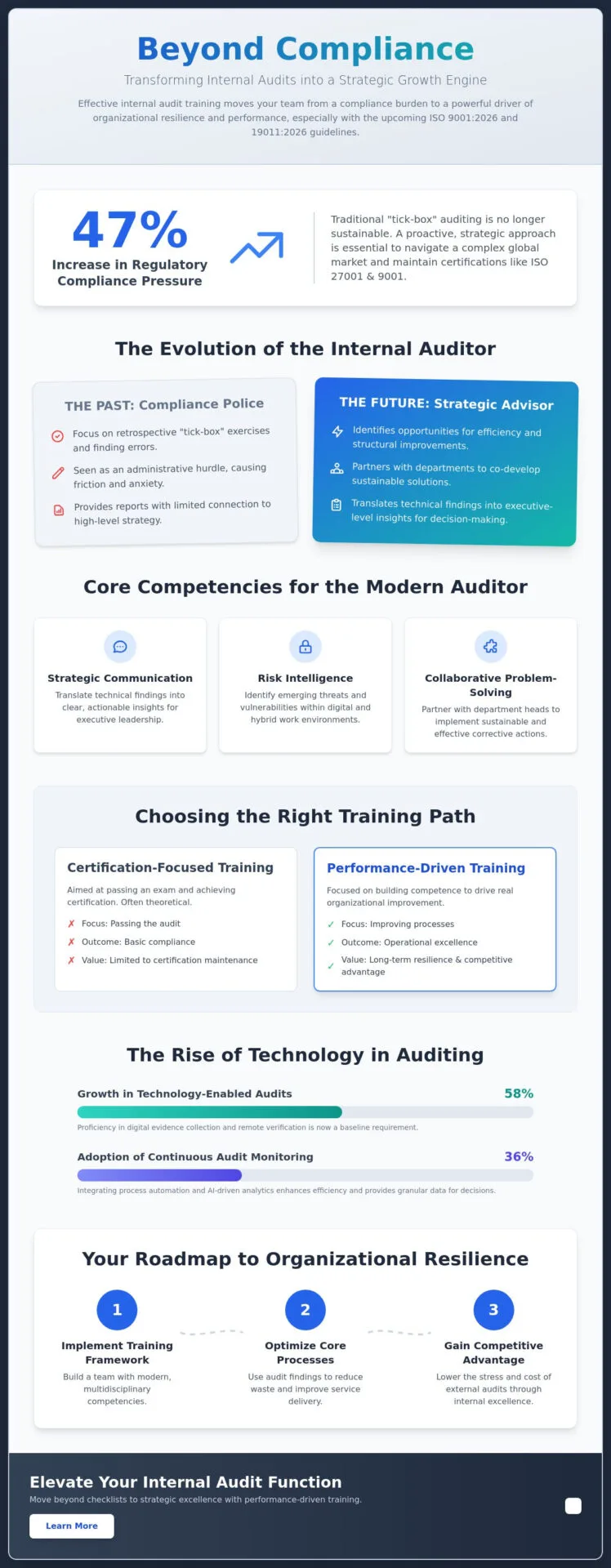
With regulatory compliance pressure increasing by 47 percent according to recent industry data, the traditional approach of treating audits as a mere administrative hurdle is no longer sustainable. You’ve likely experienced the frustration of audit processes that feel like a burden rather than a benefit, or the persistent anxiety that a minor oversight could jeopardize your ISO 27001 or 9001 standing. Effective Internal Audit training is the catalyst that shifts this dynamic, moving your team beyond simple checklist compliance toward a model of strategic governance.
We recognize the difficulty of translating technical audit findings into the high-level strategy required by executive leadership. This article provides a clear roadmap to transform your audit function into a strategic engine for growth and operational performance. You’ll discover how to build a highly competent team that maintains certifications with ease, adapts to the latest ISO 19011:2026 guidelines for remote auditing, and ultimately improves your organization’s long-term resilience in a complex global market.
Key Takeaways
- Transform your internal audit function from a routine compliance task into a powerful driver of strategic organizational growth.
- Master the essential competencies required for digital-first auditing and modern evidence collection across diverse ISO standards.
- Identify the critical differences between certification-focused and performance-driven Internal Audit training to select the right path for your team.
- Follow a structured roadmap to implement a training framework that directly supports organizational resilience and digital maturity.
- Learn how a multidisciplinary approach combines technical ISO requirements with executive leadership development for maximum operational impact.
Beyond Compliance: The Strategic Value of Internal Audit Training in 2026
The year 2026 marks a definitive shift in the global standards landscape. With the arrival of ISO 9001:2026 and the updated ISO 19011:2026 guidelines, organizations can’t afford to view auditing as a retrospective “tick-box” exercise. Sophisticated Internal Audit training serves as a catalyst for growth by equipping teams to identify operational inefficiencies before they impact the bottom line. This proactive stance is essential as regulatory compliance pressure has increased by 47 percent globally, requiring a move from tactical checking to strategic foresight.
Organizations that invest in developing competent auditors build a foundation of resilience. These professionals don’t just find errors; they identify opportunities for structural integrity and efficiency. This capability is vital for navigating complex regulatory shifts, such as the new emphasis on climate change considerations and quality culture within international standards. By transforming the audit function, leadership gains a reliable mechanism for maintaining stability in an increasingly volatile market.
The Evolution of the Internal Auditor Role
The traditional image of the “compliance police” is fading, replaced by the persona of a strategic advisor. Modern auditors require more than just a technical understanding of ISO requirements; they need the business acumen to see how those requirements support organizational goals. To fully grasp the scope of this evolution, it’s helpful to consider What is Internal Audit? in a modern corporate context. The modern internal auditor serves as a dedicated guardian of strategic integrity, ensuring that daily operations remain strictly aligned with the organization’s overarching mission.
This role expansion demands a diverse skill set, including:
- Strategic Communication: Translating technical findings into executive-level insights.
- Risk Intelligence: Identifying emerging threats within digital and hybrid environments.
- Collaborative Problem-Solving: Partnering with department heads to co-develop sustainable solutions.
Auditing as a Competitive Advantage
When an organization masters its internal processes, it gains a significant edge over competitors who struggle with recurring non-compliance. High-quality Internal Audit training ensures that findings are directly linked to process optimization, reducing waste and improving service delivery. This internal readiness significantly lowers the stress and cost associated with external ISO 27001 or 9001 audits, as the certification maintenance becomes a natural outcome of operational excellence.
C-suite leaders increasingly rely on audit data to inform large-scale decisions. By aligning audit outcomes with executive objectives, the function contributes to digital transformation and long-term sustainability. This alignment ensures that every audit adds tangible value, reinforcing the brand’s position as a leader committed to precision and continuous improvement.
Core Competencies: What Modern Internal Audit Training Must Cover
The effectiveness of a modern audit function depends on a team’s ability to navigate complex digital ecosystems. Comprehensive Internal Audit training must move beyond static checklists to encompass the nuances of digital evidence collection and remote verification. As technology-enabled audits grew by 58 percent recently, the ability to utilize AI-driven analytics and automated monitoring tools has become a baseline requirement for professional excellence. This technical proficiency ensures that the audit process remains robust in hybrid work environments while providing the granular data necessary for executive decision-making.
Professional development should also emphasize the interpersonal skills required to maintain collaborative relationships across departments. Conflict resolution and strategic reporting are essential for ensuring that audit findings lead to positive change rather than organizational friction. By referencing ASQ Auditing Resources, teams can ground their practice in globally recognized methodologies that prioritize both technical accuracy and professional conduct. Integrating process automation into the workflow further enhances efficiency, as the adoption of continuous audit monitoring has reached 36 percent across global organizations.
ISO 27001 and Information Security Auditing
Auditing an Information Security Management System (ISMS) requires a deep understanding of risk-based thinking in a cybersecurity context. Effective training prepares auditors to evaluate digital transformation initiatives and the integrity of security controls. This specialized focus is a core component of our ISO 27001 implementation services, where we emphasize the protection of sensitive data through rigorous internal oversight.
Quality and Environmental Standards (ISO 9001 & 14001)
Quality and environmental management systems demand a focus on operational performance and sustainable excellence. Identifying gaps in a QMS is a primary objective, making ISO 9001 quality management implementation a critical target for internal auditors. Training in these areas ensures that environmental impact and quality standards are seamlessly integrated into daily operations, supporting long-term growth and structural integrity.
Business Continuity and Resilience (ISO 22301)
Organizational resilience is tested through simulations and rigorous business impact analyses. Auditors must be capable of evaluating disaster recovery plans to ensure survival during unforeseen disruptions. Our ISO 22301 business continuity consulting provides the framework for these evaluations, helping teams build a culture of preparedness. If you’re ready to enhance your team’s capabilities, you can speak with our advisors to discuss a tailored training program.
Choosing the Right Path: Certification-Focused vs. Performance-Driven Training
Organizations face a critical decision when selecting professional development pathways: they must decide whether to prioritize formal credentials or operational performance. While generic courses provide a broad baseline, they often lack the agility required to address specific industry challenges or unique organizational cultures. Selecting the right Internal Audit training involves evaluating how well a program balances theoretical knowledge with practical, firm-specific application. This choice directly impacts your team’s ability to move beyond compliance and contribute to long-term efficiency.
Lead auditor certifications remain a cornerstone of team development, providing the authoritative expertise needed to manage complex ISO systems. However, simply obtaining a certificate doesn’t guarantee that an auditor can navigate the specific complexities of your organization’s workflow. Boutique advisory firms typically offer a level of customization that academic institutions cannot match, ensuring that the training directly supports your strategic goals. These specialized partners act as visionary architects, helping you integrate high-level concepts into daily operations.
For those seeking a standardized foundation, The Institute of Internal Auditors offers a wealth of resources and globally recognized certifications. These programs establish a high formality register for the profession and are essential for maintaining international benchmarks. Yet, the most successful organizations supplement these standards with performance-driven training that focuses on the co-development of solutions tailored to their specific operational pillars. This ensures that your audit function isn’t just a cost center but a dedicated facilitator for growth.
Internal Team Training vs. External Advisory
Building internal capacity is a long-term investment in your organization’s human capital. Many firms find success with a hybrid model, where internal teams receive expert guidance to bridge the gap between theory and practice. This approach ensures that your staff doesn’t just understand the rules but knows how to apply them effectively to improve governance. The most resilient firms use internal audits to mirror external standards.
The Impact of Digital Transformation on Training Choice
As organizations evolve, the scope of the audit must expand to include automated workflows and process optimization. Your choice of training must reflect this shift by incorporating IT audit skills and data analytics into the curriculum. This technical advancement is closely linked to leadership training for digital transformation, as executives must understand how technology reshapes modern governance. Adapting audit frameworks for automated environments is a strategic necessity for maintaining structural integrity in a digital-first world.
Implementing a Training Framework: A Roadmap for Organizational Resilience
Establishing a robust Internal Audit training framework requires a methodical approach that mirrors the complexity of global systems. It’s not enough to simply attend a workshop; organizations must design a pathway that integrates compliance with operational excellence. A structured roadmap ensures that every training hour contributes directly to structural integrity and long-term stability. This progression from assessment to execution creates a culture of unwavering reliability and quiet confidence.
Step 1: Conducting an ISO Gap Analysis. Before launching any initiative, leadership must identify the specific delta between current auditor capabilities and the requirements of the 2026 standards. This analysis serves as a diagnostic tool to pinpoint exactly where technical or soft skill deficiencies exist. It moves the conversation from vague assumptions to precise, data-driven needs.
Step 2: Defining Strategic Audit Scopes. Training should be tailored to audit scopes that align with your broader transformation goals. This ensures that the audit function doesn’t just verify compliance but actively supports the organization’s growth trajectory. When the scope is clear, the team can focus on areas of highest risk and highest value.
Step 3: Executing Multi-Disciplinary Training. High-performing teams benefit from cross-training across ISO 9001, 27001, and 22301. This holistic perspective allows auditors to identify how quality management, information security, and business continuity intersect to create a resilient organization. It fosters a sense of being a global citizen, knowledgeable about multiple international benchmarks.
Step 4: Continuous Professional Development. The regulatory landscape is constantly shifting, making international seminars and ongoing education essential. These platforms provide access to forward-thinking trends and global benchmarks that keep your team at the forefront of the industry. Steady, measured development ensures that excellence is predictable rather than accidental.
Setting Audit Objectives for Executive Success
Defining clear KPIs for your internal audit function is the only way to measure its true impact. Leadership needs actionable data, not just lists of non-conformities. By integrating these objectives into your digital transformation strategy, the audit process becomes a tool for active optimization. This alignment ensures that every finding supports the co-development of solutions for the C-suite.
Overcoming Training Objections
The myth that professional development must disrupt daily operations often prevents firms from reaching their full potential. Modular training and micro-learning allow busy executives to build expertise without sacrificing productivity. Proving ROI is straightforward when you calculate the cost savings from reduced compliance risks and more efficient internal processes. To begin building your customized roadmap, contact our strategic advisors today to discuss your specific organizational needs.
Elevating Your Internal Audit Function with Formatour Advisory
Formatour Incorporated positions itself as a premium partner for organizations seeking stability and growth through rigorous governance. Our Internal Audit training programs are designed by seasoned strategic mentors who understand the intricate links between international standards and operational performance. We don’t just teach the rules; we empower your team to act as visionary architects of organizational resilience. By integrating ISO expertise with executive leadership development, Formatour Incorporated ensures that your audit function is equipped to handle the complexities of modern, digital-first environments.
Our approach transforms the audit process from a retrospective check into a forward-looking strategic engine. We guide your team through a comprehensive journey that begins with technical proficiency and culminates in the ability to provide high-level insights to the C-suite. This transformation is essential for firms that want to move beyond basic compliance toward a model of continuous optimization and structural integrity. You’ll find that our methodology reinforces your role as an active participant in your organization’s long-term progress.
The Formatour Incorporated Edge: Boutique Agility, Big-Firm Standards
Formatour Incorporated prides itself on providing boutique agility paired with the high formality register of big-firm standards. Whether your focus is on an ISO 27001 implementation or maintaining ISO 9001 quality management certification, our Internal Audit training is tailored to your specific operational pillars. We avoid the “one-size-fits-all” approach of academic institutions, opting instead for a results-oriented atmosphere that feels both modern and deeply established. Our expert-led seminars and professional development services focus on tangible outcomes, ensuring that every training initiative supports your broader digital transformation goals.
For organizations managing multiple standards, we offer a multidisciplinary perspective that covers ISO 14001 environmental management and ISO 22301 business continuity. This holistic view allows your auditors to identify cross-functional efficiencies that generic programs often overlook. Formatour Incorporated acts as a steady, expert hand, helping you navigate the latest updates to international standards with quiet confidence. This specialized focus reduces the burden of external audits by ensuring your internal team is always one step ahead of international benchmarks.
Next Steps for Canadian Executive Leaders
Success in a complex global market requires more than just technical knowledge; it requires a dedicated facilitator for excellence. For Canadian executive leaders, the path to resilience begins with a strategic consultation to assess your current audit maturity. Formatour Incorporated helps you develop a long-term roadmap for certification and growth, ensuring that your human capital is your strongest asset in maintaining compliance. It’s time to shift your perspective and treat auditing as a strategic investment in your firm’s future. You can Partner with Formatour Incorporated for Strategic Excellence to begin your transformation today.
Securing Your Strategic Future Through Governance
The transition from basic compliance to a strategic engine for growth represents a significant evolution in organizational maturity. By establishing a robust Internal Audit training program, your team moves beyond simple verification to become a proactive force for operational performance and structural integrity. This shift ensures that your governance framework isn’t merely a reactive response to external standards, but a deliberate driver of long-term stability and executive success.
Formatour Incorporated provides the steady, expert hand required to navigate this complex landscape. As a premium Canadian advisory firm with over a decade of ISO certification expertise, we deliver a multidisciplinary approach that spans IT security, quality management, and executive leadership development. We’re committed to the co-development of solutions that empower your organization to lead with quiet confidence in a digital-first world. Empower your team with Formatour Incorporated’s expert internal audit training and advisory services. We look forward to helping you architect a more resilient future.
Frequently Asked Questions
What is the difference between internal audit training and lead auditor certification?
Internal Audit training focuses on the practical application of standards to evaluate and improve your own organization’s internal controls. In contrast, lead auditor certification is a professional designation that qualifies an individual to manage audit teams and conduct formal assessments for third-party certification bodies. Formatour Incorporated ensures that while your team gains technical proficiency, they also understand the strategic weight of their findings on organizational growth.
How often should internal audit teams undergo refresher training?
Refresher sessions should occur annually or whenever international standards undergo significant revisions. Staying current is vital for maintaining the structural integrity of your management systems, especially as global benchmarks evolve to include digital evidence and remote auditing techniques. Formatour Incorporated recommends a steady, methodical approach to professional development to ensure your team’s skills remain sharp and relevant to current executive objectives.
Is internal audit training required for ISO 27001 certification?
Yes, ISO 27001 mandates that individuals performing audits must be competent based on appropriate education, training, or experience. Providing documented Internal Audit training is the most reliable way to demonstrate this competency to external registrars during a certification audit. Formatour Incorporated helps firms establish this verified record of expertise, ensuring a seamless path to maintaining information security standards.
Can internal audit training help with digital transformation initiatives?
Effective training equips auditors to evaluate the security and efficiency of automated workflows and process optimization efforts. As organizations modernize, the audit function must shift from manual checklist verification to analyzing complex digital data flows. Formatour Incorporated focuses on this intersection of technology and governance, helping your team provide the oversight necessary for successful digital maturity.
What are the core ISO standards covered in Formatour Incorporated’s training programs?
Formatour Incorporated delivers comprehensive training across several critical pillars, including ISO 9001 for quality, ISO 27001 for information security, and ISO 22301 for business continuity. We also specialize in ISO 14001 environmental management. Our multidisciplinary approach ensures that your team understands how these diverse standards work together to support overall organizational resilience.
How long does a typical internal audit training program take to implement?
The implementation timeline is deliberate and methodical, typically spanning several weeks depending on the complexity of your audit scope. Formatour Incorporated utilizes modular sessions to ensure deep knowledge transfer without disrupting your daily operations. This professional pace allows high-level concepts to be integrated into your organization’s daily operational pillars effectively.
Does Formatour Incorporated offer training for ISO 14001 environmental management?
Yes, environmental management is a key component of our professional development services. Formatour Incorporated provides expert guidance on auditing for sustainable excellence, helping your organization meet international environmental benchmarks while optimizing resource efficiency. This training ensures your team can effectively evaluate the impact of your environmental management system on your long-term strategic goals.
How does internal audit training improve organizational resilience?
Training builds a culture of strategic foresight, allowing your team to identify systemic risks before they impact your stability. By empowering auditors to act as visionary architects, Formatour Incorporated ensures they can provide the actionable data leadership needs to navigate market volatility. This proactive oversight is a cornerstone of a resilient organization that values precision and unwavering reliability.
