

Automating a flawed workflow doesn’t eliminate operational friction; it simply accelerates mistakes at scale. For leaders evaluating business process optimization consulting Canada offers, the immediate challenge isn’t identifying modern tools. It’s restructuring fragmented, manual procedures across cross-functional teams without disrupting daily business. You’ve likely seen well-intentioned technology rollouts stall under passive user resistance, leaving workflows detached from quality standards and compliance mandates. Lasting operational health requires far more than rigid advisory firms delivering theoretical binders that gather dust.
Discover how executive advisory and structured business process optimization drive sustainable operational efficiency across Canadian enterprise environments. When you anchor workflow redesign to recognized governance architectures like ISO 9001, process enhancements transform into permanent institutional assets rather than short-lived quick fixes. This 2026 strategic playbook outlines how to target quantifiable redundancies, select execution-first consulting partners, and build internal leadership capabilities that drive continuous improvement long after an advisory engagement concludes.
Key Takeaways
- Overcome productivity drag by dismantling manual silos and mapping end-to-end value streams tailored to the 2026 Canadian regulatory landscape.
- Establish an agile, five-stage operational framework that translates complex diagnostic findings into immediate, measurable workflow performance.
- Evaluate business process optimization consulting Canada offers by comparing boutique multidisciplinary agility against rigid Tier-1 advisory models.
- Anchor ongoing workflow automation to proven quality frameworks like ISO 9001 to secure lasting institutional governance and compliance.
- Cultivate internal leadership capabilities and structured change management protocols to eliminate user resistance and prevent post-consulting regression.
The Strategic Imperative of Business Process Optimization in Canada
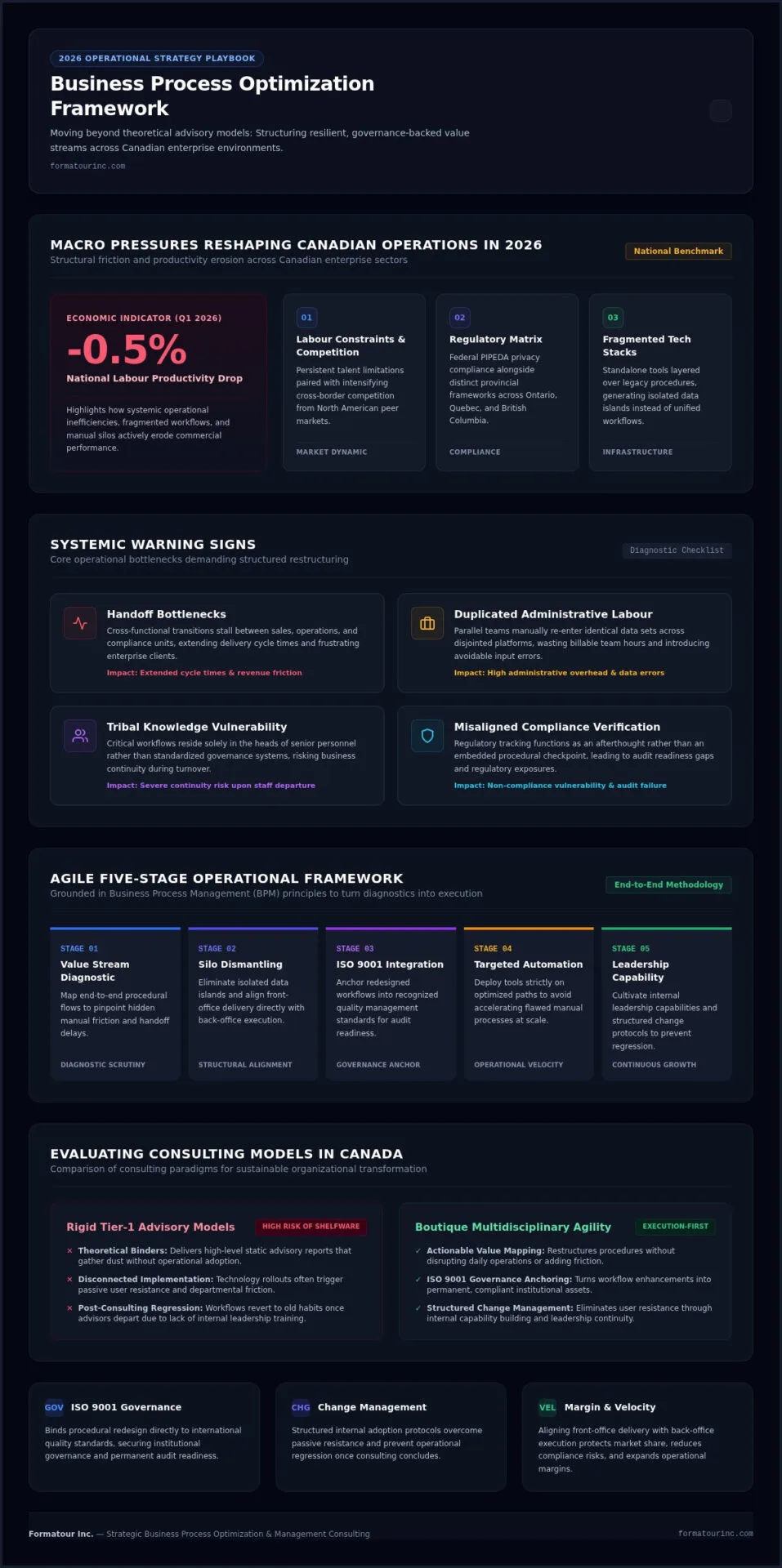
Operational efficiency across Canadian enterprises faces a defining test in 2026. National labour productivity dropped by 0.5% in the first quarter of 2026, highlighting how deeply systemic inefficiencies erode commercial performance. True process optimization goes far beyond isolated process automation; it demands the structured redesign of end-to-end value streams to eliminate structural waste. For organizations seeking business process optimization consulting Canada provides a distinct operational environment where disparate provincial guidelines, legacy technologies, and evolving market dynamics converge. Navigating this reality requires moving past reactive crisis management toward deliberate operational governance.
When organizations treat operational friction as isolated departmental glitches, they overlook broader structural interdependencies. Modern Business Process Management principles demonstrate that sustainable margin expansion hinges on aligning front-office client delivery with back-office execution. Unifying these functions reduces compliance risks, lowers operational overhead, and establishes the operational velocity required to protect market share.
Macro Pressures Reshaping Canadian Operations in 2026
Canadian enterprises navigate persistent labour constraints and intensifying cross-border competition from North American peers. In addition, organizations manage a complex regulatory matrix spanning federal privacy legislation like PIPEDA alongside distinct provincial frameworks in Ontario, Quebec, and British Columbia. Compounding this challenge, rapid digital transformation has created fragmented tech stacks: teams often layer standalone software tools over outdated procedures, creating isolated data islands instead of coherent operational workflows.
Core Symptoms of Operational Inefficiency
Workflow dysfunction rarely appears overnight; it compounds quietly across daily execution. Canadian leadership teams frequently struggle with systemic warning signs that signal an urgent need for business process optimization consulting Canada enterprises can rely on for sustainable restructuring:
- Handoff Bottlenecks: Cross-functional transitions stall between sales, operations, and compliance units, extending cycle times and frustrating enterprise clients.
- Duplicated Administrative Labour: Parallel teams manually re-enter identical data sets across disjointed platforms, wasting billable hours and introducing avoidable input errors.
- Tribal Knowledge Vulnerability: Critical workflows remain stored solely in the heads of senior employees rather than standardized governance systems, placing business continuity at severe risk during staff turnover.
- Misaligned Compliance Verification: Regulatory tracking operates as an afterthought rather than an embedded procedural checkpoint, leading to audit readiness gaps.
Eliminating these procedural drains requires rigorous operational analysis. Canadian executives must replace informal departmental fixes with resilient, scalable architectures that secure organizational stability and empower frontline execution.
Architecting a Resilient Process Optimization Framework
Ad-hoc workflow revisions rarely survive operational stress. To generate measurable bottom-line gains, modern organizations require an engineered methodology combining diagnostic scrutiny with rapid deployment. Grounded in the principles highlighted across academic curricula like the University of Toronto’s Business Process Management Certificate, structured transformation treats operations as linked value networks rather than isolated tasks. Selecting top-tier business process optimization consulting Canada provides means moving past abstract recommendations toward an actionable, five-stage transformation framework.
Crucially, process redesign must never occur in an operational vacuum. High-performing organizations bridge procedural engineering directly with recognized quality standards like ISO 9001 Quality Management Implementation. This governance alignment ensures that every workflow enhancement strengthens audit readiness and risk management while driving velocity.
Phase 1 & 2: Diagnostic Discovery and Value Stream Mapping
Transformation begins with operational reality rather than executive assumptions. Advisory teams conduct structured stakeholder interviews and direct workflow observations across cross-functional units. This diagnostic phase captures accurate cycle times, identifies handoff friction points between teams, and isolates hidden procedural waste using Lean and Six Sigma root-cause techniques. Setting clear, quantifiable baseline metrics here ensures future efficiency gains are completely measurable.
Phase 3: Targeted Workflow Re-engineering and Automation
Phase 4 & 5: Institutional Governance and Continuous Improvement
The final phases lock in progress to prevent procedural drift. Re-engineered workflows are formalized through clear standard operating procedures, integrated directly into accessible digital repositories, and monitored via structured operational scorecards. The primary stages comprise:
- Phase 1: Diagnostic Discovery: Map current-state processes through detailed stakeholder engagement and cross-functional reviews.
- Phase 2: Value Stream Mapping: Measure real cycle times, uncover hidden dependencies, and isolate process bottlenecks.
- Phase 3: Workflow Re-engineering: Eliminate non-value-added steps and implement targeted process automation.
- Phase 4: Governance Formalization: Codify updated operating procedures aligned with ISO quality standards.
- Phase 5: Performance Institutionalization: Establish tracking cadences and leadership capabilities to sustain ongoing optimization.
Executing these phases methodically allows organizations to secure operational resilience that scales predictably. If your teams are ready to systematically eliminate operational friction, consider partnering with specialists to schedule an operational diagnostics assessment.
Evaluating Business Process Optimization Consulting Models in Canada
Selecting the right advisory partner dictates whether an operational overhaul succeeds or deteriorates into expensive shelfware. Across Canada, over 2,200 business process consulting firms compete, creating a crowded marketplace with stark differences in delivery quality. When evaluating the business process optimization consulting Canada provides, executive decision-makers must distinguish between three primary archetypes: boutique multidisciplinary firms, global Tier-1 consultancies, and pure software integrators. Choosing incorrectly risks either theoretical bloat or automated process failure.
Boutique Strategic Agility vs. Tier-1 Bureaucracy
The Pitfall of Tool-First Automation Without Process Design
Software integrators often treat digital applications as operational panaceas. However, digitizing a disjointed workflow merely accelerates bottlenecks across the organization. Sustainable optimization requires workflow re-engineering before code deployment. As outlined in professional frameworks like the British Columbia Institute of Technology’s Business Process Improvement program, foundational waste elimination must precede technical integration. For strategic advisory criteria on avoiding technology mismatches, explore The 2026 Executive Guide to Digital Transformation Strategy Firms.
To assess potential consulting partners objectively, evaluate their capabilities against four core operational criteria:
- Execution Agility: Can the firm adapt its framework rapidly to specific provincial requirements, or does it enforce rigid global templates?
- Architectural Depth: Do advisors address underlying process mechanics, or do they focus narrowly on vendor software setups?
- Capability Transfer: Does the advisory model embed structured training to upskill internal teams, or does it create perpetual billing dependencies?
- Governance Alignment: Can the consulting team connect workflow redesign directly to enterprise risk management and established quality standards?
Prioritizing strategic alignment over brand scale ensures your investment drives measurable operational gains rather than redundant procedural paperwork.
Navigating Change Management and Sustaining Transformation
The primary hazard threatening any operational redesign isn’t technological friction; it’s cultural inertia. Without proactive human enablement, optimized workflows quickly revert to legacy habits the moment external advisors depart. The most effective engagements in business process optimization consulting Canada delivers treat change management as a structural pillar rather than a secondary communications exercise. Anchoring operational redesign to formal resilience frameworks like ISO 22301 Business Continuity Consulting shields organizations from operational disruption, ensuring that procedural changes protect business continuity during periods of turnover or restructuring.
Securing Executive Alignment and Frontline Adoption
Frontline resistance usually stems from fear of displacement or increased administrative burdens. Successful initiatives defuse this friction early by establishing cross-functional steering committees that unite department heads with operational supervisors. When operational leaders help conduct the initial diagnostic phase, they transition from passive recipients into active co-designers of the future state. Framing every procedure around tangible cognitive relief, such as eliminating redundant spreadsheets and manual handoffs, accelerates grassroots buy-in and ensures durable adoption.
Embedding Continuous Capability Through Executive Education
Sustainable transformation demands internal mastery. Rather than fostering permanent reliance on external advisors, progressive organizations invest in targeted executive development. As detailed in our analysis of Leadership Training for Digital Transformation, equipping managers with structured analytical capabilities turns mid-level leaders into long-term process champions.
Establishing ongoing operational routines preserves process discipline while keeping documentation aligned with changing market environments. Effective capability transfer focuses on three core mechanisms:
- Role-Based Competency Roadmaps: Training operational leads to monitor cycle-time variance and resolve minor workflow friction autonomously.
- Standardized Governance Reviews: Embedding quarterly review cadences to assess procedural drift against established performance metrics.
- Continuous Feedback Loops: Giving frontline contributors direct channels to propose workflow refinements without bureaucratic lag.
To build an enduring operational framework that empowers your internal leadership team, connect with Formatour’s advisory team to discuss a tailored enablement strategy.
Partnering with Formatour for Operational Transformation in Canada
Building enduring operational excellence requires advisory support that balances structural depth with tactical speed. Formatour Incorporated delivers this equilibrium across the Canadian enterprise market, functioning as a multidisciplinary partner for organizations navigating complex operational transformations. Backed by over a decade of advisory experience in the Canadian regulatory and commercial landscape, the firm couples Tier-1 consulting methodologies with boutique agility. Unlike global consultancies that delegate client deliverables to junior analysts, Formatour deploys seasoned senior advisors who engage directly with executive teams from project inception to operational maturity.
The Formatour Strategic Difference: Standards-Driven Optimization
Most consultancies isolate operational workflow redesign from governance, inadvertently creating compliance blind spots. Formatour resolves this tension by anchoring workflow modernization directly to international standards, including ISO 9001 for quality management and ISO 27001 for information security. This holistic integration ensures that workflow velocity never compromises regulatory compliance or risk posture. By synthesizing process automation and optimization with digital transformation consulting and executive leadership development, Formatour equips client organizations to modernize procedures while securing institutional integrity.
Initiating Your Strategic Process Optimization Engagement
Collaborating with Formatour follows a structured onboarding path designed to generate early momentum while respecting organizational capacity. This engagement model focuses on transparency, rapid alignment, and enduring capability transfer across three core stages:
- Diagnostic Discovery: Uncovering high-impact bottlenecks, workflow waste, and systemic operational friction through direct stakeholder engagement.
- Targeted Architecture: Engineering resilient future-state processes and prioritizing high-yield automation opportunities across core platforms.
- Capability Transfer: Delivering tailored leadership development programs to build frontline mastery and eliminate post-consulting regression.
When seeking the strategic clarity that premier business process optimization consulting Canada offers, executive leaders need execution certainty. Connect with Formatour to initiate a confidential operational consultation and discover how Formatour Strategic Advisory Services convert operational friction into measurable enterprise value.
Transforming Operational Friction into Long-Term Enterprise Resilience
Operational excellence isn’t achieved through isolated software rollouts or superficial process maps. Lasting efficiency requires an engineered architecture that pairs systematic waste elimination with recognized governance systems like ISO 9001. As Canadian enterprises navigate structural labour constraints and shifting economic realities, selecting the right partner for business process optimization consulting Canada provides the strategic clarity needed to scale securely. When you empower frontline supervisors through structured leadership development, workflow gains become permanent organizational capabilities rather than fleeting adjustments.
With over a decade of Canadian enterprise advisory experience, Formatour delivers multidisciplinary mastery bridging process automation, executive enablement, and international ISO quality standards. You don’t have to choose between big-firm consulting rigour and responsive execution; our senior-led boutique agility provides hands-on strategic partnership without bureaucratic drag. Accelerate your operational excellence with Formatour Incorporated and build resilient, high-velocity workflows designed to outperform competitors well into the future.
Frequently Asked Questions
What does a business process optimization consulting firm in Canada actually do?
A specialized firm analyzes, redesigns, and governs cross-functional workflows to eliminate structural bottlenecks and administrative waste. In the context of business process optimization consulting Canada organizations turn to, advisors map value streams, eliminate redundant manual touches, and implement process automation. They also align day-to-day procedures with provincial regulations and international standards, establishing standard operating procedures that improve operational speed and output consistency.
How does process optimization differ from traditional digital transformation or IT consulting?
IT consulting often focuses strictly on software implementation, whereas process optimization redesigns operational mechanics before technology is introduced. Digitizing an inefficient workflow merely accelerates errors across an organization. Process optimization analyzes underlying tasks, handoffs, and governance to eliminate waste first. Digital transformation consulting and automation then support those refined workflows, ensuring software investments serve cohesive strategic goals rather than compounding procedural friction.
How long does a strategic business process optimization engagement typically take?
A focused operational engagement typically spans eight to twenty-four weeks depending on organizational scale and workflow complexity. Initial diagnostic discovery and value stream mapping generally conclude within the first four weeks. Targeted workflow redesign, procedure codification, and pilot automation rollouts occur over the subsequent months. Broader enterprise transformations requiring multi-site operational alignment or complete management system integration may extend across several quarters.
Can process optimization be integrated with ISO 9001 or ISO 27001 compliance standards?
Yes, combining workflow redesign with international quality and security standards creates a unified, resilient operational architecture. Process optimization defines how work moves efficiently across teams, while standards like ISO 9001 for quality and ISO 27001 for information security establish governance controls. Integrating them ensures that cycle-time reductions and automated data exchanges remain fully documented, repeatable, and audit-ready under recognized global frameworks.
How do Canadian organizations measure the return on investment from process optimization advisory?
Enterprises measure return on investment through documented cycle-time reductions, administrative labour savings, and error-rate decreases. When assessing engagements in business process optimization consulting Canada executives evaluate metrics like shortened customer handoff durations and eliminated manual tasks. They also measure ROI through reduced compliance audit friction and higher team capacity, which allows organizations to expand revenue without adding proportional overhead.
How does Formatour prevent operational workflows from reverting to legacy habits after an engagement?
Formatour eliminates procedural regression through structured capability transfer and executive leadership development programs. Rather than delivering static reports and disengaging, Formatour embeds change management throughout the optimization lifecycle. Senior advisors train operational managers, establish recurring governance review cadences, and formalize updated operating procedures. This leadership enablement empowers internal teams to maintain operational discipline and resolve future bottlenecks autonomously.
Is business process optimization disruptive to daily operations while the engagement is underway?
A properly structured optimization engagement minimizes disruption by embedding diagnostics directly into existing routines. Senior advisors conduct non-intrusive value stream mapping, focused stakeholder interviews, and direct process observations that don’t pull operational staff away from critical client responsibilities. Workflow redesigns are piloted in controlled, phased rollouts, allowing teams to validate performance improvements and adapt smoothly before broad operational deployment.
