

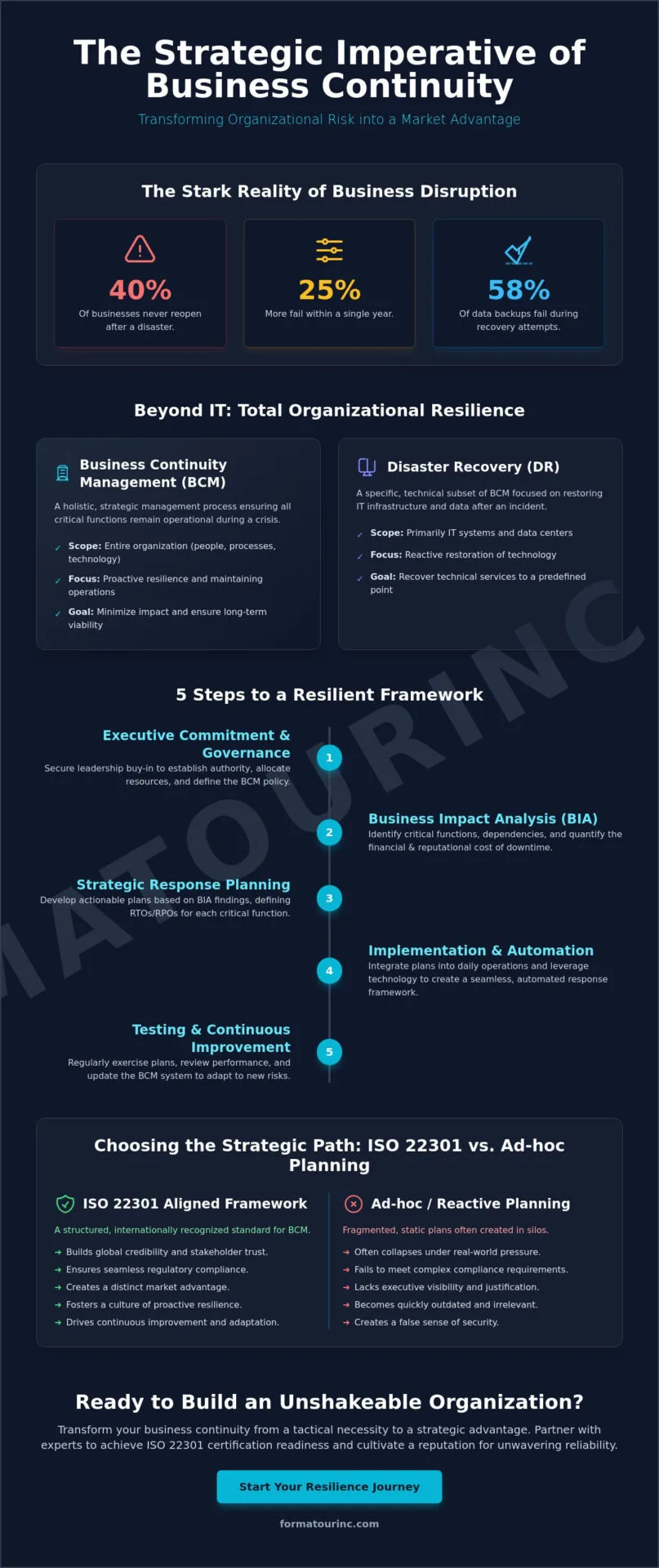
Did you know that 40% of businesses never reopen after a disaster, and another 25% fail within a single year? This stark reality underscores why a sophisticated business continuity management implementation is no longer just a tactical backup; it’s a strategic imperative for the modern executive. You likely recognize that fragmented response plans often collapse under pressure, leaving your leadership team struggling to justify resilience investments to the board. It’s a common challenge to balance complex regulatory requirements with the necessity of maintaining a lean, high-performing operation.
This guide empowers you to transform organizational risk into a distinct market advantage. We’ll explore how to align your operations with the latest ISO 22301:2019 standards, including the critical 2024 climate change amendments. By the end of this article, you’ll understand how to replace static, manual processes with a seamless, automated response framework. We’ll provide the roadmap to achieve ISO certification readiness and cultivate a reputation for unwavering reliability, ensuring your organization remains a steady leader in an unpredictable global market.
Key Takeaways
- Transition from reactive disaster recovery to a holistic resilience strategy that secures your organization’s long-term operational health.
- Utilize a rigorous Business Impact Analysis to identify critical dependencies and prioritize resources where they provide the greatest strategic protection.
- Discover how a formal business continuity management implementation aligned with ISO 22301 builds global credibility and ensures seamless regulatory compliance.
- Follow a structured five-step roadmap that emphasizes executive commitment and strategic response planning to create an automated, resilient framework.
- Transform complex compliance requirements into a distinct market advantage that enhances your reputation for reliability and sustained excellence.
What is Business Continuity Management Implementation?
A mature organization views stability not as a static goal, but as a dynamic capability. To understand What is Business Continuity Management Implementation?, one must look beyond the creation of a physical document kept on a shelf. It’s a comprehensive management process that ensures critical functions remain operational during a crisis. This shift from reactive planning to proactive resilience is what separates market leaders from those who falter when faced with global volatility. This process represents the structured integration of capability into the very fabric of an enterprise.
While many organizations possess a Business Continuity Plan (BCP), this is often just a singular component of a broader Business Continuity Management System (BCMS). The BCMS framework provides the governance, resources, and continuous improvement cycles necessary to keep those plans relevant. For modern Canadian enterprises, this implementation serves as a core pillar of strategic transformation. It aligns operational risk management with long-term growth objectives, ensuring that every department understands its role in maintaining organizational integrity. Partners like Formatour help organizations bridge the gap between simple planning and a sustained state of excellence.
The Strategic Value of Resilience in 2026
Resilience has evolved into a high-stakes asset for brand preservation. In 2026, stakeholder trust is inextricably linked to an organization’s ability to navigate digital and physical disruptions without service degradation. Within the Canadian regulatory environment, particularly for financial and critical infrastructure sectors, robust business continuity management implementation is a prerequisite for compliance. It’s no longer enough to have a generic response; the strategy must be precise. Beyond mere adherence to rules, it functions as a competitive differentiator. Organizations that demonstrate reliable supply chain continuity often secure more favorable partnerships and higher market valuations than their less-prepared counterparts.
BCM vs. Disaster Recovery: Understanding the Scope
It’s vital to distinguish between specialized technical recovery and total organizational resilience. Disaster Recovery (DR) focuses specifically on the restoration of IT systems and data after a failure. While essential, DR is only one pillar of a mature resilience framework. A holistic approach encompasses human capital, physical logistics, and alternative operational processes. Executive leadership must drive this transition, moving away from IT-centric silos toward a culture of preparedness. When leaders prioritize resilience, they empower their teams to act with confidence. This ensures that the organization’s most valuable assets, its people and its reputation, remain protected during any disruption.
The Core Pillars of a Robust BCM Framework
Building a resilient organization requires more than general foresight. It demands a structured architecture that identifies vulnerabilities before they escalate into systemic failures. A successful business continuity management implementation relies on a data-driven foundation, ensuring that every strategic decision is backed by rigorous analysis. This framework moves beyond simple checklists to create a responsive, living system. By focusing on essential recovery metrics and process dependencies, executives can safeguard the core value drivers of their enterprise.
Precision is the hallmark of professional resilience. Organizations must define clear Recovery Time Objectives (RTO) and Recovery Point Objectives (RPO) for every critical process. These metrics aren’t arbitrary. The RTO dictates the maximum tolerable duration of a disruption, while the RPO determines the acceptable volume of data loss. Considering that 58% of data backups fail during recovery, according to industry benchmarks, these metrics must be tested and validated regularly. Establishing these parameters allows leadership to allocate resources efficiently, focusing on the operations that cannot afford to fail.
Conducting a High-Impact Business Impact Analysis
The Business Impact Analysis (BIA) serves as the diagnostic tool for the entire organization. It involves mapping every internal process to identify the “vital few” operations that directly sustain revenue and brand equity. By quantifying the financial and reputational costs of downtime over specific intervals, leaders can prioritize recovery efforts with absolute clarity. BIA is the analytical engine that powers BCM priorities. This phase ensures that the 5 Steps for Successful Business Continuity Management Implementation are grounded in the specific operational realities of your firm.
Risk Evaluation and Threat Modelling
A sophisticated framework must account for an increasingly complex threat landscape. In 2026, this includes everything from sophisticated ransomware campaigns to climate-related supply chain disruptions. Following the 2024 amendments to international standards, organizations must now specifically assess how climate change impacts their operational stability. Evaluating the probability versus the impact of these risks allows for a prioritized response strategy. Integrating these efforts with ISO 27001 implementation services ensures that digital vulnerabilities don’t undermine your broader physical and operational resilience. To begin refining your organizational defense, you may wish to consult with a strategic advisor who understands these converging risks.
ISO 22301 vs. Ad-hoc Planning: Choosing the Strategic Path
Executives often face a critical choice: develop internal checklists or adopt a recognized international standard. While internal ad-hoc plans might feel faster to execute, they often crumble under the weight of complex, systemic disruptions. Ad-hoc planning lacks the scalability required for modern growth, leading to inconsistent responses that can damage brand reputation. In contrast, a business continuity management implementation rooted in ISO 22301 provides a globally recognized blueprint for resilience. It replaces guesswork with a structured, auditable system that ensures every level of the organization knows exactly how to respond when pressure mounts.
Formal certification is far more than a badge of compliance. It’s a powerful statement of reliability to global partners and stakeholders. Major regulators and industry bodies, such as those defining The Core Pillars of a Robust BCM Framework, emphasize that a plan is only as strong as the governance behind it. ISO 22301 aligns perfectly with these high-level expectations. It ensures your organization meets international benchmarks for governance, risk management, and operational integrity. This alignment is particularly vital when 35% of disaster recovery tests fail; a standardized framework provides the rigor necessary to avoid such costly oversights. Engaging expert ISO 22301 certification support transforms this complex journey into a streamlined process that empowers your leadership and protects your brand reputation.
The Framework for Global Consistency
Global consistency is paramount for organizations managing international subsidiaries. ISO 22301 standardizes terminology and processes, creating a common language between executive leadership and operational teams across different regions. This alignment ensures that a crisis response in one territory mirrors the quality and efficacy of another. The standard also incorporates a mandatory continuous improvement loop. Through regular internal audits and management reviews, the system identifies gaps before they become liabilities. This ensures your resilience strategy evolves at the same pace as your business objectives.
Synergy with Information Security and Quality
Modern threats demand a unified defense strategy. Aligning your BCMS with ISO 27001 addresses the rising tide of cyber-disruptions, ensuring that data security and operational uptime are managed as a single strategic objective. Engaging in organizational resilience consulting helps bridge the silos between IT, quality management, and operations. By implementing a unified multi-standard framework that includes ISO 9001, organizations can significantly reduce audit fatigue and administrative redundancy. This integrated approach ensures that quality, security, and continuity work in harmony to protect the enterprise’s long-term value.
5 Steps for Successful Business Continuity Management Implementation
Execution is where strategic vision transforms into operational reality. A successful business continuity management implementation isn’t a one-time project, but a phased journey that requires precision and persistence. Leaders must move beyond the theoretical to establish a framework that actually functions when the unexpected occurs. This process demands a methodical approach, beginning with high-level mandates and culminating in a culture of continuous improvement. By following a structured roadmap, organizations can ensure their resilience efforts are both scalable and sustainable.
Step 1-3: From Commitment to Documentation
The first and most critical phase involves securing a definitive mandate from the board. Without executive commitment and the allocation of dedicated resources, resilience initiatives often stall at the departmental level. Once the mandate is established, the focus shifts to developing tactical response plans tailored to diverse disruption scenarios, including cyber-attacks and climate-related events. These plans must be grounded in the Business Impact Analysis discussed earlier. Documentation must be accessible and actionable, serving as a clear operational manual during times of high stress rather than a static document designed only for audit compliance.
Step 4-5: Embedding Resilience into the DNA
The final phases focus on the human element of resilience. In 2026, training must account for the complexities of hybrid and digital work environments, ensuring that remote teams can execute response protocols without physical oversight. Utilizing strategic change management consulting is essential here to foster a resilience-first mindset across the entire workforce. This cultural integration ensures that preparedness becomes a shared responsibility rather than an administrative burden.
Testing and exercising represent the ultimate validation of your system. Given that the failure rate of disaster recovery testing is approximately 35%, regular simulations are non-negotiable. These exercises should challenge teams through realistic scenarios that test both technical systems and communication flows. Every exercise or real-world event must conclude with a rigorous “Post-Mortem” review. This analysis identifies gaps and provides the data necessary for continuous optimization, ensuring the organization’s response remains sharp. To begin building your own resilient framework, contact our specialists today for a strategic consultation.
- Step 1: Secure Board mandate and resource allocation.
- Step 2: Develop scenario-based tactical response plans.
- Step 3: Create actionable, accessible documentation.
- Step 4: Integrate resilience through training and change management.
- Step 5: Validate and optimize through rigorous testing and post-mortems.
Partnering for Resilience: The Formatour Advantage
Achieving a state of sustained organizational excellence requires more than a successful business continuity management implementation; it demands a long-term commitment to strategic evolution. While the initial framework provides the necessary structure, the transition from a project-based mindset to a permanent culture of resilience is where many organizations encounter friction. This is where a multidisciplinary advisory partner becomes indispensable. By providing expert auditing and certification support, a seasoned mentor ensures that your resilience investments deliver a measurable return on investment while safeguarding your strategic stability in a volatile market.
A visionary architect doesn’t just build for today; they design for the future. Moving beyond the implementation phase means integrating your continuity systems with other core business functions to create a holistic management environment. This approach ensures that resilience isn’t a siloed department but a foundational characteristic of your entire enterprise. By partnering with experts who understand complex global systems, you can transform your business continuity management implementation from a compliance requirement into a powerful engine for growth and reliability. Organizations seeking to accelerate this journey can benefit from specialized ISO 22301 business continuity consulting that quantifies financial risks and provides a clear, certified roadmap for incident response.
Boutique Agility with Big-Firm Standards
Formatour offers a unique blend of high-level international benchmarks and deep localized expertise. We understand the specific nuances of the Canadian regulatory and business landscape, allowing us to customize ISO 22301 implementation to fit your unique organizational culture. Our approach avoids the rigid, one-size-fits-all methodology often found in larger firms. Instead, we emphasize strategic project management and process automation to streamline your continuity efforts. This ensures that your management systems are not only compliant but also optimized for efficiency and long-term performance.
Your Roadmap to Certification and Beyond
The journey toward global recognition begins with a comprehensive gap analysis. This diagnostic phase identifies exactly where your current capabilities stand against international standards, providing a clear path forward. Beyond the technical setup, we focus on empowering your internal teams through professional development and executive leadership programs. This ensures that your staff possesses the skills to manage and improve the system long after the initial implementation is complete. To secure your organization’s future and enhance your market reputation, contact Formatour Incorporated today for a strategic resilience consultation.
Securing Your Organizational Future in 2026
Operational resilience is the hallmark of a visionary enterprise. A sophisticated business continuity management implementation serves as a strategic blueprint that transcends simple disaster recovery, transforming risk into a distinct market advantage. By grounding your strategy in rigorous Business Impact Analysis and aligning with international ISO 22301 standards, you protect your brand equity and ensure global credibility. The transition from reactive planning to a proactive culture of preparedness is what defines market leaders in an increasingly volatile landscape.
Formatour Incorporated brings over a decade of expertise in ISO standards implementation to your unique challenges. Our Canadian-based experts combine boutique advisory agility with big-firm consulting standards to guide your strategic transformation. We empower your leadership team to move beyond mere compliance, ensuring your resilience framework is both automated and future-proof. Contact Formatour Incorporated for a Strategic BCM Consultation to begin your journey toward unwavering reliability and sustained excellence. Your organization’s most resilient chapter starts today.
Frequently Asked Questions
How long does business continuity management implementation typically take?
A standard business continuity management implementation typically spans six to twelve months for mid-sized to large organizations. This timeline varies based on the existing maturity of your processes and the complexity of your global operations. A phased approach ensures that critical functions are prioritized first, allowing for a steady and manageable transformation of your organizational resilience.
Is ISO 22301 certification mandatory for Canadian businesses?
ISO 22301 certification isn’t legally mandatory for every Canadian business, but it’s increasingly required within regulated sectors like finance, healthcare, and telecommunications. Many organizations adopt the standard as a strategic differentiator to build trust with international partners. It serves as a verifiable benchmark of operational integrity and governance in the Canadian marketplace.
What is the difference between BCM and a Disaster Recovery Plan?
Business Continuity Management is a holistic strategy covering people, brand reputation, and operational processes, while a Disaster Recovery Plan is specifically focused on technical IT restoration. BCM ensures the entire enterprise can function during a crisis. Disaster recovery is a vital subset of this broader framework that restores data and systems after a failure.
How often should we test our business continuity plans?
Organizations should conduct testing at least annually, though high-risk environments often require quarterly exercises to maintain readiness. Regular validation is essential because approximately 35% of disaster recovery tests fail. Frequent simulations ensure that response protocols remain sharp and that your business continuity management implementation continues to reflect your current operational reality.
Can BCM implementation help with cyber insurance premiums?
A robust BCM framework often leads to more favorable cyber insurance terms and lower premiums. Insurers value the reduced risk profile of organizations that follow international standards like ISO 22301. Demonstrating a structured approach to resilience provides the assurance of success that underwriters look for when evaluating your organization’s digital and physical stability.
What are the most common mistakes in BCM implementation?
The most frequent errors include treating the plan as a static document and neglecting third-party vendor risks. Statistics show that 56% of businesses don’t evaluate the preparedness of their vendors, creating significant supply chain vulnerabilities. Failing to secure a firm executive mandate also remains a primary reason for the long-term failure of resilience initiatives.
How do we involve employees in the business continuity process?
Employees are involved through targeted awareness programs and realistic simulation exercises that test their response capabilities. Clear communication protocols ensure every team member understands their specific role during a disruption. This inclusive approach transforms resilience from a corporate policy into a shared organizational value that empowers your workforce.
What role does executive leadership play in BCM?
Executive leadership provides the strategic mandate and the necessary resource allocation to sustain the program. Leaders are responsible for fostering a culture where preparedness is prioritized over short-term convenience. Their active participation in management reviews ensures that resilience remains aligned with the organization’s long-term growth and strategic transformation objectives.
