

A QMS earns leadership support when it addresses a measurable business priority, not when it’s presented as another layer of paperwork. For anyone tasked with convincing leadership to invest in QMS, that distinction matters. Leaders may see a system as a software expense or a path to certification, while the real case lies in how consistent processes can support operational performance, customer confidence, and strategic goals.
Quality issues can be difficult to translate into financial terms, especially when baseline data is incomplete. You don’t need perfect records to begin building a credible case. Internal evidence such as recurring errors, rework, delays, customer complaints, or audit findings can help show where process variation is affecting the organization and what should be measured next.
This article explains how to connect QMS investment to leadership priorities, use available evidence to assess the opportunity, and compare practical approaches, from improving existing processes to introducing new tools or pursuing ISO 9001 certification. You’ll also learn how to propose a proportionate first step, assign ownership, and set measures leaders can use to evaluate progress before committing to a broader investment.
Key Takeaways
- Frame a QMS as a coordinated way to manage responsibilities, controls, and improvement, rather than as software alone.
- Use dated internal records to identify patterns in rework, complaints, corrective actions, audit findings, or delays before estimating potential benefits.
- Compare existing process-improvement efforts, dedicated software, internal expertise, and external advisory support against your organization’s needs and capacity.
- When convincing leadership to invest in QMS, structure the proposal around the executive concern, verified evidence, realistic options, resources, risks, and a clear decision request.
- Turn approval into action by confirming sponsorship, scope, responsibilities, stakeholder involvement, and governance for the next phase.
Why a QMS investment deserves an executive-level business case
A quality management system (QMS) should be presented as an operational capability, not as a request to purchase software or create more documents. It connects the processes, responsibilities, controls, and improvement practices an organization uses to deliver consistent results. The Quality Management System (QMS) concept is broader than any single tool: software may support records or workflows, but people still need to own processes, evaluate performance, and act on what they learn.
That broader view makes the investment relevant to executive decisions. Leaders need to assess how the proposed system supports strategic priorities, addresses risk exposure, strengthens operating performance, and uses staff time and other resources. They also need a realistic picture of implementation demands, including process changes, employee involvement, and ongoing ownership. A proposal that acknowledges these commitments is more credible than one that treats implementation as a quick technology purchase.
What leadership needs to understand about a QMS
A QMS works when its elements reinforce one another. Process owners clarify who is accountable, documented information helps people perform work consistently, measures show whether processes are achieving intended results, and improvement practices guide action when performance falls short. The right scope depends on the organization’s context and objectives, so a case should explain which processes need attention and why.
ISO 9001 alignment or certification may help support the business case, particularly where customers or organizational objectives make it relevant. It isn’t automatically the sole purpose of a QMS investment. The underlying goal may instead be stronger process control, more reliable outputs, or a disciplined approach to improvement.
Which business problems make the investment relevant
Start with symptoms leadership can recognize, then connect each one to an executive priority. Don’t assume a problem exists because it is common in other organizations. Validate it with internal records, feedback, or direct observation before using it to justify investment.
- Recurring rework or errors: Check operational records and connect verified patterns to reliability, capacity, or avoidable effort.
- Inconsistent handoffs or outputs: Review process records or customer feedback and assess whether the issue affects service consistency or customer experience.
- Repeated corrective work or audit findings: Examine findings and follow-up records to determine whether ownership, controls, or corrective actions need strengthening.
- Unclear process accountability: Confirm responsibilities with the teams involved, then relate any gaps to operational control and decision-making.
This evidence gives the proposal a practical foundation without overstating the case. For anyone convincing leadership to invest in QMS, the central distinction is clear: request approval to build a defined operational capability, not to create a document library. That framing lets leaders evaluate the intended outcomes, required commitment, and appropriate scope before deciding how to proceed.
How to demonstrate the business value of a QMS with credible evidence
A persuasive case starts with what the organization can verify, not with a promised return. Before proposing benefits, establish a baseline from records already available and state where the information came from and what period it covers. For example, a case might review the operations team’s rework log for a defined quarter or customer complaint records from the previous year. If the data is incomplete, inconsistent, or based on estimates, disclose that limitation rather than presenting it as a firm result.
Which QMS measures can support the proposal
Select a focused set of measures that speaks directly to the problem and leadership priority. Depending on the organization, useful evidence may include rework volume, defect trends, complaint patterns, recurring corrective actions, audit findings, or time lost to process delays. Avoid a large dashboard without a clear decision purpose. For each measure, record its definition, data source, owner, measurement period, and known limitations. That context helps leaders judge whether comparisons are meaningful.
Then compare the current state with a proposed state. Keep observed facts separate from projections, and explain the logic behind any estimate. For instance, if records show repeat corrections, the case can quantify the recorded effort involved. Any estimate of effort that might be released through improved process control should be labelled as a projection, not a realized saving.
How to handle ROI, assumptions, and uncertainty
Make the calculation traceable. Show the inputs, method, and assumptions so a leader can challenge or test them. Distinguish cashable savings, such as an expense that could actually be removed, from capacity released, reduced exposure to risk, or potential improvements in customer confidence. These benefits may matter, but they shouldn’t be presented as equivalent cash returns.
Use conservative, expected, and higher-impact scenarios only when each has a defensible basis. State what would need to be true for each scenario and how progress could be measured after approval. Don’t apply generic improvement percentages or imply that a QMS guarantees financial results. Where records are weak, recommend a discovery step to improve the baseline before seeking a larger commitment.
- Measured fact: Recorded complaints for a defined period, with the source identified.
- Assumption: The share of future complaints that a proposed change might prevent.
- Qualitative benefit: Clearer process ownership or stronger confidence in consistent delivery.
Close the evidence section with a sentence leaders can repeat, grounded in verified information: “Our [source] records show [verified issue] during [period], which puts [stated priority] at risk.” This disciplined approach supports convincing leadership to invest in QMS without overstating certainty. If specialist guidance would help connect operational evidence to implementation and certification planning, you can contact Formatour about QMS support.
QMS investment options compared: build capability, buy tools, or seek support
There’s no single investment path for every organization. A team with clear process ownership and a manageable scope may begin by improving existing workflows. Dedicated software can help with document control, tracking, and visibility, but it won’t establish sound processes or ensure people use them. Internal expertise and external advisory support can strengthen the work, and these approaches can be combined as needs evolve.
A QMS doesn’t have to mean more bureaucracy. Useful controls clarify responsibilities, preserve information people need, and help teams respond to process issues. Documentation that doesn’t support a decision, consistent work, or improvement may add effort without adding value. For an overview of implementation considerations, see this ISO 9001 quality management implementation guide.
| Approach | Fit and ownership | Change effort and scalability | Risks and leadership decisions |
|---|---|---|---|
| Improve with existing tools | May suit a focused scope with clear internal process owners. | Can support incremental change; expansion may require more coordination. | Risk: limited visibility or inconsistent practices. Leaders decide scope, ownership, and staff capacity. |
| Use dedicated QMS software | May suit needs for structured records, tracking, or process visibility. Internal owners remain essential. | Requires selection, implementation, user adoption, governance, and ongoing administration. Scalability depends on fit and configuration. | Risk: buying a tool before clarifying processes. Leaders assess integration needs, total effort, and accountability. |
| Build internal expertise | May suit organizations able to assign capable people to coordinate and maintain the system. | Develops internal ownership, though staff need time and appropriate knowledge as scope grows. | Risk: competing priorities or gaps in standards expertise. Leaders assign authority and capacity. |
| Engage external advisory support | May help when internal capacity, cross-functional alignment, or standards expertise is limited. | Can provide structured guidance; internal teams still need to participate and own the system. | Risk: unclear scope or weak knowledge transfer. Leaders define deliverables, responsibilities, and how capability will be retained. |
Choosing a proportionate approach
Internal improvement or software may be sufficient when process responsibilities are understood and the required changes are contained. Before selecting a tool, assess how it fits existing systems, who will administer it, and how teams will adopt it. If the work spans functions or ISO 9001 implementation and certification support are being considered, external expertise may provide a more structured path. Formatour’s advisory services include ISO standards implementation and support. For any external engagement, define the expected outputs and knowledge transfer before seeking approval.
For leaders weighing options, the objective is not to choose the most extensive solution. It’s to match scope, ownership, and resources to the verified need. That makes convincing leadership to invest in QMS a practical decision about capability and trade-offs, rather than a software purchase alone.
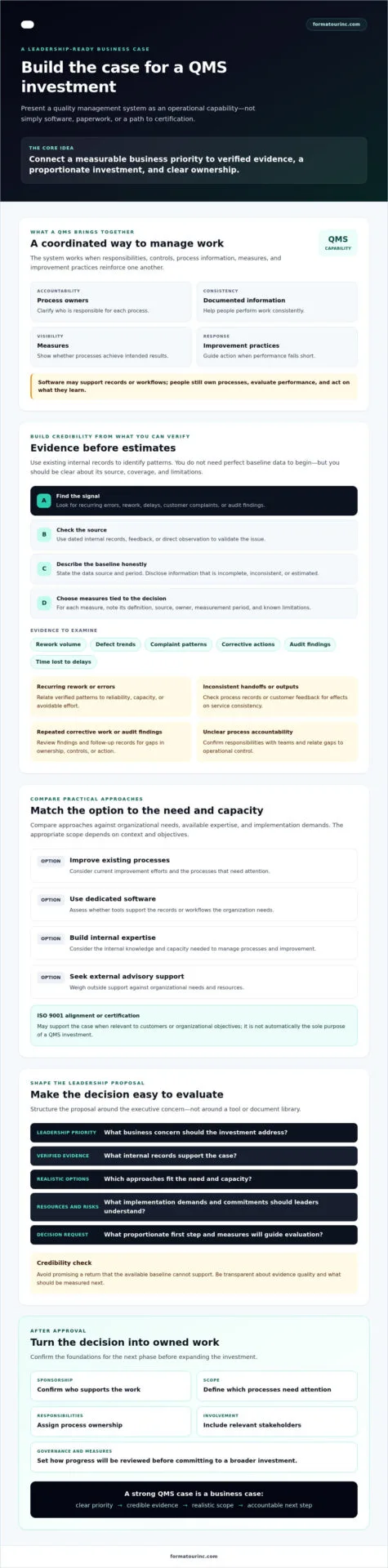
How to prepare a persuasive proposal when convincing leadership to invest in QMS
A leadership proposal should make the decision easy to assess. Lead with the business problem and its strategic relevance, then present the verified baseline, options considered, recommended scope, required resources, key risks, and the decision you’re requesting. Keep standard clauses and technical detail in supporting material. Executives need the case for action first, with enough evidence to test its logic.
A practical sequence for building the proposal
- Confirm the case. Define the problem, affected processes and stakeholders, and the leadership priority it may affect. Validate the connection rather than assuming that an operational issue automatically has executive significance.
- Assemble the evidence. Gather relevant baseline records, compare feasible approaches, and state assumptions, resource implications, and data limitations. Make clear what is measured and what remains an estimate.
- Recommend a manageable scope. Specify accountable sponsorship, process owners across affected functions, proposed measures, and review milestones. If the full investment is substantial or uncertainty remains, propose a phase with a decision gate: approve a defined first step now, then review findings before committing to later work.
Separate what leaders approve today from what they’ll assess later. For example, an initial decision might authorize a scoped assessment and staff participation, while a later review considers broader implementation resources. This creates a clear point to evaluate evidence, ownership, and readiness before expanding the commitment.
State who will sponsor the work, who owns affected processes, and how progress will be reviewed. Measures should relate to the problem identified in the proposal, with a named owner and a review cadence leadership can support. This turns approval into a governed initiative rather than an open-ended request.
Answering common executive objections
If leaders say, “We already have procedures,” assess whether those procedures are current, owned, followed, and improved in practice. In response to concerns about bureaucracy, show how the proposed scope will limit documentation to what supports consistent work, accountability, and control. If the view is “we can wait,” present the verified consequences of current issues and the evidence behind them. Avoid overstating future risk or implying certainty where the data doesn’t support it.
For anyone convincing leadership to invest in QMS, make the requested action quotable: “Approve [defined first step and resources] so [accountable owners] can address [verified issue] in support of [organizational priority], with progress reviewed at [decision gate].” Tailor each bracket to the proposal and evidence. To discuss a structured QMS implementation path, connect with Formatour.
Securing QMS Approval and Next Steps
End the proposal with a decision leaders can make, not a general request to “support quality.” Ask them to authorize a defined discovery phase, approve a scoped assessment, or allocate specific resources to an agreed next step. State what that approval covers, who will be accountable, and when leaders will review the findings. A clear boundary makes it easier to proceed without implying that every later phase is already approved.
What leadership should approve first
Define the planning effort, participating functions, and accountable sponsor. Confirm which processes are in scope and what evidence the team will gather to test the proposed direction. Set a review point where leadership can consider the assessment, resource implications, and agreed measures before deciding whether to continue, adjust the scope, or pause.
After approval, translate the decision into a short mobilization plan:
- Confirm sponsorship: Name the executive sponsor and clarify how they will provide direction and resolve barriers.
- Validate scope and participation: Confirm process boundaries, stakeholder involvement, and the time teams can commit.
- Assign responsibilities: Identify process owners and who will coordinate evidence, actions, and progress reporting.
- Establish governance: Agree on how often progress will be reviewed, which measures will be used, and what findings require a leadership decision.
Use the review point to compare progress with the baseline and measures approved at the outset. Consider whether the work has clarified the problem, strengthened ownership, or revealed additional resource needs. Leaders can then make an evidence-informed decision about expanding the initiative, refining it, or holding its scope steady.
How a specialist partner can support the next phase
External expertise may be useful when the organization needs support with ISO 9001 planning, implementation, auditing, or certification. Formatour provides ISO 9001 quality management implementation and certification support, but engaging an advisor is an option, not a prerequisite or a guarantee of results. Before approval, clarify the proposed scope, responsibilities, expected deliverables, knowledge transfer, and how the work will build on internal capability.
For a concise decision statement, adapt this template: “Approve [defined first step] with [sponsor and participating functions] to assess [scope] against [agreed measures], then return for a leadership review before further commitment.” This turns interest into a governed next step. If you’re convincing leadership to invest in QMS and would like to discuss your organization’s context and possible support, discuss your QMS investment with Formatour.
Turn the Business Case Into a Clear First Step
A strong QMS proposal doesn’t need to promise a perfect outcome. It needs to give leaders a sound basis for deciding what to do next: identify the operational priority, show what internal evidence supports action, and define a proportionate step with clear ownership and a review point.
That approach keeps the focus on organizational capability rather than paperwork or technology alone. For anyone convincing leadership to invest in QMS, a defined first decision can build alignment while allowing the organization to test assumptions and assess progress before making a broader commitment.
When specialist support would help clarify the path, Formatour offers ISO 9001 quality management implementation and certification support, alongside advisory services across information security, business continuity, and environmental management standards. The right support should fit your organization’s context, scope, and internal capacity.
Discuss your QMS investment with Formatour to explore a practical next step for your organization. With a clear case and shared ownership, leadership can move forward with confidence.
Frequently Asked Questions
What is the best way to convince leadership to invest in a QMS?
Connect the proposed QMS to a priority leaders already recognize, such as consistent delivery, customer experience, or operational control. Support the case with relevant internal evidence, explain the limits of that evidence, and compare realistic approaches rather than presenting a single predetermined solution. For convincing leadership to invest in QMS, make the immediate decision clear: specify the first step, who will own it, what resources it needs, and when leaders will review progress.
How do you demonstrate the return on investment of a QMS?
Start with a reliable baseline and show how each potential benefit is calculated. For example, use internal records to identify the time associated with rework, then distinguish measured effort from any estimate of effort that might be released. Separate cashable savings from capacity, risk reduction, or customer confidence. Explain assumptions and limitations, and avoid guaranteeing a return. If the data is too incomplete for a credible estimate, make baseline development part of the proposed first step.
Why might leadership resist investing in a QMS?
Leaders may associate a QMS with paperwork, software costs, certification, or staff time, especially if the proposal doesn’t show how it addresses an organizational priority. They may also question the evidence, see existing procedures as sufficient, or worry that implementation will disrupt operations. Address the concern directly: validate the current problem, describe a proportionate scope, identify resource needs, and explain how leaders can review findings before approving further investment.
Does a QMS have to include dedicated software?
No. A QMS is the way an organization connects process ownership, documented information, measurement, and improvement; software may support some of that work but isn’t a prerequisite. Existing tools may be adequate for a manageable scope if teams can maintain clear records and responsibilities. Consider dedicated software only after identifying the work it needs to support, along with integration, user adoption, governance, and ongoing administration requirements.
How much should an organization invest in a QMS?
There isn’t one appropriate investment amount for every organization. The resources required depend on the proposed scope, process complexity, current capability, and whether the organization needs tools or external expertise. Estimate the total effort, including staff time, training, implementation, technology, and any advisory or certification support relevant to the plan. Seek proposals based on a defined scope, then ask leadership to approve a proportionate first phase before considering further commitment.
Can a QMS improve performance without ISO 9001 certification?
Yes. An organization can use QMS practices to clarify process ownership, improve consistency, monitor performance, and address recurring issues without making certification its objective. ISO 9001 alignment or certification may be relevant when it supports customer or strategic needs, but the organization should define its intended outcomes first. Formatour provides ISO 9001 quality management implementation and certification support for organizations considering that route; certification or specific performance results shouldn’t be assumed.
