

With the average cost of downtime for large enterprises reaching $5,600 per minute according to IBM research, a single operational failure is no longer just an inconvenience; it’s a significant threat to your financial health. Investing in professional ISO 22301 certification support ensures that your organization doesn’t just survive these disruptions but uses them to demonstrate superior reliability. You likely understand that resilience is essential, yet the complexity of the Business Impact Analysis and the strain on your team can make the path to compliance feel overwhelming.
We believe that business continuity should be a strategic advantage rather than a mere checkbox. This guide demonstrates how expert guidance transforms the certification journey into a streamlined process that empowers your leadership and protects your brand reputation. We’ll explore the latest methodologies for 2026, showing you how to build a high-performance culture that outpaces competitors by remaining steady when others falter.
Key Takeaways
- Understand the evolution of Business Continuity Management Systems and why proactive resilience is the benchmark for organizational success in 2026.
- Leverage specialized ISO 22301 certification support to establish a robust framework that aligns executive leadership with operational recovery goals.
- Identify the strategic ROI of expert advisory, contrasting the risks of internal resource strain with the efficiency of verified resilience.
- Follow a logical, step-by-step roadmap that utilizes the Plan-Do-Check-Act cycle to ensure a seamless and successful certification audit.
- Explore how combining business continuity with information security and quality management creates a multidisciplinary shield for global enterprises.
Navigating the Resilience Landscape: Why ISO 22301 Certification Support is Essential in 2026
Business continuity has transitioned from a back-office technical requirement to a central pillar of corporate governance. At its core, ISO 22301 represents the international gold standard for Business Continuity Management Systems (BCMS). It provides a rigorous framework designed to identify potential threats and build the capacity to respond effectively. For many organizations, securing professional ISO 22301 certification support is the most efficient way to align their internal processes with these demanding global expectations. Professional advisory doesn’t just simplify the paperwork; it provides the strategic foresight needed to turn a compliance obligation into a tool for sustainable growth.
The shift from reactive disaster recovery to proactive organizational resilience defines the current era of leadership. While disaster recovery focuses on restoring IT systems after a crash, resilience involves the entire organization’s ability to absorb shocks and maintain essential functions. This distinction is vital. Stakeholders now expect more than just a backup server; they demand evidence that the business can sustain operations regardless of the crisis. Navigating these complex international standards requires a steady hand and a deep understanding of how global benchmarks apply to local operational realities.
The Evolution of Business Continuity in a Volatile Market
Traditional contingency planning often relied on static documents that gathered dust on a shelf. The modern ISO 22301:2019 framework requires a dynamic approach that integrates with your daily operations. This version places a heavier emphasis on leadership commitment and performance evaluation than the original 2012 standard. This alignment is particularly critical as firms pursue digital transformation and process automation. By embedding resilience into these technological shifts, companies protect their investments from sudden market shifts and operational disruptions.
A BCMS serves as a strategic asset that ensures executive leadership maintains control during periods of extreme volatility.
Regulatory and Market Drivers for Canadian Organizations
Canadian organizations face unique pressures to demonstrate their reliability to both local and international partners. In sectors like finance, healthcare, and utilities, regulatory bodies increasingly view continuity plans as a non-negotiable requirement for licensing and operation. Beyond legal mandates, certification serves as a powerful trust signal for global supply chain partners who need to know their vendors won’t collapse under pressure. Engaging in organizational resilience consulting provides the stability needed to navigate these complex requirements. Comprehensive ISO 22301 certification support helps leaders bridge the gap between internal resource constraints and the sophisticated demands of international auditors, ensuring the organization thrives under pressure.
The Core Pillars of ISO 22301 Certification Support
Professional ISO 22301 certification support provides a structured methodology that transforms theoretical standards into operational reality. While the technical requirements of the standard are rigorous, the most successful implementations prioritize leadership commitment as the primary driver of success. Executives must view the Business Continuity Management System (BCMS) not as a siloed IT initiative, but as a core governance pillar that protects the entire value chain. Expert advisory services act as the vital bridge between the specific ISO 22301:2019 requirements and your unique commercial objectives. This multidisciplinary approach ensures that risk management accounts for human capital, technological infrastructure, and physical facilities simultaneously. It fosters a culture where every department understands its role in the broader survival and success of the enterprise.
Mastering the Business Impact Analysis (BIA) and Risk Assessment
The Business Impact Analysis (BIA) serves as the diagnostic heart of your resilience strategy. It requires a meticulous identification of critical business functions and the establishment of precise Recovery Time Objectives (RTOs). Without high-level ISO 22301 certification support, many organizations struggle to quantify the impact of downtime across diverse departments, leading to misallocated resources. A data-driven BIA evaluates threats to people, technology, and facilities with surgical precision, providing a clear roadmap for recovery investments. This methodology ensures that your recovery priorities are strategically aligned with the expectations of your board and global stakeholders. By moving beyond guesswork, you create a foundation where every resilience dollar is spent on protecting the most vital aspects of your operation.
Developing and Documenting the BCMS Framework
Documentation is often where internal teams encounter the most friction. Expert-led business continuity management implementation streamlines this process by focusing on actionable plans rather than theoretical bloat. A Business Continuity Plan (BCP) is only effective if it remains accessible and clear during a high-pressure crisis. This phase involves the seamless integration of incident response and crisis management protocols, ensuring that your team knows exactly who does what when a disruption occurs. It’s about building a living framework that evolves with your organization as you grow. If you’re ready to align your resilience goals with global standards, you can consult with our strategic advisors to begin your journey toward a more secure future.
The Strategic ROI of Partnering for ISO 22301 Certification
Viewing certification as a mere line item overlooks the profound financial and operational advantages it provides. While a “do-it-yourself” approach might seem cost-effective initially, it often leads to significant internal resource strain and missed non-conformities that delay progress. Professional ISO 22301 certification support mitigates these risks by providing a proven framework that moves your organization toward compliance with surgical precision. By leveraging external expertise, your internal teams remain focused on their core responsibilities, preventing the productivity dip that typically accompanies complex regulatory projects.
The cost-benefit analysis of verified resilience is clear when you consider the financial impact of operational failure. With downtime costs for large enterprises averaging $5,600 per minute, the ability to recover faster isn’t just a safety net; it’s a direct preservation of capital. This level of readiness also reduces the administrative burden of responding to repetitive client audits. Much like Microsoft’s ISO 22301 compliance strategy, achieving this standard signals to the market that your infrastructure is built for reliability. This verified status often results in lower insurance premiums and a stronger brand reputation that attracts high-value stakeholders who prioritize stability.
Operational Performance and Efficiency Gains
The certification journey often reveals hidden operational inefficiencies that have gone unnoticed for years. During the Business Impact Analysis, we frequently identify redundant processes and communication silos that hinder daily performance. By addressing these gaps, you don’t just prepare for a crisis; you build a leaner, more efficient organization. Process automation and optimization are frequently the natural outcomes of a well-executed BCMS, as the framework forces a clear-eyed look at how value is actually delivered. Resilience is a driver for sustained operational performance that ensures your business remains competitive in any market condition.
Accelerating the Path to Certification
Time to market is a critical factor for organizations seeking a competitive edge. An internal implementation can easily stretch beyond 18 months as teams navigate the learning curve of the standard. In contrast, supported implementation typically achieves results in half that time by following a structured, expert-led roadmap. Experienced consultants identify common pitfalls before they become costly setbacks, ensuring a smooth audit process. A boutique approach provides the agility needed to tailor the standard to your specific needs while maintaining the high-level authority required for global recognition. This accelerated path allows you to realize the benefits of certification sooner, protecting your revenue streams and empowering your leadership team with a sense of quiet confidence.
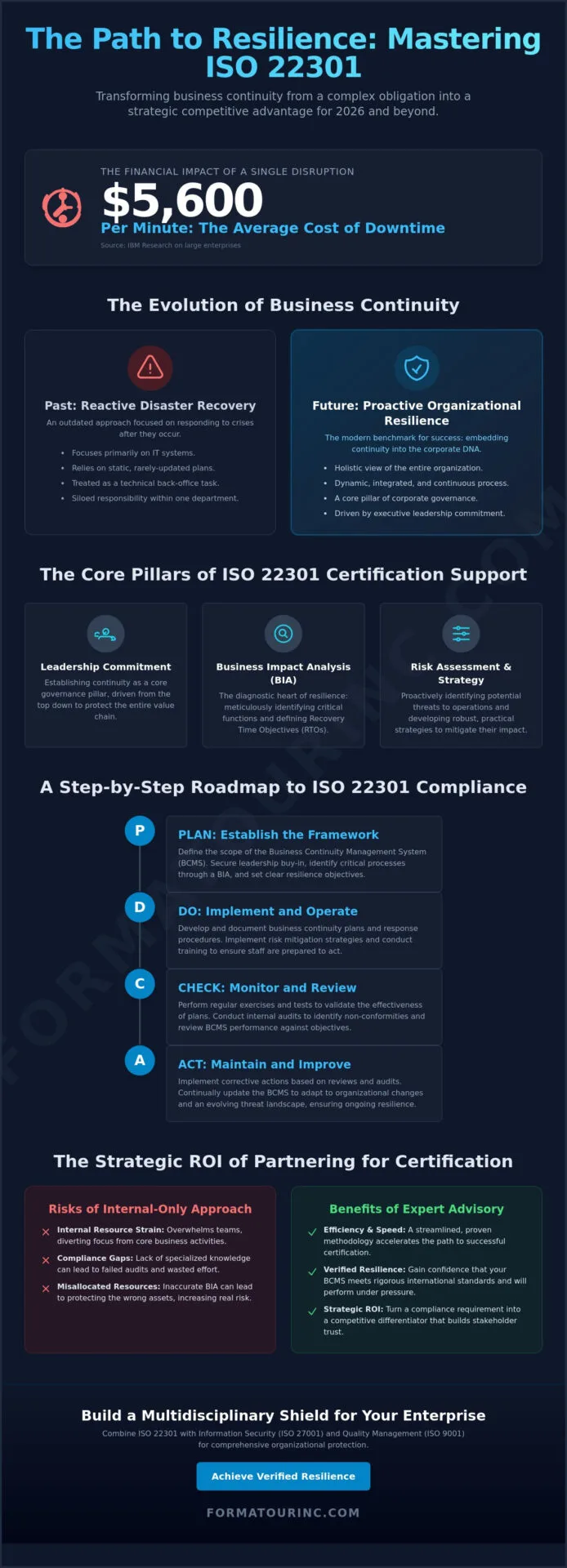
A Step-by-Step Roadmap to ISO 22301 Compliance
Achieving compliance requires a methodical progression that extends far beyond simple administrative tasks. A successful journey depends on a structured roadmap that integrates the Plan-Do-Check-Act (PDCA) cycle into the very fabric of the organization. This iterative process ensures that your Business Continuity Management System (BCMS) is not a static document but a living, evolving entity. Comprehensive ISO 22301 certification support guides leadership through each phase, from the initial discovery to the final certification audit. It provides the technical precision needed to meet international benchmarks while maintaining operational agility. By following this logical flow, firms move from a state of vulnerability to one of verified reliability.
Gap Analysis: Identifying the Resilience Deficit
The process begins with a rigorous benchmarking exercise. We evaluate your current capabilities against the specific requirements of the standard to identify exactly where your resilience deficit lies. A clear remediation plan then prioritizes high-risk areas, ensuring that resources are allocated where they will have the most significant impact on stability. Because this phase often requires shifts in organizational behavior, integrating strategic change management consulting is essential for navigating these transitions smoothly. This ensures that the technical changes are supported by the necessary cultural shifts.
Before the external certification body arrives, an internal audit serves as a critical dress rehearsal. This phase is designed to uncover any remaining non-conformities in a controlled environment. It allows your team to test the effectiveness of the business continuity plans and refine response protocols without the pressure of a formal assessment. Following this, a management review ensures that the BCMS remains aligned with the strategic direction of the firm. This board-level oversight is vital for the long-term health and sustainability of your resilience program. It confirms that the system is performing as intended and delivering real value to the organization.
Training and Culture: Empowering the Workforce
Resilience is ultimately a human endeavor. Awareness training for all staff members ensures that every employee understands their role during a disruption. For business continuity coordinators, specialized training provides the deeper technical expertise required to manage the BCMS lifecycle effectively. This investment in professional development enhances the overall capacity of the workforce to adapt to unforeseen challenges. When employees are empowered with knowledge, they become an active part of the organization’s defense mechanism. If you are ready to secure your organization’s future with a verified resilience framework, reach out to our advisory team to begin your roadmap today.
The Formatour Advantage: Multidisciplinary Resilience for Global Firms
Formatour Incorporated stands as a premium Canadian advisory firm dedicated to the stability and growth of global organizations. We provide a level of ISO 22301 certification support that transcends basic compliance, positioning resilience as a core driver of executive strategy. Our approach recognizes that a business continuity plan is only as strong as the governance framework supporting it. By choosing a partner with boutique agility, you receive tailored, project-specific guidance that addresses your unique operational risks while meeting the highest international standards. We don’t just deliver a manual; we help you build a high-performance culture that thrives under pressure.
Integrating Quality, Security, and Continuity
Efficiency in 2026 requires a consolidated approach to governance. We manage multiple ISO standards, including ISO 9001 and ISO 14001, to reduce redundant work and streamline your internal resources. The synergy between ISO 27001 Information Security Management and ISO 22301 Business Continuity is particularly vital. Cyber threats represent a significant disruption risk for modern enterprises, making integrated security and continuity non-negotiable. Our expertise in digital transformation and process automation ensures that your resilience framework is built into your technological evolution. This multidisciplinary perspective allows us to co-develop solutions that align perfectly with your long-term strategic vision and operational reality.
Expert Auditing and Implementation Services
Our auditing process is designed for sustained compliance rather than a one-time pass. We provide a steady, expert hand that guides you through the complexities of international benchmarks with quiet confidence. This rigorous methodology ensures that your BCMS remains effective long after the initial audit is complete. Beyond implementation, we offer international seminars and executive leadership development programs to foster a culture of continuous growth within your team. This focus on human capital ensures that your leadership remains knowledgeable about forward-thinking trends and global benchmarks. Formatour acts as a visionary architect for your organizational health, providing the assurance of success through meticulous planning and unwavering reliability. We invite you to explore our comprehensive advisory services and begin building a more resilient future today.
Securing Your Organizational Legacy through Verified Resilience
Resilience is no longer a defensive posture; it’s a foundational element of modern executive leadership. By moving beyond reactive disaster recovery and embracing a proactive Business Continuity Management System, your organization gains the stability required to navigate a volatile global market. Expert guidance ensures that this transition is both seamless and strategically aligned with your long-term commercial objectives. It’s about protecting your brand equity while optimizing the very processes that drive your daily success.
Formatour Incorporated brings over a decade of multidisciplinary advisory experience to your resilience journey. As a premium Canadian firm with deep expertise across ISO 9001, 27001, 22301, and 14001, we provide the steady hand needed to integrate quality, security, and environmental management into a single, high-performance framework. For organizations seeking a deeper understanding of how professional ISO 22301 business continuity consulting transforms vulnerability into strategic advantage, our comprehensive guide provides the roadmap you need. We invite you to partner with Formatour for ISO 22301 certification support and transform your organizational resilience into a verified competitive advantage. Your path to a secure and sustainable future begins with a single strategic decision, and we’re ready to facilitate your progress.
Frequently Asked Questions
What is the primary difference between ISO 22301 and a standard disaster recovery plan?
ISO 22301 establishes a comprehensive Business Continuity Management System (BCMS) that encompasses the entire organization, including people, physical facilities, and supply chain dependencies. In contrast, a standard disaster recovery plan focuses specifically on the technical restoration of IT systems and data after a failure. While disaster recovery is a component of the broader standard, ISO 22301 ensures that the business remains operational through any type of disruption.
How long does the ISO 22301 certification process typically take with professional support?
Engaging professional ISO 22301 certification support typically streamlines the implementation timeline to between six and nine months. Organizations attempting to navigate the process internally often face timelines exceeding 18 months due to the complexity of the requirements and the learning curve involved. Expert guidance identifies potential non-conformities early, ensuring a more efficient path to a successful final audit.
Can ISO 22301 certification support help reduce our corporate insurance premiums?
Many insurance providers recognize ISO 22301 as a rigorous risk mitigation benchmark, which often leads to more favorable terms or reduced premiums for certified firms. By providing verifiable proof of your ability to maintain critical functions during a crisis, you reduce the insurer’s potential liability. Professional support ensures your framework is robust enough to satisfy the strict due diligence requirements of global insurance underwriters.
How does ISO 22301 integrate with other standards like ISO 27001 or ISO 9001?
ISO 22301 utilizes the same High-Level Structure (HLS) as ISO 27001 and ISO 9001, which allows for the seamless integration of management systems. This shared architecture reduces redundant documentation and enables leadership to manage quality, security, and continuity under a single governance framework. Integrating these standards creates a multidisciplinary shield that protects the organization from a wider array of operational and digital threats.
What are the most common challenges organizations face during ISO 22301 implementation?
The most frequent hurdles include securing sustained leadership commitment and managing the heavy documentation workload required for compliance. Many firms also struggle to conduct a truly data-driven Business Impact Analysis without external expertise to quantify the financial effects of downtime. Overcoming these challenges requires a clear roadmap and the strategic allocation of internal resources to ensure the BCMS becomes part of the corporate culture.
Is ISO 22301 certification mandatory for Canadian businesses in specific sectors?
While not a universal legal requirement, certification is increasingly mandated by regulatory bodies in the Canadian financial, healthcare, and utility sectors to ensure the availability of essential services. Beyond regulation, many global supply chain partners now require ISO 22301 as a condition for long-term contracts. This trend reflects a growing market demand for verified reliability in an increasingly volatile global economy.
How often does an organization need to undergo re-certification for ISO 22301?
ISO 22301 certifications operate on a three-year cycle to ensure the management system remains effective and relevant. Organizations must undergo annual surveillance audits to verify continued compliance and address any minor operational shifts. At the end of the third year, a full re-certification audit is performed to renew the certificate and confirm the long-term health of the business continuity program.
What is the role of the Business Impact Analysis (BIA) in the certification process?
The Business Impact Analysis serves as the foundational diagnostic tool that identifies which business functions are critical to survival. It establishes precise Recovery Time Objectives (RTOs) by analyzing the consequences of disruption over time. A well-executed BIA ensures that your recovery strategies are prioritized based on actual risk, providing the data necessary to make informed investment decisions regarding ISO 22301 business continuity consulting and organizational resilience.
