

The most significant risk to your organization isn’t a line of malicious code, but a gap in strategic leadership at the highest level. Many leaders feel trapped between the technical jargon of IT departments and the growing weight of personal liability for data breaches. This guide provides the essential information security governance training for executives needed to bridge that gap. We understand that your role isn’t to manage firewalls, but to manage risk and ensure that every security dollar spent delivers a measurable return on investment.
It’s natural to feel overwhelmed when security discussions become buried in technical complexity. You’ve likely spent years building a reputation that you don’t want to see tarnished by a single oversight. We’ll show you how to master the transition from technical oversight to strategic security leadership through a structured framework for decision making. By aligning your strategy with ISO 27001 and global standards, you’ll gain the confidence to lead board-level reporting with clarity. This guide explores the pillars of effective governance, ensuring your security posture supports long-term growth and organizational resilience.
Key Takeaways
- Distinguish between strategic governance and technical management to ensure your security posture supports long-term organizational growth.
- Define a clear risk appetite at the board level to align information security budgets with tangible business ROI.
- Explore the non-negotiable pillars of information security governance training for executives to bridge the communication gap between IT departments and the C-Suite.
- Follow a five-step roadmap to integrate security governance into your broader corporate strategy, starting with a high-level gap analysis.
Defining Information Security Governance in the Modern C-Suite
Information security governance isn’t a technical checklist; it’s the strategic framework that directs and controls an organization’s security efforts. While management focuses on the “how” (the specific tools and tactics used to defend the perimeter), governance addresses the “what” and “why”. It ensures that security initiatives aren’t isolated IT projects but integral components of the corporate mission. For many leaders, ISO 27001 implementation services provide the perfect entry point for this structural shift. This international standard offers a blueprint for building a resilient culture where security is woven into the very fabric of daily decision making.
As we move through 2026, the stakes have evolved significantly. Boards are no longer shielded by plausible deniability regarding cyber incidents. They’re now held legally and ethically accountable for data resilience across the entire enterprise. This shift demands a deeper understanding of Information Governance, which connects security and compliance with broader risk management and business continuity goals. Comprehensive information security governance training for executives helps leadership move past the “IT silo” problem, ensuring that security budgets are seen as strategic investments in stability rather than mere cost centers.
The Three Pillars of Executive Security Oversight
Successful oversight rests on three fundamental pillars that transform security from a technical hurdle into a business driver. First, strategic alignment ensures that every security measure directly supports and enables business objectives. Second, value delivery focuses on optimizing security investments to achieve maximum ROI, ensuring resources are allocated where they mitigate the most critical risks. Finally, accountability establishes clear, documented roles from the Board level down to the operational IT teams. Without these pillars, even the most sophisticated technology won’t protect an organization from systemic failure or long-term reputational damage.
Why 2026 is the Year of the ‘Resilient Leader’
The current global landscape demands a new archetype: the resilient leader. With digital transformation accelerating across every sector, executive liability has expanded beyond traditional financial oversight to include the integrity of the digital ecosystem. Targeted information security governance training for executives prepares these leaders to maintain market confidence during periods of intense volatility. It provides the strategic foresight needed to navigate unforeseen geopolitical shifts and technological disruptions. By mastering these concepts, leaders can transform security from a reactive burden into a proactive competitive advantage that attracts partners and reassures stakeholders.
Core Training Modules for Information Security Leadership
Effective information security governance training for executives moves beyond theoretical models to focus on the practical realities of high-level leadership. It’s not enough to understand that threats exist; leaders must know how those threats impact the bottom line. This requires a curriculum centered on applied learning, utilizing real-world case studies to demonstrate how governance decisions affect organizational health. By integrating these modules with leadership training for digital transformation, executives can ensure that security becomes an accelerator for innovation rather than a roadblock.
A critical component of this training involves mastering the distinction between risk appetite and risk tolerance. Risk appetite defines the broad level of uncertainty your organization is willing to accept to achieve its strategic goals. In contrast, risk tolerance represents the specific, granular boundaries for acceptable variation from those goals. Mastering this balance allows executives to align security spending with the actual risk profile of the business, ensuring that resources aren’t wasted on low-impact vulnerabilities.
Risk Management and Decision-Making Frameworks
Leaders don’t need a computer science degree to interpret a risk register, but they do need a framework for prioritization. Training should demystify international standards like ISO 31000 and the NIST Cybersecurity Framework, focusing on how these structures support corporate strategy. The goal is to move from qualitative descriptions to quantitative analysis. By translating cyber risk into financial terms, such as potential loss of revenue or recovery costs, executives can provide the CFO with the data needed for informed budget allocation. This clarity transforms security spend into risk mitigation investment.
Incident Response and Crisis Leadership
The first 48 hours of a security breach are the most critical for an executive’s career and the company’s reputation. Governance training prepares leaders to step into the role of crisis manager, focusing on stakeholder communication and legal protection. It’s about balancing transparency with the need to protect the organization’s interests. Once the immediate threat is neutralized, the focus shifts to post-incident governance. This involves leading the recovery phase and ensuring that lessons learned are integrated into the next iteration of the security strategy. If you’re looking to refine your leadership approach, you might speak with a strategic advisor to evaluate your current governance readiness.
Governance vs. Management: Why Technical Training Isn’t Enough
Governance and management represent two distinct functions that must work in tandem to ensure organizational resilience. While management is concerned with the operational execution of security protocols, governance provides the strategic direction and oversight. When these roles are blurred, or when leadership treats security as a purely technical concern, the entire system becomes vulnerable. It’s a common misconception that a strong IT department is a substitute for executive involvement. In reality, the most sophisticated technical defenses will falter if they aren’t guided by a clear, board-level mandate.
Many Chief Information Security Officers (CISOs) fail not because of technical incompetence, but because they lack the institutional support that only a robust governance framework can provide. Security cannot be “outsourced” to a single department or treated as an IT silo. It’s a fundamental business risk that requires the same level of attention as financial or operational risk. This multidisciplinary approach is similar to the requirements for successful ISO 9001 quality management implementation, where quality is viewed as a shared responsibility across the entire organization rather than an isolated compliance task. Effective information security governance training for executives ensures that every leader understands their role in this integrated ecosystem.
The Executive Language Gap: Translating Bits to Business
A significant barrier to effective governance is the persistent language gap between technical teams and the boardroom. Technical professionals often present data in terms of vulnerabilities and patches. However, executives must translate these “bits” into business outcomes like market share protection and operational continuity. Training empowers leaders to bridge this gap. Instead of being overwhelmed by technical metrics, trained executives learn to ask the right questions during audits. They shift the conversation from technical minutiae to how specific risk profiles impact strategic objectives. This creates a culture where security is recognized as a shared business value rather than a technical burden.
Comparing Training Formats: Seminars vs. Long-term Coaching
Selecting the right educational path is essential for busy leaders. Intensive international seminars offer a high-impact environment for rapid knowledge acquisition and networking with global peers. These are ideal for establishing a foundational understanding of complex systems in a short timeframe. For more sustained growth, boutique advisory services provide bespoke executive leadership development that aligns with your specific organizational culture. While generic online modules might suffice for general staff, they often lack the nuance required at the C-suite level. Specialized information security governance training for executives should focus on long-term impact and the co-development of solutions that fit your unique business landscape.
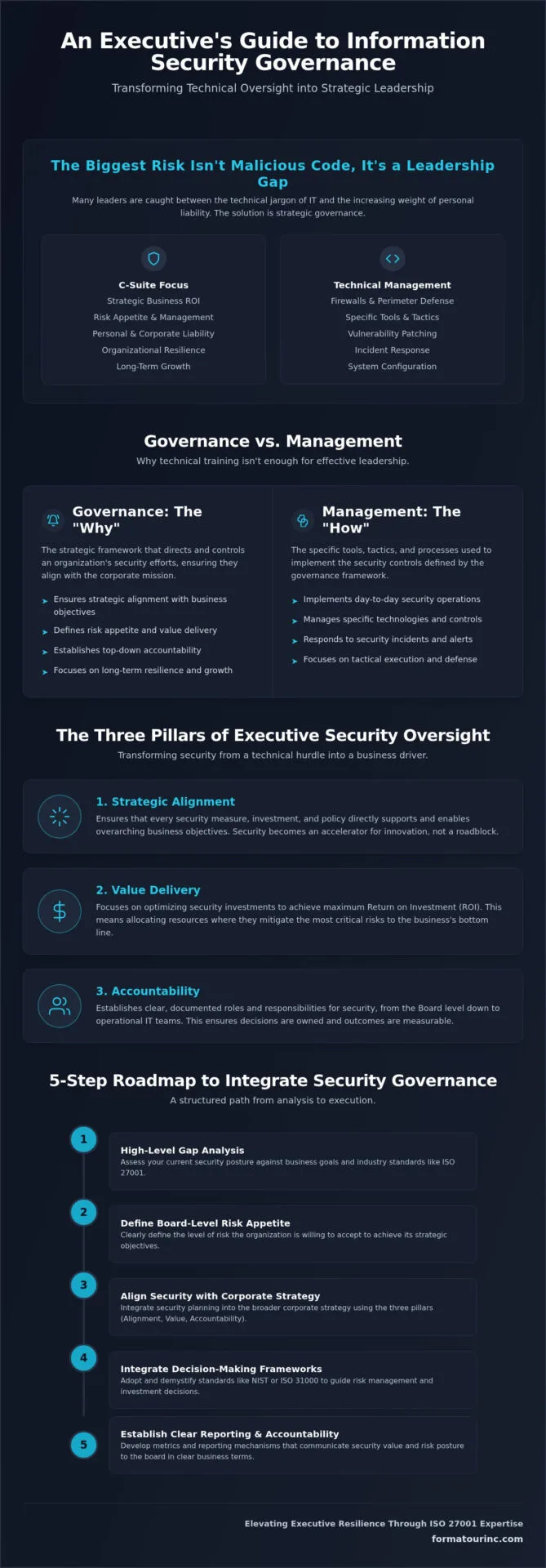
5 Steps to Integrating Security Governance into Corporate Strategy
Transformation doesn’t happen by accident. It requires a methodical approach to weave security into the very fabric of your business planning. Unlike technical training, which focuses on specific tools, information security governance training for executives provides the strategic framework to lead this integration. By following these five steps, you can move from reactive defense to proactive resilience.
- Step 1: Conduct a high-level governance gap analysis. Evaluate your current oversight mechanisms against international benchmarks to identify where strategic intent and operational reality diverge.
- Step 2: Define risk appetite at the board level. Establishing clear boundaries for acceptable risk allows your teams to innovate within safe parameters while ensuring compliance with global standards.
- Step 3: Align security KPIs with organizational performance. Shift your focus from technical metrics to business-centric indicators, such as the availability of critical services or the protection of intellectual property.
- Step 4: Empower a cross-functional security steering committee. Break down departmental silos by involving leaders from Legal, Finance, and HR in the security decision-making process.
- Step 5: Commit to continuous education and auditing. Maintain your edge by investing in ongoing training and periodic third-party reviews to validate your governance maturity.
Aligning Security with Organizational Performance
Modern organizations use security as a powerful market differentiator. When you can demonstrate a robust governance posture, you significantly increase your success rate in complex RFPs and build deeper trust with global clients. ISO certifications aren’t just about compliance; they’re engines for process optimization and operational excellence. By measuring success through resilience metrics, you can prove that your security investments are directly contributing to the organization’s long-term stability and growth. This strategic alignment ensures that security is viewed as a value-add rather than a sunken cost.
The Role of External Advisory in Strategy Execution
Even the most capable leadership teams benefit from an objective, external perspective. Engaging a boutique firm for ISO 22301 business continuity consulting provides the specialized expertise needed to ensure your organization can weather any disruption. Third-party auditing offers unbiased oversight, identifying blind spots that internal teams might overlook. Additionally, high-performing organizations often integrate these efforts with ISO 14001 certification services to ensure that their growth remains sustainable and environmentally responsible. If you’re ready to begin your transformation, reach out to our advisory team to schedule a strategic assessment.
Formatour: Elevating Executive Resilience through ISO 27001 Expertise
Formatour provides a multidisciplinary path to strategic transformation, positioning itself as a premium partner for organizations seeking both stability and growth. We recognize that true resilience isn’t found in a software suite but in the clarity of executive oversight. By delivering specialized information security governance training for executives, we empower leaders to navigate the complexities of the modern digital landscape with quiet confidence. Our methodology moves beyond surface-level compliance, treating international standards as a catalyst for deeper organizational evolution.
The Formatour Advantage: From Certification to Transformation
We utilize ISO 27001 as the fundamental foundation for establishing digital trust within your enterprise. This standard serves as more than a checklist; it’s a strategic framework that aligns your security posture with your broader business objectives. Formatour specializes in the co-development of solutions that integrate seamlessly into your daily operations, ensuring that governance becomes a natural extension of your leadership style. Our implementation and auditing services are specifically tailored for the C-suite, providing the precise data points needed for informed board-level reporting. This boutique agility allows us to provide Canadian and global firms with big-firm standards while maintaining the personalized focus of a dedicated mentor.
Next Steps: Securing Your Organization’s Future
Building a culture of resilience requires a commitment to continuous professional development. Formatour offers a comprehensive suite of international seminars and leadership programs designed to sharpen your strategic foresight. These sessions provide a collaborative environment where executives can explore forward-thinking trends and international benchmarks alongside their peers. By participating in our information security governance training for executives, you’re not just attending a course; you’re joining a global network of leaders dedicated to excellence.
The path to organizational health begins with a single strategic decision. We invite you to book an initial consultation to evaluate your current governance maturity and identify opportunities for optimization. Our expert team stands ready to guide you through the process of securing your organization’s future through precision and intelligence. Contact Formatour Inc. for Premium Advisory Services to begin your journey toward strategic transformation and enduring resilience.
Leading with Resilience in a Digital Age
Mastering the transition from technical oversight to strategic leadership isn’t just a professional milestone; it’s a requirement for organizational survival. By distinguishing between governance and management, you ensure that security becomes a driver of business value rather than a technical burden. Integrating these principles into your corporate strategy allows for a clear risk appetite and measurable ROI. Comprehensive information security governance training for executives provides the necessary framework to bridge the gap between IT departments and the boardroom, fostering a culture of accountability and digital trust.
Formatour brings over a decade of strategic transformation experience to every partnership. Our Canadian multidisciplinary advisory standards and ISO 27001 Lead Auditor expertise ensure that your leadership team receives the highest level of guidance. We co-develop solutions that align with international benchmarks while maintaining the agility of a boutique firm. We’re ready to help you optimize your governance structures for long term success.
Secure Your Board’s Future with Formatour’s Executive Advisory
Your organization’s future depends on the strategic foresight you cultivate today. Build a legacy of resilience that carries your business forward with confidence.
Frequently Asked Questions
What is the difference between cybersecurity training and information security governance training?
Cybersecurity training often focuses on technical skills, threat detection, or general employee awareness. In contrast, information security governance training for executives centers on the strategic framework, risk appetite, and oversight mechanisms required for board-level reporting. It moves beyond the “how” of technical defense to the “what” and “why” of organizational resilience and strategic alignment.
Does an executive need prior technical experience for governance training?
No technical background is necessary for this level of training. The curriculum is specifically designed to translate complex technical vulnerabilities into business risks and financial impacts. This allows leaders to focus on strategic decision making and resource allocation without needing to understand underlying code or network architecture. The goal is to empower leaders to lead, not to code.
How long does a typical executive security governance program take?
The duration depends on the desired depth of integration. Intensive international seminars typically last between three to five days for foundational knowledge. However, comprehensive leadership development programs often involve modular coaching sessions over several months. This steady pace ensures that governance principles are effectively woven into the organization’s daily operations and long-term strategy.
Is ISO 27001 certification mandatory for effective information security governance?
ISO 27001 isn’t strictly mandatory, but it’s the most recognized international benchmark for information security management. Using it as a foundation provides a clear, auditable structure for your governance efforts. It simplifies the path to compliance with various global regulations and demonstrates a commitment to excellence to your partners, clients, and stakeholders.
How can I measure the ROI of executive security training?
ROI is evidenced by a measurable decrease in the cost of security incidents and more efficient resource allocation. Successful information security governance training for executives also drives value through faster procurement cycles and enhanced client trust. When security is viewed as a business enabler, it directly contributes to the organization’s competitive advantage and long-term stability.
What is the board’s legal responsibility regarding information security in Canada?
Canadian boards have a fiduciary duty to manage material risks, which includes cybersecurity. Emerging regulations such as Bill C-26 emphasize the need for proactive oversight and accountability for critical infrastructure. This legal landscape means directors must be able to demonstrate that they’ve taken reasonable steps to protect the organization’s digital assets and maintain operational continuity.
How does governance training help with digital transformation strategy?
Governance training ensures that security is integrated into the design phase of every digital initiative. This prevents the “bolted-on” security approach that often stalls transformation projects. By aligning security with business goals, leaders can accelerate digital adoption while maintaining a resilient and compliant organizational posture that supports innovation without increasing unacceptable risk levels.
Can training be customized for specific industries like finance or manufacturing?
Bespoke training programs are frequently tailored to meet the specific demands of highly regulated sectors. Finance requires a focus on transaction integrity and strict data privacy, while manufacturing might prioritize operational technology (OT) resilience. Customization ensures that the governance framework addresses the precise threat landscape and regulatory requirements unique to your specific business environment.
