

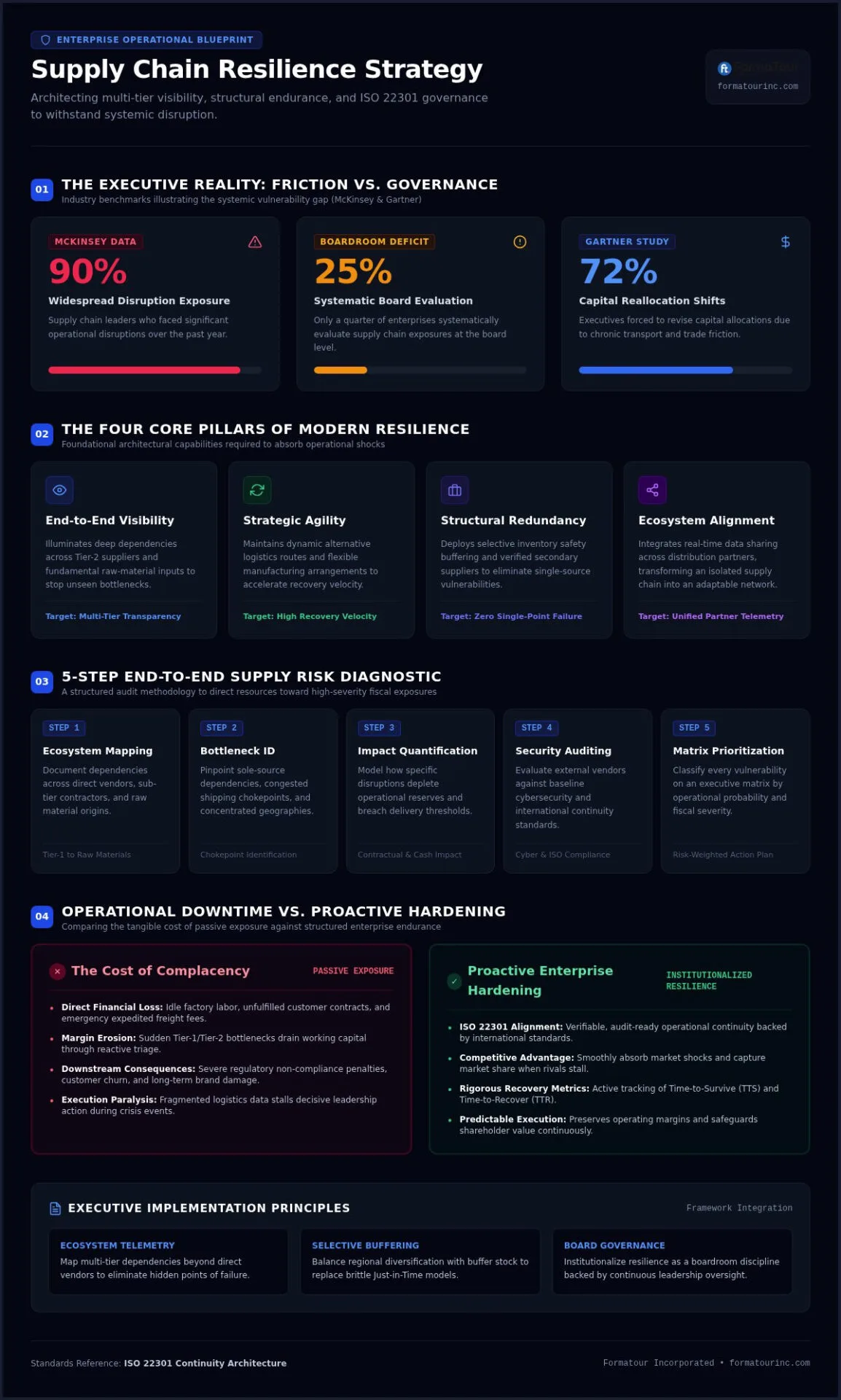
Stockpiling warehouse inventory will not protect your enterprise from systemic operational shocks. True endurance is forged through institutionalized governance, multi-tier visibility, and rigorous standards, not idle working capital. According to McKinsey, 90% of supply chain leaders faced significant disruptions over the past year, yet only 25% systematically evaluate these exposures at the board level. For executive teams facing chronic market friction, architecting a mature supply chain resilience strategy has quickly transitioned from a logistical contingency into an indispensable board-level mandate.
You’ve likely experienced the mounting frustration when sudden Tier-1 and Tier-2 bottlenecks erode margins, while fragmented logistics data stalls decisive action. In this guide, you’ll discover how to architect, implement, and govern an enterprise supply chain resilience strategy that withstands disruption and protects business continuity. We examine the exact roadmap needed to integrate international risk frameworks like ISO 22301, achieve multi-tier supplier transparency without sacrificing capital efficiency, and build an agile operating framework ready for 2026 and beyond.
Key Takeaways
- Map complex supplier ecosystems across Tier-1, Tier-2, and raw-material dependencies to eliminate hidden single points of failure.
- Balance selective inventory buffering with regional diversification to overcome the structural vulnerabilities of rigid just-in-time models.
- Deploy a phased operational roadmap that embeds workflow telemetry and cross-functional oversight into your enterprise supply chain resilience strategy.
- Anchor organizational continuity to established international frameworks like ISO 22301 to build verifiable, audit-ready operational endurance.
- Institutionalize resilience as a core boardroom discipline through structured executive leadership development and continuous risk governance.
What Is a Supply Chain Resilience Strategy and Why Does It Matter?
A supply chain resilience strategy is an enterprise’s structural capacity to anticipate unexpected disruptions, absorb operational shocks, and rapidly adapt without sacrificing continuity. While traditional risk management focuses on reactive containment after a failure occurs, true resilience re-engineers operating workflows to withstand ongoing pressure. Chronic geopolitical realignments, extreme climate patterns, and targeted cyber vulnerabilities mean that relying on linear, friction-free trade is no longer realistic. Embedding proactive governance directly protects revenue, safeguards shareholder value, and elevates an organization’s competitive positioning.
The Four Pillars of Modern Supply Chain Resilience
Modern operational continuity rests upon four core capabilities:
- End-to-End Visibility: Illuminating dependencies down to Tier-2 suppliers and material inputs prevents unseen bottlenecks before they stall production.
- Strategic Agility: Maintaining alternative logistics paths and flexible manufacturing arrangements accelerates recovery velocity during sudden trade restrictions.
- Structural Redundancy: Deploying safety buffers and secondary suppliers protects critical product lines against single-source failures.
Applying an institutionalized supply chain resilience framework allows leadership to track recovery metrics like time-to-survive and time-to-recover. Rather than viewing resilience as a software dashboard or static inventory stockpile, forward-thinking organizations treat it as an executive governance discipline supported by continuous process optimization.
The Cost of Complacency: Operational Downtime vs. Proactive Hardening
Proactive hardening shifts this balance. Systematically strengthening operational protocols through structured continuity programs, such as those guided by Formatour Incorporated, transforms operational defense into measurable enterprise value. Organizations that replace improvised triage with rigorous continuity standards absorb shocks smoothly, capture market share when competitors stall, and preserve operating margins through predictable execution.
Conducting an End-to-End Supply Risk Assessment
Architecting an effective supply chain resilience strategy requires an unvarnished audit of your operational exposure. Many executive teams discover systemic vulnerabilities only after a single-source partner halts production or an export restriction takes effect. A repeatable diagnostic methodology provides leadership with the clarity needed to direct resources toward the vulnerabilities that threaten cash flow most.
To harden operations effectively, organizations follow a five-step diagnostic framework:
- Ecosystem Mapping: Document dependencies across direct vendors, sub-tier contractors, and fundamental raw-material sources.
- Bottleneck Identification: Pinpoint sole-source dependencies, congested shipping chokepoints, and concentrated geographic clusters.
- Impact Quantification: Determine how specific interruptions affect operational reserves, regulatory compliance, and contractual delivery thresholds.
- Compliance and Security Auditing: Evaluate external vendors against baseline cybersecurity protocols and international continuity standards.
- Matrix Prioritization: Classify every vulnerability on an executive risk matrix based on operational probability and fiscal severity.
Mapping Beyond Tier-1: Uncovering Hidden Dependencies
While McKinsey reports that 95% of organizations track primary supplier exposure, only 42% maintain visibility into Tier-2 operations and beyond. Blind spots deep in your value network frequently cause the most protracted supply disruptions. Modern diligence combines automated tracking tools with direct contractual verification. Aligning your discovery processes with established NIST supply chain risk management guidelines ensures rigorous baseline standards across all third-party software, sub-tier manufacturers, and regional transport providers.
Conducting a Supply-Side Business Impact Analysis (BIA)
A supply-side Business Impact Analysis shifts resilience from abstract theory into precise financial metrics. It establishes your Maximum Tolerable Downtime across key revenue drivers and quantifies operational losses per hour of downtime. When you integrate these findings into an enterprise risk register, capital allocation becomes straightforward. Executive teams ready to identify critical single points of failure can schedule a strategic continuity consultation to systematically evaluate their sub-tier dependencies.
Core Strategic Architectural Models: Redundancy, Agility, and Diversification Compared
Decades of prioritizing hyper-lean, just-in-time delivery created fragile supply networks that break under unexpected stress. Pure efficiency isn’t enough anymore. When transit corridors stall or export restrictions tighten, organizations running zero-inventory models face immediate production shutdowns. Stockpiling excessive inventory is equally flawed, as it ties up valuable working capital in static assets. An effective supply chain resilience strategy harmonizes three primary capabilities: selective redundancy, structural agility, and geographical diversification. Modern enterprises resolve this tension by adopting hybrid sourcing models that combine offshore volume production with responsive regional manufacturing hubs.
Nearshoring and Regionalization vs. Global Cost Optimization
Evaluating sourcing purely through baseline purchase prices overlooks the hidden costs of extended freight corridors. A thorough total cost of ownership analysis accounts for holding expenses, fluctuating maritime tariffs, and the revenue lost during transit delays. Data from McKinsey indicates that 43% of enterprises plan to expand their sourcing or manufacturing footprint across North America to mitigate exposure to single overseas markets. Anchoring production within regional trade blocs compresses fulfillment cycles from months to days. As detailed in a Harvard Business Review analysis on supply network resilience, regionalized manufacturing shields operations from unilateral border restrictions while maintaining the operational flexibility required to meet sudden demand surges.
Multi-Sourcing and Strategic Buffering: Managing the Working Capital Trade-off
How to Implement a Resilient Supply Chain: A Phased Operational Roadmap
Transforming enterprise logistics from a reactive posture into an adaptive network demands a disciplined, phased execution model. A successful supply chain resilience strategy aligns technical integration with institutional governance, ensuring that every operational layer supports business continuity. Organizations achieve sustainable transformation by progressing through four structured implementation phases:
- Phase 1: Cross-Functional Governance: Unify procurement, risk management, legal counsel, and IT leadership under a single operational steering committee.
- Phase 2: Telemetry and Workflow Digitization: Deploy digital tracking across critical handoffs to replace manual reporting with verified operational milestones.
- Phase 3: Management System Formalization: Anchor operational continuity protocols to internationally recognized, audit-ready management standards.
- Phase 4: Empirical Simulation and Testing: Subject the operating architecture to controlled disruptions to measure real-world recovery capabilities.
Aligning Supply Architecture with ISO Standards and Operational Continuity
True operational durability requires structured management frameworks rather than ad hoc responses. Organizations embed structured recovery workflows by leveraging expert ISO 22301 business continuity consulting. As logistics systems become increasingly interconnected, securing external data exchanges through certified ISO 27001 implementation services protects proprietary data across partner networks. Concurrently, applying rigorous ISO 9001 quality management implementation guarantees that secondary suppliers maintain uncompromising quality parameters during sudden production shifts.
Executing Stress Tests and Disruption Simulations
Paper-based continuity plans rarely survive complex logistical shocks. Enterprise resilience must be stress-tested through structured crisis simulations that mimic real-world friction. Leadership teams should run cross-functional tabletop exercises that model critical vendor bankruptcies, sudden maritime chokepoints, or sudden regional export curbs. Tracking metrics like mean time to detect and mean time to recover during these exercises exposes operational bottlenecks before an actual crisis hits, allowing teams to refine mitigation playbooks with confidence.
Integrating Advanced Digital Tooling and Automation
Modernization bridges the gap between high-level continuity policies and daily execution. Automated freight tracking and automated inventory monitoring give decision-makers immediate clarity during transit delays. To benchmark your technical roadmap, review our executive guide to digital transformation strategy firms. When you’re ready to engineer a robust supply chain resilience strategy that unites digital precision with certified continuity standards, speak with our strategic advisors.
Institutionalizing Resilience: Governance, Executive Leadership, and Advisory Support
Resilience collapses when treated merely as a transactional purchasing concern. To sustain long-term continuity, enterprises must elevate their supply chain resilience strategy into a permanent governance discipline reviewed directly by executive leadership and the board of directors. Static annual audits leave organizations blind to emerging vulnerabilities. Modern board oversight instead relies on dynamic Key Risk Indicators and cross-functional operational scorecards that monitor vendor solvency, lead-time variances, and geopolitical exposures in real time.
Transforming strategy into practice requires clear executive accountability. When leadership establishes shared operational metrics across divisions, resilience shifts from an abstract aspiration into daily operational execution.
Cultivating Leadership Capability and Cross-Functional Alignment
Resilience isn’t just a technical challenge; it’s a leadership imperative. Operations directors need structured executive education in scenario modeling, crisis mitigation, and decisive stakeholder communication. Crucially, organizations must dissolve legacy silos separating procurement, legal compliance, and logistics teams. When procurement focuses exclusively on unit costs while legal operates in isolation on regulatory mandates, systemic blind spots multiply. Forward-thinking enterprises eliminate this friction by pairing traditional cost targets with supply stability metrics in executive performance reviews.
The Role of Specialized Advisory in Transforming Enterprise Operations
Internal reviews frequently fall victim to institutional confirmation bias. Engaging independent advisory experts provides an unvarnished assessment of your operational landscape, revealing sub-tier bottlenecks that internal audits overlook. Specialized advisors accelerate compliance with international standards, helping organizations integrate rigorous continuity controls into their operational culture. Formatour Incorporated pairs boutique agility with premier management consulting to guide executives through complex operational transformations. To institutionalize an enduring supply chain resilience strategy across your global footprint, contact our advisory team.
Architecting an Enduring Operational Advantage
Enduring operational continuity requires moving beyond reactive crisis management. A truly robust supply chain resilience strategy establishes deep visibility across sub-tier networks, balances strategic safety buffers with regional diversification, and embeds audit-ready frameworks into core governance. Organizations that treat resilience as an enterprise discipline don’t just survive global turbulence; they protect margins and seize market share when fragile competitors falter.
Executing this transformation demands specialized expertise and proven governance structures. Formatour Incorporated delivers multidisciplinary Canadian advisory services, uniting deep specialization in ISO 22301 and ISO 27001 with executive leadership development programs designed to align board vision with rigorous audit standards. To build an agile, defensible operational network ready for tomorrow’s challenges, partner with Formatour to design and implement your resilient supply chain strategy.
Frequently Asked Questions
What is the primary difference between supply chain agility and supply chain resilience?
Supply chain agility represents the speed and operational flexibility needed to respond to short-term changes in demand or supply, such as rapidly rerouting freight. Resilience is a broader structural discipline. It encompasses an organization’s systemic capacity to absorb severe shocks, maintain operational continuity, and reconfigure its entire ecosystem during sustained market crises without failing critical commitments.
How does an organization build supply resilience without significantly inflating working capital?
Enterprises prevent capital bloat by implementing strategic, targeted buffering rather than indiscriminate bulk stockpiling. By standardizing component designs across multiple product lines, teams can switch between alternate manufacturers without accumulating redundant inventory. A mature supply chain resilience strategy focuses on establishing pre-qualified vendor contracts and active secondary relationships, securing emergency manufacturing capacity rather than locking cash in warehouse pallets.
What role do international management standards like ISO 22301 play in supply chain resilience?
Standards like ISO 22301 provide an internationally recognized framework that standardizes business continuity planning, incident mitigation, and operational recovery. Adopting certified systems ensures that continuity practices aren’t isolated inside departmental spreadsheets. Instead, it embeds auditable, cross-functional risk governance throughout daily operations, establishing clear accountability across procurement, information security, and executive leadership.
How far down the supply tiers should an enterprise risk assessment extend?
Enterprise assessments must reach at least Tier-2 and critical raw-material suppliers. While direct Tier-1 suppliers maintain immediate commercial relationships, systemic disruptions often stem from lower-tier component manufacturers and regional processing nodes. Comprehensive mapping down to raw material inputs reveals hidden bottlenecks, allowing leadership to address sole-source dependencies before regional crises freeze upstream production.
What are the most effective metrics for measuring supply chain resilience?
The most actionable resilience metrics focus on operational velocity and recovery thresholds rather than simple unit costs. Key performance measures include Time-to-Survive (how long an organization can operate during a total supplier shutdown), Time-to-Recover (the duration required to restore full production capacity), and Mean Time to Detect emerging supply anomalies across digital telemetry points.
How can companies identify single points of failure in their supplier ecosystem?
Organizations uncover single points of failure by conducting multi-tier dependency audits combined with a formal Business Impact Analysis. This process cross-references supplier bills of materials with geographic logistics data. It pinpoints shared component manufacturers, vulnerable shipping corridors, and proprietary material dependencies where no pre-qualified secondary supplier exists.
Why do digital transformation initiatives fail to deliver supply chain resilience without organizational governance?
Digital tools only deliver visibility; they don’t resolve the underlying operational or governance failures. Without cross-functional alignment, clear crisis ownership, and executive leadership training, automated tracking dashboards simply display disruptions faster without enabling decisive action. True enterprise resilience requires pairing digital process optimization with structured executive governance and proven operational continuity frameworks.
