

A project can be busy from day one and still lack a shared purpose, clear boundaries, or authority to proceed. Learning how to write a project charter means more than filling in a template. It means getting agreement on why the work should happen, who will lead it, and what success will look like.
When objectives and expected outcomes aren’t aligned, planning can amplify uncertainty instead of resolving it. A charter gives the sponsor, stakeholders, and project manager a common reference point before detailed work begins. It’s a decision document, not a full project plan, so it should provide enough information to authorize the work without mapping every task.
This practical guide walks you through defining the project’s purpose, measurable objectives, scope and exclusions, roles, authority, key risks, and high-level timeline and budget. You’ll also learn how to keep the document concise and ready for a decision, so stakeholders can agree on boundaries and outcomes and the project manager has a clear foundation for planning.
Key Takeaways
- Learn how to write a project charter that gives stakeholders a clear basis for approving work before detailed planning begins.
- Separate authorization essentials from supporting context, then tailor the level of detail to the decision at hand.
- Use a step-by-step workflow to turn the project trigger into a review-ready charter with clear decisions and content.
- Choose a lean or more detailed format based on uncertainty, stakeholder needs, project risk, and governance requirements.
- Put an approved charter to work by using its objectives, boundaries, and assumptions to guide planning.
What Is a Project Charter, and What Does It Authorize?
Teams can start researching, assigning tasks, or committing resources before agreeing on why a project exists, who can make decisions, or where the work must stop. That activity may look like progress, but without shared direction, people can pursue different outcomes or make assumptions about authority. Knowing how to write a project charter starts with resolving these questions before detailed planning begins.
A project charter is an authorization document that establishes a shared basis for planning by defining the project’s purpose, intended outcome, leadership, and initial boundaries. Approval signals that the project has organizational backing and gives the project manager a mandate to coordinate work within the agreed direction. It does not specify every task or determine how the team will carry them out.
Think of the charter as a decision record, not an operating manual. A project to replace a customer database, for example, might be authorized to improve access to reliable customer information, with a named sponsor and project manager. The charter establishes the direction and authority to proceed. The delivery team develops the schedule, assigns activities, and selects execution methods during planning. The Project Charter overview also describes the document’s role in authorizing and framing project work.
What decisions should a project charter make clear?
A useful charter records the decisions stakeholders need to judge whether the project is worth authorizing and gives the project manager a clear starting mandate. At minimum, connect the business need to an intended outcome and identify the sponsor and project manager. These details establish why the work matters, who is accountable for sponsoring it, and who will coordinate it.
The charter should also state the initial boundaries and the authority being granted. For example, it might establish that a system replacement is intended to improve access to information while excluding unrelated process redesign from the current scope. This helps stakeholders agree on the approved direction without prematurely fixing detailed schedules, task assignments, or execution methods. Those decisions belong in later planning.
Why write the charter before project planning?
Planning depends on a common understanding of the problem and the outcome the work is meant to achieve. If stakeholders interpret the purpose differently, they may build plans around incompatible assumptions. Agreeing on the need, sponsor, project manager, and boundaries first gives the planning team a reference for shaping scope, estimating work, and identifying decisions that exceed its initial mandate.
Approval also clarifies ownership before resources and activities are organized. The charter doesn’t guarantee success or resolve every uncertainty. It creates a defined basis for addressing them. As planning develops, new information may require the team to revisit assumptions or seek a decision from the sponsor. Starting with an authorized direction helps distinguish a change in execution from a change in the project’s purpose.
Which Project Charter Components Define a Sound Foundation?
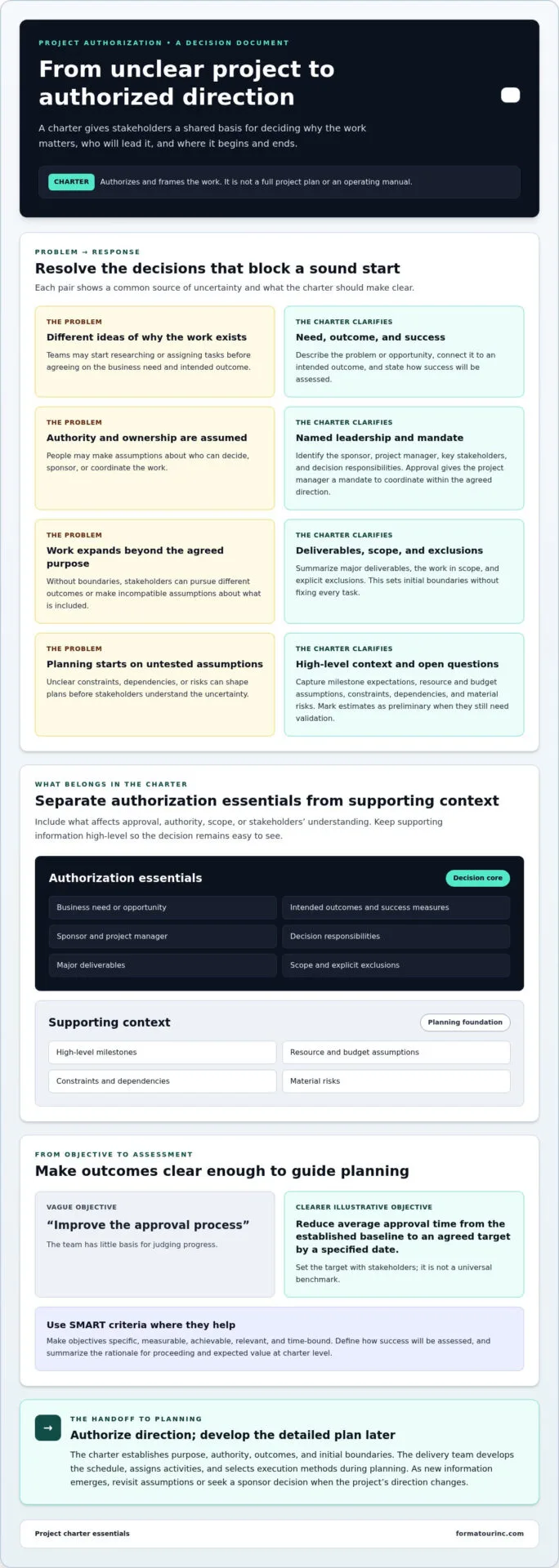
A charter should contain enough information for stakeholders to make an informed authorization decision, not every detail the team will eventually need. Prioritize what must be clear before work can be planned: why the project matters, what outcome it seeks, who holds authority, and where the initial boundaries sit.
The core components should establish why the project merits approval, what it is expected to achieve, who is accountable, and what limits guide the work. Supporting context helps stakeholders assess the decision, but shouldn’t obscure it.
- Authorization essentials: business need or opportunity, intended outcomes and success measures, sponsor, project manager, decision responsibilities, major deliverables, scope, and explicit exclusions.
- Supporting context: high-level milestones, resource and budget assumptions, constraints, dependencies, and material risks.
This hierarchy keeps the charter decision-ready. Include an item when it affects approval, authority, scope, or stakeholders’ understanding of the project. Label estimates as preliminary when they still need validation, rather than presenting them as commitments.
Set the strategic foundation: need, objectives, and success
Describe the problem or opportunity in terms stakeholders will recognize, then connect it to an outcome. A vague objective such as “improve the approval process” gives the team little basis for judging progress. A clearer illustrative version is “reduce average approval time from the established baseline to an agreed target by a specified date.” Set the target with stakeholders rather than treating it as a universal benchmark.
Use SMART criteria where they help make objectives specific, measurable, achievable, relevant, and time-bound. Define how success will be assessed, and summarize the business case at charter level: the rationale for proceeding and the expected value. Detailed analysis can follow during planning.
Establish boundaries: scope, people, resources, and risks
Name the sponsor, project manager, key stakeholders, and decision-makers. Summarize major deliverables, the work considered in scope, and explicit exclusions. Then add milestone expectations, resource assumptions, constraints, and risks that could affect authorization or planning. Keep this at a high level rather than turning it into a task schedule. State what remains uncertain so stakeholders can distinguish an initial estimate from a confirmed commitment.
To decide how much detail to include, start with unresolved approval questions. If stakeholders need a clearer boundary, spell out inclusions and exclusions. If a resource estimate remains uncertain, label its basis and state when it will be validated. For project management and strategic consulting support in shaping governance and planning, explore project management support.
How to Write a Project Charter Step by Step
A reliable drafting process turns a project trigger into a document stakeholders can review and decide on. Before writing, gather the available background and identify who can authorize the work. Then build the charter in a deliberate sequence, resolving high-impact questions before polishing the wording. This is how to write a project charter without letting a template dictate which decisions matter.
Move from the project need to a reviewed draft by documenting the rationale, authority, evidence, outcomes, boundaries, delivery context, and stakeholder decisions.
- Describe the trigger. State the problem or opportunity that prompted the proposed work and why it merits attention now. Use plain language and available evidence, such as a documented process concern or a strategic priority. Separate established facts from assumptions so readers can see what supports the request.
- Identify the people who shape and authorize the work. Name the proposed sponsor and project manager, then identify subject-matter experts and affected stakeholders who should contribute. Clarify what input each group provides. The sponsor should address strategic intent and authorization. Subject-matter experts can help test whether the proposed outcomes and boundaries are practical.
- Gather assumptions, constraints, and evidence. Record relevant information already available, along with known dependencies, limitations, and uncertainties. Ask contributors to distinguish evidence from expectation. If a resource estimate or timing assumption is preliminary, label it as such rather than letting the draft imply a firm commitment.
- Define outcomes and boundaries. Describe the intended results in observable terms and state how progress or success will be assessed. Then identify major deliverables, included work, and explicit exclusions. For example, a process review might include documenting current approval steps but exclude redesigning the wider operating model. This gives stakeholders a concrete basis for resolving scope questions.
- Summarize delivery context. Add high-level milestones, resource assumptions, constraints, and material risks that could affect authorization or subsequent planning. Keep this information at summary level. The goal is to disclose relevant conditions, not create a detailed schedule or assign every task before the project is approved.
- Check authority and accountability. Review the draft for clear decision ownership. Confirm who sponsors the project, who manages it, which decisions the project manager can make within the proposed mandate, and which require sponsor input. If a responsibility or approval path is unclear, mark it as an open decision to resolve.
- Review with the sponsor and affected stakeholders. Circulate the draft to people whose decisions, expertise, or work it describes. Ask them to check the rationale, outcome measures, scope, exclusions, assumptions, and responsibilities. Revise conflicting language and bring unresolved choices forward. Approval should resolve open decisions, not hide them behind vague wording.
Before presenting the document for approval, check that its key statements are consistent: the need supports the intended outcome, the outcome fits the boundaries, and the named authority matches the proposed responsibilities. A concise, reviewed draft gives stakeholders a clear decision to make and creates a sound starting point for detailed planning.
How Much Detail Should a Project Charter Include?
A useful charter doesn’t need to become a lengthy project plan. Its purpose is to make the authorization decision clear and establish boundaries for the work. Include enough detail for stakeholders to understand the project’s direction, authority, and main uncertainties, then develop execution detail during planning.
There’s no universal page count. Right-size the document by considering the decisions that remain, the number and needs of stakeholders, the level of uncertainty and risk, and the governance required. A straightforward initiative with agreed ownership may need a concise charter. Work involving dependencies, significant uncertainty, or multiple decision-makers may need clearer assumptions, responsibilities, and approval paths.
Choose a lean or detailed charter for the project context
Use the comparison as a decision aid, not a template requirement. Add detail where it resolves an approval question or reduces ambiguity. If a section doesn’t help stakeholders authorize, govern, or understand the work, it may belong in a later planning document.
| Consideration | Lean charter may suit | More detail may be needed when |
|---|---|---|
| Decisions and ownership | Authority and responsibilities are already clear | Several parties share or approve decisions |
| Scope and uncertainty | Boundaries and expected outcomes are well understood | Key assumptions, dependencies, or exclusions need agreement |
| Risk and governance | Risks are limited and oversight is straightforward | Material risks or formal review points affect authorization |
| Stakeholders | A small group can align on the project direction | Different groups need clarity on impacts or accountabilities |
For example, an internal process update with a clear sponsor and defined boundaries may need only a brief summary of the need, outcome, owner, scope, and key assumptions. If the same initiative depends on several teams and has unresolved resource or governance decisions, the charter should surface those issues before approval. Let decision complexity determine the level of detail, not an arbitrary document length.
Separate a charter from a proposal, plan, and statement of work
Document names vary across organizations, so focus on function. A proposal makes the case for undertaking work. It may inform the authorization decision, but it isn’t necessarily the document that grants authority. A charter records the approved direction and mandate. A project plan then explains how the team intends to execute the work, with more developed activities, timing, and coordination.
A statement of work describes agreed work, often by defining deliverables and responsibilities. Its relationship to a charter depends on the organization and project context. It may support or sit alongside authorization, but the title alone doesn’t establish which document approves the project. Confirm how your organization assigns these roles, then avoid repeating the same detail across documents without purpose.
For a complex initiative, project management support can help clarify the right level of governance and detail. Discuss your project management needs.
How to Approve a Project Charter and Put It to Work
Approval gives the charter practical force when the right people understand what they’re approving and the project team can refer to the decision afterward. Treat sign-off as a governance checkpoint, not a formality. The sequence is straightforward: resolve open issues, confirm authority, record the decision, and communicate the approved version.
Review, approve, and communicate the charter
- Check for internal consistency. Confirm that the objectives, scope, resources, milestones, and risks support the same project direction. For instance, a milestone shouldn’t imply a deliverable that the scope excludes.
- Resolve outstanding decisions. Make unclear responsibilities, conflicting expectations, and material assumptions visible. An assumption that still needs validation should remain labelled as an assumption, not be presented as settled fact.
- Confirm understanding and authority. Ensure the sponsor and relevant stakeholders understand the objectives, boundaries, decision responsibilities, and approval being requested. Verify that the approving person has authority to authorize the work under the organization’s governance process.
- Record and communicate approval. Capture the approval and its date in the organization’s chosen format, then share the final version with the people responsible for delivery and oversight. Identify which version is approved so teams don’t work from conflicting drafts.
Approval should settle the decisions required to proceed. If an important issue remains open, document its owner and how it will be resolved rather than using sign-off to conceal uncertainty. This preserves a reliable reference for the planning team and reduces the risk that stakeholders interpret approval differently.
Use the charter as a foundation for project governance
Once approved, use the charter to test later planning choices. If a proposed activity, resource request, or competing priority comes up, compare it with the authorized objectives and boundaries. A request that supports the intended outcome and fits the agreed scope can be considered through normal planning. A request that changes the project’s purpose or crosses an exclusion needs an explicit decision from the appropriate authority.
Change control makes those decisions visible. When a material shift affects objectives, scope, assumptions, or authority, record the proposed change, its rationale, and the decision. Update the charter when the change is approved, and communicate the revised version to affected stakeholders. Don’t silently rewrite the agreement. The record should show how the project’s mandate has evolved.
The charter remains a reference point, not a substitute for the project plan. Use it to keep execution connected to the approved direction while detailed plans guide day-to-day work. Organizations refining governance or strategic direction may also find Strategic Consulting and Support relevant. Formatour Incorporated provides project management and strategic consulting support to help organizations develop a practical approach suited to their needs.
Move from Authorization to Confident Planning
A charter creates value when its decisions shape the work that follows. Use the approved direction to guide planning conversations, clarify where decisions belong, and keep attention on the outcomes stakeholders agreed to pursue. If your organization is deciding how to write a project charter for a complex initiative, strengthening the governance and planning approach around it can be a useful next step.
Formatour Incorporated brings over 10 years of experience across public and private sectors, with Studies and Project Management among its services. Its practical, tailored approach is designed to support measurable, sustainable results. Organizations can also draw on its Strategic Consulting and Support to connect project direction with broader priorities.
Discuss your project management needs with Formatour Incorporated to identify a practical next step for your organization. Clear authorization sets a steady course for the work ahead, while a well-supported planning process helps your team move forward with purpose.
Frequently Asked Questions
Is a project charter legally binding?
Usually, a project charter is an internal authorization record, not automatically a legally binding contract. Its effect depends on its wording, who approves it, organizational policies, and whether it forms part of a separate agreement. For example, a charter approving an internal process review differs from a signed agreement with a supplier. If the document includes contractual commitments or will be relied on as an agreement, have the appropriate legal professional review it.
Can a project charter be changed after approval?
Yes. A charter can be revised when an authorized decision changes the project’s direction, boundaries, or mandate. Record what changed, who approved it, when the revision took effect, and which version is current. This creates a traceable record for people joining the work later. Minor planning refinements may not require a charter revision, but a change to the intended outcome or approved scope should follow the organization’s decision process.
Should a project charter include a detailed task list?
No. A detailed task list belongs in the project plan or, in an Agile setting, a backlog. Tasks are likely to change as the team learns more, so placing them in the charter can make an authorization document cumbersome to maintain. The charter can identify a major deliverable, such as a completed service redesign, while the delivery team later determines research activities, review sessions, and individual assignments.
Does every project need a project charter?
Not necessarily. The need and level of formality depend on organizational governance, project risk, and the decisions or resources involved. A small, low-risk piece of work may only need a brief written record of its purpose, owner, and approval. A cross-functional initiative with competing priorities generally benefits from clearer authorization. If you’re deciding how to write a project charter, scale its formality to the consequences of proceeding without shared direction.
Can an Agile project have a project charter?
Yes. An Agile project can use a charter to establish its purpose, intended value, sponsor, decision rights, and constraints while allowing the team to refine its solution as it learns. For example, the charter can describe the user outcome and agreed boundaries without fixing every backlog item in advance. The team can then prioritize work iteratively, escalating proposed changes that would alter the approved mandate.
What is the difference between a project charter and a statement of work?
A charter typically records internal authorization and the project’s overall direction. A statement of work (SOW) describes agreed work, often for a defined engagement between parties. For example, an organization might authorize an initiative through a charter, then use an SOW to specify services and deliverables in a supplier arrangement. Their relationship varies: an SOW may support a project, while the charter addresses a different governance decision.
