

The internal audit is often dismissed as a mere administrative hurdle, yet for Canadian executives, it’s the ultimate stress test for organizational resilience. You’re likely managing the weight of the ISO 27001:2022 transition while your internal teams are already stretched thin by daily operations. It’s nearly impossible to achieve the level of objective scrutiny required by Clause 9.2 when staff are essentially auditing their own systems. Utilizing an outsourced ISO 27001 internal audit Canada provides the impartial oversight necessary to identify hidden vulnerabilities before they become certification failures.
We recognize that your goal isn’t just to pass an audit; it’s to build a robust framework that supports digital transformation and aligns with the stringent requirements of the Protecting Privacy and Consumer Data Act. This guide will show you how to turn a compliance obligation into a high-level strategic asset. You’ll discover how specialized expertise ensures a successful certification journey, provides actionable security insights, and prepares your organization for the evolving Canadian regulatory environment.
Key Takeaways
- Understand how to satisfy the Clause 9.2 impartiality mandate through an outsourced ISO 27001 internal audit Canada, ensuring an objective evaluation of your security controls.
- Recognize the strategic ROI of internal auditing by transforming a standard compliance requirement into a catalyst for operational optimization and risk mitigation.
- Navigate the complexities of the 2026 Canadian privacy landscape, including Bill C-36, by aligning your ISMS with both global standards and domestic legislation.
- Implement a structured five-phase engagement framework that bridges the gap between technical security requirements and high-level executive business objectives.
- Leverage the multidisciplinary expertise of a strategic mentor to achieve a successful certification audit while supporting your organization’s digital transformation journey.
Navigating ISO 27001 Internal Audit Requirements in the Canadian Landscape
Compliance within the Canadian digital economy requires more than a superficial commitment to security. Organizations in major hubs like Toronto, Montreal, and Vancouver are finding that the ISO/IEC 27001 Standard serves as a critical bridge between internal governance and external trust. Under the 2022 revision, Clause 9.2 mandates that every organization conduct internal audits at planned intervals to ensure their Information Security Management System (ISMS) remains effective. This isn’t a suggestion; it’s a foundational requirement that must be completed before the Stage 2 certification audit. For many leaders, an outsourced ISO 27001 internal audit Canada is the most reliable way to secure an objective baseline of their security posture.
Your ISMS shouldn’t be a static document gathering dust. It’s a living framework that evolves alongside your digital transformation goals. By treating the internal audit as a strategic milestone rather than a checkbox, Canadian firms can identify gaps in their security controls early. This proactive approach ensures that the final certification audit is a validation of success rather than a discovery of failure.
The Core Requirements of Clause 9.2
The 2022 standard demands documented evidence that your audit program is both impartial and comprehensive. Internal auditing is the systematic process of evaluating an ISMS against the 2022 standard’s specific controls to verify that security objectives are being met. Auditor competence is a non-negotiable factor. If the individual performing the audit lacks the necessary technical depth or industry context, the resulting report may fail to satisfy the certification body’s expectations. Professional auditors provide the rigor needed to ensure your documented processes align with actual operational practices.
Data Sovereignty and Canadian Compliance
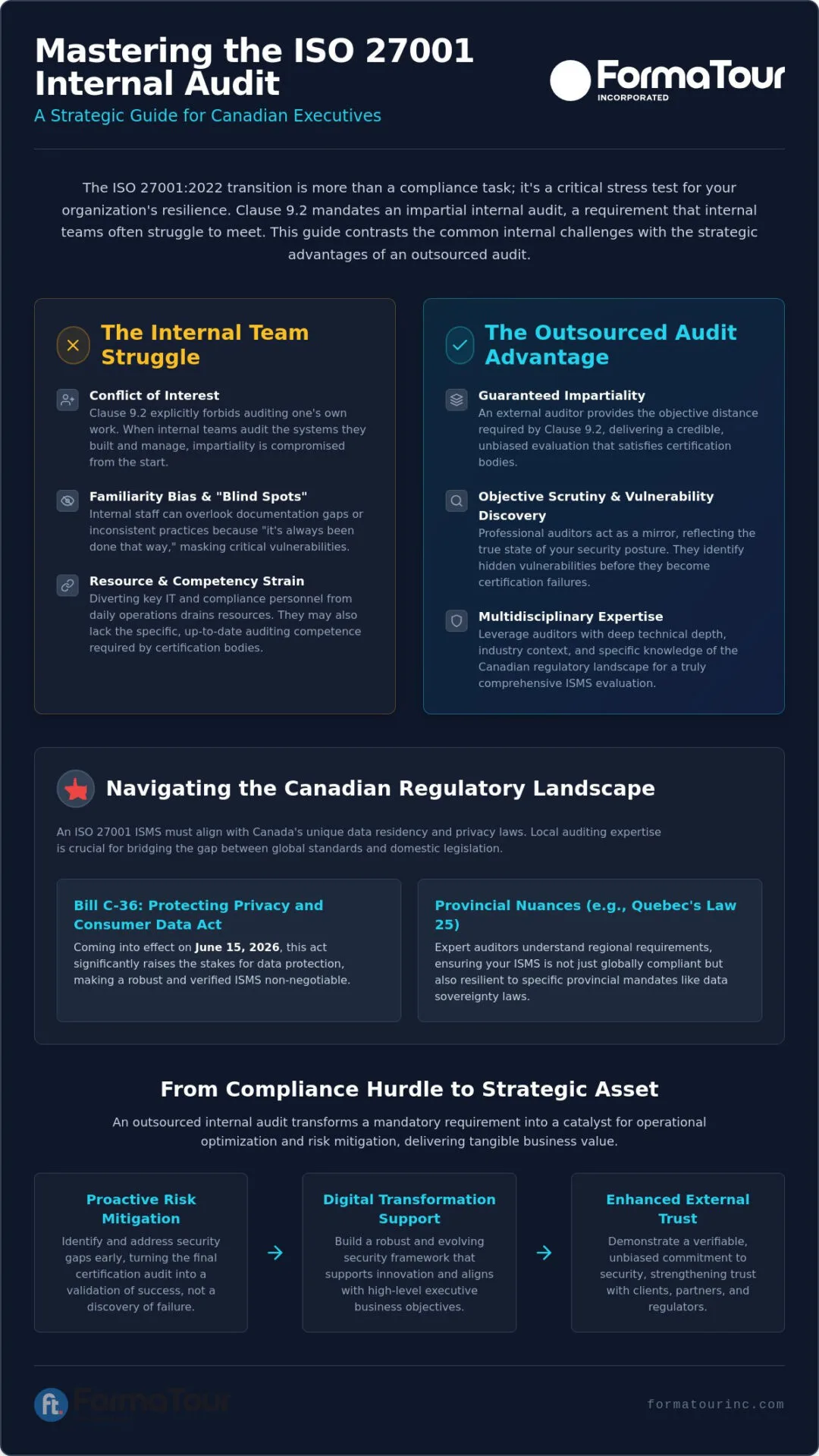
Canadian firms face a unique regulatory environment where data residency and privacy are paramount. With the introduction of Bill C-36, the Protecting Privacy and Consumer Data Act, on June 15, 2026, the stakes for data protection have never been higher. ISO 27001 provides the structural integrity needed to comply with the Digital Charter Implementation Act. Local auditors understand the nuances of Canadian data residency laws and provincial requirements like Quebec’s Law 25. Global firms operating within Canada prioritize local expertise to ensure their ISMS isn’t just globally compliant, but domestically resilient. An outsourced ISO 27001 internal audit Canada provides this specific regional insight, bridging the gap between international standards and local legal mandates.
The Impartiality Mandate: Why Internal Teams Often Struggle with Clause 9.2
Impartiality is the cornerstone of a credible Information Security Management System. Clause 9.2 of the ISO 27001:2022 standard explicitly requires that auditors do not audit their own work. For many organizations, this creates a significant structural paradox. When the individuals most capable of understanding the technical controls are the same ones who designed and implemented them, the audit’s integrity is compromised from the start. An outsourced ISO 27001 internal audit Canada removes this inherent conflict of interest, providing the objective distance required by certification bodies.
Beyond the strict regulatory language, familiarity bias poses a silent threat to organizational security. Internal staff often develop “blind spots” for gaps in controls they manage daily. They may overlook missing documentation or inconsistent practices simply because “that’s how we’ve always done it.” Professional external auditors act as a mirror, reflecting the true state of your security posture without the fog of internal assumptions. This rigor is essential for building The Business Case for ISO 27001, as it ensures that your compliance claims are backed by verifiable, unbiased evidence.
Resource allocation is another critical executive consideration. Diverting your internal IT or compliance teams to conduct a full-scale audit can take them away from core operations for several weeks. This loss of productivity often outweighs the perceived savings of a DIY approach. By leveraging an outsourced ISO 27001 internal audit Canada, you allow your technical talent to remain focused on innovation and digital transformation while experts handle the specialized task of compliance verification.
The Structural Impartiality Problem
Small to mid-sized Canadian firms rarely have the luxury of separate, independent departments large enough to audit one another effectively. Attempting to have one team lead audit another often leads to internal friction, especially when staff members are tasked with finding faults in the work of their peers or superiors. Outsourcing eliminates these social and political pressures. An external partner reports directly to leadership with total transparency, ensuring that findings are based on facts rather than office dynamics. If you’re concerned about how these structural requirements apply to your specific team size, speaking with a strategic advisor can clarify the best path forward.
Professional Competence vs. Internal Knowledge
While your internal team has deep knowledge of your specific infrastructure, they may lack the broad, cross-industry perspective that a seasoned auditor brings. External professionals have seen hundreds of ISMS implementations and understand how different organizations solve similar security challenges. This breadth of experience is vital because mastering the 93 controls of the ISO 27001:2022 standard requires dedicated auditing experience that goes beyond general IT management. A professional auditor identifies not just what is missing, but how your existing controls can be optimized for better performance and efficiency.
Evaluating the Strategic ROI of an Outsourced Internal Audit
Viewing the internal audit as a financial burden is a common executive oversight. In reality, a well-executed audit serves as a diagnostic tool for high-level strategic transformation. It provides a rare opportunity to look beneath the operational surface and identify structural weaknesses that hinder growth. By shifting the perspective from a cost-sink to a strategic investment, Canadian leaders can leverage the audit process to build a more resilient and competitive organization. An outsourced ISO 27001 internal audit Canada doesn’t just highlight security gaps; it clarifies the path toward long-term operational excellence.
Market competitiveness in Canada is increasingly tied to verifiable trust. Within the Canadian public sector and among premium private enterprise partners, ISO 27001 certification has transitioned from a differentiator to a baseline requirement. Demonstrating rigorous adherence to ISO/IEC 27001:2022 requirements through an independent audit validates your organization’s maturity. This validation is often the deciding factor when bidding for high-stakes contracts where data security is a primary concern. The ROI is found in the doors that open when your security posture is beyond reproach.
Strengthening Organizational Resilience
A comprehensive audit does more than protect data; it secures the future of the business. By identifying risks before they manifest as costly breaches, organizations avoid the severe financial and reputational damage that follows a security failure. This proactive risk management aligns perfectly with other international benchmarks, such as those found in our ISO 22301 Business Continuity Consulting guide. When an outsourced ISO 27001 internal audit Canada is performed with a focus on resilience, it ensures that your ISMS supports business continuity even under duress.
Driving Operational Performance
Audit findings often reveal that manual security processes are redundant or inefficient. Professional auditors identify opportunities for automation, allowing your team to replace tedious manual checks with streamlined, technology-driven solutions. This optimization reduces the margin for human error while freeing up valuable talent for higher-order tasks. For the C-suite, these insights provide a data-driven foundation for governance decisions. There is also a significant psychological benefit; when an entire organization feels “certification ready,” it fosters a culture of precision and confidence that permeates every department.
Executing a Seamless Audit: A Framework for Canadian Executives
Executing an outsourced ISO 27001 internal audit Canada requires a structured methodology to ensure that technical findings translate into tangible business value. A methodical approach minimizes operational friction while maximizing the depth of the inquiry. For executive leadership, this process provides the clarity needed to transition from a state of compliance to a state of sustained resilience. We utilize a refined five-phase framework designed to guide organizations through the complexities of the 2022 standard.
- Phase 1: Planning and Scoping. The audit begins by aligning security objectives with core business goals. This ensures the ISMS remains relevant to your specific operational context and satisfies the board’s risk appetite.
- Phase 2: Fieldwork and Evidence Collection. Auditors gather and verify data through targeted interviews and technical reviews. This phase is carefully managed to minimize disruption to your daily operations.
- Phase 3: Reporting and Gap Analysis. Technical findings are interpreted for the executive board. We provide a clear analysis of where controls meet the standard and where vulnerabilities persist.
- Phase 4: Remediation Support. We help you turn findings into a strategic roadmap. This phase prioritizes security improvements that offer the highest impact on your overall security posture.
- Phase 5: Final Validation. A concluding review confirms that all identified gaps are addressed. This final step ensures your organization is fully prepared for a successful Stage 2 certification audit.
Selecting the Right Canadian Advisory Partner
The effectiveness of your audit depends heavily on the caliber of your partner. You should prioritize firms that demonstrate a balance of high-level accreditation and boutique agility. It is often beneficial to work with experts who also provide ISO 27001 implementation services, as they possess a practical understanding of how to bridge the gap between abstract controls and functional workflows. A partner who understands the local Canadian business culture ensures that the audit respects domestic regulatory expectations while maintaining global standards. This regional insight is essential for maintaining compliance with evolving privacy laws like PIPEDA or Bill C-36.
Preparing Your Team for the External Auditor
Clear communication is the most effective tool for reducing staff anxiety during an audit. Leaders should frame the engagement as a collaborative exercise in improvement rather than a search for individual errors. Efficiency is further enhanced by organizing all evidence in centralized repositories, such as Sharepoint or G-Suite, before the auditor arrives. This preparation ensures that the fieldwork phase remains focused on analysis rather than data retrieval. Setting clear expectations for the closing meeting and final report delivery helps the executive board prepare for the governance decisions that follow the audit. If you’re ready to transform your compliance process into a strategic advantage, reach out to our strategic advisory team to discuss your specific requirements.
Formatour Incorporated: Elevating Information Security Through Expert Auditing
Formatour Incorporated serves as a premium advisory partner for Canadian organizations that demand excellence in governance and security. We bridge the gap between complex international standards and practical operational success, offering a sophisticated alternative to traditional, checkbox-driven auditing. Our firm is built on the principle of delivering big-firm standards with boutique agility, ensuring that every engagement is tailored to the unique strategic objectives of our clients. When you choose an outsourced ISO 27001 internal audit Canada through Formatour, you aren’t just hiring a technician; you’re engaging a strategic mentor dedicated to your long-term growth.
We believe that information security is a foundational pillar of modern business, not an isolated IT function. Our approach integrates the rigor of ISO 27001:2022 with broader organizational goals, ensuring that your ISMS supports rather than hinders your progress. This perspective is particularly vital for firms undergoing significant change, where the audit serves as a baseline for leadership training for digital transformation. By aligning compliance with executive development, we help you build a culture of security that scales with your ambition.
Our Multidisciplinary Advantage
Our expertise extends beyond information security to include comprehensive mastery of ISO 9001 Quality Management and ISO 14001 Environmental Management systems. This multidisciplinary perspective allows us to create a holistic management framework where different standards work in harmony to improve overall structural integrity. We complement our auditing services with premium executive education programs designed to sustain compliance long after the initial certification is achieved. Whether your operations are centered in major urban hubs or span across remote Canadian territories, our national coverage ensures that expert guidance is always within reach. An outsourced ISO 27001 internal audit Canada with Formatour provides the comprehensive oversight necessary to manage complex global systems with precision.
Your Partner in Strategic Transformation
Formatour is the preferred choice for organizations that seek more than a mere certificate on the wall. We focus on driving tangible operational performance and strengthening organizational resilience through every audit we conduct. Our commitment to your success means we act as an active participant in your progress, identifying efficiencies and optimizations that others might overlook. We invite you to experience a partnership defined by intelligence, reliability, and a shared vision for excellence. To begin your journey toward a more secure and resilient future, book a consultation with our ISO 27001 experts today.
Securing Your Competitive Advantage Through Strategic Compliance
Navigating the complexities of the 2026 Canadian regulatory landscape requires more than just technical proficiency. It demands a partner who understands that an outsourced ISO 27001 internal audit Canada is a catalyst for organizational resilience and long-term stability. By prioritizing the impartiality mandate of Clause 9.2, you protect your firm from internal bias while unlocking actionable insights that drive digital transformation. We’ve explored how a structured framework turns a compliance requirement into a high-level strategic asset for the C-suite.
Formatour Incorporated brings over a decade of Canadian advisory excellence to every engagement. Our multidisciplinary expertise across ISO 27001, 9001, and 22301 ensures a holistic approach to your management systems. We combine big-firm consulting standards with the boutique agility necessary to meet your specific operational needs. Secure your organization’s future with a premium ISO 27001 internal audit from Formatour Incorporated. Your journey toward a more secure and efficient future starts with a commitment to expert oversight.
Frequently Asked Questions
Is outsourcing the ISO 27001 internal audit allowed by the certification body?
Yes, outsourcing is fully permitted and often encouraged by certification bodies to ensure total impartiality. Clause 9.2 of the ISO/IEC 27001:2022 standard requires that the audit process be objective; it doesn’t mandate that the auditor be an internal employee. Many organizations find that an outsourced ISO 27001 internal audit Canada is the most reliable method to satisfy the independence requirement while accessing specialized technical expertise.
How much does it typically cost to outsource an ISO 27001 internal audit in Canada?
The total investment for an external internal audit depends on the complexity of your IT environment, the number of physical locations, and the maturity of your management system. Larger organizations with multiple sites or complex cloud architectures will require a more extensive review than smaller, single-site firms. We suggest consulting with a strategic advisor to determine a precise scope based on your organization’s specific operational footprint and security objectives.
Can the same firm perform my internal audit and my certification audit?
No, the same firm cannot perform both audits because it would represent a fundamental conflict of interest. Certification bodies must remain entirely independent of the internal auditing and implementation process to maintain the integrity of the standard. While your internal audit partner prepares you for success, the final Stage 2 certification audit must be conducted by a separate, accredited third-party registrar.
How long does a professional ISO 27001 internal audit engagement take?
A comprehensive engagement typically spans several weeks from the initial planning phase to the delivery of the final executive report. The fieldwork portion, where auditors review evidence and conduct interviews, usually requires three to ten days of active inquiry depending on your scope. This methodical pace ensures a thorough evaluation without causing significant disruption to your team’s daily responsibilities.
What is the difference between an internal audit and a gap analysis?
A gap analysis is an informal diagnostic tool used early in the implementation process to identify missing security controls. The internal audit is a formal, mandatory requirement that tests whether your existing controls are operating effectively and as documented. While a gap analysis helps you build your system, the internal audit provides the verifiable evidence of compliance necessary to pass your certification audit.
When is the best time to schedule an outsourced internal audit?
The ideal time to schedule your audit is approximately two to three months before your Stage 2 certification audit. This timeframe allows your organization to address any identified non-conformities and gather evidence that corrective actions have been successfully implemented. Regular annual audits are also necessary after certification to ensure your system evolves alongside new threats and business changes.
What happens if the internal audit identifies major non-conformities?
Identifying major non-conformities is a vital part of the process that allows you to fix critical issues before the certification body sees them. Your auditor will provide a detailed roadmap for remediation, outlining exactly where your controls fall short of the standard. Resolving these issues early demonstrates strong governance and significantly reduces the risk of failing your final certification assessment.
Does ISO 27001 internal auditing help with SOC 2 compliance?
Yes, there is a significant synergy between these two frameworks, with a high percentage of control overlap. An outsourced ISO 27001 internal audit Canada often validates many of the same security practices required for a SOC 2 Type 1 or Type 2 report. This integrated approach allows you to streamline your compliance efforts, saving time and resources while strengthening your overall security posture.
