

Distance doesn’t weaken a team by itself; unclear leadership does. The leadership skills for remote teams that matter most help people work toward shared goals, communicate across locations, and stay accountable without relying on constant supervision.
Remote managers often face familiar challenges: messages get misread, trust takes time to build, and meetings multiply while expectations remain unclear. Measuring performance can feel difficult, too, when people contribute from different places and on different schedules. These concerns don’t require more oversight. They call for clear agreements, consistent communication, and a fair focus on outcomes.
This guide explains how to set expectations without micromanaging, strengthen trust and participation, and establish communication and performance routines your team can rely on. You’ll also learn how to make meetings more purposeful, document decisions, and support connection across the team. Together, these habits create a dependable way to lead distributed work and build leadership capability that supports broader organizational change.
Key Takeaways
- Use leadership skills for remote teams to connect individual contributions with shared priorities, regardless of where people work.
- Build psychological safety through fair decisions, dependable follow-through, and openness to questions or concerns.
- Choose meetings, messages, or written updates based on the urgency and complexity of the work.
- Use a consistent weekly rhythm to review priorities, surface obstacles, and make timely adjustments.
- Strengthen individual leadership habits with team norms and ongoing development that support organizational change.
Leadership skills for remote teams start with clarity, trust, and purpose
Remote leadership means guiding people toward shared outcomes across locations, time zones, and working arrangements. The task isn’t to recreate office visibility online. It’s to make the purpose of the work, each person’s contribution, and the path to a decision clear enough that people can act with confidence.
Physical distance changes how context travels. A quick conversation after a meeting or an informal desk-side clarification may not happen, so assumptions can persist and decisions can be missed. This is a feature of distributed work, not evidence that employees lack commitment. Effective leadership skills for remote teams make important information easy to find and give people dependable ways to ask for clarity, raise concerns, and understand what happens next.
Effective remote leadership is visible in clear priorities, attentive listening, fair decisions, and dependable follow-through, not in a manager’s physical location. Presence doesn’t mean being available every minute. It means setting reasonable communication expectations, responding consistently, and offering support without interrupting people’s focus or autonomy.
What changes when a team works remotely?
With fewer informal interactions, employees may have less access to the reasoning behind a change or the context they need to prioritize. A decision shared in a call may not reach someone who couldn’t attend; a brief message may leave room for competing interpretations. Over time, these gaps can create duplicated effort or delays, even when everyone is committed to the work.
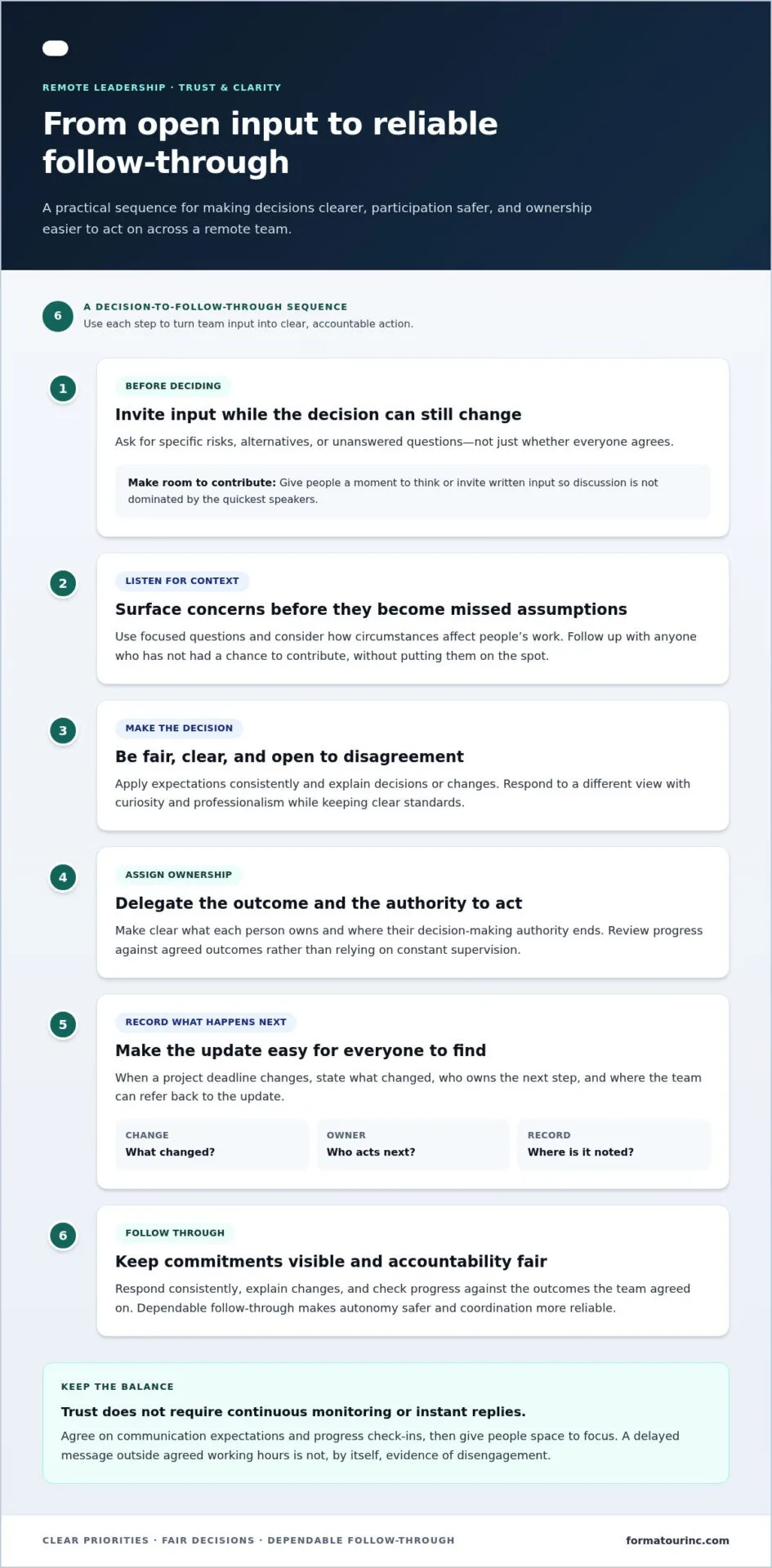
Leaders can reduce this friction by making three things easy to find: current priorities, clear ownership, and recorded decisions. For example, after changing a project deadline, state what changed, who owns the next step, and where the team can refer back to the update. The challenges of virtual team leadership also include coordinating communication and building trust across distance, so deliberate information-sharing needs to be part of the work rather than an afterthought.
Which leadership skills matter most?
Clarity, active listening, empathy, delegation, and accountability work together. Clarity defines the desired result; listening surfaces questions or risks; empathy helps a leader understand how circumstances affect people’s work. Delegation gives employees authority to make appropriate decisions, while accountability keeps commitments and shared outcomes in view.
- Clarity: Explain priorities, responsibilities, and what a completed task needs to achieve.
- Active listening and empathy: Ask focused questions and consider concerns before deciding on a response.
- Delegation and accountability: Assign ownership with suitable decision-making authority, then review progress against agreed outcomes.
Trust grows when these behaviours are consistent and expectations are applied fairly. A manager who delegates a decision but later reverses it without explanation can discourage initiative. A manager who sets boundaries, explains changes, and follows through makes autonomy safer and coordination more reliable. Developing these capabilities is part of broader executive leadership development, particularly as organizations adapt how work is coordinated.
Build trust and psychological safety without relying on office proximity
Trust in a remote team is built through everyday interactions, not a camera that stays on or a manager who responds instantly. Psychological safety means people can ask questions, raise concerns, offer a different view, and acknowledge mistakes without expecting humiliation or unfair treatment. That openness helps leaders identify risks early and gives teams a stronger basis for learning and sound decisions.
Psychological safety grows when people can communicate openly and respectfully, knowing their questions and concerns will receive thoughtful consideration. It doesn’t mean avoiding difficult feedback or putting every idea to a vote. Leaders can set clear standards while responding to disagreement with curiosity and professionalism.
Consistency matters. If expectations shift without explanation, or similar situations receive different treatment, employees may hesitate to speak up. Following through on commitments, explaining decisions, and applying standards fairly all demonstrate that trust is mutual. Trust also doesn’t require continuous monitoring or immediate replies. Agree on response expectations and progress check-ins, then allow people space to focus. A delayed message outside agreed working hours isn’t, by itself, evidence of disengagement.
Create space for honest participation
Invite input while a decision can still change. Instead of asking whether everyone agrees, request specific risks, alternatives, or unanswered questions. In a video meeting, give participants a moment to think or invite written input so discussion isn’t dominated by the quickest speakers. Follow up with employees who haven’t had a chance to contribute, without putting them on the spot.
When a mistake occurs, begin with learning-focused questions: What happened? What information was missing? What would help prevent a repeat? Address responsibility and impact clearly, but don’t make blame the first response. This approach encourages timely disclosure and turns an error into useful insight while preserving accountability.
Delegate with clear boundaries
Delegation builds trust when people know both what they own and where their authority ends. For each responsibility, specify the outcome, decision-making authority, constraints, available support, and situations that require escalation. For example, an employee might choose the format for a project update independently but bring forward a proposed change to scope or timing before acting.
Agree on these boundaries in advance. Employees can then use sound judgment without guessing whether they need permission for each step, while managers retain visibility into material risks. Revisit the agreement if the work changes; delegation is not a one-time handoff when priorities or dependencies shift.
Recognize contributions with specific feedback. Name what the person did and why it helped, then identify any next step or area to strengthen. Praise can reinforce good work, but it shouldn’t replace useful guidance when improvement is needed. These behaviours are practical leadership skills for remote teams, developed through deliberate practice and executive leadership development. Formatour offers leadership development programs to support organizations as they build these capabilities.
Choose communication and accountability practices that fit remote work
Remote teams need communication practices that move work forward without filling every gap in the calendar. The right channel depends on the purpose: how urgent the issue is, how much interpretation it requires, and whether participants need to work through options together. A clear channel choice also makes accountability easier because decisions, owners, and next steps are less likely to disappear in scattered conversations.
When should remote teams meet or communicate asynchronously?
Use a live conversation when delay could create a serious obstacle, a topic is sensitive, or a decision depends on discussion and clarification. A complex project trade-off, for example, may need dialogue so participants can test assumptions and resolve competing priorities. Follow up with a written record of the decision, its rationale, and who owns the next action.
Written updates work well for routine status, reference material, and information colleagues may need outside the moment it is shared. They allow people in different time zones to contribute without being present simultaneously, and they create a useful record. If a written exchange becomes difficult to interpret or repeatedly circles the same issue, move it to a focused conversation and document the outcome afterward.
How can leaders make accountability fair?
Accountability should be based on commitments agreed with the people doing the work, not on how often they appear online. At the start of an assignment, align on the intended outcome, the owner, dependencies, milestones, and review points. Make the expected standard visible, too, so progress is assessed against shared criteria rather than assumptions about how work should look.
- Define the outcome: Describe the result and quality expected, not just activity to complete.
- Agree on checkpoints: Set meaningful milestones where the team can review progress and surface risks early.
- Review fairly: Discuss results, blockers, and changes in scope using the same agreed commitments for everyone involved.
If responsibility is unclear, a simple RACI-style agreement can help distinguish who does the work, who makes the decision, and who needs to provide input or receive updates. For example, on a client report, one person may draft it, a manager may approve it, and subject experts may contribute. Keep the framework proportionate; the goal is to resolve ambiguity, not add process to every task.
These communication and accountability practices make leadership skills for remote teams visible in the way work is coordinated. Review them as projects change, and adjust the norms when they create unnecessary delay or leave ownership uncertain.
Develop remote team leadership through repeatable weekly practices
A reliable weekly routine gives a distributed team a shared point of reference without requiring constant check-ins. It helps managers catch shifting priorities and emerging obstacles early, while giving employees room to organize their work. Use this cycle as a starting point, then adapt it to the team’s responsibilities and working arrangements.
- Clarify priorities: Confirm the most important outcomes for the week, who owns them, and what may need to wait.
- Check progress: Review meaningful milestones and changes since the last check-in, not every task or hour spent.
- Remove blockers: Identify decisions, resources, or coordination needed to keep work moving, then assign an owner to each follow-up.
- Reflect: Note what helped the team deliver and where handoffs, workload, or expectations caused friction.
- Adjust: Update priorities or working agreements, and explain changes so everyone understands the reason.
This cycle needn’t mean five meetings. A short written update may be enough to review progress, while a conversation can help resolve a complex blocker. Review the team’s meeting load regularly: remove sessions that no longer serve a clear purpose, shorten those with narrow agendas, and protect blocks of focused work. The objective is a useful rhythm, not a fuller calendar.
Use one-to-ones for support, not surveillance
Agree on a dependable one-to-one cadence that suits the role and the employee’s needs, then revisit it if circumstances change. Use the time to discuss workload, obstacles, feedback in both directions, development interests, and wellbeing. Ask what support would help rather than requesting a task-by-task account. End by recording agreed actions and owners, so both people know what happens next.
Review team health and adapt the routine
Look for recurring signals, such as missed handoffs, the same blocker surfacing repeatedly, meeting fatigue, or priorities that keep changing without clear explanation. Ask the team which routines support their work and which create unnecessary effort. Adjust transparently: state what will change, why it’s changing, and when you’ll review whether the adjustment is useful.
These repeatable practices also help leaders build capability during organizational change. As workflows and responsibilities evolve, managers may need to strengthen how they communicate priorities, support employees, and guide adoption. Leadership training for digital transformation can connect those leadership needs with broader change efforts. Formatour’s executive leadership development programs support leadership capability as organizations adapt. Details are available through Formatour’s leadership development information.
Turn remote leadership skills into sustained organizational capability
Individual habits become more dependable when the organization reinforces them. A manager may set clear priorities, invite feedback, and delegate thoughtfully, but those practices are harder to sustain if team norms reward constant availability or departments use conflicting expectations. Leaders need support from shared agreements, consistent processes, and senior-level commitment to how work is coordinated.
Start by identifying the behaviours that matter most to your organization’s priorities. If teams need to collaborate across locations, for example, leaders might practise documenting decisions, clarifying ownership, or making space for input from employees who aren’t in the same meeting. Agree on how these behaviours should appear in daily work, then review whether existing routines and expectations support them.
Structured development may be useful when similar challenges recur across teams, such as unclear delegation, missed handoffs, feedback that arrives too late, or accountability that relies on visibility rather than agreed outcomes. These patterns aren’t a diagnosis of an individual’s performance. They can signal an opportunity to strengthen leadership practices and examine whether organizational expectations are aligned.
Know when to seek structured leadership development
Leadership growth is strengthened through reflection, practice, and feedback. A manager can identify a specific situation, such as a decision that stalled because ownership was unclear, consider how they responded, and practise a different approach for the next similar situation. Feedback from colleagues and employees can help reveal whether the intended behaviour is being experienced as intended.
Development is most useful when connected to real responsibilities and reinforced over time. A single learning experience can introduce ideas, but it won’t resolve every organizational challenge on its own. Leaders also need opportunities to apply new approaches, discuss what they learn, and adjust their practice as team needs evolve.
Connect leadership development to business priorities
Align development goals with strategic and operational needs, rather than treating leadership learning as separate from the work. If a business is changing how teams deliver projects, leaders might practise communicating the reason for change, clarifying decision rights, and gathering feedback at defined points. Choose behaviours that people can observe and review, such as whether decisions are recorded or employees know who owns the next step.
Formatour provides executive leadership development to help organizations build leadership capability alongside organizational change. Connecting development to a recurring challenge, such as coordination or delivery, can help keep learning focused on business priorities. More information is available through Formatour’s leadership development services.
Strengthening leadership skills for remote teams is an ongoing organizational effort. Shared expectations, practical opportunities to learn, and regular reflection help translate individual intent into more consistent leadership practice.
Make your next leadership step intentional
Strong remote leadership develops through choices leaders make consistently, then refine as the organization changes. Choose one behaviour to strengthen, such as making decisions easier to follow or giving employees clearer authority. Practise it deliberately, invite feedback, and consider what team-wide support would help make it part of everyday work.
The leadership skills for remote teams are not separate from broader organizational capability. They influence how people adapt to new priorities, coordinate across functions, and contribute their expertise. Formatour combines advisory expertise with professional development services, including executive leadership development programs, to help organizations connect leadership growth with wider priorities.
Identify the leadership capability that would make the greatest difference to your organization’s direction. A focused conversation can clarify where development fits and what you want leaders to practise. Discuss your leadership development priorities with Formatour.
Frequently Asked Questions
What are the most important leadership skills for remote teams?
The most important leadership skills for remote teams include clear decision-making, active listening, empathy, delegation, and accountability. They work best as a connected set: a manager who explains the reasoning behind a decision helps employees understand how to apply it when a similar issue arises. For example, outline which client requests require approval and which employees can resolve independently. That clarity supports sound judgment without escalating every decision.
How can a leader build trust with a remote team?
A leader builds trust by being predictable in how they make decisions, respond to concerns, and handle commitments. For example, if a manager promises to raise a workload concern with senior colleagues, they should report back even if there’s no immediate resolution. Follow-through signals that employee input matters. Trust also grows when leaders explain the reasoning behind decisions that affect people, rather than leaving colleagues to interpret silence or changes on their own.
Can remote teams be as productive as office-based teams?
Remote teams can be productive when the work is organized around clear results, suitable coordination, and access to the information employees need. Productivity depends on the role, team practices, and organizational context, so no single arrangement guarantees the same results for every group. A useful review might compare delivery quality, completed commitments, and recurring delays over time, then identify whether the causes relate to workload, unclear decisions, or dependencies between teams.
How often should managers meet with remote employees?
There’s no single meeting schedule that suits every remote employee. Set a regular one-to-one rhythm based on the person’s responsibilities, experience, and current workload, then adjust when needs change. A new project or shifting role may call for closer discussion; stable work may need less frequent formal check-ins. Keep meetings purposeful by agreeing on topics in advance and making routine updates available in writing when a conversation isn’t necessary.
How do you hold remote employees accountable without micromanaging?
Hold employees accountable by agreeing on deliverables and review points, then assessing the work against those commitments rather than monitoring online activity. For example, for a research assignment, define the expected output, due date, and any quality criteria at the outset. At the agreed review, discuss progress and obstacles. If circumstances have changed, revisit the commitment together rather than treating an outdated plan as an automatic measure of performance.
What is the difference between synchronous and asynchronous communication?
Synchronous communication happens in real time, such as a phone call or live meeting, and lets participants respond immediately. Asynchronous communication, such as a written project update, can be read and answered at different times. A manager might use a live conversation to resolve a disagreement that needs discussion, then record the decision in writing for reference. Choosing deliberately helps teams collaborate without expecting everyone to be available at once.
How can remote leaders prevent team members from feeling isolated?
Remote leaders can reduce isolation by creating opportunities for meaningful connection that aren’t limited to task updates. Invite colleagues to share expertise, pair people on a defined piece of work, or make room in team discussions for informal check-ins when appropriate. Pay attention to changes in participation, but don’t assume quietness alone indicates a problem. A private, supportive conversation can help establish whether someone wants more connection or different support.
What should a remote leader do when communication breaks down?
When communication breaks down, address the specific misunderstanding promptly and privately where appropriate. Restate the decision or request in neutral terms, ask what each person understood, and identify where context was lost. Then agree on the next action, its owner, and where the corrected information will be recorded. If the issue involves competing assumptions across a team, share a concise clarification with everyone affected so the same confusion doesn’t continue.
