

With global cybercrime costs projected to exceed $10 trillion annually by 2026, the demand for sophisticated governance has never been more urgent. You likely recognize that maintaining an Information Security Management System is no longer just about checking boxes; it’s about building a foundation of digital resilience. Yet, the complexity of the ISO/IEC 27001:2022 standards and the pressure of a rigorous certification exam can feel overwhelming. Engaging in ISO 27001 lead auditor training is the strategic step required to translate technical controls into the language of executive strategy and organizational value.
This guide shows you how this specialized training empowers you to lead high-impact audits that drive organizational growth and structural integrity. We’ll examine the full audit lifecycle, from mastering the 2024 climate action amendments to leveraging AI-assisted tools for automated evidence collection. We’ll provide a clear roadmap to achieving a globally recognized certification and positioning yourself as a visionary architect of security and trust in an increasingly complex global landscape.
Key Takeaways
- Understand the transition of the lead auditor from a compliance officer to a strategic architect of organizational trust and resilience.
- Master the ISMS audit lifecycle through ISO 27001 lead auditor training to ensure the seamless application of the Plan-Do-Check-Act cycle.
- Evaluate the strategic benefits of internalizing audit capabilities to minimize external costs and enhance long-term governance.
- Prepare for the rigorous certification journey by identifying essential candidate prerequisites and the structure of the intensive examination.
- Learn to convert audit findings into actionable insights that drive process automation and support broader digital transformation goals.
The Evolution of the ISO 27001 Lead Auditor Role in 2026
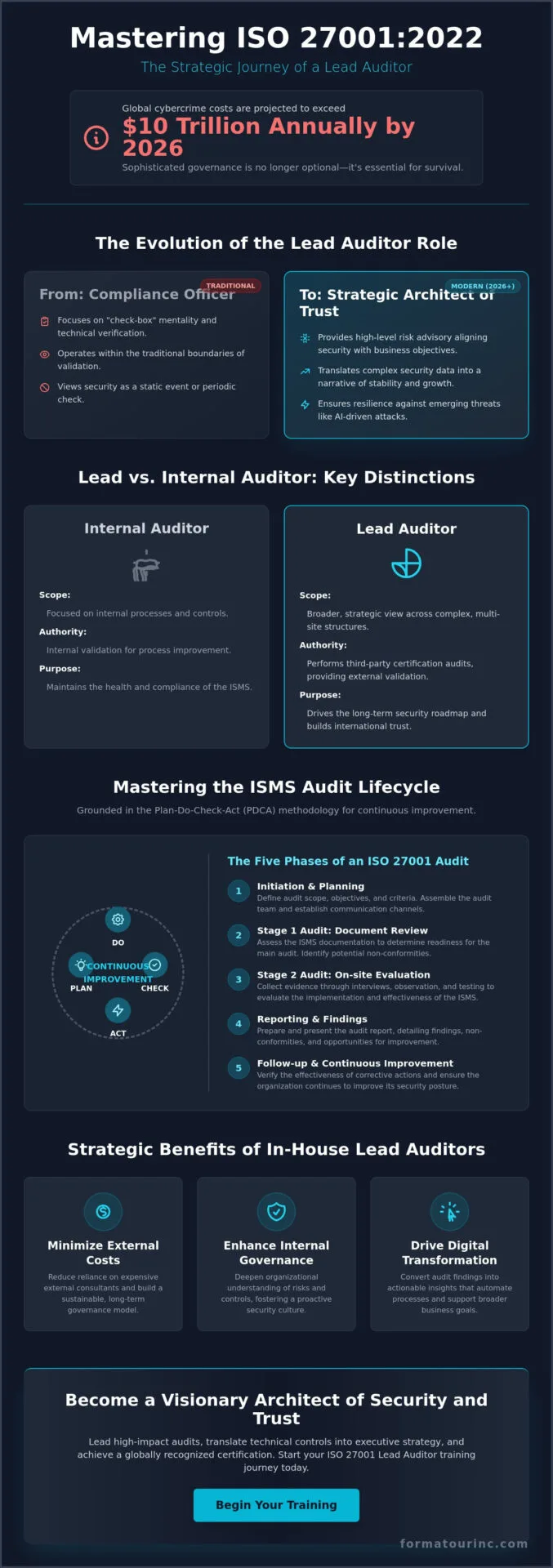
The role of the Lead Auditor has undergone a fundamental transformation, moving far beyond the traditional boundaries of technical verification. In 2026, these professionals act as the visionary architects of organizational trust. They no longer simply validate controls; they provide high-level risk advisory that aligns security posture with business objectives. This shift is driven by the ISO/IEC 27001:2022 standard, which demands a proactive approach to threat intelligence and continuous improvement rather than a reactive “check-box” mentality.
For Canadian firms, this evolution is particularly critical. As national and provincial privacy landscapes become more stringent, an ISO/IEC 27001 Lead Auditor certification serves as a benchmark for navigating complex regulatory requirements while maintaining global competitiveness. Professionals seeking this level of expertise often begin with ISO 27001 lead auditor training to bridge the gap between technical proficiency and executive leadership. This training ensures that auditors can translate complex security data into a narrative of stability and growth that resonates in the boardroom.
Core Responsibilities of a Certified Lead Auditor
Lead Auditor vs. Internal Auditor: Key Distinctions
While both roles are essential to the health of an organization, the Lead Auditor operates with a higher level of authority and a broader scope. Lead Auditors possess the credentials necessary to perform third-party certification audits, providing the external validation required for international trade and partnership trust. They require a depth of knowledge suited for complex, multi-site organizational structures where risk profiles vary across different geographies. Their work has a profound strategic impact on ISO 27001 implementation services, as their insights often dictate the roadmap for long-term security optimization. ISO 27001 lead auditor training provides the rigorous methodology needed to manage these high-stakes responsibilities, ensuring that every audit contributes to the organization’s overall structural integrity.
Core Curriculum: Mastering the ISMS Audit Lifecycle
Mastering the audit lifecycle requires a profound understanding of both the technical requirements of the standard and the governance principles that sustain them. Effective ISO 27001 lead auditor training provides a rigorous exploration of the ISMS framework, focusing on the core clauses and the updated Annex A controls. This curriculum isn’t merely academic; it’s a practical blueprint for assessing how an organization protects its intellectual capital. By grounding the audit in the Plan-Do-Check-Act (PDCA) methodology, auditors ensure that security isn’t a static event but a continuous cycle of improvement. This systematic approach is essential for identifying vulnerabilities before they’re exploited by emerging threats.
Auditors must also internalize the principles of ISO 19011, the definitive guideline for management system auditing. This framework provides the structural discipline needed to handle complex risk assessments and treatment methodologies. For those currently transitioning to the new standard, the curriculum emphasizes the 2022 updates, including new controls for cloud services and threat intelligence. Understanding these nuances allows the auditor to evaluate whether an organization is truly resilient or merely compliant on paper.
The Five Phases of an ISO 27001 Audit
The audit journey begins with initiation and a detailed document review, often referred to as the Stage 1 audit. This phase determines if the organization’s ISMS is ready for a full assessment by identifying gaps in the foundational documentation. The process then moves into Stage 2, which involves on-site activities and sophisticated evidence collection techniques. During this phase, the auditor verifies that the documented processes are functioning effectively in the daily operations of the business. The final phase involves drafting non-conformity reports. These documents shouldn’t just list failures; they must provide the clarity needed to drive actual operational improvement and long-term structural resilience.
Soft Skills and Professional Ethics for Auditors
Technical knowledge alone doesn’t make a lead auditor successful. The ability to extract honest insights from stakeholders through advanced interviewing techniques is vital for uncovering the true state of security culture. High-stakes environments require auditors to maintain unwavering objectivity and professional scepticism, ensuring that findings are based on objective evidence rather than corporate narrative. The depth of expertise gained during ISO 27001 lead auditor training ensures that these professionals can navigate political nuances while remaining focused on the integrity of the audit. Ultimately, the goal is writing authoritative reports that facilitate strategic transformation across the enterprise. If you’re ready to elevate your team’s internal expertise, consider consulting with a strategic partner to identify the right training path.
Strategic Impact: Why Organisations Invest in Lead Auditor Training
Investing in ISO 27001 lead auditor training represents a calculated decision to internalize high-level governance and oversight capabilities. While many organizations initially rely on external consultants to navigate the complexities of compliance, this model often leads to knowledge silos and recurring costs. By developing deep-seated internal expertise, firms ensure that the architectural understanding of their security framework remains within the building. This shift significantly reduces the long-term expense of compliance monitoring while fostering a culture of continuous improvement and heightened information security awareness across all departments.
Internal lead auditors act as the primary catalyst for organizational resilience. They’re uniquely positioned to identify vulnerabilities in real-time, allowing for immediate remediation rather than waiting for annual external reviews. This proactive stance is essential for those looking to accelerate the timeline for how to get ISO 27001 certified. When an organization possesses the internal authority to conduct its own rigorous audits, the final certification process becomes a validation of existing excellence rather than a stressful hurdle. Leaders who recognize the benefits from being ISO 27001 certified understand that these internal experts are the guardians of their corporate reputation.
Mitigating Global and Local Risks
In 2026, Canadian industries face a sophisticated threat landscape, with 73% of over 4,000 chief audit executives identifying cybersecurity as their top internal audit priority. Lead auditors equipped with specialized training are vital for addressing these specific challenges, particularly in securing complex supply chains. They possess the skills to perform rigorous third-party audits, ensuring that vendors and partners don’t become the weak link in the organization’s security perimeter. This level of scrutiny is indispensable for protecting intellectual property in highly competitive digital markets where a single breach can negate years of innovation and structural growth.
Bridging the Gap Between Security and Business Goals
The most significant strategic impact of ISO 27001 lead auditor training is the ability to translate technical ISMS performance into tangible ROI for stakeholders. Lead auditors don’t just report on control failures; they provide evidence-based findings that justify security investments and demonstrate how compliance supports broader business objectives. This capability is a cornerstone of a robust digital transformation strategy. It ensures that as an organization adopts process automation and cloud-native solutions, the underlying security foundations are secure, scalable, and fully aligned with international benchmarks. Global firms seeking to establish these foundations can benefit from understanding how ISMS implementation services convert compliance requirements into a scalable foundation for resilience.
The Path to Certification: Preparation, Prerequisites, and Examination
The journey toward certification is a disciplined commitment to professional excellence and structural governance. Most candidates opt for a standard five-day intensive format, which provides the necessary immersion to master complex auditing techniques. This timeframe allows for a deep dive into risk management scenarios and mock audit exercises, ensuring that participants don’t just memorize clauses but learn to apply them in high-stakes corporate environments. Engaging in ISO 27001 lead auditor training during this window transforms technical knowledge into a leadership asset that drives long-term organizational value.
Essential Prerequisites for Success
Success in this rigorous programme depends on a solid foundation. Candidates should possess a fundamental understanding of ISO/IEC 27001 terminology and principles before the first session. Prior experience in information security or management system auditing is highly recommended to grasp the nuances of the audit lifecycle effectively. Preparation often involves reviewing the official ISO standards, such as ISO/IEC 27001:2022 and ISO/IEC 27002:2022, which cost approximately $125 and $225 respectively. These documents serve as the primary reference points for the entire certification journey and are indispensable for pre-course study.
Selecting a Certified Training Provider
Choosing the right partner for your education is as critical as the study itself. Global recognition depends on accreditation from respected bodies like PECB or IRCA, which ensures the certification carries weight in international markets. It’s essential to evaluate trainer expertise, looking for mentors with real-world auditing experience rather than just academic credentials. Many organizations find value in reviewing an ISO 27001 certification consulting guide to align their training investments with specific corporate resilience goals and digital transformation objectives.
The final hurdle is the certification exam, typically a three-hour assessment that tests your ability to interpret the standard and manage audit programmes under pressure. Beyond the training fees, which can range from $1,500 to $2,730 in North America, candidates should account for certification application fees of approximately $500. Maintaining the credential requires a commitment to Continuing Professional Development (CPD) and an Annual Maintenance Fee, often around $100 for PECB-certified professionals. This ongoing investment ensures your skills remain sharp as the global threat landscape evolves. If you’re ready to begin this path, connect with our strategic advisors to discuss a tailored roadmap for your team.
Maximising ROI: Integrating Trained Auditors into Your Resilience Strategy
The true value of ISO 27001 lead auditor training isn’t realized in the classroom but in the subsequent integration of these experts into the organization’s daily operations. Once certified, these professionals should lead an internal audit programme that mirrors international standards, ensuring that compliance is a living process rather than a static document. They serve as the steady hand during crises, maintaining organizational resilience by quickly assessing impact and recovery protocols. By using audit insights to drive process automation, firms transform security from a cost centre into a driver of operational performance and efficiency. These auditors also act as internal mentors, bridging the knowledge gap within executive leadership development programs to ensure that governance remains a top-down priority.
Continuous Improvement and the Audit Cycle
Maximising your investment requires a robust feedback loop that moves audit findings directly into strategic project management. This systematic approach ensures the ISMS evolves alongside technological shifts and the expanding global regulatory landscape. Lead auditors use their deep expertise to prepare the organization for external surveillance audits, ensuring that the doubled number of valid certificates worldwide—reaching 96,709 in 2024—reflects a genuine competitive advantage rather than a mere administrative achievement. This continuous cycle of evaluation and optimization maintains the structural integrity of the business over the long term.
The Formatour Advantage: Multidisciplinary Excellence
Formatour Incorporated understands that information security is inseparable from organizational health and leadership. We integrate ISO standards with strategic transformation and executive development, ensuring that ISO 27001 lead auditor training serves as a catalyst for broader growth. Our approach offers the agility of a boutique partner combined with the rigorous standards of a global consultancy. We don’t just help you achieve certification; we co-develop solutions that optimize your human capital and technological assets. Contact Formatour Incorporated to empower your team with the strategic foresight and technical precision required to lead in 2026.
Securing Your Competitive Advantage Through Strategic Governance
The transition from a compliance-focused mindset to one of strategic digital resilience is the defining challenge for leaders in 2026. By internalizing high-level expertise through ISO 27001 lead auditor training, your organization gains more than just a certificate; it secures a visionary architect capable of aligning technical security with executive goals. You’ve seen how mastering the audit lifecycle and integrating findings into process automation creates a sustainable foundation for growth. This investment ensures that your governance framework isn’t just a defensive measure but a catalyst for trust and structural integrity.
Formatour Incorporated brings over a decade of multidisciplinary advisory experience to your transformation journey. Our Canadian-based experts combine boutique agility with big-firm standards to deliver precision in ISO implementation and auditing. We’re dedicated to co-developing solutions that protect your intellectual capital and optimize your operational performance. It’s time to move beyond technical checkboxes and embrace a culture of continuous improvement that resonates at every level of your enterprise.
Empower your leadership team with ISO 27001 expertise at Formatour Inc. and take the first step toward enduring organizational resilience. We look forward to partnering in your long-term success.
Frequently Asked Questions
Is the ISO 27001 Lead Auditor exam difficult to pass?
The examination is intentionally rigorous to ensure that only qualified professionals lead complex information security audits. It tests your ability to apply the standard to practical business scenarios rather than simple rote memorization of the clauses. Success requires a deep understanding of audit principles and the structural requirements of the ISO/IEC 27001:2022 framework. Most candidates find that a disciplined approach to the intensive five-day training is essential for achieving the required pass mark.
How long does ISO 27001 Lead Auditor certification last?
Your certification typically remains valid for three years from the date of issuance. Maintaining this credential requires a commitment to professional growth through Continuing Professional Development (CPD) activities and the payment of an annual maintenance fee to the certification body. At the end of the three-year cycle, professionals must undergo a recertification process to demonstrate their skills remain aligned with the current threat landscape and international standards.
Can I take ISO 27001 Lead Auditor training online in Canada?
Accredited providers offer virtual instructor-led training (VILT) options that are fully accessible to professionals across Canada. these online programmes provide the same level of academic rigour and global recognition as in-person seminars while offering greater geographic flexibility. You’ll engage in real-time discussions, practical workshops, and mock audit exercises through sophisticated digital platforms. This ensures that ISO 27001 lead auditor training remains effective and inclusive for teams operating in diverse locations.
What is the difference between ISO 27001 Lead Implementer and Lead Auditor?
The Lead Implementer focuses on the internal design, execution, and management of the Information Security Management System (ISMS). In contrast, the Lead Auditor is trained to evaluate the effectiveness of that system through objective evidence and systematic assessment. While the implementer builds the house, the auditor ensures it meets the architectural standards required for international certification. Both roles are vital for organizational resilience but require different skill sets regarding authority and objective evaluation.
Do I need prior auditing experience to attend the Lead Auditor course?
Formal auditing experience isn’t a mandatory prerequisite, but it’s highly recommended for those seeking to master the curriculum quickly. You should possess a fundamental understanding of the ISO/IEC 27001 principles and terminology before the course begins. Many successful candidates come from IT management, risk advisory, or quality assurance backgrounds. This foundational knowledge allows you to focus on the advanced methodology of leading an audit team rather than learning the basic concepts of the standard.
How does ISO 27001 Lead Auditor training benefit my career in 2026?
Achieving this certification positions you as a strategic mentor in a global market where cybersecurity is the top internal audit priority. Professionals with these credentials often see significant salary growth, with senior risk manager roles in North America reaching average salaries between $163,000 and $173,000. The training empowers you to bridge the gap between technical security and executive strategy, making you an indispensable partner for organizations pursuing digital transformation and structural integrity.
What are the main changes in the 2022 version of the ISO 27001 exam?
The updated assessment focuses heavily on the 2022 revisions, which include a consolidated set of Annex A controls and a stronger emphasis on cybersecurity and privacy. You’ll be tested on your ability to audit new areas such as threat intelligence, cloud security, and configuration management. Recent amendments also require auditors to evaluate how climate change impacts an organization’s ISMS. These changes ensure that certified professionals are equipped to handle the sophisticated, AI-driven threats prevalent in 2026.
How much does ISO 27001 Lead Auditor training typically cost in Canada?
Investment levels vary based on the accreditation body, the delivery format, and the depth of the curriculum provided. You should account for the cost of the training course itself along with examination fees and official copies of the ISO standards. Many organizations view these costs as a strategic investment in internal human capital that reduces long-term reliance on external consultants. It’s advisable to consult with a strategic partner to identify a programme that aligns with your specific corporate resilience goals.
