

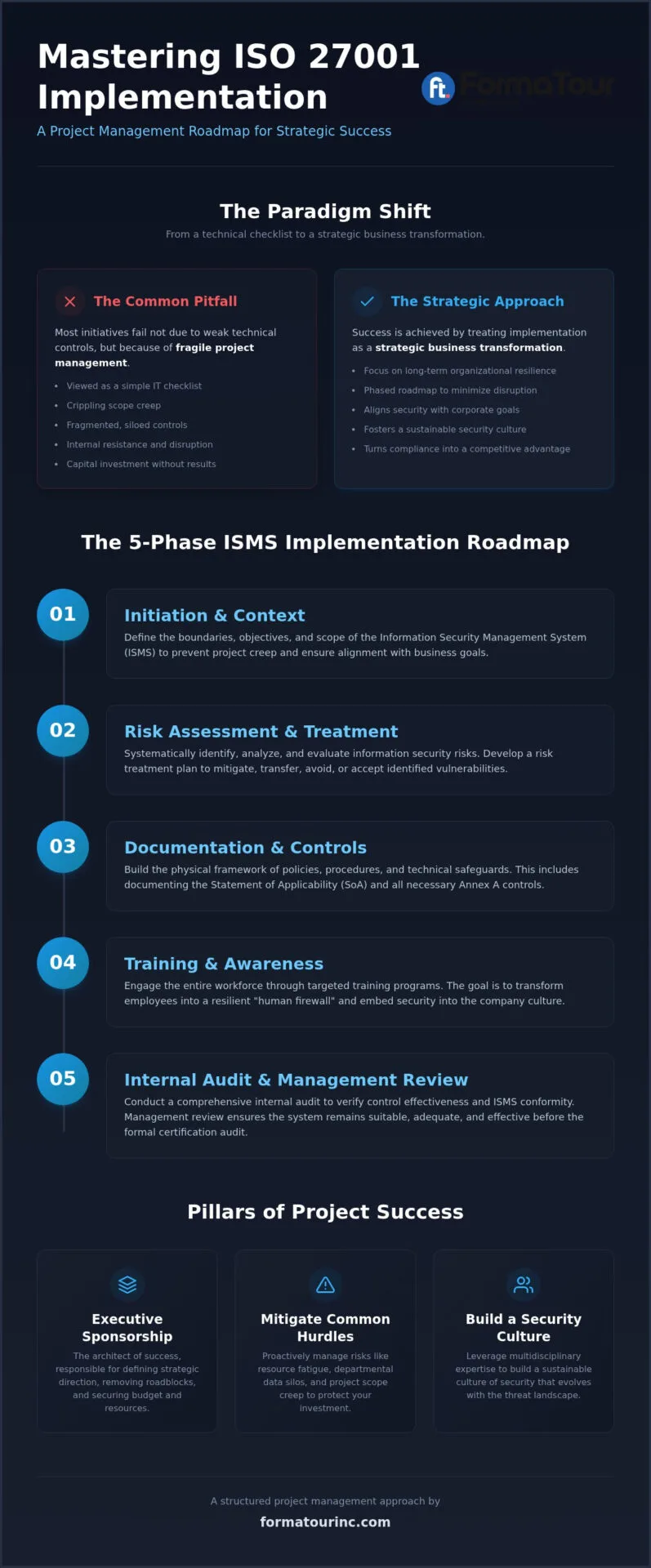
Most ISO 27001 initiatives fail not because the technical controls were insufficient, but because the underlying project management was fragile. For many Canadian executives, the prospect of certification feels like a high stakes gamble where significant capital investment might still result in audit failure or crippling scope creep. You have likely felt the tension between the need for robust security and the fear that new processes will spark internal resistance or disrupt your core business operations.
It is a valid concern; however, achieving international standards does not require sacrificing organizational agility. This guide empowers you to master the project management for ISO 27001 implementation by treating it as a strategic transformation rather than a mere IT checklist. You will gain a clear, phased roadmap designed to minimize operational downtime while fostering a resilient security culture that persists long after the auditors leave. We will explore the architectural framework and disciplined management practices necessary to secure your C$ investments and position your firm as a trusted leader in the global marketplace.
Key Takeaways
- Recognize ISO 27001 as a catalyst for strategic transformation, shifting the focus from technical compliance to long-term organizational resilience.
- Master the project management for ISO 27001 implementation by utilizing a phased roadmap that protects your core business operations from disruption.
- Select the optimal governance methodologies and communication plans to ensure cross-departmental alignment and executive oversight throughout the certification journey.
- Learn to mitigate common implementation risks, such as resource fatigue and data silos, to protect your capital investment and secure a successful audit outcome.
- Leverage multidisciplinary expertise to build a sustainable security culture that evolves alongside Canada’s shifting regulatory and technological landscape.
The Strategic Necessity of Project Management for ISO 27001
ISO 27001 implementation is frequently misconstrued as a technical IT task. This narrow perspective often leads to fragmented controls and organizational friction. In reality, a successful Information Security Management System (ISMS) is a sophisticated governance framework that requires a high level of project management maturity. Organizations that view this journey through the lens of strategic transformation are far more likely to achieve certification on time and within budget. Technical skill provides the tools, but governance provides the blueprint.
Effective project management for ISO 27001 implementation provides the structure needed to bridge the gap between technical requirements and business objectives. Technical expertise alone cannot navigate the complexities of departmental silos or cultural resistance. By 2026, information security will no longer be seen as a defensive cost center. Instead, it’ll be recognized as a primary driver of operational performance and a prerequisite for international trade, especially for Canadian firms looking to expand their global footprint.
Beyond the Tick-Box: ISO 27001 as Strategic Transformation
A well-managed implementation does more than satisfy an auditor; it protects your long-term brand equity in an increasingly volatile digital landscape. When security objectives align with corporate goals, the ISMS becomes a tool for efficiency rather than a source of bureaucracy. An ISMS is a living management system designed to evolve with your business risks, not a static collection of digital documents stored on a server. This approach ensures that your investment in compliance translates directly into a competitive advantage within the Canadian market, where data privacy expectations continue to rise.
The Role of the Executive Sponsor in Project Success
Leadership commitment is the most critical factor in the implementation lifecycle. An executive sponsor isn’t just a figurehead; they’re the architect of the project’s success. Their responsibilities include defining the strategic direction, removing organizational roadblocks, and ensuring that the project remains a priority across all departments. Without this high-level authority, even the most skilled project managers will struggle to secure the cross-functional cooperation required for Annex A controls.
Securing the necessary budget and resource commitment requires framing the project in terms of value and resilience. By positioning the ISMS as a pillar of corporate stability, leaders can justify the allocation of capital and human talent. For organizations seeking a partner to navigate these complex requirements, professional ISO 27001 Implementation Services provide the multidisciplinary expertise needed to turn compliance into a strategic asset. This level of oversight ensures that your C$ investments yield a culture of security that persists long after the initial audit is complete.
Designing the Roadmap: 5 Key Phases of ISMS Implementation
A successful certification journey follows a precise, five-phase progression. It’s a methodical build that ensures every control is both necessary and effective. Without this structure, organizations often find themselves lost in a sea of technical requirements that don’t serve their broader business goals. Mastering the project management for ISO 27001 implementation requires a commitment to these distinct stages, ensuring that each phase builds a foundation for the next.
- Phase 1: Initiation and Context – Defining the boundaries and objectives of your Information Security Management System (ISMS).
- Phase 2: Risk Assessment and Treatment – Identifying vulnerabilities and determining the most effective ways to mitigate them.
- Phase 3: Documentation and Controls – Building the physical framework of policies, procedures, and technical safeguards.
- Phase 4: Training and Awareness – Engaging your workforce to transform them into a resilient human firewall.
- Phase 5: Internal Audit and Management Review – Providing the critical validation and oversight needed before the official certification audit.
Scoping for Success: Avoiding Project Creep
Project creep is a significant risk that can quickly inflate costs and delay timelines. Defining a manageable ISMS boundary is essential for maintaining focus. You must decide which departments, locations, and assets are included in the scope to avoid unnecessary complexity. The Statement of Applicability (SoA) acts as your primary project planning tool, documenting which controls apply and why. Involving key stakeholders from IT, HR, and legal departments early on ensures that the scope is realistic and aligned with operational realities. Organizations often find that consulting with a strategic advisor helps clarify these boundaries before the first C$ is spent on implementation.
Risk Management: A Project-Based Approach
Effective risk management treats security threats as business variables rather than just technical glitches. Move away from generic lists and focus on assessments that highlight specific business impacts. This approach allows you to allocate your limited resources to the “High-Impact, High-Probability” quadrant where they’ll provide the most significant value. Risk treatment is a continuous project activity that evolves alongside your threat landscape, rather than a one-time administrative task. By viewing risk through this lens, you ensure that your security posture remains robust as your company grows and the Canadian regulatory environment shifts.
The Project Manager’s Toolkit: Risk, Governance, and Controls
Successful implementation relies on selecting the right methodology to guide your team through the certification process. While Waterfall provides a linear path suitable for strict regulatory timelines, an Agile approach allows teams to iterate on security controls as organizational needs shift. Mastering the project management for ISO 27001 implementation bridges these methodologies to ensure that the Information Security Management System (ISMS) remains flexible yet compliant. A robust communication plan is equally critical; it ensures that every department understands their specific role in the security framework. Without clear, multi-departmental alignment, the risk of technical silos and process gaps increases significantly.
Governance and Accountability Frameworks
Precision in role definition is the cornerstone of effective governance. A RACI matrix clarifies exactly who is Responsible, Accountable, Consulted, or Informed for each ISO 27001 control. This structure prevents the diffusion of responsibility that often leads to critical oversights during an audit. Integrating these security requirements into an existing Project Management Office (PMO) ensures that information security is treated as a core business function rather than an isolated IT project. For leaders looking to align these efforts with broader growth, The 2026 Executive Guide to Digital Transformation Strategy Firms offers insights into how modern governance drives long-term resilience.
Evidence Collection and Document Control
Collecting evidence shouldn’t be a manual burden that drains your team’s productivity. Leveraging process automation streamlines the gathering of logs, access reviews, and policy acknowledgments, turning a complex requirement into a background operation. This level of optimization ensures that controls are secure by design, meaning security is integrated into daily workflows rather than added as an afterthought. Managing the documentation lifecycle requires a disciplined approach to avoid overwhelming staff with administrative overhead. Robust version control is essential to maintain audit readiness, ensuring that only the most current, approved procedures are in use across the organization at all times.
Overcoming Common Implementation Hurdles & Resource Allocation
The most frequent objection to certification isn’t the cost or the technical complexity; it’s the perceived lack of time. Executives often worry that the rigorous requirements of the standard will drain their team’s capacity and distract from core revenue generating activities. However, robust project management for ISO 27001 implementation reframes this challenge. It treats security not as a competing priority, but as a framework for operational excellence that eventually saves time by reducing incidents and streamlining processes. Resource fatigue and data silos are real risks, yet they’re usually symptoms of poor planning rather than the standard itself.
Managing the balance between internal bandwidth and external advisory expertise is a strategic necessity. While your internal team holds the institutional knowledge, an external partner provides the specialized roadmap to avoid common pitfalls. This collaborative approach ensures that your staff doesn’t burn out while trying to interpret complex clauses in isolation. By distributing the workload and utilizing proven frameworks, you protect your C$ investment and keep the project on its critical path.
Managing Internal Resistance and Cultural Change
Resistance often stems from a fear that new security controls will slow down daily operations. To overcome this, you must pivot the internal narrative from security as a burden to security as a business enabler. Effective training programs play a vital role here; they should empower employees with the “why” behind the controls rather than just the “how.” When staff understand that an ISMS protects their own work and the company’s reputation, they become active participants in the system’s success. For leaders looking to guide this shift, Leadership Training for Digital Transformation provides the tools to manage the human side of organizational change.
Realistic Timelines and Budgeting for 2026
Setting realistic expectations is paramount for maintaining executive support. While smaller firms might achieve readiness in six months, mid-market Canadian organizations typically require nine to twelve months for a full implementation. Hurrying the process often leads to hidden costs, such as rework after a failed internal audit or the need to replace poorly chosen technical controls. A disciplined budget accounts for both direct costs and the indirect time commitment of your staff. To ensure your project remains lean and effective, get a custom roadmap for your organization that aligns with your specific operational structure and risk profile.
Partnering for Excellence: The Formatour Advantage
Navigating the path to certification requires more than a simple software subscription. While generic toolkits offer basic templates, they often lack the nuance required for complex organizational structures. Formatour Incorporated provides a premium advisory experience that combines the rigorous standards of global firms with the personalized agility of a boutique consultancy. Our approach to project management for ISO 27001 implementation ensures that your security framework isn’t just a layer of bureaucracy, but a driver of organizational resilience. We support the entire lifecycle, from the initial gap analysis through to the final certification audit, providing a steady hand at every stage of the journey.
Our multidisciplinary expertise spans Strategy, Performance, and Resilience. We don’t just implement controls; we optimize them to enhance your overall business performance. This holistic view prevents the common pitfall of treating security as an isolated technical silo. By integrating ISO 27001 with other management standards, we help you build a unified system that scales with your ambitions. This boutique agility allows us to customize frameworks to your specific operational needs while maintaining a high formality register that satisfies international auditors.
Tailored Solutions for the Canadian Market
Canadian firms face unique challenges, particularly when balancing international standards with domestic privacy requirements. Formatour specializes in navigating the intersection of ISO 27001 and Canadian privacy regulations, ensuring your ISMS satisfies both global auditors and local regulators. Whether your operations are centralized or spread cross-provincially, our national coverage provides the local expertise needed to maintain consistency. This focus on Strategic Transformation and Process Optimization ensures that your compliance efforts support your specific market position in Canada. It’s about creating a system that respects local laws while opening doors to global trade.
Sustaining Compliance Beyond the Audit
Certification is a milestone, not the finish line. A truly resilient organization maintains a culture of security that persists long after the auditors have departed. Formatour ensures your ISMS delivers ongoing operational value through continuous auditing and executive leadership development. We help you transform your security posture into a sustainable asset that evolves alongside new threats. This long term commitment protects your C$ investment and ensures that security remains a core pillar of your corporate identity. To secure your organization’s future and achieve lasting compliance, schedule a consultation with our strategic advisors today.
Securing Your Organization’s Strategic Future
Achieving ISO 27001 certification is a significant milestone that signals to the global market that your organization values integrity and resilience. It requires shifting from a reactive technical mindset to a proactive governance model. By mastering the project management for ISO 27001 implementation, you ensure that security becomes an integrated part of your operational DNA rather than a disruptive burden. This journey demands a clear roadmap, active executive sponsorship, and a commitment to cultural change that persists well beyond the final audit.
Formatour Incorporated offers a unique blend of boutique agility and big-firm consulting standards to guide you through this transformation. As a premium multidisciplinary advisory firm, we provide the expert hand needed to navigate complex regulatory landscapes while optimizing your core business processes. We empower your leadership to turn compliance into a tool for sustainable growth and organizational resilience. Trust is the currency of the modern economy; protecting it is your most vital strategic move.
Partner with Formatour for a resilient ISO 27001 implementation and build a foundation of trust that supports your long term ambitions in Canada and beyond. Your path to a more secure and efficient future begins with a single strategic step.
Frequently Asked Questions
What is the most critical phase in project management for ISO 27001 implementation?
The Risk Assessment and Treatment phase is the most critical element of the implementation. This phase identifies the specific vulnerabilities of your organization and dictates which controls from Annex A are necessary. Without a precise assessment, the entire project management for ISO 27001 implementation lacks direction. It ensures that your C$ investments are allocated to the areas of highest risk, providing the structural integrity required for a successful certification audit.
How long does a typical ISO 27001 project take for a mid-sized company?
A mid-sized Canadian company typically requires between nine and twelve months to complete a full implementation. This duration accounts for the time needed to define the scope, conduct risk assessments, and allow for at least three months of operational evidence before the audit. While smaller firms might move faster, rushing the process often results in process gaps that auditors will identify. A measured pace ensures that security controls are deeply integrated into the corporate culture.
Can we manage the ISO 27001 implementation project entirely in-house?
While an organization can manage implementation in-house, it often introduces significant risks related to internal bias and resource fatigue. Internal teams may overlook critical gaps or struggle to interpret complex clauses without specialized guidance. It’s a balanced approach to partner with an external advisor who provides an objective perspective and the boutique agility needed to customize frameworks. This ensures that your internal talent focuses on daily operations while experts guide the strategic transformation.
What are the most common project management mistakes in ISO 27001?
The most frequent errors include defining an overly broad scope and failing to secure genuine executive sponsorship. Scope creep often leads to budget overruns and project delays, while a lack of leadership support results in departmental resistance. It’s another mistake to treat the ISMS as a static IT project rather than a living management system. Successful project management for ISO 27001 implementation requires alignment between technical controls and organizational objectives to ensure long term resilience.
How does ISO 27001 project management differ from standard IT project management?
ISO 27001 project management shifts the focus from technical deployment to organizational governance and risk treatment. Unlike standard IT projects that often end at go-live, an ISMS requires continuous improvement and cross-departmental accountability. It involves HR, legal, and facilities management, making it a multidisciplinary strategic initiative. The success of the project is measured by the resilience of the security culture and the effectiveness of the governance framework rather than just technical uptime.
What is the role of an external consultant in the project management process?
An external consultant acts as a strategic mentor and a visionary architect for your security framework. They provide the specialized knowledge required to navigate international standards while ensuring your system remains lean and efficient. By conducting gap analyses and pre-audit reviews, they mitigate the risk of failure and ensure your documentation meets the high formality register required by certification bodies. This partnership accelerates the timeline and reduces the administrative burden on your internal staff.
How much does it cost to implement ISO 27001 in Canada in 2026?
The total investment for implementation depends on your organization’s size, the complexity of your data environment, and the current maturity of your security controls. Costs typically include consultant fees, technical control upgrades, staff training, and the final certification audit. While specific figures vary, Canadian firms should budget for both direct capital expenditures and the indirect time commitment of internal stakeholders. Investing in quality project management prevents the hidden costs of rework and audit failure.
Is ISO 27001 implementation worth the investment for a small business?
It’s highly valuable for small businesses seeking to secure contracts with larger enterprises or government agencies. ISO 27001 acts as a universal language of trust, providing an immediate competitive advantage in a crowded marketplace. It protects your brand equity by reducing the probability of a data breach that could be financially devastating. For a small firm, the standard provides a clear roadmap for growth and ensures that security scales alongside your operational success.
