

An audit-ready information security management system is useful only if people can operate it every day. That is the practical test for an ISO 27001 consultant Canada organizations engage: can they turn the standard into risk-based decisions, clear ownership, and evidence drawn from real work?
It is understandable to worry that implementation could become a documentation-heavy project with unclear responsibilities and an unmanageable workload. A structured approach starts with your organization’s context, sets a workable scope, and connects controls to governance and daily operations. The goal is not paperwork for its own sake. It is a resilient ISMS aligned with ISO/IEC 27001:2022 and prepared for a credible certification process.
This guide explains what a consultant contributes, how to organize implementation, and what effective support should deliver. It also covers how Canadian operating conditions and privacy obligations, including PIPEDA and applicable provincial laws, fit into the work. You will come away with a clearer view of responsibilities, practical evidence, and the steps from risk assessment to audit preparation.
Key Takeaways
- An ISO 27001 consultant Canada organizations work with can guide ISMS design and audit readiness, while leadership remains accountable for security decisions and effectiveness.
- Build implementation around assessed risks and applicable requirements instead of applying every control indiscriminately.
- Consulting can strengthen certification readiness, but the independent audit outcome depends on implementation, evidence, leadership decisions, and findings.
- Determine which Canadian privacy obligations apply to your organization and data, including relevant federal and provincial regimes.
- Formatour connects ISO 27001 support with governance, operational performance, and organizational resilience, tailoring the work to the organization.
What an ISO 27001 Consultant in Canada Does for Your Organization
An ISO 27001 consultant Canada organizations engage helps turn the requirements of an information security management system (ISMS) into a practical way to manage information security risks. The work should connect governance, controls, and evidence to how the organization operates, rather than creating documents that sit apart from day-to-day responsibilities. For a foundational overview of the standard and its certification process, see ISO/IEC 27001.
An ISO 27001 consultant advises an organization on designing and implementing its ISMS and preparing for an independent certification audit, but does not make the certification decision. This distinction keeps responsibilities clear: the consultant supports system development, the organization owns its security decisions, and an independent certification body assesses conformity.
What work can an ISO 27001 consultant support?
Consulting typically begins with understanding the organization’s context, interested parties, services, and information flows. From there, a consultant can help define an appropriate ISMS scope, assess gaps against ISO/IEC 27001:2022, and prioritize work according to relevant risks and requirements. Scope needs deliberate boundaries. An overly broad scope can make implementation harder to manage, while a narrow one still needs to reflect the organization’s objectives and dependencies.
Support may include developing policies and procedures, selecting controls in response to assessed risks, coordinating implementation, and building staff awareness. A practical test is whether people know their responsibilities and can produce relevant evidence through normal work. A consultant can also help prepare an internal audit, support management review, and organize corrective actions so that identified issues lead to improvement rather than a last-minute paperwork exercise.
What stays with the organization and its certification body?
Advice does not transfer accountability. Executives remain responsible for providing resources, assigning ownership, approving risk treatment decisions, and reviewing whether the ISMS is effective. Teams operate the controls and maintain evidence, such as completed reviews or access approvals, as part of their regular activities. This ownership helps make the system sustainable after the consulting engagement ends.
Consulting and internal audit support are distinct from independent certification. The organization selects a certification body to conduct the certification audit and make the certification decision. A consultant cannot guarantee that outcome. Formatour provides collaborative ISO 27001 implementation, auditing, and certification support tailored to the organization, connecting standards work with governance, operational performance, and resilience. A well-implemented, risk-based ISMS can strengthen customer assurance and management oversight while helping the organization respond more consistently to changing risks.
How ISO 27001 Consulting Turns Business Risks into a Working ISMS
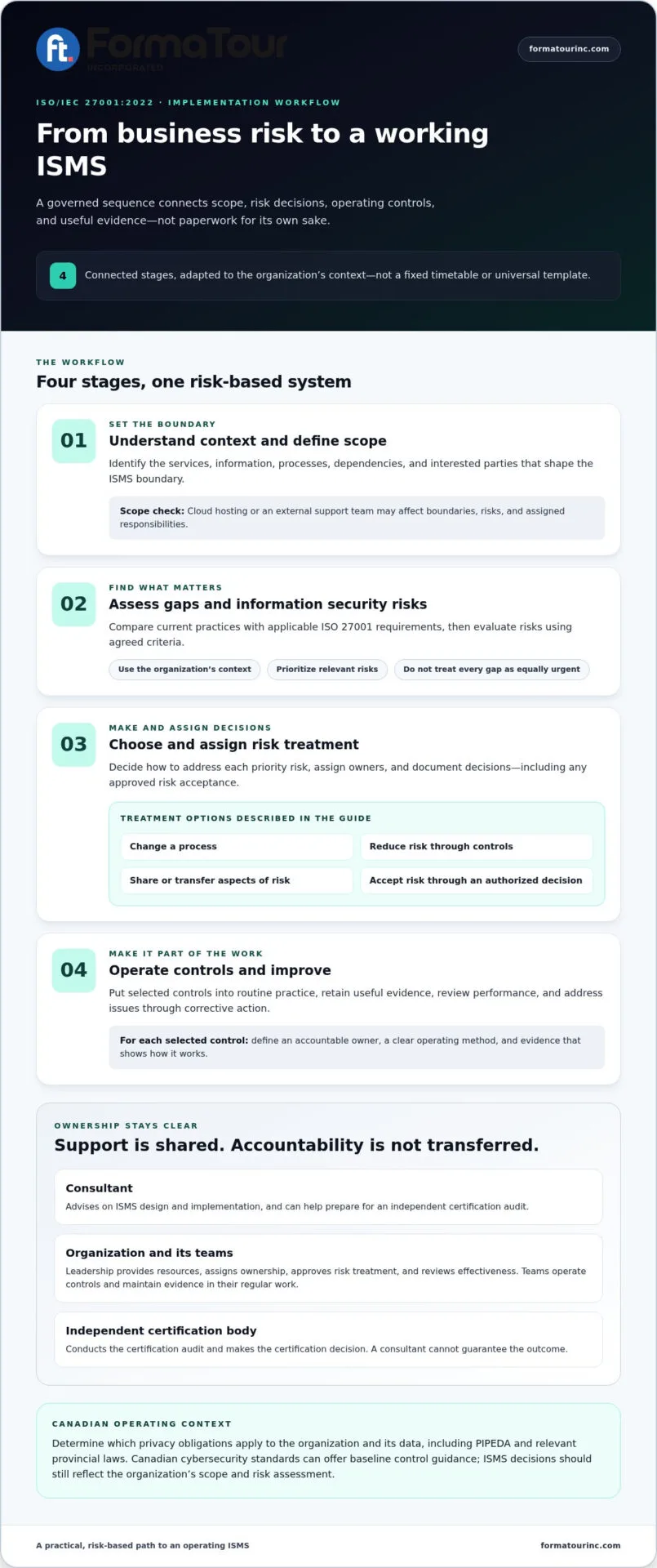
A working ISMS takes shape through a governed sequence, not by collecting policies or applying controls in bulk. An ISO 27001 consultant Canada organizations engage can help connect decisions about scope, risk, controls, and evidence to business operations. The details should reflect the organization’s context. The workflow below is adaptable, not a fixed timetable or universal template.
- Understand context and define scope: Identify the services, information, processes, dependencies, and interested parties that shape the ISMS boundary.
- Assess gaps and risks: Compare current practices with applicable ISO 27001 requirements, then evaluate information security risks using agreed criteria.
- Choose and assign treatment: Decide how to address each priority risk, assign owners, and document decisions, including any approved risk acceptance.
- Operate and improve: Put selected controls into routine practice, retain useful evidence, review performance, and address issues through corrective action.
From scope and gap analysis to risk treatment
Scope definition involves more than naming a department or technology platform. For example, if a service relies on cloud hosting and an external support team, those dependencies may affect the ISMS boundary, the risks to assess, and the responsibilities to define. A gap assessment helps prioritize work against the standard and the organization’s own requirements, rather than treating every gap as equally urgent.
Risk assessment should guide treatment decisions, and treatment decisions should determine which controls are selected, assigned, and maintained. Options may include changing a process, reducing a risk through controls, sharing or transferring aspects of risk, or accepting a risk through an authorized decision. Canadian organizations can also refer to the Government of Canada’s Canadian cybersecurity standards for baseline control guidance. ISMS decisions should still be grounded in the organization’s own scope and risk assessment.
From controls and evidence to management review
Each selected control needs an accountable owner, a clear operating method, and evidence that shows how it works. For instance, an access-review procedure should identify who reviews access, which records demonstrate that the review occurred, and how exceptions are resolved. Where possible, evidence should arise naturally from operations instead of requiring staff to recreate a history before an audit.
Awareness also needs to continue beyond initial training. Employees should understand the security responsibilities relevant to their roles and follow processes as work changes. Internal audits test whether the ISMS is implemented as intended. Management reviews help leaders assess performance, risks, and resource needs. Corrective actions should address causes, not just symptoms, to support continual improvement and organizational resilience.
Formatour’s collaborative ISO 27001 support helps organizations connect risk decisions with governance and daily practice. Discuss your ISMS implementation needs to shape a practical approach for your organization.
Does Hiring an ISO 27001 Consultant Guarantee Certification?
No. Consulting can improve an organization’s readiness, but it cannot guarantee certification. A consultant helps prepare the ISMS. An independent certification body assesses whether the system conforms to the applicable requirements and makes its own decision.
Consulting can strengthen implementation readiness, but only an independent certification body can determine the certification outcome. This distinction matters when setting expectations. An ISO 27001 consultant Canada organizations engage can guide preparation, identify gaps, and help teams respond to findings. The outcome also depends on the organization’s defined scope, implemented controls, available evidence, leadership decisions, and audit findings.
Consulting support versus the certification audit
A consultant may advise on ISMS design, coordinate implementation, prepare staff, and help the organization assess whether its processes are operating as intended. Internal audits and readiness reviews can surface weaknesses before certification, but they are preparation tools, not substitutes for the independent certification audit. The certification body evaluates the management system and makes its certification decision separately from the consulting work.
Preparation is most useful when it helps the organization understand how to demonstrate its own practices. Teams should be able to explain who owns a control, how it operates, and where reliable evidence is retained. A polished set of documents alone cannot show that the system is consistently in use.
Why a usable ISMS matters more than paperwork
Readiness depends on documented processes matching everyday operations. Common weaknesses include an unclear or inconsistently applied scope, records that do not show controls were performed, and unresolved audit findings. For example, a policy may require periodic access reviews, but if no one is assigned to complete them or the organization cannot produce review records, the written requirement and operating practice do not match.
A consultant can help teams examine these gaps, clarify responsibilities, and prepare responses to nonconformities. Effective corrective action looks beyond fixing an isolated record: it identifies the underlying cause, assigns action, and checks whether the change improves ongoing control performance. Leadership decisions remain central because management must determine priorities, provide resources, and accept or address risks.
Certification is one assessment point, not permanent assurance that security risks have disappeared. A functioning ISMS needs continued review as the organization, its processes, and its risks change. The value of consulting is not a promised audit result. It is stronger preparation and a system the organization can operate and improve.
Planning ISO 27001 Consulting for Canadian Operations
ISO/IEC 27001 is an international standard, but the legal requirements affecting a Canadian organization depend on its activities, locations, data, and relationships. A sound implementation considers both: the standard guides the ISMS, while applicable laws and contracts inform the organization’s risks and obligations. An ISO 27001 consultant Canada organizations work with can help map these considerations into implementation planning. Jurisdiction-specific legal interpretation should be coordinated with the organization’s legal and privacy advisers.
How Canadian privacy obligations relate to an ISMS
ISO 27001 certification does not automatically establish compliance with privacy legislation. The ISMS can support disciplined security practices, but an organization still needs to determine which statutory requirements apply and assess them separately. PIPEDA may be relevant to private-sector organizations handling personal information in commercial activities, while provincial private-sector privacy regimes may apply in some circumstances. Applicability depends on the organization’s operations and information flows, so no single law should be treated as a universal rule for every Canadian business.
Build privacy considerations into the context and risk assessment, then have qualified legal or privacy advisers interpret the requirements for the organization’s specific jurisdictions and activities. This keeps the ISMS aligned with security objectives without treating a management-system standard as a substitute for legal advice.
Scoping for Canadian and cross-border operations
A Canadian headquarters may rely on distributed employees, cloud platforms, suppliers, and business units in other locations. Map the systems and information flows that support the services in scope, including where data is accessed, stored, processed, or shared. The purpose is not to assume that a particular location determines the applicable law. It is to identify relationships, risks, and requirements for careful review.
During scoping, consider customer commitments, contractual terms, sector-specific expectations, and jurisdictional requirements alongside business processes and dependencies. For example, an external service provider may support a critical process, so its role and relevant controls should be understood within the ISMS. Dependencies that affect continuity can also inform resilience planning. Organizations can explore ISO 22301 business continuity consulting as a related management-system consideration.
For a deeper view of how implementation connects security practices with organizational resilience, use the implementation steps in this guide. To discuss how these considerations fit your organization’s ISMS planning, speak with Formatour about ISO 27001 consulting.
What to Expect from Formatour as Your ISO 27001 Consultant in Canada
Formatour’s ISO 27001 implementation, auditing, and certification support is shaped around the organization’s context, defined scope, risks, and internal capacity. The work connects information security objectives to governance and operating practices, helping teams make controls practical instead of treating implementation as a documentation exercise. Support prepares the organization for certification activity, while the certification body makes the independent certification decision.
How Formatour aligns ISO 27001 work with organizational priorities
Planning starts with the organization’s goals and operating model. The work can identify how security responsibilities fit existing processes, where controls need clearer ownership, and what internal capacity is available to sustain the ISMS. Formatour’s broader advisory perspective connects standards support with strategic transformation, operational performance, and organizational resilience. Explore Formatour’s advisory services for broader organizational context.
A practical engagement aims to close the gap between documented controls and daily work. This may involve aligning responsibilities with existing roles, making evidence part of routine processes, and setting implementation priorities around relevant risks. The scope and form of support are tailored to the organization rather than imposed as a single template.
The following comparison clarifies how collaboration can be structured:
| Project need | Consultant contribution | Organizational ownership |
|---|---|---|
| Defined scope and priorities | Facilitate context analysis and structured planning | Confirm business boundaries, objectives, and priorities |
| Risk-based controls | Advise on control selection and implementation planning | Approve risk decisions and assign accountable owners |
| Audit preparation | Support readiness reviews and help organize responses to findings | Operate controls, maintain evidence, and implement corrective actions |
Prepare for a focused ISO 27001 consulting discussion
A focused discussion starts with a clear picture of your project. Outline the business drivers, systems, locations, customer commitments, and current security practices that may shape the ISMS. Identify an executive sponsor, potential internal owners, and the capacity available to carry implementation into routine operations. These details help clarify where advisory support can add value and how the work can align with organizational priorities.
Formatour takes a collaborative approach to ISO 27001 consulting, with support tailored to organizational needs and focused on sustainable practices. Discuss your ISO 27001 objectives and the context shaping your project.
Build an ISMS Your Organization Can Sustain
Effective ISO 27001 implementation is more than preparing for an audit. It starts with a clear scope, turns assessed risks into practical controls, and gives leaders and teams defined responsibilities for keeping the ISMS effective. Canadian organizations also need to consider which privacy obligations apply to their operations and information.
An ISO 27001 consultant Canada organizations engage can support this structured work, but leadership remains accountable and certification is decided independently. The strongest outcome is a risk-based system that supports governance, customer assurance, and everyday operations, not documentation disconnected from the work it is meant to guide.
Formatour provides ISO 27001 implementation, auditing, and certification support, connecting information security management with operational performance and organizational resilience. Its multidisciplinary advisory approach is tailored to the organization’s context and priorities.
Discuss your ISO 27001 objectives and take a considered next step toward an ISMS your organization can operate, improve, and present for independent assessment.
Frequently Asked Questions
What does an ISO 27001 consultant do?
An ISO 27001 consultant advises an organization on designing, implementing, and preparing its information security management system (ISMS) for assessment. Support can include defining scope, assessing gaps and risks, planning controls, developing practical documentation, coordinating implementation, and preparing teams for internal audits and management reviews. The consultant helps organize the work, while leaders retain responsibility for security decisions and teams operate controls as part of their regular duties.
How do I choose an ISO 27001 consultant in Canada?
Look for a structured, collaborative approach that connects the standard to your organization’s risks, operations, and internal capacity. A useful engagement should clarify scope, responsibilities, implementation priorities, evidence needs, and audit preparation, without implying that the consultant decides certification. Formatour provides ISO 27001 implementation, auditing, and certification support, combining standards advisory with a broader focus on governance, operational performance, and organizational resilience.
Does an ISO 27001 consultant guarantee certification?
No. An ISO 27001 consultant can strengthen readiness, but cannot guarantee the result of an independent certification audit. The certification body assesses the ISMS and makes its own decision based on factors such as scope, implemented controls, evidence, leadership decisions, and audit findings. Consulting can help identify gaps and plan responses to nonconformities, but certification depends on the organization’s implementation and the independent assessment.
How long does ISO 27001 consulting take in Canada?
There is no single timeline that applies to every Canadian organization. Duration depends on factors such as the ISMS scope, the number of processes and dependencies involved, current security practices, available internal owners, and the work needed to implement and evidence controls. A focused scope and active leadership involvement can help structure the project. An ISO 27001 consultant Canada organizations engage should tailor planning to those conditions rather than assume a universal schedule.
Does ISO 27001 certification make a Canadian company legally compliant?
No. ISO 27001 certification demonstrates that an ISMS has been assessed against the standard, but it does not automatically establish compliance with Canadian privacy laws or other legal obligations. Requirements depend on the organization, its activities, and the information it handles. PIPEDA and applicable provincial privacy regimes may be relevant in different circumstances. Coordinate with legal and privacy advisers to interpret obligations for your specific operations and jurisdictions.
Can a small business in Canada use an ISO 27001 consultant?
Yes. A small business can use consulting support to define a manageable ISMS scope, identify relevant risks, assign practical responsibilities, and plan implementation around available capacity. The work should be proportionate to the organization’s context rather than create unnecessary documentation. Formatour’s support is tailored to organizational needs, helping connect information security controls with governance and daily operations as the business prepares for independent certification assessment.
