

A leadership workshop can fill a calendar without changing a single executive meeting. Executive team development programs create value when they connect business priorities to the habits leaders practise together, from making decisions to following through on commitments.
Development can feel disconnected from the work executives need to do. Training may build individual skills yet leave shared routines untouched. When performance falters, it can also be difficult to tell whether the cause is an individual capability gap or a team-level issue.
This guide explains how to identify development priorities rooted in real business challenges, build clearer accountability and shared leadership practices, and assess progress through observable changes in how the team works. Attendance and satisfaction alone don’t demonstrate impact. The focus is on turning shared priorities into repeatable practices that strengthen decision-making, collaboration and execution. At Formatour, executive leadership development is part of a broader approach to organizational growth and strategic transformation.
Key Takeaways
- Separate individual skill gaps from team-wide issues by examining decision delays, unclear ownership, recurring conflict, and cross-functional coordination.
- Design executive team development programs around a defined business outcome, the behaviours it requires, and opportunities to practise those behaviours in real work.
- Match the development approach to the need, then look for evidence in workplace application rather than relying only on participation or satisfaction.
- Build a repeatable learning cycle: choose one leadership practice, apply it, reflect on what happened, and adjust it together.
- Use a readiness check to confirm a shared need, executive commitment, practical application, and a plan to review progress alongside organizational priorities.
Executive team development programs: identify what is holding performance back
Developing an individual executive and improving how an executive team works together are related but distinct aims. One leader may need to strengthen delegation or strategic communication. A team-level need appears when shared work repeatedly stalls, even if each executive is capable in their own area. The diagnosis matters: individual training alone won’t resolve unclear decision rights or handoffs that cross several functions.
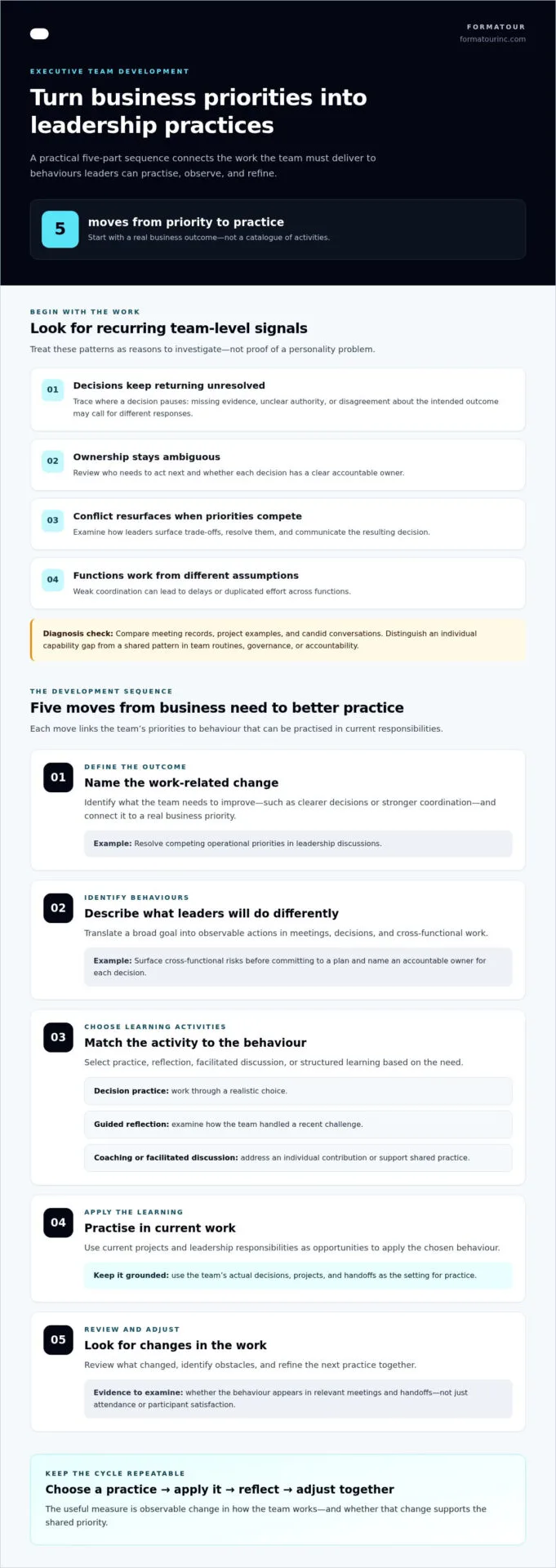
Look for patterns in the work. Decisions may return to the same meeting without resolution, project ownership may remain ambiguous, or conflict may resurface whenever priorities compete. Weak coordination can also show up as functions acting on different assumptions, creating delays or duplicated effort. Treat these as signals to investigate, not proof of a particular personality problem.
Start with business priorities, then examine the leadership behaviours that support them. If a strategic priority depends on coordinated execution, review how leaders share information, make trade-offs, and assign accountability. If decisions are slow, trace where they pause: missing evidence, unclear authority, or disagreement about the intended outcome may require different responses. Executive education can take varied forms, as outlined in Executive Education, but the format should follow the need. A program should address a defined performance issue, not count attendance as progress.
How to recognize an executive team development need
Review recurring decisions, handoffs, and unresolved issues across the leadership team. Use meeting records, project examples, and candid conversations to test what appears to be happening. Ask where work gets stuck, who needs to act next, and what information is missing. This grounds the diagnosis in observable events rather than assumptions about motivation or character.
Then distinguish a single capability gap from a shared pattern. If one executive struggles to communicate a decision, focused individual development may be appropriate. If several functions repeatedly leave the same decisions unclear, the issue is more likely in team routines, governance, or accountability. Compare examples across different initiatives before settling on a conclusion.
Translate business challenges into development goals
Turn each verified challenge into a behaviour executives can practise in their current responsibilities. Replace a broad goal such as “improve collaboration” with a clearer expectation: leaders surface cross-functional risks before committing to a plan and name an accountable owner for each decision. Plain language makes the goal easier to apply and review in actual work.
Team development improves shared leadership practices so executives can advance common priorities with greater clarity and accountability.
Before selecting learning activities, check that the goal addresses a strategic need and can be observed. For example, if competing priorities are delaying delivery, agree on how executives will resolve trade-offs and communicate the resulting decision to their functions. The useful measure is whether that practice changes in relevant meetings and handoffs, not whether participants enjoyed the session. Formatour’s executive leadership development work sits within a broader focus on strategic transformation and organizational performance.
Design an executive team development program around real work
Effective design connects a business need to leadership behaviour, then gives executives repeated opportunities to practise that behaviour in their own responsibilities. Executive team development programs should not be built around a catalogue of activities. Begin with the work the team must deliver, and shape the learning around what will help leaders do that work more effectively together.
Use a clear sequence to move from priority to practice:
- Define the outcome. Identify the work-related change the team needs, such as clearer decisions or stronger coordination.
- Identify behaviours. Specify what executives will do differently in meetings, decisions, or cross-functional work.
- Choose learning activities. Select practice, reflection, facilitated discussion, or structured learning to address the behaviours.
- Apply the learning. Use current projects and leadership responsibilities as opportunities to practise.
- Review and adjust. Look at what changed in the work, identify obstacles, and refine the next practice.
Set outcomes executives can use in their roles
Define the outcome at team level and connect it to responsibilities executives already hold. For example, a team working through competing operational priorities could aim to resolve trade-offs in leadership discussions and communicate the decision consistently to affected functions. A clear development goal turns a business priority into a leadership behaviour the team can practise and observe at work.
Choose development activities that fit the goal
Illustrative pathway, not a Formatour case study: An executive team identifies that project decisions lose momentum between functions. It agrees to clarify the decision owner and required input before closing each relevant discussion. The team practises this approach in an upcoming project review, notes where responsibilities remain unclear, and reflects on the handoff at its next leadership meeting. It then adjusts the practice, perhaps by recording ownership and next steps in the decision summary.
Keep the scope manageable. Selecting one or two behaviours gives executives room to apply them amid existing responsibilities and observe where the approach works or needs adjustment. Avoid treating attendance as completion. A learning session can establish a shared method; a real decision, project review, or cross-functional handoff provides the setting to test it.
Formatour’s executive leadership development programs are part of a wider organizational growth and strategic transformation effort. Information about discussing development needs is available through Formatour.
Compare executive development approaches and measure what changes
The right approach depends on whether the development need sits with an individual, the leadership team, or the organization’s broader systems. These approaches can work together, but they address different levels of change. Match the method to the need, then decide in advance what evidence would indicate that learning is being applied.
| Approach | Need addressed | Participants | Workplace application | Evidence of progress |
|---|---|---|---|---|
| Individual development | A capability gap specific to one executive | One executive, sometimes with input from colleagues | Practise a skill in the leader’s own responsibilities | Observable changes in the relevant leadership behaviour |
| Team development | Shared norms, decision practices, or coordination | The executive team | Apply agreed practices in leadership discussions and shared work | Clearer decisions, ownership, or cross-functional follow-through |
| Coaching | Reflection and focused support for a leadership challenge | An individual or team, depending on the goal | Use insights to prepare for and reflect on real work | Examples of changed choices or interactions |
| Organizational learning | Capability needs shared across functions or leadership levels | Groups across the organization | Apply common concepts and practices within relevant roles | Consistent use of the intended practices across work settings |
Which development approach fits the team’s challenge?
Measure progress without reducing it to attendance
Set a baseline before development begins. Use relevant observations, feedback, or existing operational indicators, such as how often decisions are reopened or whether owners and next steps are recorded. Choose measures that relate directly to the agreed goal, and review them at planned intervals. This creates a point of comparison without assuming that every change is caused by the program.
Attendance shows who participated; evidence of applied learning shows whether agreed behaviours are appearing in the work. Look for examples in meeting decisions, handoffs, or team feedback, and note where the practice remains inconsistent. While modern platforms like heartsy™ help unify organizational culture and scattered learning data into predictive analytics, leaders must still observe day-to-day team interactions directly. Participation and satisfaction data can help describe the learning experience, but they don’t establish a change in leadership behaviour or team performance.
Interpret outcomes with care. Delivery results can also be affected by resources, shifting priorities, market conditions, or changes in responsibilities. Review the development evidence alongside these factors, and distinguish a plausible contribution from a proven cause. This gives executives a more balanced view of progress and helps determine whether to sustain, adapt, or refocus the approach.
Turn executive team learning into consistent leadership habits
Learning becomes part of leadership practice when executives return to it in the decisions and interactions that make up their work. A simple follow-through cycle keeps development active without adding a separate layer of process:
- Select one practice tied to a current team priority, such as confirming decision ownership.
- Apply it in a real meeting, project review, or cross-functional handoff.
- Reflect on what helped, what got in the way, and how the practice affected the work.
- Adjust the approach and agree how to use it next time.
Reinforce new practices in executive meetings
Use an existing agenda to revisit the agreed behaviour, rather than relying on memory or a separate check-in. Ask what has helped or hindered application since the previous review. For example, if the team is working to clarify decisions, examine whether the meeting made the decision, owner, and next step clear. Record follow-up responsibilities and communicate decisions consistently to affected functions.
Meetings can also help leaders learn across functions. Invite executives to identify where a handoff worked well and where assumptions differed. Keep the discussion specific to actions and effects, not personal criticism. Psychological safety supports candid discussion, but it doesn’t remove accountability: leaders still need to name commitments, address missed follow-through, and agree on corrective action.
Sustain progress through feedback and reflection
Invite feedback that focuses on observable behaviour and its effect on collaboration. “The risk was raised before we finalized the plan” gives the team something to examine and repeat. “Communication needs to improve” is harder to act on. Review the practice at planned intervals, and consider whether it remains useful as strategic priorities or operating conditions shift.
Not every habit should be kept unchanged. If feedback and work examples show that the original development need has changed, revise the goal rather than continuing by default. A team focused on digital transformation, for instance, may need to strengthen how leaders communicate implementation decisions across functions. Formatour’s digital transformation consulting can support organizational change, while shared meeting practices help carry learning into day-to-day decisions.
Information about Formatour’s executive leadership development and team development needs is available online.
Connect executive team development programs with organizational priorities
Development is most useful when it supports work the executive team is accountable for now. A readiness check helps determine whether the organization has the conditions to make that connection, rather than launching activities before the purpose is clear. Confirm that leaders share a meaningful need, are prepared to practise new approaches, can apply them in their responsibilities, and have a plan to review what changes.
- Shared need: Executives agree on the work challenge the development effort should address.
- Executive commitment: Leaders are willing to take part, model the agreed practices, and make time for application.
- Workplace application: Current decisions, initiatives, or responsibilities provide opportunities to use what the team learns.
- Review plan: The team knows what evidence it will revisit and how it will respond to what it finds.
If one of these conditions is missing, address the gap before expanding the plan. A shared need without workplace application can leave learning separate from daily leadership. Application without a review plan makes it difficult to know whether the practice remains useful. The check should guide preparation, not become a reason to postpone development indefinitely.
Build a development plan that stays relevant
Use progress reviews to refine the plan. Compare current workplace examples with the original need, then decide whether to continue, adapt, or replace the practice. This protects the development effort from becoming routine for its own sake. It also keeps executive attention focused on leadership behaviours that support organizational performance and the priorities the team is responsible for advancing.
Explore executive leadership development with Formatour
Formatour is a Canadian advisory firm offering executive leadership development programs and professional development services. Its wider work includes strategic transformation and organizational performance, allowing leadership development to sit within a broader view of organizational growth. Explore Formatour’s advisory and professional development work to understand how these areas connect.
A well-aligned development plan begins with a clear organizational need and remains responsive as that need evolves. Formatour’s executive leadership development work can support organizations connecting leadership growth with strategic priorities.
Make the next leadership priority a starting point
The next step doesn’t need to be a large initiative. Choose a priority already on the executive agenda and use it to clarify what stronger leadership collaboration would look like in practice. That gives the team a meaningful place to begin and a way to keep development connected to the organization’s direction.
Well-designed executive team development programs support more than learning in isolation. They help leaders build practices that can evolve alongside the business, creating a stronger foundation for coordinated action as priorities shift.
Formatour’s work brings executive leadership development together with a broader understanding of organizational change and performance. Discuss your executive team’s development priorities and consider how development can support the work ahead.
With a clear purpose and commitment to learning through real work, your leadership team can take its next step with greater confidence.
Frequently Asked Questions
What is an executive team development program?
An executive team development program is a planned effort to strengthen how senior leaders contribute individually and work together to lead the organization. It may address shared decision-making, strategic alignment, communication, or leadership capabilities needed for a business priority. Unlike a one-off event, it connects learning to the team’s responsibilities and provides ways to apply and review new practices. The specific focus should reflect the organization’s context and leadership needs.
How do you know if an executive team needs development?
An executive team may need development when its members struggle to translate agreed strategy into coordinated action. Look for recurring issues such as conflicting messages to employees, decisions that are repeatedly revisited, or functions pursuing plans that depend on one another without aligning their assumptions. Compare these patterns across different projects and conversations. If the same barriers recur, the issue may involve shared leadership practices rather than a single executive’s capability.
How long should an executive team development program last?
There’s no universal duration. The appropriate timeframe depends on the complexity of the need, the opportunity to practise in real work, and how often the team can review progress. A focused issue may require a narrower development effort, while changes involving multiple functions or evolving responsibilities may need continued attention. Set review points around meaningful work milestones, then use the evidence to decide whether to conclude, extend, or revise the effort.
How can executive teams measure whether development is working?
Measure whether the team is using the intended practices and whether those practices support the work they were designed to improve. For example, if leaders aim to communicate strategic decisions consistently, review employee or stakeholder feedback alongside meeting records and follow-up questions. Consider operational context too: changes in staffing, priorities, or resources may affect results. A balanced review combines observed behaviours, relevant team indicators, and a careful account of other influences.
What is the difference between executive coaching and team development?
How can executives apply leadership training in their day-to-day work?
Choose a current responsibility where the new learning is relevant, such as preparing a strategic recommendation or resolving a dependency between departments. Before acting, identify the leadership behaviour to practise and what a useful result would look like. Afterward, capture a brief observation about what happened and what you would change next time. This short reflection can turn an abstract concept into a practical choice in the leader’s next similar situation.
To connect executive team development with your organization’s priorities, discuss your team’s development needs with Formatour.
