

Ninety percent of global leaders now report that the accelerating pace of change is outpacing their organization’s ability to adapt, according to the 2025 Accenture Pulse of Change report. You likely feel this pressure every day as you attempt to bridge the gap between ambitious board-level visions and the complex reality of daily operations. It’s a common struggle, and without a structured approach, even the most inspired projects often fail to deliver lasting value or measurable results.
To lead your organization through these complexities, you need more than just a vision. You require a robust business transformation strategy framework built on international standards and structural integrity. This guide provides the architectural blueprints necessary to build a resilient, future-ready organization. We’ll explore a clear, step-by-step roadmap that aligns your technology, people, and governance protocols. By integrating proven ISO benchmarks, you’ll gain the competitive agility needed to thrive through 2026 and beyond. We’ll show you how to transform operational stability into your greatest strategic advantage.
Key Takeaways
- Distinguish between tactical change management and a structural business transformation strategy framework to ensure your organization evolves with purpose and precision.
- Learn how integrating international ISO standards provides the necessary governance and security to support sustainable digital maturity and process automation.
- Discover the advantages of resilience-centric models that offer the agility of a boutique firm while maintaining the rigorous standards of global advisory leaders.
- Identify the critical steps of the 2026 roadmap, starting with a strategic gap analysis and moving toward full leadership alignment through executive development.
- Understand how to bridge the gap between high-level vision and daily operations to foster a culture of continuous improvement and competitive agility.
What is a Business Transformation Strategy Framework?
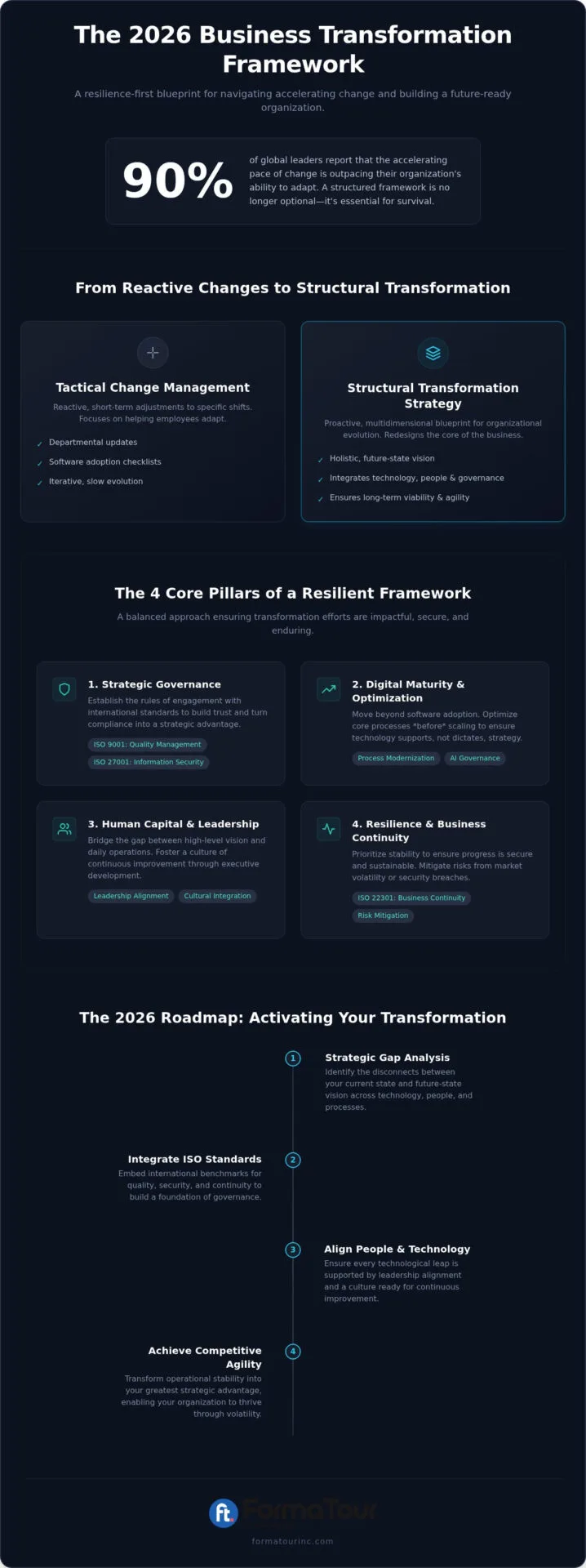
A business transformation strategy framework serves as a multidimensional blueprint for organizational evolution. It isn’t merely a checklist for software adoption or a series of departmental updates. Instead, it creates a structural foundation that allows a company to pivot without losing its core integrity. While many leaders confuse change management with transformation, they represent different scales of action. Change management is tactical, focusing on helping employees adapt to specific shifts. Transformation strategy is structural, redesigning the very DNA of the business to ensure long-term viability in an increasingly volatile market.
Defined simply, the framework is the precise intersection where executive vision, rigorous governance, and operational execution meet to redefine an organization’s future.
In 2026, a resilience-first approach is mandatory for any serious enterprise. Transformation efforts that prioritize speed over stability often collapse under the weight of market volatility or security breaches. By anchoring your strategy in international standards, such as ISO 22301 for business continuity, you ensure that your progress is both secure and sustainable. Adopting a comprehensive business transformation strategy framework ensures that every technological leap is supported by a robust organizational safety net.
The Core Drivers of Transformation in 2026
Macroeconomic pressures and the rapid rise of agentic AI have shifted the goalposts for global enterprises. We’ve moved past digital-first models that often prioritize shiny tools over operational substance. Today’s successful organizations adopt compliance-and-resilience-first models. This shift is driven by three primary factors:
- The need for autonomous AI systems that require strict governance and information security protocols like ISO 27001.
- Increasingly complex international regulations that demand high-level quality management and environmental accountability.
- A competitive landscape where extreme flexibility is a prerequisite for survival rather than a luxury.
The Difference Between Evolution and Transformation
Small iterative changes are no longer enough for market survival in a high-velocity economy. Evolution is slow and reactive. Transformation is proactive and total. To maintain momentum during these long-term shifts, organizations must implement operating loops. These loops allow for continuous feedback and adjustment while keeping the future-state vision in sight. This vision acts as the definitive north star of the framework, ensuring that technological adoption and human capital development remain perfectly aligned. Without this alignment, organizations risk a disconnect where high-level vision never actually reaches the daily operational reality of the workforce.
The 4 Core Pillars of a Modern Transformation Framework
A resilient business transformation strategy framework relies on the seamless integration of four foundational pillars. These pillars provide the necessary structure to support growth while mitigating the risks associated with rapid organizational change. By focusing on governance, technology, people, and resilience, leaders ensure their transformation efforts are both impactful and enduring. Without this balanced approach, organizations often find that their technological gains are undermined by cultural resistance or security vulnerabilities.
Strategic Governance: The Role of ISO Standards
Strategic governance provides the rules of engagement for any large-scale shift. Implementing ISO 9001 quality management implementation establishes a culture of excellence and consistency that guides every department. This foundation is further strengthened by ISO 27001, which secures the digital transformation journey by safeguarding intellectual property and client data. These international certifications act as a global passport, building trust with partners and stakeholders across different jurisdictions. They turn compliance from a hurdle into a strategic advantage.
Digital Maturity and Process Optimization
Digital maturity is often misunderstood as the mere adoption of new software. True maturity requires a comprehensive digital transformation strategy that optimizes core processes before they are scaled. Identifying and modernizing existing operating loops ensures that automation drives measurable performance gains rather than just accelerating inefficient habits. This pillar focuses on aligning technological capabilities with specific business outcomes. It ensures that every investment in automation contributes directly to the organization’s competitive agility.
Leadership: The Cultural Engine of Transformation
Leadership remains the cultural engine that powers every other aspect of the framework. Transformation projects frequently stall when there is a lack of specialized leadership training for digital transformation. Executives must be equipped to articulate a clear vision that resonates with the entire workforce. Addressing cultural resistance through transparent and authoritative communication ensures that every team member understands their role. When leaders don’t model the change they wish to see, the rest of the organization rarely follows.
The final pillar, organizational resilience, focuses on the ability to thrive during disruption. By anchoring your framework in ISO 22301 standards, you create a robust business continuity plan that protects your operations from external shocks. This structural foresight minimizes downtime and protects your brand’s reputation during periods of market volatility. To ensure these pillars are properly integrated into your own roadmap, you may wish to speak with a transformation specialist about your specific organizational needs.
Evaluating Popular Frameworks vs. Resilience-Based Models
Selecting the right business transformation strategy framework often involves choosing between specialized extremes. Software-centric models prioritize ERP integration and data flow, yet they frequently neglect the human elements that drive adoption. Conversely, people-centric frameworks focus heavily on individual change management but may lack the rigorous governance needed for global compliance. A resilience-centric approach bridges these gaps by treating organizational stability as the primary objective. This ensures that every strategic shift reinforces the company’s core rather than stretching it to the point of failure.
The Resilience-Based Framework (The Formatour Model)
The Formatour approach integrates ISO 22301 business continuity consulting directly into the transformation roadmap. This focus on resilience significantly reduces the risk of “transformation fatigue” within the workforce. When employees see that new systems are stable and reliable, their resistance fades. Success is measured not just by the speed of implementation, but by the long-term stability and security of the new organizational state. It’s a shift from “moving fast and breaking things” to “moving precisely and building strength.” This methodology ensures that compliance is a byproduct of excellence rather than a separate, burdensome task.
Framework Selection Criteria for Executives
The 2026 Roadmap: Activating Your Transformation Strategy
Activating a business transformation strategy framework requires a disciplined, phased approach that moves beyond high-level theory into measurable operational change. This roadmap ensures that every structural shift is validated by international standards, providing a sense of security for stakeholders and employees alike. It’s a five-step journey that transitions from initial diagnosis to sustainable anchoring. By following a structured path, leaders can avoid the common pitfalls of fragmented implementation and misaligned priorities. A well-defined business transformation strategy framework acts as the steering mechanism for this complex voyage.
Phase 1: Diagnosis and Strategic Design
Conducting a thorough ISO gap analysis is the essential first step to identify organizational risks. This audit highlights the distance between current operations and international benchmarks. Once the gaps are clear, leadership must align through executive seminars to refine the vision. This alignment allows for the architecture of a future state where digital and process design are intentionally linked. We then build transformation workstreams based on priority impact, ensuring that resources are allocated where they’ll generate the most significant resilience. Defining measurable KPIs at this stage links daily operational performance directly to your long-term strategic goals. This creates a data-driven environment where progress is visible and progress is undeniable.
Phase 2: Execution and Continuous Optimization
The execution phase shifts the focus toward activation via pilot programs and process automation. Leveraging project management advisory services for complex initiatives ensures that your transformation remains on track and within scope. Process automation is used strategically to buy back time for high-level strategic work, allowing your team to focus on innovation rather than repetitive manual tasks. Successful pilots move through a standardization loop, where they’re refined and scaled across the enterprise. This methodical scaling prevents the fragmentation often seen in hurried transformation attempts. Finally, the transformation is anchored through formal certification and a schedule of internal audits. This step transforms a one-time project into a permanent organizational capability. It ensures that the gains in quality, security, and efficiency are preserved for the long term. If you’re ready to begin your assessment, you can schedule a strategic consultation to discuss your specific roadmap.
Partnering for Success: The Formatour Advisory Approach
Formatour Incorporated bridges the gap between the rigid, often impersonal structures of large global consultancies and the responsive, personalized nature of a boutique advisory. We act as a strategic mentor for organizations navigating the complexities of both the Canadian and international business landscapes. Our approach ensures that your business transformation strategy framework is not just a theoretical document but a living part of your operational excellence. We provide the expert hand needed to guide leaders through the integration of high-level benchmarks into daily workflows. This balance of authority and accessibility allows us to co-create solutions that are as robust as they are practical.
Integrated ISO and Transformation Services
Digital trust is the currency of the modern enterprise, and it’s built on a foundation of proven security. We prioritize ISO 27001 implementation services as a critical starting point for any digital transformation. This ensures that as you adopt new technologies, your data and intellectual property remain protected against evolving threats. Additionally, the growing global demand for environmental accountability makes ISO 14001 certification services vital for long-term, sustainable growth. We don’t believe in off-the-shelf solutions that ignore the nuances of your business. Instead, we co-develop strategies that respect your specific organizational culture while meeting rigorous global standards. This collaborative process ensures that transformation feels like a shared achievement rather than an external disruption.
Empowering Your Internal Teams
True resilience is built from within, and it requires a workforce that is both skilled and confident. We focus on empowering your internal staff through specialized IT certification and lead auditor training. This ensures your team possesses the necessary skills to maintain, update, and audit your business transformation strategy framework long after our initial advisory engagement ends. Our goal is to provide the tools for sustainable excellence, moving away from temporary fixes that often fail when market pressures increase.
By developing deep internal expertise, you create a self-sustaining cycle of continuous improvement and compliance. This long-term focus protects your strategic investment and ensures your organization remains future-ready regardless of macroeconomic shifts. When you’re prepared to move beyond surface-level change, you can consult with Formatour Incorporated to design your 2026 transformation framework. Booking a strategic transformation study is the definitive first step toward securing your position as a resilient market leader.
Securing Your Strategic Advantage for 2026
Success in the next era of global business depends on your ability to transform without sacrificing stability. We’ve explored how a robust business transformation strategy framework bridges the gap between high-level vision and operational reality. By anchoring your growth in international ISO standards and empowering your leadership through targeted development, you create an organization that’s both agile and secure. True transformation isn’t a one-time project; it’s the development of a permanent capability for excellence and resilience.
As a Canadian premium advisory firm with a global strategic vision, Formatour Incorporated provides the expertise required to navigate these complex shifts. Our ISO certified experts work alongside you to co-develop solutions that align your technology, people, and governance. Whether you’re optimizing processes or pursuing international certification, we offer the steady hand needed to ensure your long-term success. Take the definitive step toward a more resilient future today. Partner with Formatour for Strategic Transformation and lead your organization with quiet confidence through the challenges of 2026 and beyond.
Frequently Asked Questions
What is the most effective business transformation strategy framework for 2026?
Resilience-centric models that incorporate ISO standards like ISO 9001 and ISO 22301 are the most effective for 2026. These frameworks ensure that your organizational evolution is built on a foundation of quality and continuity. By prioritizing structural integrity over mere speed, you create a system capable of withstanding macroeconomic shocks. This approach provides a clear roadmap for aligning your long-term vision with daily operational requirements.
How does ISO 27001 integrate into a digital transformation framework?
ISO 27001 acts as the defensive perimeter within a modern business transformation strategy framework. It ensures that every technological advancement is accompanied by rigorous information security protocols. As you automate processes and adopt AI, this standard safeguards your data assets and maintains digital trust with stakeholders. Integrating security early in the transformation journey prevents costly breaches and ensures that your digital maturity is built on a secure, auditable foundation.
Why do most business transformation strategies fail?
Most strategies fail because of a critical disconnect between high-level executive vision and the daily reality of the workforce. According to the 2025 Accenture Pulse of Change report, 90% of leaders feel the pace of change is accelerating beyond their control. Without a structured framework to manage this pace, organizations suffer from transformation fatigue and cultural resistance. Failure often stems from treating transformation as a tactical software update.
What are the 4 pillars of business transformation?
The four pillars include Strategic Governance, Digital Maturity, Human Capital, and Organizational Resilience. Strategic Governance focuses on international standards and compliance. Digital Maturity targets process optimization and automation. Human Capital centers on leadership development and cultural alignment. Finally, Organizational Resilience ensures business continuity through standards like ISO 22301. Together, these pillars provide a balanced approach that prevents one area of the business from outstripping the others during periods of rapid growth.
Can a small firm use the same transformation framework as a global giant?
The core principles of a robust business transformation strategy framework are entirely scalable across organizations of all sizes. While a global giant may have more complex operating loops, a smaller firm can leverage its boutique agility to implement ISO standards more rapidly. The focus remains the same: aligning people and technology under a unified governance model. Smaller organizations often find that this structured approach provides a significant competitive advantage.
How do you measure the ROI of a business transformation strategy?
ROI is measured through a combination of operational efficiency gains and improved organizational stability. You should track metrics such as reduced downtime, faster process cycles through automation, and successful ISO certification audits. Long-term value is also found in enhanced brand reputation and the ability to pivot quickly during market disruptions. By focusing on resilience, you protect your strategic investments and ensure that the transformation delivers sustainable financial performance rather than temporary spikes.
How long does a typical business transformation take to implement?
A comprehensive transformation typically takes between 18 and 36 months to fully anchor within the corporate culture. The initial assessment and pilot phases may occur within the first six months, but achieving full ISO certification and internalizing new operating loops requires a longer commitment. This timeline ensures that changes are sustainable and that the organization doesn’t revert to old habits once the initial project pressure subsides. Patience is essential for excellence.
What is the role of executive leadership in the transformation framework?
Executive leaders serve as the visionary architects and primary mentors for the entire transformation effort. Their role is to articulate a clear vision and ensure that resources are aligned with strategic objectives. Beyond setting the direction, they must model the cultural shifts they expect from their teams. Without active leadership participation and transparent communication, the workforce rarely adopts the new digital and operational realities required for the framework to succeed long-term.
