

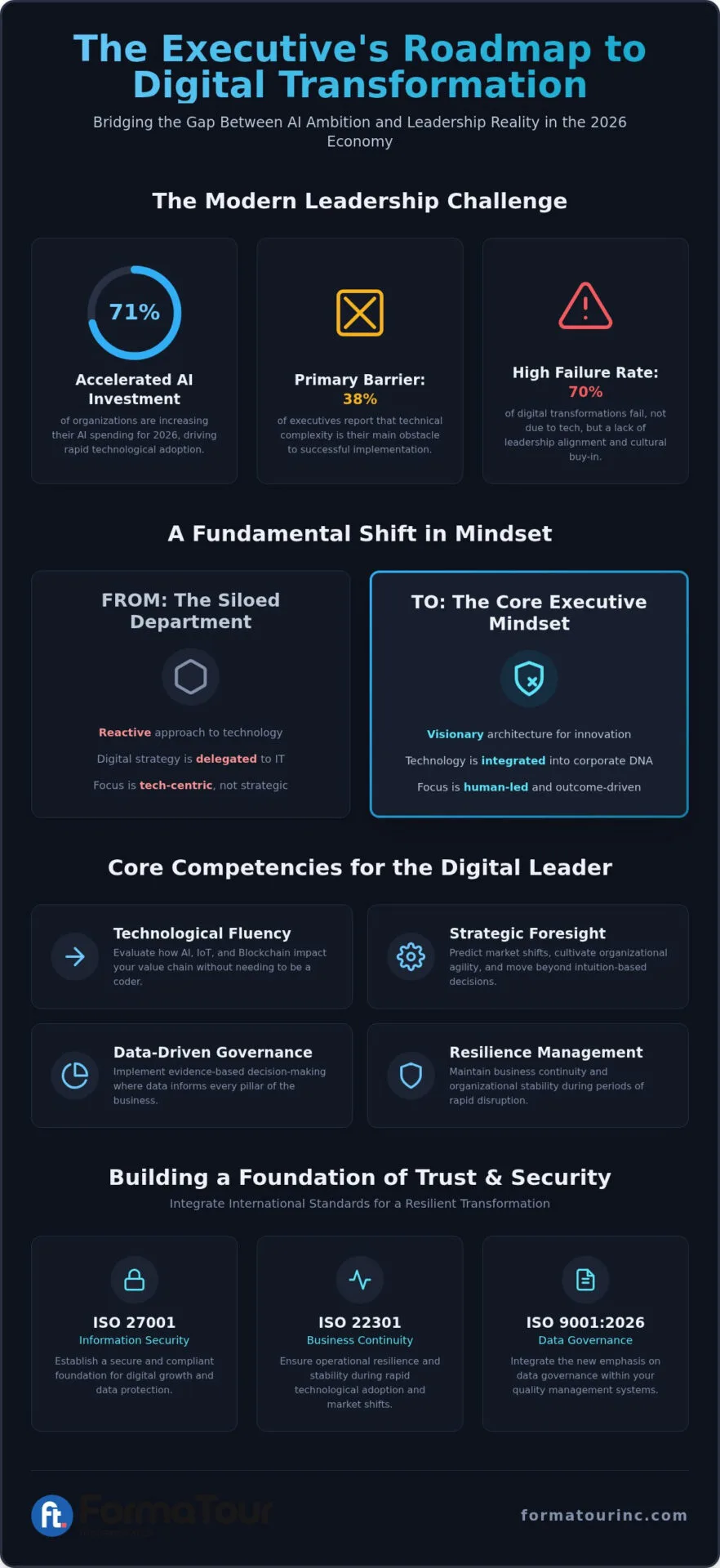
While 71% of organizations have accelerated their AI investments for 2026, nearly 38% of executives report that technical complexity remains their primary barrier to success. You’ve likely felt the tension of maintaining a cohesive strategy when IT initiatives seem disconnected from your core executive vision. It’s a common challenge to balance the pursuit of rapid innovation with the heavy responsibility of cybersecurity and regulatory compliance. Specialized leadership training for digital transformation has become the essential bridge between these competing priorities.
This guide provides a comprehensive roadmap for upskilling your leadership team and aligning digital growth with rigorous international standards. You’ll gain the executive competencies required to steer complex shifts while ensuring your organization remains resilient and secure. We’ll explore how to foster digital fluency across your board, optimize operational performance, and integrate the new ISO 9001:2026 emphasis on data governance. By the end of this guide, you’ll have a clear strategy to transform technological anxiety into a steady, expert hand that guides your firm toward sustainable excellence.
Key Takeaways
- Recognize the transition from viewing technology as a separate department to embracing a digital-first executive mindset that aligns innovation with long-term strategy.
- Master the specific technical fluencies and strategic foresight delivered through leadership training for digital transformation to unify IT initiatives with your corporate vision.
- Establish a secure foundation for growth by integrating ISO 27001 and ISO 22301 standards into your transformation roadmap to ensure resilience and compliance.
- Implement a methodical approach to identifying leadership gaps and aligning training modules with your organization’s unique operational goals.
- Leverage a multidisciplinary advisory perspective to navigate complex global systems and achieve seamless integration of high-level concepts into daily operations.
The Evolution of Executive Leadership in the 2026 Digital Economy
Success in this era isn’t found in the tools themselves but in how they’re integrated into the corporate DNA. Comprehensive leadership training for digital transformation provides the framework for this shift. It moves the conversation from technical specifications to strategic outcomes. It asks how technology advances a market position while maintaining a commitment to international standards. This training ensures that the executive suite isn’t just reacting to tech trends but is actively shaping the organization’s digital future.
From Tech-Centric to Human-Led Transformation
Canadian organizations face unique pressures as national trends point toward rapid enterprise-wide AI implementation. With 71% of organizations increasing their AI spending this year, the focus has shifted toward enhancing employee productivity through automation. This requires a sophisticated approach that doesn’t sacrifice operational integrity. Partnering with a specialized Formatour homepage allows leaders to bridge this gap through multidisciplinary advisory and leadership training for digital transformation. By prioritizing digital fluency, Canadian executives can turn the complexity of the current IT environment into a clear competitive advantage. This strategic alignment ensures that growth remains sustainable, secure, and fully compliant with global benchmarks.
Core Competencies of Transformative Digital Leaders
Leading a modern organization requires more than a passing acquaintance with new software. It demands a suite of specific competencies that blend high-level strategy with technical insight. Transformative leaders don’t need to write code, but they must possess the technological fluency to evaluate how AI, IoT, and Blockchain impact their value chain. This shift from technical oversight to strategic integration is the cornerstone of effective leadership training for digital transformation. By mastering these domains, executives ensure their digital initiatives aren’t just expensive experiments but are instead drivers of structural integrity.
Technological Fluency for the C-Suite
Demystifying emerging technologies is the first step toward effective governance. Non-technical executives often feel alienated by the jargon of digital shifts. High-quality leadership training for digital transformation focuses on the “what” and “why” of these tools, allowing leaders to foster a data-driven culture without disrupting daily operations. Implementing IT certification training programs for the broader leadership team builds a shared language of innovation. This collective fluency allows the C-suite to partner more effectively with technical teams, ensuring that IT strategy remains perfectly aligned with the executive vision.
Agility and Operational Performance
True digital leadership balances the rigorous standards of a large-scale firm with the boutique agility required for rapid pivoting. This balance is critical when leading process automation and optimization initiatives. Operational Performance is the measurable efficiency and effectiveness of an organization’s internal processes, optimized through the seamless integration of technology and human capital. By focusing on these pillars, leaders can achieve the high-level growth they seek while maintaining the stability of international quality standards like ISO 9001. If you’re ready to refine these competencies within your own team, consider how you can consult with a strategic advisor to tailor a development path for your organization.
Bridging the Gap: Governance, ISO Standards, and Digital Resilience
Digital transformation often falters when organizations treat it as a series of disconnected software upgrades rather than a fundamental governance challenge. In the 2026 landscape, the most successful firms are those that build their digital future on a foundation of international standards. By integrating rigorous frameworks into their core strategy, executives move beyond mere adoption to achieve true digital resilience. This is where leadership training for digital transformation becomes a critical differentiator. It equips the C-suite with the knowledge to use compliance as a strategic enabler rather than a bureaucratic hurdle.
Positioning international standards as a competitive advantage allows Canadian firms to compete on a global scale with unwavering reliability. It signals to partners and clients that the organization is grounded in precision and excellence. When leadership training for digital transformation includes these benchmarks, it transforms the executive team from observers of change into architects of a secure, optimized future. This multidisciplinary approach ensures that every digital milestone is supported by a robust framework of governance and structural integrity.
ISO 27001 as a Leadership Framework
Information security isn’t solely the domain of the IT department. The executive’s role in establishing and maintaining an Information Security Management System (ISMS) is pivotal for organizational health. This framework provides the necessary guardrails for rapid tech adoption, ensuring that innovation doesn’t outpace security. Through targeted training, leadership teams learn to empower their internal staff for auditing and certification processes. This proactive stance is detailed in our ISO 27001 Implementation Services, which illustrates how security becomes a pillar of strategic foresight rather than a reaction to threats.
Building Organizational Resilience
The ability to maintain business continuity during significant technological shifts is a hallmark of a mature organization. Strategic change management, when viewed through the lens of ISO 22301, allows leaders to anticipate disruptions and mitigate risks before they impact the bottom line. Developing an “Organizational Resilience” persona within the executive team fosters a culture of stability and quiet confidence. For a deeper exploration of these methodologies, our sibling article on ISO 22301 Business Continuity Consulting provides a strategic guide to maintaining resilience in 2026. This focus on continuity ensures that digital growth never comes at the expense of structural stability.
Designing a Roadmap for Executive Leadership Training
Executing a digital shift requires a structured pathway that translates executive vision into operational reality. While generic programs offer broad overviews, specialized leadership training for digital transformation must be tailored to the specific maturity of your organization. A methodical roadmap ensures that every hour of development contributes directly to structural integrity and growth. This process moves the leadership team from a state of reactive adoption to one of proactive, visionary architecture.
- Step 1: Conduct a Digital Maturity and Leadership Gap Analysis. This initial assessment identifies where current competencies fall short of future requirements and established benchmarks.
- Step 2: Align Training Modules with Strategic Business Objectives. Ensure that learning outcomes support specific goals, such as reaching new ISO certification benchmarks or expanding into new digital markets.
- Step 3: Select the Right Format. Balance the global perspective of international seminars with the focused, collaborative environment of in-house workshops to suit your team’s schedule and learning style.
- Step 4: Implement Applied Learning through Strategic Project Management. Theoretical knowledge must be immediately applied to real-world organizational challenges. This ensures that the training delivers tangible improvements to current workflows rather than remaining an abstract exercise.
- Step 5: Measure ROI through Operational Performance Metrics. Track improvements in efficiency, security, and compliance to validate the investment. Leaders should look for a clear correlation between training participation and the successful completion of digital milestones.
The Importance of Multidisciplinary Advisory
Quantifying the success of leadership training for digital transformation involves tracking specific KPIs. These include innovation rates, employee retention, and the speed of achieving compliance milestones. For many firms, the ultimate benchmark is how effectively these skills support ISO 9001 Quality Management standards. Additionally, the value of international business seminars shouldn’t be underestimated. These sessions provide a global perspective that is essential for leading in a connected economy. If you’re ready to build a bespoke roadmap for your team, you can schedule a consultation with our advisory team to begin your transformation.
Elevating Organizational Performance through Formatour’s Development Programs
Formatour Incorporated bridges the gap between technical compliance and strategic leadership. We recognize that true optimization happens when international standards meet visionary management. Our leadership training for digital transformation isn’t a static curriculum; it’s a dynamic partnership designed to foster structural integrity. By combining deep ISO expertise with high-level executive development, we ensure your organization doesn’t just adapt to change but masters it. This approach positions us as a steady, expert hand for firms seeking both stability and growth in a complex global market. Next steps for executives involve moving from theory to application. Booking an initial advisory session allows us to assess your current leadership gaps and align our modules with your strategic business objectives.
Our Multidisciplinary Approach to Transformation
We co-develop solutions that integrate people, process, and technology. This multidisciplinary approach ensures that IT certifications aren’t isolated technical achievements but drivers of executive performance. For those evaluating the market, our Digital Transformation Strategy Firms guide offers a framework for selecting a partner that aligns with your specific maturity level. We help you move beyond the “big-firm” rigidity toward a model of boutique agility that respects your unique industry landscape and specific ISO goals. This customization allows for the seamless integration of high-level concepts into your daily operations, ensuring that every technological shift is backed by a solid governance structure.
Partnering for Resilience and Growth
Choosing a premium, Canadian-based advisory partner provides national coverage with localized expertise. We act as a strategic mentor, offering long-term support through ISO internal audit assistance and sustained quality management. This specialized leadership training for digital transformation ensures that your digital growth remains grounded in international benchmarks like ISO 27001 and ISO 22301. Our role is to provide the strategic foresight needed to navigate rapid technological adoption without sacrificing security. By focusing on human capital and structural integrity, we help you achieve a results-oriented atmosphere that feels both modern and deeply established. Empower your leadership team with Formatour to begin co-developing a future defined by precision, intelligence, and unwavering reliability.
Securing the Future of Digital Leadership
The intersection of technological fluency and international governance is the definitive competitive edge for the 2026 economy. Leaders don’t just need new tools; they require a fundamental shift toward visionary architecture where every digital shift is anchored by robust security and business continuity frameworks. This transition ensures that innovation never outpaces the structural integrity of your organization. Dedicated leadership training for digital transformation is the essential vehicle for this evolution, providing the competencies needed to navigate complex global systems with quiet confidence.
Formatour brings over a decade of strategic transformation success and specialized ISO 27001 and ISO 22301 Lead Auditor expertise to your organization. As a premium Canadian multidisciplinary advisory, we co-develop solutions that align your executive vision with rigorous international standards. It’s time to move beyond reactive management and embrace a future defined by precision and resilience. Empower your executive team with Formatour’s boutique leadership training to turn technological complexity into a clear, sustainable advantage. Your path to digital mastery is ready for implementation.
Frequently Asked Questions
What is leadership training for digital transformation?
Leadership training for digital transformation is a specialized development process that equips executives with the competencies to align emerging technologies with long-term strategic goals. It focuses on building technological fluency, strategic foresight, and the ability to govern complex digital shifts. By mastering these domains, leadership teams ensure that digital initiatives deliver tangible ROI while maintaining organizational resilience and compliance with international standards.
Why do executives need specific training for digital shifts in 2026?
Executives require targeted training because the speed of technological cycles has outpaced traditional management models. With enterprise AI adoption doubling and IT environments becoming increasingly complex, leaders must move beyond delegating digital tasks. Specific training enables the C-suite to act as visionary architects who can bridge the gap between IT strategy and executive vision, ensuring that rapid tech adoption doesn’t compromise security or operational performance.
How does ISO 27001 certification relate to leadership development?
ISO 27001 certification is deeply rooted in leadership because a successful Information Security Management System requires top-down governance. Leadership development empowers executives to oversee the implementation and auditing processes effectively. It transforms compliance from a technical checklist into a strategic framework for risk management. Formatour leverages over a decade of lead auditor expertise to help leaders integrate these security benchmarks into their broader transformation strategy.
Can leadership training improve our organizational resilience?
Leadership development significantly enhances organizational resilience by embedding business continuity principles, such as those found in ISO 22301, into the executive mindset. When leaders are trained to anticipate disruptions and manage change strategically, the entire organization becomes more agile. This proactive approach ensures that digital shifts don’t lead to operational downtime, allowing the firm to maintain steady performance even during periods of rapid technological or market volatility.
What is the difference between academic leadership programs and boutique advisory training?
Boutique advisory training offers a level of customization and practical application that broad academic programs often lack. While universities provide foundational theory, boutique firms like Formatour prioritize agility by tailoring modules to your specific industry and ISO goals. This multidisciplinary approach ensures that training is immediately applicable to your real-world operational challenges, focusing on the co-development of solutions rather than just the delivery of generic course content.
How long does a typical executive leadership development program take?
The duration of an executive program depends entirely on your organization’s maturity and strategic objectives. Programs can range from intensive international seminars lasting a few days to comprehensive development tracks that span several months. Formatour prioritizes a methodical and deliberate flow, ensuring that each phase builds logically upon the last. This flexibility allows leadership teams to balance their professional development with the ongoing demands of high-level organizational management.
How do we measure the ROI of digital transformation training for our C-suite?
Measuring the ROI of leadership training for digital transformation involves tracking specific operational performance metrics and strategic milestones. Key indicators include a higher innovation rate, improved employee retention during shifts, and the speed at which the organization achieves or maintains ISO certifications. Leaders can also quantify success through improved data governance and a closer alignment between digital growth and international security standards, resulting in reduced risk and increased market competitiveness.
Does Formatour provide training for ISO 9001 and ISO 14001 as part of leadership development?
Yes, Formatour provides expert training and implementation support for both ISO 9001 Quality Management and ISO 14001 Environmental Management. We integrate these standards into our broader leadership development programs to ensure a holistic approach to organizational health. This multidisciplinary perspective helps executives manage the synergy between quality, environmental responsibility, and digital growth, positioning the firm as a global citizen committed to sustainable and high-quality operational standards.
