

What makes an advisory partner useful isn’t just the strength of its strategy. It’s whether leaders can put that strategy into practice. For Canadian executives, priorities can lose momentum between leadership decisions and daily operations. Security, continuity, quality, and environmental responsibilities can also sit apart from broader organizational goals. When evaluating C-suite advisory services Canada has to offer, look for a partner that can connect these priorities to practical, lasting change.
Effective advisory support advances transformation while keeping operational performance in view. This guide explains how to assess advisory fit and scope, connect leadership decisions to delivery, and build the capability to adapt. It covers executive development, digital transformation, process improvement, project management, and management systems, including how these areas can work together. With the right scope, advisory services do more than offer recommendations: they help turn executive intent into coordinated progress across the organization.
Key Takeaways
- Assess C-suite advisory services Canada by how well they connect executive priorities to operational change, not just strategic recommendations.
- Distinguish advisory from coaching, consulting, and project delivery so the engagement is scoped around the outcomes your organization needs.
- Compare potential partners on strategic fit, implementation support, relevant expertise, governance, and knowledge transfer.
- Prepare for an engagement by clarifying priorities, securing executive sponsorship, defining scope, aligning stakeholders, and reviewing progress.
- Look for an integrated approach that links transformation, operational performance, resilience, and leadership capability.
What C-Suite Advisory Services in Canada Should Help Leaders Achieve
Executive priorities create value when they shape decisions, guide resources, and influence how work gets done. C-suite advisory services Canada organizations engage should connect those stages, rather than leave strategy as a leadership statement without a clear route to action. An advisor brings a senior-level perspective to issues that cross functions, helps clarify trade-offs, and supports alignment between plans and operational realities.
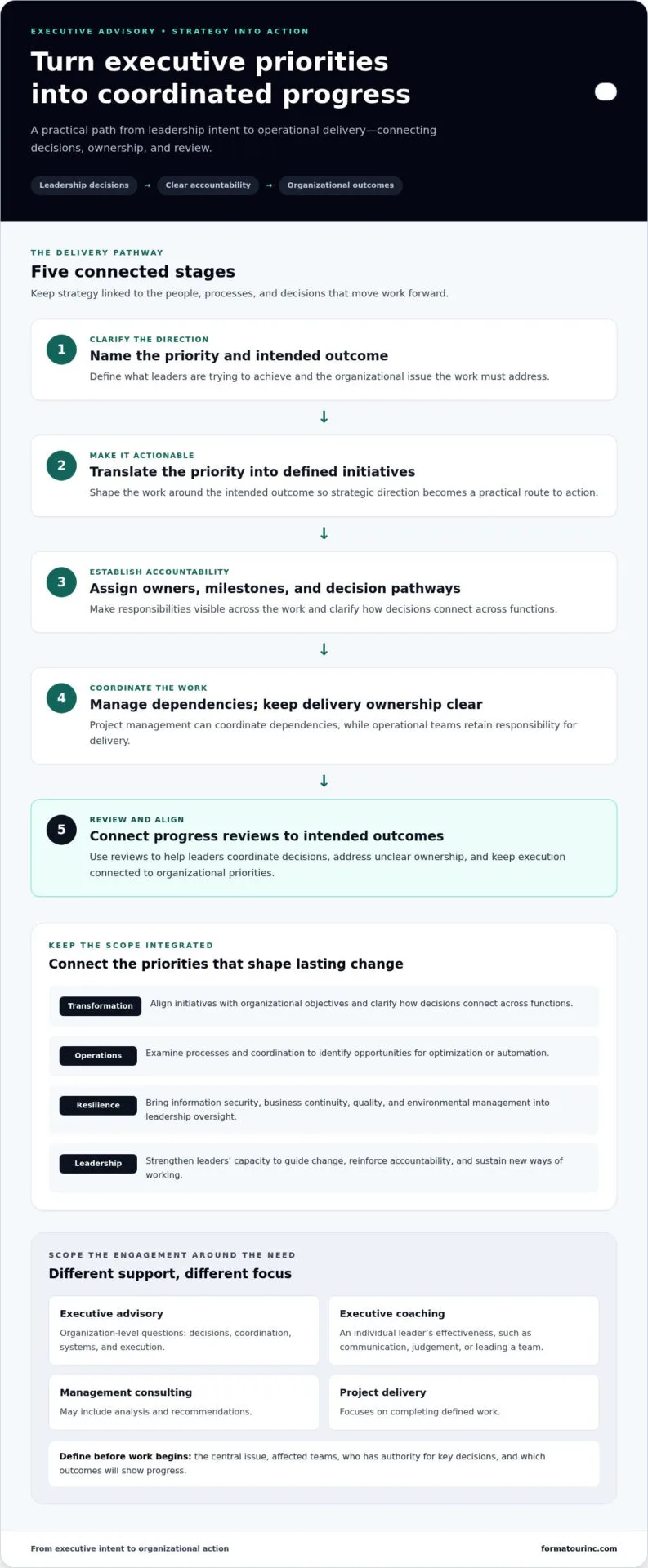
Executive advisory connects leadership decisions, clear accountability, and organizational outcomes. It helps leaders make informed choices and establish the ownership and coordination needed to act on them. The work may involve strategic transformation, operational performance, resilience planning, or complex change. It can draw on methods associated with management consulting, with scope shaped by organizational priorities and the decisions leaders need to make.
Which executive challenges can advisory support address?
Advisory can help when board direction, executive priorities, and operational teams are out of alignment. A transformation, for example, may have an agreed objective but unclear ownership across functions. The result can be delayed decisions, duplicated effort, or competing work. An advisor can help leaders define responsibilities, coordinate decisions, and link progress reviews to intended outcomes.
It can also help leaders connect resilience-related systems to organizational priorities. Information security, quality, and business continuity are more effective when they support the wider business rather than operate as disconnected initiatives. Leaders might consider how a process change affects service continuity, or how quality objectives relate to operational performance. This is organizational oversight, not legal representation or physical security work.
How does C-suite advisory differ from executive coaching?
Before work begins, identify the central issue, affected teams, and decisions that lack clear ownership. This helps determine whether the priority is strategic guidance, leadership capability, coordinated implementation, or a combination. Formatour brings these dimensions together through executive leadership development, transformation, process optimization, project management, and support for management systems including ISO 27001, ISO 9001, ISO 22301, and ISO 14001. The focus is practical alignment between executive intent and organizational action.
What C-Suite Advisory Services Include: From Strategy to Organizational Resilience
Executive advisory can cover several connected areas, with the right mix determined by an organization’s priorities. C-suite advisory services Canada leaders consider may include strategic transformation, operational performance, resilience planning, and executive development. The value comes from connecting these areas so changes in direction are reflected in processes, responsibilities, and leadership decisions.
Advisory and implementation are related, but they are not identical. Strategic advice helps define priorities and choices; implementation support helps turn them into coordinated work. A practical scope specifies where the advisor guides decisions, where teams own delivery, and how progress will be reviewed. The Canadian Association of Management Consultants offers a reference point for consulting standards and ethics.
- Strategic transformation aligns initiatives with organizational objectives and clarifies how decisions connect across functions.
- Operational performance examines processes and coordination to identify opportunities for optimization or automation.
- Organizational resilience connects information security, business continuity, quality, and environmental management with leadership oversight.
- Executive development strengthens leaders’ capacity to guide change, reinforce accountability, and sustain new ways of working.
Connecting strategic priorities with operational delivery
Digital transformation and process optimization should address a specific organizational need, rather than become goals in themselves. Automation may be appropriate when a repetitive workflow creates delays or inconsistent handoffs. A process review may instead reveal that decision rights or responsibilities need clarification first. Coordinating leaders, functional teams, and project leads keeps change connected to everyday operations. Formatour supports this work through digital transformation consulting, process automation and optimization, and project management.
Building resilience through management systems and leadership
Management systems give leaders a structured way to assign responsibility, establish processes, and review performance in distinct areas. ISO 27001 relates to information security management; ISO 22301 to business continuity; ISO 9001 to quality management; and ISO 14001 to environmental management. Each addresses a different organizational priority. A standard or certification alone doesn’t guarantee effective security, continuity, quality, or environmental performance. Results depend on how the system is implemented, maintained, and used.
Leadership capability is part of effective implementation. Executives set expectations, assign ownership, and support teams as practices change. Development can reinforce those responsibilities, while project work and management-system implementation help embed them in operations. Formatour brings these disciplines together to support strategic priorities through practical organizational change. Leaders can discuss their organizational priorities with the team.
How to Compare C-Suite Advisory Firms in Canada
Compare proposals against the same organizational challenge, not just their language, credentials, or breadth of services. A strong proposal explains how the work will connect executive priorities to operational realities and distinguishes the advisor’s contribution from the responsibilities of your leaders and teams. Advisory fit depends on alignment between organizational priorities, relevant expertise, and execution.
Use the same criteria to compare C-suite advisory services Canada organizations are considering. The table can help you spot differences in approach before deciding on a scope.
| Assessment area | What to examine | Signs of a strong fit |
|---|---|---|
| Strategic fit | Does the proposed work address a stated executive priority? | Objectives connect clearly to organizational needs and decisions. |
| Implementation support | Does the scope include practical guidance for putting recommendations into action? | Responsibilities, milestones, and decision pathways are clear. |
| Relevant expertise | Does the team understand the challenge and operating context? | Experience aligns with transformation, performance, resilience, or leadership needs. |
| Governance | How will executives oversee the work and resolve decisions? | Accountability, escalation routes, and progress reviews are defined. |
| Knowledge transfer | How will internal teams build capability during the engagement? | Methods and learning are shared with the people responsible for sustaining the work. |
Which capabilities should executives assess?
Look beneath the stated problem. Recurring delays between departments may seem to call for automation, but the underlying issue could be unclear approvals, duplicated steps, or competing ownership. Ask whether the proposed work will examine causes and operating context before recommending a response. Addressing only a symptom can leave the root issue unresolved.
How can leaders assess scope, accountability, and fit?
Review each proposal for defined objectives, deliverables, decision rights, and responsibilities. Check who will participate, which leaders will sponsor the work, and how progress will be discussed. Recommendations should account for current processes and operational demands, rather than assume teams can absorb change without trade-offs or coordination.
Consider how relevant standards fit into the wider strategy. ISO 27001, ISO 22301, ISO 9001, or ISO 14001 may support specific organizational priorities, but the engagement should connect management-system work to governance and ongoing operations. Certification should not be treated as the strategy itself. Compare the proposed scope with the outcomes your organization intends to pursue.
How to Prepare for a C-Suite Advisory Engagement Without Losing Operational Focus
Preparation gives advisory work a clear mandate and helps protect day-to-day responsibilities. Before launching C-suite advisory services, leaders can use this sequence to focus the engagement, establish accountability, and pace change around operational capacity.
- Clarify the priority. State the organizational challenge, intended outcome, decision owner, and teams affected. Identify constraints, dependencies, and the measures leaders will use to assess progress.
- Establish executive sponsorship. Name a sponsor with the authority to make or escalate decisions and the responsibility to keep the work aligned with leadership priorities.
- Define the scope. Specify what the engagement will address, its deliverables, team responsibilities, and how advisory guidance will connect to implementation.
- Align stakeholders. Identify functions and project teams whose work may change. Agree how they can raise operational concerns and contribute relevant knowledge.
- Review progress. Set milestones and a communication rhythm that supports timely decisions without drawing teams into unnecessary meetings.
A baseline helps keep the scope realistic. Map the processes involved, current responsibilities, known risks, and active initiatives that could compete for the same people or leadership attention. A proposed workflow change, for example, should account for existing handoffs and service requirements before rollout is scheduled. This view helps leaders sequence work, identify dependencies, and distinguish an urgent issue from a broader improvement opportunity.
What should the executive sponsor define first?
The sponsor should make the engagement’s purpose actionable by describing the challenge, intended outcome, decision owner, affected teams, and constraints. They should also identify what must continue uninterrupted while the work proceeds. A concise, regular update can keep executives informed about decisions and risks while allowing operational teams to focus on delivery.
How should progress and change be governed?
Agree on milestones, responsibilities, and review points before implementation begins. At each review, leaders can assess progress against the intended outcome, emerging risks, dependencies, and any needed adjustments. Teams need a clear route to flag issues early, especially when a change could affect other functions or essential processes. Governance should enable decisions, not add reporting without a clear purpose.
Staged work can preserve operational focus: assess the current state, test priorities and dependencies, then sequence implementation into manageable phases. Leaders can adjust timing or scope as evidence emerges while keeping continuity requirements visible. For digital transformation, this also means preparing leaders to guide new processes and support teams through changed responsibilities. Leadership training for digital transformation can help build the capability to guide that change.
Formatour’s contact page provides a way to discuss an advisory engagement shaped around your priorities and operational needs.
Choosing a C-Suite Advisory Partner for Your Canadian Organization
As you make your decision, consider whether a prospective partner can:
- Relate the proposed work to your organization’s priorities and operating context.
- Clarify how advice, implementation support, and internal responsibilities will work together.
- Bring relevant expertise to transformation, operational performance, resilience, or executive development.
- Collaborate with leaders and teams while supporting knowledge transfer and internal capability.
When is a multidisciplinary advisory partner the right fit?
Formatour supports organizations across strategic transformation, operational performance, resilience, and executive development. Its services include digital transformation, process optimization, project management, and implementation and auditing support for ISO 27001, ISO 9001, ISO 22301, and ISO 14001. These capabilities are relevant when an organization’s priorities span leadership, operating processes, and management systems. The scope should reflect the challenge, the organization’s capacity, and its intended outcomes.
What should the first advisory conversation establish?
Executives can make an initial discussion productive by outlining the challenge, desired outcome, stakeholders, and constraints that may shape the work. Existing initiatives, decision ownership, and operational demands also provide useful context. This helps clarify whether the priority calls for strategic guidance, implementation support, leadership development, or a coordinated combination.
A focused conversation can establish a sensible starting scope: the issue to address, the people who need to be involved, and how the work could connect to organizational priorities. It should create clarity rather than push a predetermined solution. Formatour combines established consulting standards with boutique agility to support practical organizational change.
If your organization is assessing its next steps, contact Formatour about your advisory priorities. Share the challenge and desired outcomes to begin a focused discussion about scope and fit.
Turn Executive Priorities Into Your Next Move
The value of C-suite advisory services Canada organizations choose is reflected in what leaders can put into practice. Your next step doesn’t need to be a sweeping transformation plan. Start by identifying one priority that needs clearer executive alignment, stronger operational support, or a more deliberate approach to resilience. A focused mandate can clarify ownership and create a practical foundation for broader change.
Formatour is a Canadian advisory firm working across strategic transformation, operational performance, and organizational resilience. Its expertise spans executive development, digital transformation, process optimization, and ISO implementation and auditing. This breadth supports organizations whose priorities cross leadership, operations, and management systems, while keeping the engagement grounded in organizational needs.
Bring your central challenge, desired outcomes, and operational context into the first conversation. Together, you can explore a scope that connects executive intent to practical organizational progress. Discuss your organization’s strategic priorities with Formatour and take a considered step toward change your teams can carry forward.
Frequently Asked Questions
What are C-suite advisory services?
When should a Canadian company hire a C-suite advisor?
How do C-suite advisory services differ from management consulting?
C-suite advisory focuses on senior-level decisions and how they shape the organization, while management consulting is a broader field that can include analysis, recommendations, and implementation support. The terms can overlap, so compare the proposed work rather than relying on its label. A review may diagnose workflow bottlenecks, for example, while an advisory engagement may also help executives decide which issue to address first and how to assign ownership.
Can C-suite advisory support digital transformation and operational improvement?
Yes. Advisory support can help leaders connect a digital initiative to an operational need before committing teams and resources. If customer requests are delayed, for example, an assessment might examine handoffs, approval steps, and information flow to determine whether process redesign or automation is appropriate. Digital transformation consulting and process optimization can support that work. The organization should define what it wants to improve and how it will evaluate progress.
How can executives measure the value of advisory services?
Executives can assess value against agreed objectives, not just the number of recommendations delivered. Depending on the engagement, useful indicators might include decision turnaround time, completion of key milestones, fewer process handoff issues, or stronger staff understanding of new responsibilities. Establish a baseline before work begins, then review progress at agreed intervals. These measures help leaders distinguish activity from meaningful organizational progress without assuming every outcome can be attributed to the advisor alone.
What should a C-suite advisory engagement include?
A well-scoped engagement should identify the business challenge, intended outcomes, deliverables, decision owners, and responsibilities for both the advisor and internal teams. It should also outline how leaders will review progress and address changes in scope. A transformation project, for example, may need an executive sponsor, operational leads, and agreed escalation routes. Clear boundaries help teams understand which decisions they retain and where they need advisory input.
How can leaders maintain daily operations during a transformation?
Leaders can protect day-to-day work by sequencing changes around operational capacity and identifying processes that must remain stable. Before launching an initiative, consider which teams will take on additional work, where dependencies exist, and how staff can flag disruption. A phased rollout lets teams learn from early implementation and adjust later stages. Keep progress reviews focused on decisions, risks, and operational impacts, rather than adding unnecessary reporting demands.
Can an advisory firm support ISO implementation and executive strategy together?
Yes. An advisory firm can connect management-system work with executive priorities when the engagement defines both clearly. A company strengthening information security management, for instance, may also need leaders to clarify oversight, internal responsibilities, and how security processes fit routine operations. Formatour supports ISO implementation and auditing alongside executive development and organizational transformation. The standard provides a structured framework, while leadership decisions and ongoing practices shape how it functions in the organization.
