

Most Canadian executives treat ISO certification as a simple administrative checklist, yet many inadvertently risk their entire investment by blurring the lines between the architects who build the system and the auditors who verify it. You likely recognize the complexity of the three-tier hierarchy, especially with the ISO 9001:2026 publication date approaching and the strict climate action amendments now active in ISO 27001:2022. Learning how to choose an ISO consulting firm in Canada is no longer just about compliance; it’s a strategic necessity to avoid the legal wall of conflict of interest that can stall your progress.
We agree that the fear of invalidating a certificate due to ISO 17021 impartiality violations is a significant burden on your leadership team. This guide promises to help you master the ISO ecosystem by defining the critical boundaries between governance, verification, and implementation. You’ll gain a clear roadmap for ISO 27001 or 9001 success that moves your organization beyond a mere certificate. We’ll examine the Standards Council of Canada framework, explain why your consultant cannot be your auditor, and show you how to leverage these standards for sustainable, long-term growth.
Key Takeaways
- Master the three-tier ISO hierarchy to ensure your organization aligns correctly with the Standards Council of Canada governance framework.
- Discover how to choose an ISO consulting firm in Canada that acts as a strategic mentor rather than a simple checklist provider.
- Protect your investment by understanding the ISO 17021 legal wall that prevents certification bodies from consulting on their own audits.
- Differentiate between identifying operational gaps and closing them to ensure your budget supports tangible process optimization and growth.
- Implement a phased 2026 executive roadmap that transitions your firm from initial strategic alignment to full certification readiness.
The ISO Governance Hierarchy: Defining the Three Tiers
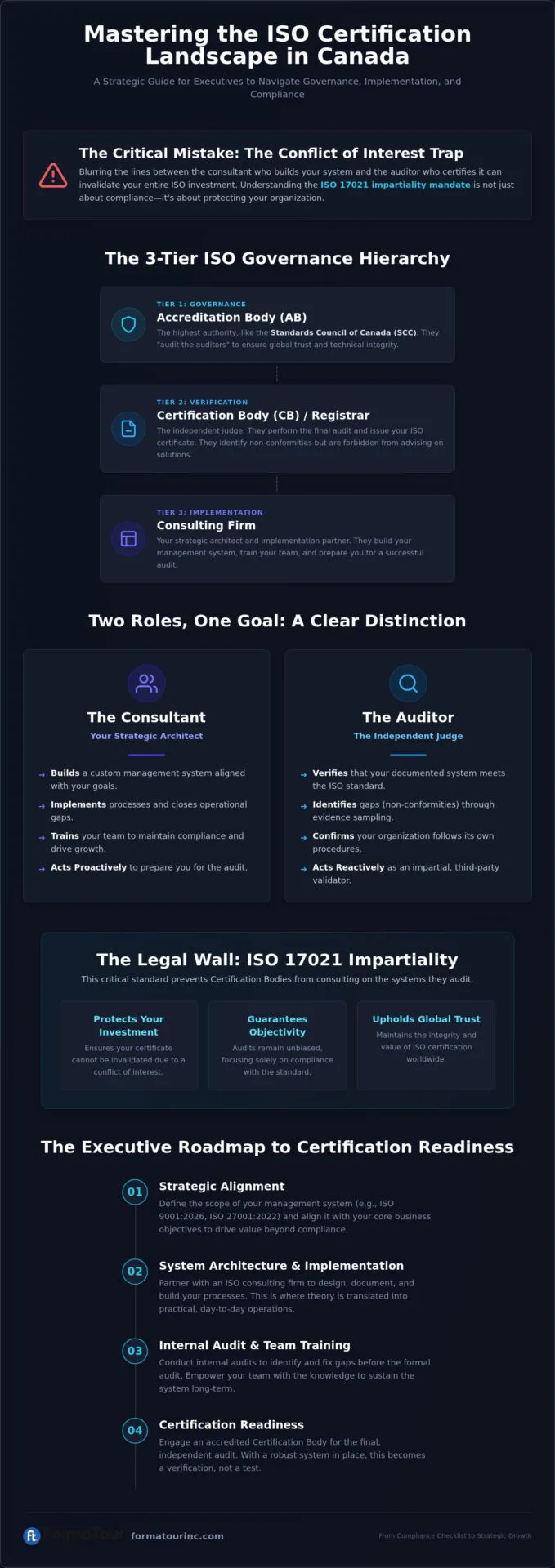
The global ISO ecosystem functions through a rigorous separation of powers designed to maintain trust and technical integrity. This three-tier hierarchy ensures that no single entity holds absolute authority over the creation, implementation, and validation of international standards. For Canadian executives, understanding this structure is the foundation of a successful certification strategy. It clarifies why you need different partners for different stages of your journey and highlights the importance of knowing how to choose an ISO consulting firm in Canada that understands these functional boundaries.
What is an Accreditation Body (AB)?
At the pinnacle of the hierarchy sits the Accreditation Body. These organizations are typically government-appointed or industry-recognized entities that “audit the auditors.” In Canada, the Standards Council of Canada (SCC) serves as the primary authority. Their role involves conducting an independent, third-party evaluation of Certification Bodies to verify their technical competence and impartiality. By overseeing entities like ANAB in the United States or UKAS in the United Kingdom, these bodies ensure that an ISO certificate issued in Toronto carries the same weight as one issued in London or New York.
The Role of the Certification Body (CB)
Certification Bodies, often referred to as Registrars, operate at the second tier. Their primary deliverable is the physical ISO certificate, which typically follows a three-year cycle of surveillance and recertification. They perform the final, objective audit of your management system to confirm it meets every requirement of standards like ISO 9001:2026 or ISO 27001:2022. However, a critical constraint exists; under ISO 17021-1 regulations, which were reaffirmed in May 2026, these bodies are strictly forbidden from providing consultancy. They can identify a non-conformity, but they cannot tell you how to fix it without violating their mandate for impartiality.
The Consulting Firm: Your Strategic Implementer
This is where the third tier becomes essential. Consulting firms like Formatour Incorporated act as your strategic implementation partners. While the SCC governs and the CB validates, the consultant builds. We translate the complex “what” of ISO documentation into the practical “how” of your daily operations. When you evaluate how to choose an ISO consulting firm in Canada, look for a partner that provides the mentorship and process optimization required to bridge the gap between regulatory requirements and organizational growth. We prepare your team for the validator’s arrival, ensuring your systems are resilient, efficient, and fully compliant before the first auditor sets foot in your office.
Consulting Firms vs. Certification Bodies: Functional Differences
Executives often confuse the scope of a Certification Body (CB) with that of a consultant. While both interact with your management system, their objectives are diametrically opposed. A CB verifies compliance; a consultant builds the strategy that makes compliance possible. This distinction is vital when researching how to choose an ISO consulting firm in Canada. A CB identifies gaps during an audit but is legally barred from closing them. Conversely, a consultant serves as your architect, transforming those identified weaknesses into operational strengths. This proactive approach ensures your team isn’t just reacting to auditor findings but is leading with a robust, pre-vetted system.
The Consultant as the Strategic Architect
Your implementation partner designs systems that align with your unique business objectives rather than forcing your operations into a generic template. This includes integrating ISO 27001 with your existing digital transformation strategy to ensure security doesn’t hinder agility. High-quality ISO 27001 implementation services focus on training your team to sustain these improvements long after the initial audit. The consultant acts as your internal advocate, reducing risk by ensuring every process is both compliant and optimized for performance. We help you navigate the nuances of Canadian regulations while maintaining the boutique agility required for modern market competition.
The Certification Body as the Independent Judge
The CB acts as the external validator. Their auditors sample evidence to verify that your organization actually follows its documented procedures. Because they must remain impartial under oversight from Canada’s national accreditation body, they cannot offer advice or solutions. If they find a non-conformity, they issue a formal notice but leave the resolution entirely in your hands. This rigid boundary protects the integrity of the ISO brand but creates a high-stakes environment where a lack of preparation can lead to a failed audit. Their goal is verification, not transformation.
Choosing between a “badge on the wall” and a resilient corporate culture often comes down to the quality of your implementation partner. When you determine how to choose an ISO consulting firm in Canada, prioritize firms that demonstrate a commitment to your long-term organizational health. A consultant’s value lies in building a system that survives the audit and thrives in the local landscape. If you are ready to align your governance with strategic excellence, you may wish to discuss your specific operational goals with our advisory team.
The Consulting Firm: Why Implementation Requires an Advisory Partner
ISO standards are fundamentally “what” documents. They define the specific requirements for a management system but remain silent on the methodologies for execution. This inherent ambiguity makes an advisory partner indispensable for organizations seeking more than a superficial badge. When you evaluate how to choose an ISO consulting firm in Canada, you must look for a partner that bridges the gap between abstract requirements and operational reality. Formatour Incorporated provides this bridge by combining boutique agility with big-firm strategic standards. We ensure that frameworks like ISO 27001 or ISO 9001 aren’t just compliant but are fully optimized for your specific business environment.
Beyond Compliance: Strategic Transformation
Implementation serves as a powerful catalyst for process automation and optimization. By integrating ISO 9001 quality management implementation into your core operations, you transform a regulatory necessity into a driver for measurable efficiency. We align security standards with your executive leadership development goals, treating the ISO journey as a professional evolution for your entire team. Within this framework, the consultant functions as a strategic mentor for the C-suite who provides the foresight needed to navigate complex global systems. This approach ensures that digital transformation and compliance move in lockstep, creating a resilient foundation for organizational growth.
Audit Readiness and Internal Auditing
A critical requirement of every management system is the performance of an internal audit. This step must be completed before the Certification Body arrives to ensure that all potential non-conformities are identified and addressed. Because of ISO 17021 and the Mandate for Impartiality, your final auditor cannot assist with this preparation. Our role is to manage this process, alleviating staff anxiety through professional development and thorough readiness reviews. We ensure that specialized areas like ISO 22301 business continuity consulting remain practical and grounded in your organization’s actual risk profile. Understanding how to choose an ISO consulting firm in Canada requires finding a partner that treats the internal audit as a valuable diagnostic tool rather than a mere rehearsal. This proactive stance guarantees that when the external validator arrives, your systems are not just ready; they are exemplary.
The Legal Wall: ISO 17021 and the Mandate for Impartiality
ISO/IEC 17021-1 represents the regulatory backbone of the global certification industry. This standard mandates that Certification Bodies (CBs) operate with absolute impartiality, competence, and consistency. On May 13, 2026, the continuation of the current edition of ISO/IEC 17021-1 was officially confirmed, reinforcing the strict boundaries that prevent a registrar from providing consultancy services to its own audit clients. If a registrar helps you design your workflows, they cannot objectively evaluate them during an audit. This conflict, known as the risk of self-review, remains the primary threat to the integrity of international standards. For Canadian executives, the consequences of ignoring this legal wall are severe, often leading to the revocation or invalidation of a certificate by an Accreditation Body like the Standards Council of Canada (SCC).
The Threat of Conflated Roles
Some providers market themselves as “one-stop shops” that handle both implementation and the final certification audit. While this model may appear convenient, it frequently fails the impartiality test during rigorous SCC oversight. When a single entity controls both the architecture and the validation of a system, the resulting certificate often lacks the credibility required by global partners. Vetting your Certification Body requires ensuring they maintain no financial or operational ties to your implementation team. This independent oversight is essential for a successful digital transformation, as it provides an unbiased perspective on your organizational resilience. Understanding these regulatory constraints is a vital step in learning how to choose an ISO consulting firm in Canada that protects your long-term interests.
Ensuring a Clean Break Between Implementation and Audit
The transition from building your management system to undergoing a third-party audit requires a deliberate and clean break. We recommend selecting an accredited CB only after your consultant has finalized the system and completed the mandatory internal audit. This sequencing ensures that your implementation partner acts as a strategic mentor while the CB remains an independent validator. In larger multidisciplinary organizations, a “Chinese Wall” strategy is often employed to prevent any exchange of sensitive information between consulting and auditing divisions. Impartiality is the currency of ISO trust. By maintaining a clear separation of duties, you ensure that your certification is not just a document on the wall, but a verified testament to your operational excellence. If you need assistance in establishing this critical separation, you can consult with our advisory team to ensure your journey remains fully compliant with ISO 17021 requirements.
When you evaluate how to choose an ISO consulting firm in Canada, prioritize partners who respect these functional boundaries. A firm that understands the legal wall will focus on building a resilient system that stands up to the most rigorous independent scrutiny. This approach eliminates the risk of wasted budgets and ensures your certification remains a valid asset for years to come. By following this structured path, you demonstrate a commitment to transparency that resonates with stakeholders and regulators alike.
The 2026 Executive Roadmap: Sequencing Your ISO Journey
Achieving certification is a marathon that requires a disciplined sequence of actions. For Canadian organizations, a standard 12-month timeline ensures that systems are not only compliant but also deeply embedded in the corporate culture. Success depends on understanding the specific order of operations, from initial strategic alignment to the final validation by an independent registrar. When you determine how to choose an ISO consulting firm in Canada, prioritize partners who can orchestrate this entire cycle while maintaining the strict impartiality required by the Standards Council of Canada (SCC).
- Phase 1: Strategic Alignment and Advisory Selection (Month 1-2). Establish your core objectives and select a consulting partner. This phase focuses on defining the scope of your management system and ensuring executive buy-in.
- Phase 2: Implementation and Process Optimization (Month 3-8). This is the most intensive period. Your team works with consultants to build documentation, automate workflows, and optimize operations to meet the requirements of standards like ISO 9001:2026.
- Phase 3: Internal Audit and Management Review (Month 9). A mandatory diagnostic phase where you perform a full internal audit. This identifies any remaining non-conformities before the external validator arrives.
- Phase 4: Certification Body Selection and Stage 1 Audit (Month 10). Select your CB and undergo a document review. The auditor confirms that your system is ready for the high-stakes Stage 2 evaluation.
- Phase 5: Stage 2 Certification Audit and Continuous Improvement (Month 12+). The final audit occurs. Upon success, you receive your certificate and begin the cycle of annual surveillance audits and ongoing optimization.
Selecting Your Advisory Partner
Your choice of consultant defines the ceiling of your success. Look for a firm that offers a multidisciplinary approach, blending expertise in IT security, quality management, and organizational resilience. It is essential to evaluate their experience in digital transformation strategy to ensure your ISO framework supports, rather than hinders, your technological growth. A partner who understands the specific Canadian regulatory environment will provide the foresight needed to navigate SCC updates and local compliance nuances. When researching how to choose an ISO consulting firm in Canada, focus on firms that act as mentors rather than simple document providers.
The Final Handover to the Certification Body
As you approach the final audit, your consultant transitions into a supportive observer role. They prepare your staff for the auditor’s questions and ensure all evidence is organized, yet they cannot speak on your behalf during the audit itself. This separation maintains the integrity of the process. Once you achieve your initial goals, you can expand your maturity through ISO 14001 certification services to address environmental governance and sustainable excellence. To begin your journey with a clear understanding of your current standing, you should Contact Formatour for a preliminary gap analysis and a tailored implementation roadmap.
Securing Your Strategic Advantage Through Independent Excellence
Navigating the complex ISO landscape requires more than just technical documentation; it demands a clear understanding of the functional boundaries that protect your certification investment. By respecting the legal wall between the strategic architect and the independent validator, you ensure that your management system is both resilient and fully compliant with ISO 17021 impartiality rules. This clarity prevents wasted budgets and protects your organization from the risk of invalidated certificates during Standards Council of Canada oversight.
Frequently Asked Questions
Can the same company provide both ISO consulting and certification?
No, it is a direct violation of ISO 17021 impartiality rules. A single entity can’t act as both the architect and the judge of a management system. If a company claims to offer both, they’re likely ignoring global governance standards. This separation ensures that the certification remains objective and credible for your stakeholders, protecting the strategic value of your investment in international standards.
What is the difference between an accreditation body and a certification body?
An accreditation body audits the auditors, while a certification body audits your organization. In Canada, the Standards Council of Canada (SCC) is the national accreditation body that grants authority to certification bodies. The certification body, or registrar, is the entity that performs your third-party audit and issues the physical ISO certificate once you demonstrate full compliance with the requirements of the chosen standard.
Is it mandatory to hire a consulting firm for ISO certification?
No, the ISO standards don’t legally require you to use an external consultant. However, most Canadian organizations find that learning how to choose an ISO consulting firm in Canada is essential for navigating complex documentation. A consultant provides the technical expertise and project management needed to transform abstract standards into practical operational processes. This partnership significantly reduces the risk of audit failure and wasted internal resources.
How do I verify if a certification body is properly accredited in Canada?
You can verify accreditation status directly through the Standards Council of Canada (SCC) website. The SCC maintains a public directory of all accredited certification bodies authorized to operate within the country. It’s vital to check this list before signing a contract. Choosing an unaccredited body can lead to your certificate being rejected by government agencies or international clients who require verified, impartial compliance.
What happens if a certification body is found to be consulting for its clients?
The certification body faces severe disciplinary actions, including the potential revocation of its own accreditation. For the client, any certificates issued under these circumstances may be declared invalid or void. This situation creates a massive financial and reputational risk for your organization. Maintaining a clean break between your implementation partner and your registrar is the only way to protect your long-term certification investment.
How much does ISO consulting typically cost compared to certification?
Consulting fees generally represent the largest portion of your initial budget because they cover months of implementation and training. These costs vary based on your company size and digital transformation goals. Certification fees are separate and paid to the registrar for the audit itself. While consulting is an upfront investment in building the system, certification involves ongoing annual surveillance fees to maintain the certificate’s validity.
Does a consultant attend the final certification audit?
Yes, a consultant often attends as an observer to support your team and ensure the audit stays on track. They provide moral support and help you understand the auditor’s technical requests. However, they can’t answer questions on your behalf or argue with the auditor about findings. Their role during the visit is to facilitate communication and document any identified non-conformities for later resolution.
Why is ISO 17021 important for my business in 2026?
ISO 17021 is the foundational standard that ensures global trust and integrity in the certification process. As supply chains become more complex in 2026, your partners need assurance that your certificate was issued through an impartial evaluation. Adhering to these rules protects you from conflict-of-interest scandals. It guarantees that your management system meets the rigorous technical standards required for international trade and performance.
