

With 94 percent of small and medium sized businesses reporting a cyberattack in 2024, the question is no longer if your systems will be tested, but how they will endure. For many leaders, understanding how to get ISO 27001 certified feels like deciphering a complex, technical labyrinth that threatens to disrupt daily operations. You likely recognize the need for a globally recognized security posture, yet the fear of business disruption and uncertainty regarding the total commitment can make the process feel insurmountable. It’s a common concern that the pursuit of compliance might stall the very growth it’s meant to protect.
We believe that true security is a strategic pillar for global market access rather than a mere administrative hurdle. This definitive guide provides an executive level roadmap to help you achieve the ISO 27001:2022 standard while enhancing your organizational resilience. You’ll gain a clear understanding of the 93 essential controls, the latest climate action mandates, and the precise steps required to foster a culture of continuous improvement. We’ll explore the entire certification journey from the initial audit through the three year surveillance cycle to ensure your digital transformation remains secure and efficient.
Key Takeaways
- Understand the evolution of the ISO/IEC 27001:2022 standard and learn exactly how to get ISO 27001 certified to strengthen your organization’s global standing.
- Establish a solid foundation for your Information Security Management System by securing executive alignment and precisely defining your operational scope.
- Navigate the complexities of risk assessment and the Statement of Applicability to ensure your security controls are both relevant and effective.
- Prepare for the external certification process by conducting thorough internal audits and leadership reviews that validate your organizational readiness.
- Foster a culture of continuous security improvement to maintain compliance and operational excellence throughout the three year surveillance cycle.
What is ISO 27001 Certification and Why is it Essential in 2026?
ISO/IEC 27001:2022 represents the global benchmark for establishing, implementing, and maintaining an Information Security Management System (ISMS). In 2026, it’s no longer just a technical requirement for the IT department; it’s a strategic imperative for the boardroom. This standard provides a structured framework that enables organizations to manage risks related to data security effectively. By following the guidelines within ISO/IEC 27001, firms can move beyond reactive troubleshooting to a proactive stance of resilience. Understanding how to get ISO 27001 certified is the first step toward transforming security from a cost center into a competitive differentiator.
Achieving this certification unlocks significant business value. It’s often a prerequisite for participating in high-value global tenders and securing lucrative contracts with enterprise-level clients. Beyond market access, certified organizations frequently benefit from reduced cyber insurance premiums and enhanced brand equity. Stakeholders and investors view the certification as a badge of unwavering reliability and professional maturity. Leaders who master how to get ISO 27001 certified find that the process streamlines client due diligence and reduces the burden of repetitive security questionnaires.
It’s vital to distinguish between implementation and certification. Implementation is the internal journey of building the ISMS and integrating the 93 security controls into your operations. Certification is the final verification step, where an independent third-party auditor confirms that your system meets the international standard’s rigorous requirements. This distinction is crucial for managing expectations regarding timelines and resource allocation.
The Core Pillars of an Information Security Management System (ISMS)
The ISMS is built upon three fundamental pillars often referred to as the CIA triad. Confidentiality ensures that sensitive data remains accessible only to those with authorized access. Integrity focuses on safeguarding the accuracy and completeness of information throughout its lifecycle. Availability guarantees that data and systems are ready for use whenever the business requires them. Balancing these three elements creates a robust security posture that supports sustainable growth.
ISO 27001 vs. SOC 2: Choosing the Right Path for Your Firm
Selecting the right framework depends on your target market and operational goals. ISO 27001 is the preferred choice for global operations, offering a rigid, internationally recognized framework. SOC 2 is more prevalent in North American markets and offers flexibility through its Trust Services Criteria. While SOC 2 reports are typically issued annually, ISO 27001 operates on a three-year cycle with annual surveillance audits, requiring a sustained commitment to continuous improvement and long-term maintenance.
Phase 1: Strategic Preparation and Gap Analysis
Successful implementation begins in the boardroom. Without a clear commitment from executive leadership, an Information Security Management System (ISMS) remains a series of disconnected technical tasks rather than a unified business strategy. Leaders must understand Why You Need ISO 27001 Certification to allocate the necessary human and financial capital effectively. This foundational support ensures that security objectives align with broader organizational goals, fostering an environment where compliance is a shared responsibility rather than an isolated IT burden.
Budgeting for this journey requires a comprehensive view of both direct and indirect costs. Organizations should account for internal implementation resources, potential consulting partnerships, and the formal external audit fees. While small firms might utilize a focused toolkit approach, larger enterprises often invest significantly more to ensure a robust, enterprise-wide rollout that withstands rigorous scrutiny. Precise financial planning prevents mid-project stalls and ensures a smooth, professional progression toward the final certification audit. Understanding how to get ISO 27001 certified means recognizing that the initial investment paves the way for long-term operational stability. For organizations evaluating external support, reviewing a comprehensive guide to ISO 27001 certification consulting can help leadership make informed decisions about selecting the right strategic partner.
Defining Your ISMS Scope
Defining the scope is a critical exercise in precision. You must identify the specific business units, physical locations, and digital assets that will fall under the certification umbrella. A scope that’s too broad can lead to resource exhaustion and implementation fatigue. Conversely, one that’s too narrow might fail to satisfy the due diligence requirements of your enterprise clients. Documenting the formal Scope Statement is a mandatory requirement that sets the boundaries for your entire security framework and prevents the common pitfall of scope creep during the audit phase.
The Strategic Gap Analysis
A formal gap analysis serves as the definitive roadmap for your remediation efforts. By comparing your existing controls against the 93 controls outlined in Annex A of the 2022 standard, you can pinpoint exactly where your current posture falls short. This process identifies “low-hanging fruit,” such as missing documentation or simple policy updates, alongside structural deficiencies that require deeper strategic investment. Mastering how to get ISO 27001 certified involves prioritizing these gaps based on their associated risk, ensuring that your remediation efforts yield the highest possible security return on investment.
Strategic preparation transforms a complex international standard into a manageable series of operational milestones. If you’re ready to align your leadership team with these benchmarks, our Executive Leadership Development Programs can help bridge the gap between technical compliance and strategic governance, ensuring your organization projects a persona of unwavering reliability.
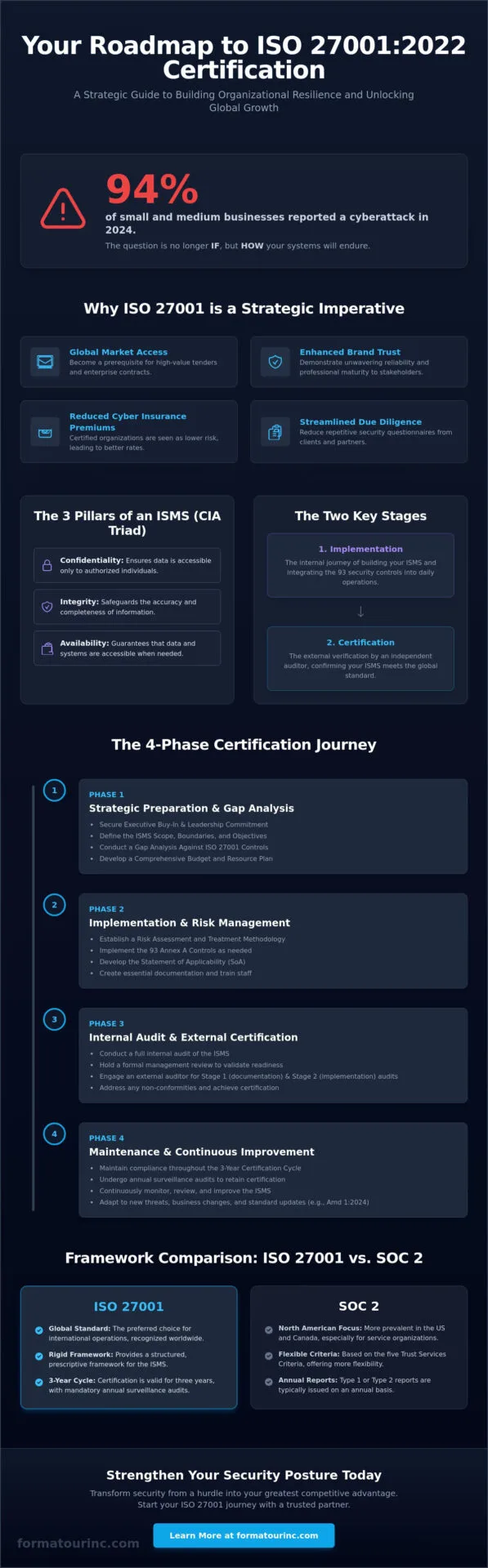
Phase 2: Implementation and the Risk Management Framework
Risk management represents the intellectual core of the ISO 27001 standard. Rather than applying a generic checklist, organizations must build a framework tailored to their specific threat environment. This phase is where the strategic preparation from Phase 1 matures into operational reality. Mastering how to get ISO 27001 certified requires a disciplined approach to identifying, analyzing, and evaluating risks that could compromise your information assets. By grounding your security decisions in data, you ensure that resources are directed toward the most critical vulnerabilities.
Every decision made during implementation should reflect the organization’s unique risk profile. This involves drafting the Statement of Applicability (SoA), which identifies which of the 93 Annex A controls are relevant to your scope and provides a clear justification for any exclusions. This document transforms abstract security goals into a concrete list of technical and organizational requirements. It serves as the primary map for auditors to understand how your firm has addressed the standard’s rigorous demands.
Mastering the Risk Assessment Process
Selecting a methodology is the first step in creating a repeatable assessment process. Organizations typically choose between an asset-based methodology, focusing on hardware and data, or a scenario-based approach, which examines potential events and their consequences. Defining a clear risk appetite allows leadership to set impact levels that reflect the business’s tolerance for disruption. Microsoft’s Approach to ISO 27001 demonstrates how large-scale enterprises integrate these assessments into a global infrastructure to maintain stability. The Risk Treatment Plan serves as the definitive bridge between the identification of security gaps and the specific actions taken to mitigate them.
Documentation and Policy Development
Policies must serve as active guides for employee behavior rather than static files stored on a server. Creating mandatory documents like the Information Security Policy and Access Control procedures ensures that security expectations are transparent and enforceable. Our ISO 27001 Implementation Services focus on developing documentation that reflects your actual processes while meeting every requirement of the standard. Treating these as living documents allows your ISMS to evolve alongside emerging threats and organizational changes. This alignment ensures that your security posture remains resilient without creating unnecessary friction in your daily operations. When policies are integrated into the workflow, they move from being “shelfware” to becoming a foundational part of your corporate identity.
Phase 3: The Internal Audit and External Certification Process
Transitioning from implementation to verification marks a critical evolution in your security journey. While Phase 2 focused on the construction of your Information Security Management System (ISMS), Phase 3 is dedicated to rigorous validation. This phase ensures that the strategic framework you’ve built actually performs under scrutiny. It provides the empirical proof required to satisfy international standards and executive expectations. Mastering how to get ISO 27001 certified necessitates this transition from internal development to independent assessment.
The process begins with a formal Management Review. This meeting allows leadership to provide essential oversight, ensuring that the ISMS remains aligned with the organization’s strategic direction. It’s a moment of accountability where leadership reviews audit results, feedback from stakeholders, and the status of preventive actions. This high-level involvement reinforces the security culture established during the preparation phase, transforming compliance from a project into a permanent operational pillar.
The Critical Role of the Internal Audit
A mandatory internal audit serves as your primary defense against external failure. This exercise must be conducted by an objective auditor who was not involved in the system’s development. Whether you utilize an internal team or a third-party consultant, the goal is to identify non-conformities before the certification body arrives. Our ISO 27001 lead auditor training equips professionals with the expertise to conduct these evaluations with precision, ensuring that every control is scrutinized for both design and effectiveness. This proactive identification allows for remediation in a controlled environment, reducing the risk of surprises during the official audit.
Stage 1 vs. Stage 2 External Audits
External certification is conducted in two distinct stages. Stage 1 is primarily a documentation review where the auditor ensures your ISMS design fulfills the standard’s requirements. It’s a readiness check to confirm you’re prepared for the final assessment. Stage 2 is the evidence-based verification where the auditor observes your controls in practice. They’ll interview staff, review logs, and inspect physical security measures to prove the system functions as intended. If the auditor identifies “Observations” or “Minor Non-Conformities,” they should be viewed as opportunities for refinement rather than failures. Addressing these promptly demonstrates your commitment to continuous improvement and organizational resilience.
If you’re ready to validate your security posture and achieve global recognition, our team provides the expert guidance necessary to navigate these final hurdles. Explore our ISO 27001 Information Security Management solutions to ensure your organization is fully prepared for the certification audit.
Phase 4: Maintaining Resilience and Continuous Improvement
Achieving the initial certificate marks the transition from an intensive implementation project to a permanent state of operational excellence. While the initial focus was on how to get ISO 27001 certified, the subsequent three year cycle shifts toward preservation and growth. Surveillance audits in years one and two verify that your controls remain effective against emerging threats. By the time you reach the full recertification audit in year three, your system should be a mature reflection of your organizational resilience. This steady rhythm of assessment ensures that your security posture never becomes static or obsolete.
This stage provides the perfect opportunity to leverage your security framework for broader digital transformation. Integrating process automation into your ISMS reduces the manual burden of evidence collection and risk monitoring. It transforms security from a reactive barrier into a proactive enabler of efficiency. When your workflows are both secure and automated, you achieve a level of operational integrity that supports rapid, sustainable scaling. This alignment allows your leadership team to focus on strategic initiatives with the confidence that the underlying infrastructure is robust.
Building a Culture of Security Awareness
A resilient organization depends on a workforce that understands its role in the security architecture. Ongoing awareness initiatives ensure that security remains a shared value rather than a technical mandate. We integrate specific security KPIs into standard business performance reviews to foster accountability. Our Executive Leadership Development Programs empower senior management to champion this shift, ensuring security awareness permeates every level of the firm. This human-centric approach turns your employees into a proactive defense layer.
The Path to Integrated Management Systems
Global organizations often realize significant efficiencies by unifying various international standards. Combining ISO 27001 with ISO 9001 for quality or ISO 22301 for business continuity creates a single, streamlined governance framework. This integrated approach reduces audit fatigue and provides a holistic view of corporate health. Formatour Incorporated’s boutique approach to multidisciplinary advisory helps you navigate these complex integrations, ensuring your management systems work in harmony to protect your strategic interests. This unified strategy projects a persona of unwavering reliability to your global stakeholders.
Securing Your Organization’s Strategic Future
Achieving compliance in 2026 is a definitive statement of intent that your organization values integrity and long term stability. The journey of understanding how to get ISO 27001 certified transforms your security posture from a series of reactive measures into a proactive, strategic asset. By integrating these international standards into your daily operations, you don’t just protect data; you build the brand equity and trust necessary to scale in an increasingly scrutinized global marketplace. This roadmap ensures that your commitment to excellence remains visible to every stakeholder and competitor.
Formatour Incorporated serves as your strategic partner in navigating these complex organizational landscapes. As a Canadian based global advisory firm, we provide the boutique agility required for tailored solutions while maintaining the rigorous standards expected of a top tier consulting partner. Our expertise across ISO 9001, ISO 27001, and ISO 22301 allows us to co-develop integrated systems that support your digital transformation and process automation goals. Partner with Formatour Incorporated for Strategic ISO 27001 Implementation to ensure your path to certification is steady, professional, and successful. We’re ready to help you architect a more resilient future.
Frequently Asked Questions
How long does it typically take to get ISO 27001 certified?
The timeline for certification depends largely on the size and operational complexity of your organization. Small organizations with fewer than 20 employees generally complete the process within three to six months. Medium-sized firms typically require five to eight months, while large enterprises may take up to 20 months to achieve full compliance and verification.
What is the average cost of ISO 27001 certification for a mid-sized firm?
Total investment for a mid-sized technology company often ranges between $19,000 and $50,000 in the first year. These costs include the initial implementation efforts, internal resource allocation, and the formal two-stage audit fees. It’s best to view these expenditures as a strategic investment in organizational resilience and global market competitiveness.
Can we achieve ISO 27001 certification without external consulting?
It’s possible to achieve certification using internal resources, though many leaders find the technical density and documentation requirements challenging to manage alone. Partnering with an expert allows your team to understand how to get ISO 27001 certified while avoiding common implementation pitfalls and business disruptions. Professional guidance ensures your system is both compliant and strategically aligned with your growth objectives.
How often do we need to perform an internal audit for ISO 27001?
Internal audits must be conducted at planned intervals, which typically means at least once per year. This regular assessment ensures your management system remains effective and continues to meet the rigorous requirements of the 2022 standard. Consistent auditing provides the empirical evidence needed for management reviews and prepares your organization for annual surveillance audits. Organizations looking to build this capability in-house may benefit from a structured ISO 27001 lead auditor training program that equips internal staff to conduct these evaluations with confidence and precision.
What is the difference between a certification body and an implementation partner?
An implementation partner acts as a strategic mentor to help you build and optimize your security framework. A certification body is an independent third party that performs the formal audit to verify your compliance. To ensure impartiality, international standards prohibit the same organization from providing both implementation consulting and formal certification services. Understanding how to evaluate and select the right ISO 27001 certification consulting partner is therefore a critical decision that directly impacts your audit readiness and long-term security outcomes.
What happens if we fail our Stage 2 audit?
If the auditor identifies non-conformities, they’ll issue a report detailing the specific areas that require remediation. Major non-conformities must be addressed and verified through a follow-up audit before the certification body grants your certificate. Minor issues usually require a documented corrective action plan that the auditor will review during your first annual surveillance audit.
How does ISO 27001:2022 differ from the 2013 version?
The 2022 version introduced a more focused structure with 93 security controls categorized into four themes: Organizational, People, Physical, and Technological. It replaced the 114 controls from the 2013 version and added a requirement to consider climate change as a relevant issue within the ISMS. All certifications for the 2013 version expired in October 2025, making the 2022 version the only valid standard.
Is ISO 27001 mandatory for companies operating in Canada or the EU?
While not a universal legal requirement, ISO 27001 is increasingly mandatory for specific sectors under EU regulations like NIS2 and DORA. In Canada and other global markets, enterprise clients often make this certification a non-negotiable contractual requirement. It serves as an essential badge of reliability that simplifies client due diligence and supports international digital transformation initiatives.
