

What if the most effective defense against a data breach isn’t a new piece of software, but a systematic internal review of your existing governance? Many security leaders feel the weight of an impending certification audit, fearing that a single overlooked control in the updated ISO 27001:2022 standard could derail their compliance efforts. It is a common frustration to find yourself buried in technical density while struggling to translate abstract clauses into the tangible evidence an auditor requires.
This guide introduces a strategic ISMS internal audit checklist designed to bridge the gap between technical security and long-term organizational resilience. By adopting this framework, you’ll gain the confidence to verify your system’s integrity and ensure it meets the rigorous demands of modern international standards. We’ll explore the mandatory management clauses, the restructured Annex A thematic pillars, and a proven methodology that turns raw audit findings into a roadmap for continuous improvement. This approach transforms the audit from a stressful obligation into a powerful diagnostic tool for your business.
Key Takeaways
- Understand how the mandatory requirements of Clause 9.2 serve as a strategic diagnostic tool to strengthen your organization’s security posture.
- Utilize a structured ISMS internal audit checklist to verify that executive leadership engagement and organizational context align with the latest international standards.
- Identify the specific evidence required to satisfy the four new thematic pillars of Annex A, covering Organizational, People, Physical, and Technological controls.
- Master a two-stage methodology that combines thorough document reviews with evidence-based implementation assessments to ensure real-world effectiveness.
- Learn to categorize audit findings and apply root cause analysis to transform non-conformities into sustainable opportunities for strategic growth.
The Strategic Role of the ISMS Internal Audit in 2026
Information security governance provides the structural integrity needed to navigate a volatile digital landscape. An internal audit acts as a systematic, evidence-based evaluation of this governance, ensuring that the management system remains aligned with the ISO/IEC 27001 standard. This is not merely a technical check but a comprehensive review of how information security is embedded within the organization’s culture and operational processes. It’s the process by which a business proves to itself that its protective measures are functioning as intended.
Clause 9.2 of the standard mandates that organizations conduct internal audits at planned intervals. This requirement prevents the management system from becoming a static document that fails to address emerging risks. In 2026, the paradigm has shifted from compliance for the sake of certification to compliance for the sake of resilience. Utilizing a robust ISMS internal audit checklist allows leadership to verify that their security framework is actually capable of withstanding real-world disruptions rather than just meeting theoretical requirements. This proactive scrutiny identifies where the system is lagging behind the pace of technological change.
The Objectives of an Internal Audit
The primary objective is to confirm that the ISMS conforms to both the international standard and the organization’s own internal requirements. It serves as a diagnostic tool that identifies where processes are underperforming or where digital transformation can enhance security. By treating the audit as a strategic mentor, organizations can uncover opportunities for optimization that lead to greater efficiency and reduced overhead. It’s about moving beyond basic protection to find ways to make security a seamless part of the user experience.
Internal vs. External Audits: The Preparatory Gap
While an external audit focuses on verification for certification, the internal audit serves as a critical preparatory phase. It acts as a safe-to-fail environment where blind spots are identified and corrected before they are scrutinized by a third-party registrar. This impartial perspective is essential for uncovering deep-seated operational issues that internal teams might overlook. Linking these results to the Management Review process ensures that findings translate into executive action. For organizations requiring this level of strategic foresight, partnering with a firm like Formatour Incorporated ensures that your internal assessments meet the highest global benchmarks for quality and reliability. You can explore how professional advisory services enhance this process at Formatour Incorporated.
Core ISMS Clauses: The Management System Checklist
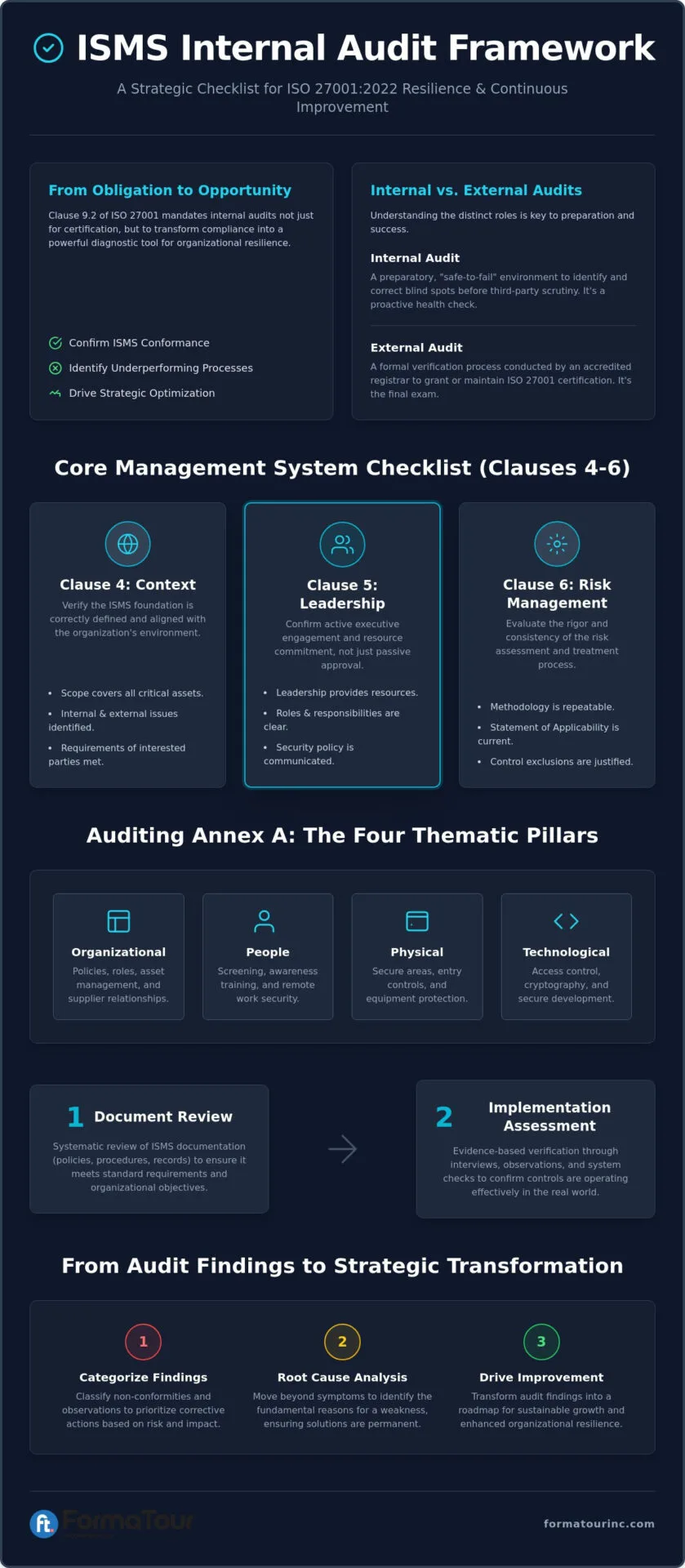
The operational success of an information security framework depends on the integrity of its mandatory management clauses. While technical controls receive significant attention, Clauses 4 through 10 of the ISO 27001:2022 standard establish the governance necessary to sustain those technical measures. An effective ISMS internal audit checklist must prioritize Clause 4, which requires a rigorous evaluation of the organizational context. This means verifying that the scope of the system covers all relevant internal and external issues, including the specific requirements of interested parties. If the boundaries of the system are poorly defined, even the most advanced security tools will fail to protect the organization’s true perimeter.
Governance and Leadership Evidence
Auditing Clause 5 requires a deep dive into executive engagement. You must look for evidence that leadership isn’t just signing off on policies but is actively providing the resources and direction needed for success. This involves checking that roles and responsibilities are clearly assigned and that the information security policy is effectively communicated across the workforce. A key indicator of a mature system is the alignment between security objectives and high-level business goals. When security KPIs directly support organizational growth, the management system becomes an asset rather than a burden.
Risk Management Rigour
Clause 6 is the engine of the ISMS, requiring a systematic approach to risk assessment and treatment. The internal audit should evaluate whether the risk methodology produces consistent, repeatable results that inform decision-making. It’s essential to verify that the Statement of Applicability is current and that every exclusion is justified by a specific risk owner. For organizations seeking to benchmark their technical choices against global standards, referencing a comprehensive catalog of security and privacy controls provides a useful technical baseline. Auditors must confirm that risk owners have formally accepted any residual risks, ensuring accountability remains at the appropriate level.
Performance evaluation under Clauses 9 and 10 ensures the system remains agile through continuous monitoring and improvement. This phase of the audit focuses on the effectiveness of corrective actions and the quality of management reviews. If your organization finds the documentation of these clauses overwhelming, you can schedule a strategic consultation to streamline your approach. Our advisors help you bridge the gap between abstract requirements and tangible audit evidence, ensuring your system is both compliant and operationally efficient.
Annex A Controls: Auditing the Four Thematic Pillars
The transition from the 2013 version to the ISO 27001:2022 standard introduced a more streamlined, operationally focused structure for security controls. By consolidating 114 controls into 93 and organizing them into four distinct themes, the standard allows auditors to evaluate security through a functional lens. This shift requires an updated ISMS internal audit checklist that moves away from technical silos and toward a holistic view of organizational health. The four thematic pillars, Organizational, People, Physical, and Technological, provide a comprehensive framework for assessing how security is woven into the daily fabric of the business.
Organizational controls (5.1 – 5.37) represent the broadest category, covering everything from high-level policies to the granular management of supplier relationships. When auditing these controls, you must seek evidence that information security is integrated into project management and that asset inventories are both accurate and assigned to clear owners. Understanding the value of an ISO 27001 internal audit lies in its ability to reveal whether these organizational mandates are actually driving secure behavior or simply existing as “shelfware.”
People and Physical Security Verification
Auditing the People theme (6.1 – 6.8) involves scrutinizing the entire employment lifecycle. Your checklist should include verification of background screening processes and evidence that confidentiality agreements remain enforceable after an employee departs. Given the prevalence of hybrid work, auditors must evaluate how remote work security is managed and whether awareness training effectively addresses modern threats like social engineering. On the physical side, the audit should confirm the integrity of the security perimeter. This includes testing entry controls, verifying the secure disposal of media, and observing whether “clear desk and clear screen” policies are maintained in practice.
Technological Control Assessment
The Technological theme (8.1 – 8.34) requires a deep dive into the systems that protect data at rest and in transit. Auditors should verify that access control and identity management systems follow the principle of least privilege. It’s also vital to assess the rigour of vulnerability management and secure coding practices to ensure that software development doesn’t introduce unnecessary risk. The 2022 update introduced critical new controls, such as Data Leakage Prevention (8.12) and Information Deletion (8.10). Your ISMS internal audit checklist must specifically look for evidence that data is deleted when no longer required and that automated tools are in place to prevent the unauthorized export of sensitive information.
Methodology: How to Execute the Internal Audit
Executing an audit is the moment where strategic theory meets operational reality. A robust ISMS internal audit checklist provides the structure, but the auditor’s methodology determines the depth of the insight gained. The process begins with establishing a clear audit programme and scope. This stage isn’t merely about scheduling dates; it’s about identifying high-risk areas and ensuring that the audit resources are directed where they can provide the most value. By defining the boundaries of the assessment early, you prevent scope creep and ensure a focused, efficient evaluation of your security governance.
The audit then moves into a two-stage review process. First, the desk audit involves a thorough examination of your documentation to ensure that policies and procedures align with the ISO 27001:2022 requirements. However, a system that looks good on paper may fail in practice. The second stage, the implementation review, seeks evidence that these policies are actually functioning within the organization. This phase requires a hands-on approach, moving beyond the digital files to observe real-world workflows and system configurations.
Effective Audit Interview Techniques
Interviews are the most effective way to gauge the “human” side of information security. Instead of asking closed questions that lead to simple “yes” or “no” answers, use open-ended inquiries to assess employee awareness. For example, asking a staff member to describe the steps they take when they suspect a phishing attempt reveals far more than asking if they’ve read the incident response policy. This technique allows you to verify actual practice against written policy while managing the interaction with professional poise and empathy. It turns the audit from an interrogation into a collaborative discovery process.
Sampling and Evidence Collection
Auditors can’t check every single record, so selecting a representative sample is crucial for a valid assessment. The key to successful evidence collection is “triangulation.” This involves verifying a control through three distinct lenses: reviewing the document, interviewing the responsible party, and observing the control in action. If all three sources align, you have a solid audit trail. If they don’t, you’ve identified a potential non-conformity. Maintaining this level of rigour ensures that every item on your ISMS internal audit checklist is backed by verifiable proof rather than assumptions.
The final stage is documenting these findings into a comprehensive audit report. This document should do more than list failures; it should provide a strategic roadmap for improvement. It categorizes findings into major non-conformities, minor non-conformities, or observations for improvement, allowing leadership to prioritize their response. If your internal team needs to sharpen these skills, you can contact us today to discuss lead auditor training. Empowering your staff with professional auditing techniques is the fastest way to build a culture of continuous security improvement.
From Audit Findings to Strategic Transformation
Completion of the audit process marks the transition from assessment to active transformation. The data gathered through your ISMS internal audit checklist is only as valuable as the actions taken in response to its findings. Categorizing these findings into major non-conformities, minor non-conformities, and observations allows leadership to prioritize remediation efforts based on actual risk levels. A major non-conformity indicates a significant breakdown in the management system; a minor non-conformity suggests an isolated failure that doesn’t jeopardize the overall system. Observations, often overlooked, represent strategic opportunities for process optimization and increased efficiency.
Moving beyond the symptom to the organizational cause is the hallmark of a mature security framework. Root cause analysis ensures that corrective actions address the underlying weakness rather than providing a superficial fix. If an audit reveals that access logs aren’t being reviewed, the solution isn’t just to review them today. It’s to determine why the process failed in the first place. This might reveal a lack of resources, unclear responsibilities, or a need for technical automation. By addressing the root cause, you prevent the recurrence of the issue and strengthen the structural integrity of your governance.
Managing Non-conformities and Observations
Effective remediation requires a disciplined approach to timelines and verification. Once a corrective action plan is established, organizations must set clear deadlines for resolution and verify the effectiveness of the changes after implementation. Simply closing a ticket isn’t enough; you must prove the new control prevents the issue from recurring. Observations should be treated as a catalyst for digital transformation. They often highlight areas where manual tasks can be automated, reducing the burden on human capital while strengthening the overall security posture through process optimization.
The Executive Management Review
The final step in this cycle is the executive management review, where audit results are presented to leadership. This is a pivotal moment to align ISMS performance with broader organizational resilience goals. By demonstrating the link between security gaps and business risks, security professionals can drive strategic investment in the tools and talent necessary for growth. This high-level engagement ensures that information security remains a core component of the corporate strategy rather than an isolated IT function. To ensure your system meets these rigorous standards, you can discover how Formatour Incorporated can elevate your internal audit process and guide your organization toward sustainable compliance and resilience.
Empowering Your Organization Through Strategic Assurance
Transitioning to the ISO 27001:2022 standard is a pivotal opportunity to move beyond technical checkboxes and toward true organizational resilience. By utilizing a structured ISMS internal audit checklist, you’ve established a foundation for identifying vulnerabilities and optimizing your security governance. This process ensures that your management system isn’t just a static document but a living framework that evolves with your business goals and the global threat landscape. It’s the difference between merely surviving an audit and actively thriving in a digital-first economy.
Formatour Incorporated offers the boutique agility and big-firm consulting standards necessary to refine this process. Our Canadian-based multidisciplinary advisory firm provides specialized ISO 27001 Lead Auditor expertise to guide your team through every complexity of the standard. We help you translate audit findings into tangible strategic growth while maintaining the highest register of professional integrity. Partner with Formatour for a Strategic ISO 27001 Internal Audit to secure your future and empower your leadership with actionable insights. Your journey toward a more resilient organization begins with a single, expert-led step.
Frequently Asked Questions
Is an ISMS internal audit mandatory for ISO 27001 certification?
Yes, conducting an internal audit is a mandatory requirement under Clause 9.2 of the ISO 27001 standard. Organizations must provide documented evidence of these audits to the certification body to demonstrate that the system is being monitored and maintained. Without a completed internal audit, a certification body cannot proceed with the Stage 2 assessment. It serves as the primary mechanism for verifying that your security governance aligns with organizational objectives.
Can our own IT manager conduct the ISMS internal audit?
An IT manager can conduct the audit provided they aren’t auditing their own work or processes. The standard requires that auditors be impartial and objective throughout the evaluation. If the IT manager designed or manages the controls being reviewed, a conflict of interest arises. Many organizations engage external partners or train staff from different departments to ensure the necessary independence and professional rigour required for a valid assessment.
How often should we perform an ISMS internal audit checklist review?
ISO 27001 requires audits at “planned intervals,” which typically translates to a full cycle every twelve months. However, a robust ISMS internal audit checklist review should be risk-based rather than strictly calendar-driven. High-risk areas or departments experiencing significant change may require more frequent scrutiny. This approach ensures that your resources are focused on the most critical vulnerabilities while maintaining continuous compliance with the 2022 standard.
What happens if we find major non-conformities during the internal audit?
Finding a major non-conformity is an opportunity for strategic correction before the external certification audit. You must document the finding, conduct a thorough root cause analysis, and implement a formal corrective action plan. The goal is to demonstrate to the external auditor that your management system is capable of identifying and resolving significant weaknesses. Successful remediation proves that your “Check” and “Act” phases are functioning effectively to protect organizational integrity.
How long does a typical ISO 27001 internal audit take to complete?
The duration varies based on organizational size, complexity, and the number of sites included in the scope. For a small to medium enterprise, a comprehensive audit typically requires three to five business days. Larger global organizations with complex technological ecosystems may require ten days or more. This timeframe includes the initial desk audit of documentation, on-site or virtual interviews, and the final preparation of the audit report.
What is the difference between an internal audit and a gap analysis?
A gap analysis is a preliminary assessment performed at the start of the implementation journey to identify what is missing compared to the standard. In contrast, an internal audit is a formal testing of an established system to verify that defined policies are actually being followed. While a gap analysis provides a roadmap for development, the internal audit provides the evidence of operational effectiveness required for certification and long-term resilience.
Should the internal audit cover all 93 Annex A controls every year?
You don’t necessarily need to audit every single control in a single session, but your audit programme must cover the entire scope of the ISMS over a defined cycle. Most organizations use their ISMS internal audit checklist to evaluate high-priority controls annually while rotating lower-risk areas over a two or three-year period. This risk-based scheduling ensures thoroughness without overwhelming the organization’s internal resources or disrupting daily operations.
How do we document evidence for virtual or remote work controls?
Evidence for remote work controls is gathered through a combination of technical logs and virtual observations. Auditors may review VPN connection logs, endpoint management configurations, and incident reports related to remote access. Virtual interviews are also essential to verify that employees understand their responsibilities regarding home office security. Screenshots of encrypted drives or secure configuration settings provide the tangible proof needed to satisfy the requirements of the People and Technological control themes.
