

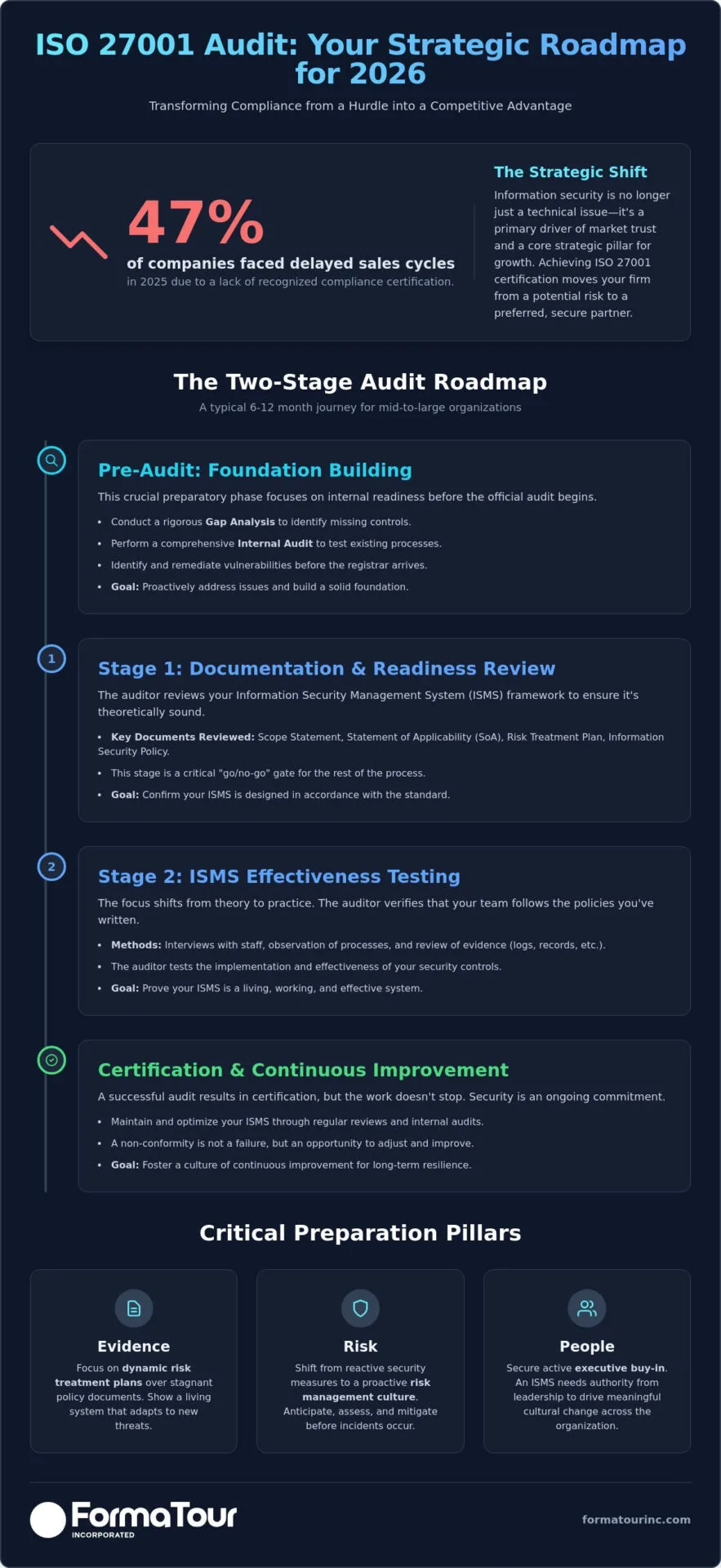
Recent data indicates that 47% of companies experienced delayed sales cycles in 2025 due to a lack of recognized compliance certification. This statistic highlights a fundamental shift where information security has evolved from a technical necessity into a primary driver of market trust. For leadership, the challenge lies in balancing the rigor of international standards with the need for organizational agility. Learning how to prepare for an ISO 27001 audit is a strategic transformation that secures your market position and protects your long-term investment.
It’s natural to feel concerned about the potential for operational disruption or the nuances of the 93 controls defined in the 2022 standard. We provide a structured, executive-level roadmap designed to streamline your path to certification while ensuring your daily business remains focused on growth. This guide explores the essential phases of preparation, from addressing the latest climate action amendments to optimizing your documentation for the 2026 audit environment. You will gain a clear perspective on how to achieve compliance with confidence and precision.
Key Takeaways
- Reframe the audit from a technical hurdle into a strategic milestone that enhances organizational resilience and market trust.
- Master the structural roadmap of the two-stage certification process to understand exactly how to prepare for an ISO 27001 audit in 2026.
- Implement a rigorous gap analysis and internal audit to satisfy mandatory requirements and identify operational vulnerabilities before the registrar arrives.
- Streamline your evidence-gathering phase by focusing on dynamic risk treatment plans rather than just stagnant policy documentation.
- Select a high-value Certification Body and advisory partner to ensure your compliance journey drives long-term digital transformation.
The Strategic Significance of the ISO 27001 Audit in 2026
The ISO 27001 audit is often perceived as a daunting technical hurdle. However, for organizations aiming for sustainable growth, it represents a pivotal milestone in operational resilience. In 2026, information security has transcended the IT department to become a core strategic pillar discussed in every boardroom. This shift occurs because a robust Information Security Management System (ISMS) provides the structural integrity needed to withstand a volatile digital environment. Understanding this ISO/IEC 27001 overview is the first step toward achieving organizational maturity.
Learning how to prepare for an ISO 27001 audit ensures that your security governance is not merely a reactive shield, but a proactive engine for excellence. By standardizing security protocols, your leadership team creates a foundation for operational performance that remains consistent regardless of external pressures. This strategic alignment transforms compliance from a burdensome checklist into a significant competitive advantage that resonates with stakeholders and clients alike.
Beyond Compliance: Building Trust and Competitive Advantage
Modern procurement processes now demand verifiable proof of security. A successful audit changes the conversation with potential partners; it moves your firm from being a potential risk to a preferred, secure vendor. For Canadian firms, this certification serves as a passport for global market expansion. It signals to international clients that you adhere to the most rigorous standards of governance and data protection. This shift from reactive security to proactive risk management directly correlates with increased market differentiation and long-term client retention.
Understanding the Auditor’s Mindset: What They Really Look For
Executives often fear the auditor’s arrival, viewing it as an interrogation. In reality, the auditor acts as a validator of your management system’s effectiveness. They don’t look for absolute perfection. Instead, they seek evidence of continuous improvement and a commitment to standardized processes. Identifying a “non-conformity” isn’t the same as a “failed” audit. It’s simply a signal that a specific area requires adjustment to maintain the system’s health. When you focus on how to prepare for an ISO 27001 audit with this perspective, the process becomes a collaborative effort to optimize your organization’s performance and safeguard its future.
Mapping the Two-Stage Audit Process: A Structural Roadmap
Achieving certification requires a clear understanding of the auditor’s journey. The process isn’t a single event but a structured progression designed to verify both intent and action. At the core of this roadmap lies leadership buy-in. Without active executive support, the Information Security Management System (ISMS) lacks the authority to drive necessary cultural changes. Successful leaders view this as a strategic investment rather than a compliance cost. Mastering how to prepare for an ISO 27001 audit involves navigating two distinct stages, each with its own set of objectives and hurdles.
The 2026 audit cycle for mid-to-large organizations typically spans six to twelve months. This timeframe accounts for the complexity of the 2022 standard and the integration of new climate action amendments. It’s vital to follow a strategic guide to ISO 27001 implementation to ensure every phase is managed with precision. This timeline provides a buffer for remediating gaps identified during internal reviews. Knowing the details of step-by-step audit preparation allows your team to align resources effectively from the start.
Stage 1: The Documentation and Readiness Review
The primary objective of Stage 1 is to confirm that your ISMS framework is theoretically sound. The auditor reviews your documentation to ensure it meets the standard’s requirements before moving to the high-stakes testing phase. Key focus areas include your Scope statement, the Statement of Applicability (SoA), and the Risk Treatment Plan. You’ll need a comprehensive set of mandatory documents, such as your Information Security Policy and evidence of risk assessment methodologies. This stage acts as a “go or no-go” gate for the rest of the process.
Stage 2: Testing the Effectiveness of Your ISMS
Stage 2 shifts the focus from theory to practice. This is where the auditor verifies that your team actually follows the policies you’ve written. Whether conducted on-site or virtually, this assessment involves deep-dive interviews with staff across various departments. Auditors look for evidence of operational consistency. They might sample access logs, review incident response records, or observe physical security measures. Understanding how to prepare for an ISO 27001 audit at this level requires ensuring that every employee understands their role in the security framework. If you’re ready to begin this journey, you can consult with our advisors to refine your strategy.
The Pre-Audit Phase: Gap Analysis and Internal Auditing
The pre-audit phase is the foundation of a successful certification. It’s where strategic vision meets operational reality. Mastering how to prepare for an ISO 27001 audit requires a diagnostic approach that identifies vulnerabilities before they become liabilities. Organizations that skip this phase often encounter unexpected hurdles during the formal assessment, leading to wasted resources and delayed timelines. A proactive stance here ensures that your management system is resilient enough to withstand the scrutiny of a registrar.
Engaging a boutique agile advisory firm provides the objective pre-assessment necessary for a successful outcome. This approach offers big-firm consulting standards with the speed and personalization required for modern digital enterprises. By leveraging external expertise, your leadership team gains a clear, unbiased view of the organization’s security posture. This perspective is vital for ensuring that your preparation remains aligned with global benchmarks while maintaining the flexibility to suit your unique business structure.
Conducting a Rigorous Gap Analysis
A gap analysis serves as the baseline for your entire project, mapping your current state against the desired state defined by the 2022 standard. Rather than addressing every technical flaw simultaneously, you should prioritize remediation based on business risk. This ensures that your most critical assets are secured first, providing the highest return on your compliance investment. Gap Analysis is the diagnostic phase of strategic transformation.
This process often reveals that security governance isn’t just about technology; it’s about people and processes. Similar principles apply to ISO 9001 Quality Management Implementation, where internal reviews identify efficiency leaks across the organization. By standardizing these diagnostic steps, you build a culture of continuous improvement that extends beyond a single certification.
The Internal Audit: Your Dress Rehearsal for Success
Clause 9.2 of the standard makes the internal audit a mandatory prerequisite for the certification body’s arrival. This isn’t a mere formality. It’s a dress rehearsal that tests the resilience of your ISMS. Auditor independence is critical here; the person conducting the internal audit must not be the same person who designed or manages the controls. This ensures an unbiased evaluation of your system’s effectiveness and prevents internal blind spots from compromising the final audit.
A formal internal audit allows your team to implement corrective actions for any findings. It provides a safe environment to fail, learn, and optimize your processes. Utilizing professional ISO 27001 internal audit services helps identify hidden vulnerabilities that might otherwise derail your Stage 2 assessment. When you understand how to prepare for an ISO 27001 audit through this rigorous lens, you enter the final certification phase with the confidence of an organization that is truly secure.
Critical Preparation Pillars: Evidence, Risk, and People
Successful certification rests on three fundamental pillars: evidence, risk, and people. Many organizations struggle because they rely on stagnant policies that don’t reflect daily operations. Learning how to prepare for an ISO 27001 audit requires shifting from static documentation to dynamic proof of performance. The Risk Treatment Plan stands as the heart of the auditor’s evaluation. It demonstrates that your leadership doesn’t just identify threats but actively manages them through a structured, resilient governance framework.
Executive leadership plays a vital role in fostering a genuine security culture. When the C-suite treats the audit as a strategic milestone rather than a technical chore, that priority trickles down to every department. This top-down commitment ensures that security becomes a shared responsibility. Mastering how to prepare for an ISO 27001 audit involves aligning your organizational values with the rigorous requirements of the 2022 standard.
Evidence Collection: Moving from Policies to Proof
Auditors distinguish between artifacts and narrative. Artifacts include the logs, records, and system outputs that prove a control is functioning as intended. Narrative represents the process explanations provided by your team during interviews. Organizing a digital evidence repository or a dedicated audit war room ensures that high-value evidence remains accessible and orderly. You should prioritize the following high-value records:
- Management review minutes showing leadership engagement.
- Risk treatment records documenting active mitigation.
- Incident response logs and subsequent corrective actions.
- Evidence of regular access control reviews.
The Human Element: Empowering Teams through Training
Staff awareness is the most common point of failure during Stage 2 assessments. Even the most sophisticated technical controls fail if employees cannot explain their purpose or follow the associated procedures. This human-centric transformation is often supported by leadership training for digital transformation, which empowers managers to lead by example. When leaders understand the strategic “why” behind security, they communicate it more effectively to their teams.
Prepare your non-technical staff for auditor interviews by focusing on the specific tasks they perform daily. They don’t need to be cybersecurity experts; they simply need to demonstrate that they follow established protocols. A quick interview guide can help them articulate how they handle sensitive data or report potential security incidents. If you’re ready to build a more resilient security culture, reach out to our advisory team to discuss a tailored roadmap for your organization.
Navigating the Certification Journey with Expert Advisory
Securing a certificate is a significant achievement, yet it represents the commencement of a long-term commitment to excellence. Understanding how to prepare for an ISO 27001 audit involves more than just meeting the requirements of a single assessment; it requires selecting a partner who can translate complex standards into sustainable business value. This journey is as much about the quality of your advisory as it is about the rigor of your technical controls. A sophisticated approach ensures that your management system remains a living asset that evolves with your organization.
Choosing the right advisory firm allows you to navigate the complexities of international standards with quiet confidence. Formatour Incorporated positions itself as a premium partner for organizations seeking this level of strategic transformation. We provide the steady, expert hand needed to guide your leadership through the intricate landscape of global compliance. By focusing on multidisciplinary resilience, we help you build a foundation that supports both immediate certification success and long-term operational health.
Selecting the Right Certification Body and Partner
Your choice of a Certification Body (CB) is a critical decision that impacts the global recognition of your achievement. It’s essential to select a CB accredited by recognized authorities such as UKAS or ANAB. These bodies provide the necessary assurance that your audit meets international benchmarks for impartiality and competence. You must also distinguish between the role of the Auditor and the Consultant. While the Registrar (CB) validates your compliance, an Advisor like Formatour Incorporated works alongside you to co-develop solutions and optimize your governance framework. Evaluating potential partners based on their boutique agility and big-firm standards ensures you receive a tailored experience that fits your specific industry needs.
From Certification to Continuous Operational Resilience
Certification isn’t a point-in-time project but a transition to Business as Usual (BAU) compliance. The surveillance audit cycle ensures that your Information Security Management System remains effective and relevant throughout its three-year lifespan. This ongoing process encourages a culture of continuous improvement, where security becomes embedded in every operational pillar. For organizations seeking a holistic management system, ISO 27001 naturally integrates with other standards like ISO 9001 for quality and ISO 14001 for environmental management. Expanding your focus to include ISO 22301 Business Continuity Consulting further strengthens your organizational resilience against unforeseen disruptions. When you’re ready to elevate your security governance, Partner with Formatour Incorporated for your ISO 27001 journey to ensure a seamless path to excellence.
Advancing Toward Operational Excellence and Resilience
Finalizing your strategy for how to prepare for an ISO 27001 audit ensures that your organization transitions from a state of reactive defense to one of proactive security governance. By integrating the pillars of risk management, documentation readiness, and staff empowerment, you build a system that transcends the certification itself. This journey solidifies your market position and creates a resilient infrastructure capable of supporting sustainable growth in a complex global economy. It is a catalyst for organizational maturity that rewards precision and strategic foresight.
Formatour Incorporated serves as your premium partner in this multidisciplinary transformation. With deep expertise across ISO 27001, 9001, 22301, and 14001, we provide the strategic foresight required to harmonize these standards into a single, cohesive management system. As a Canadian-based firm with global reach, we understand the nuances of international benchmarks while maintaining the agility to address your organization’s unique operational challenges. Our role is to provide the steady, expert hand that guides you through complex organizational landscapes toward a successful outcome.
Secure your competitive advantage and ensure a seamless audit experience. Secure Your Organization’s Future with Formatour’s ISO 27001 Advisory. Our team is dedicated to guiding you through every phase of this strategic milestone with quiet confidence and unwavering reliability.
Frequently Asked Questions
How long does it take to prepare for an ISO 27001 audit in 2026?
Preparation typically requires six to twelve months for mid-to-large organizations. This duration allows for a comprehensive gap analysis, remediation of identified vulnerabilities, and the mandatory period of operating the management system to generate evidence. Smaller entities with fewer complex processes might complete the cycle in three to six months. Factors such as current maturity levels and leadership commitment significantly influence the final timeline. Understanding how to prepare for an ISO 27001 audit involves accounting for these variables early in the planning phase.
What are the most common reasons for failing an ISO 27001 audit?
The most frequent causes of failure include insufficient staff awareness and a lack of dynamic evidence. While technical controls might exist, the audit often fails if employees cannot explain security protocols during interviews. Additionally, failing to address the 2024 climate action amendments or providing stagnant policies without operational proof can lead to major non-conformities. Success when learning how to prepare for an ISO 27001 audit requires moving beyond a checkbox mentality toward a culture of continuous improvement.
Can we use automated tools to prepare for the audit?
One in three organizations now utilize AI-powered tools for security programs, including evidence collection and risk assessments. Automation streamlines the gathering of technical artifacts and helps maintain a continuous compliance posture. However, tools cannot replace the strategic oversight required for governance or the human element of staff training. A balanced approach combines automated efficiency with expert advisory to ensure the management system remains robust and relevant to your specific business environment.
What is the difference between a Stage 1 and Stage 2 audit?
A Stage 1 audit is a readiness review focused on verifying that your documentation framework meets the standard’s requirements. The auditor examines the scope, Statement of Applicability, and Risk Treatment Plan to ensure the system is theoretically sound. Stage 2 is the effectiveness assessment where the auditor tests the actual implementation of these policies. This involves sampling records and interviewing staff to confirm that the management system operates as described on paper.
Is an internal audit mandatory before the certification audit?
Clause 9.2 of the ISO 27001:2022 standard explicitly requires an internal audit before the registrar’s arrival. This process serves as a formal dress rehearsal to identify and correct any non-conformities in a controlled environment. The internal auditor must be independent of the processes they are reviewing to ensure an unbiased evaluation. Completing this step is a fundamental requirement for progressing to the Stage 1 readiness review and eventually achieving full certification.
How much does ISO 27001 certification cost for a Canadian firm?
Audit fees vary based on organizational size and complexity, with small firms typically seeing costs between $7,800 and $10,000 for the audit itself. Large enterprises often face audit fees exceeding $30,000. Total first-year expenses, which include internal preparation and system implementation, can range from $10,000 to over $100,000. These figures represent the investment required for the Certification Body and internal resource allocation, excluding any external advisory services your firm may choose to engage.
How often do we need to undergo surveillance audits after certification?
Surveillance audits occur annually during the three-year certification cycle. These assessments are less intensive than the initial certification but ensure that the management system remains effective and continues to improve. After two years of surveillance, a full recertification audit is required in the third year to renew the certificate. This consistent cycle helps maintain operational resilience and ensures that security practices evolve alongside emerging digital threats and changing regulatory landscapes.
