

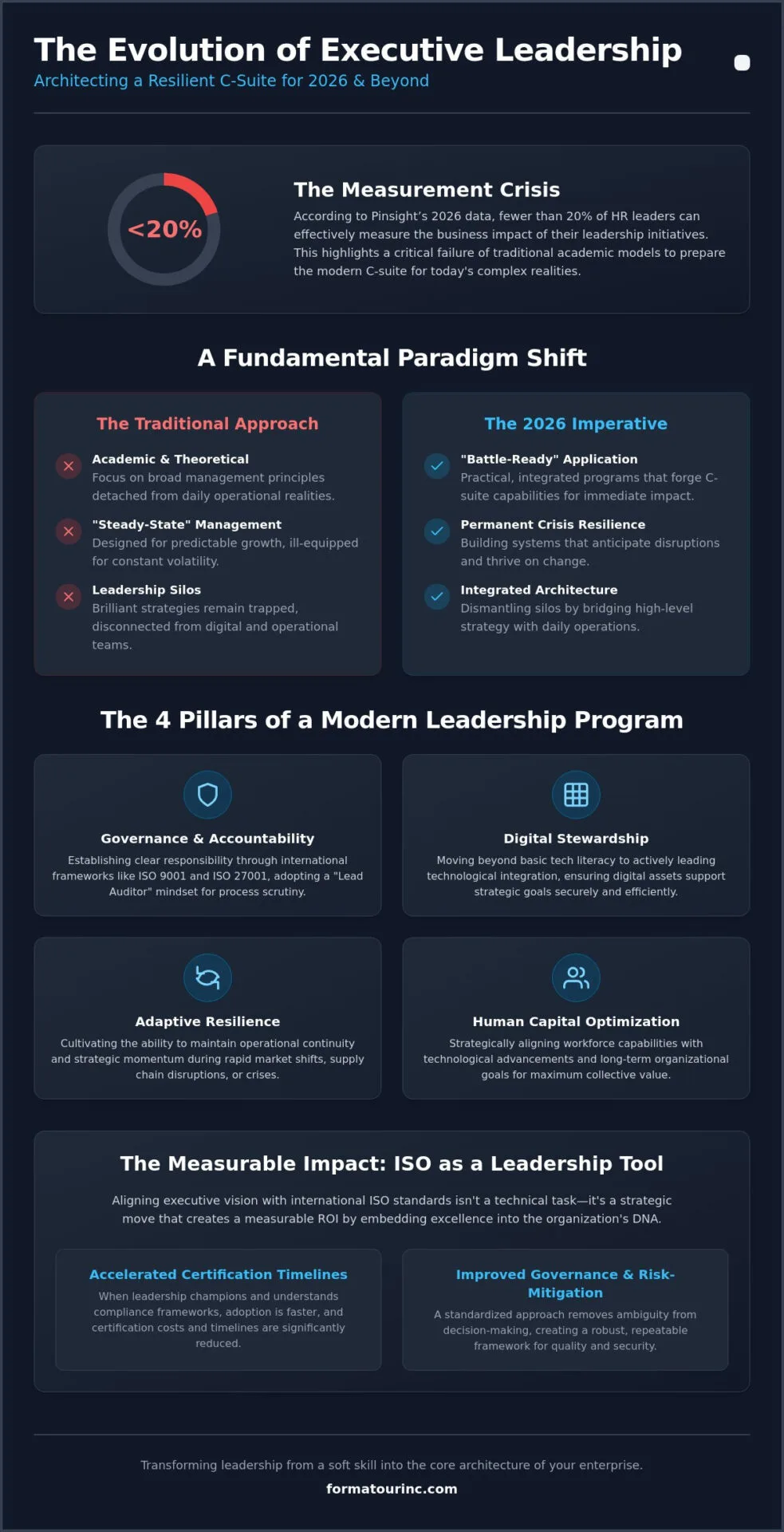
According to Pinsight’s 2026 data, fewer than 20% of HR leaders can effectively measure the business impact of their leadership initiatives, suggesting that the traditional academic model of professional growth has failed the modern C-suite. You’ve likely seen brilliant strategic visions stall because they were trapped in leadership silos, disconnected from the digital infrastructure and international standards that define the global market. It’s frustrating to invest in high-level education that feels detached from the daily realities of governance and technological change.
We understand that true leadership isn’t just about theory; it’s about architecting an organization that’s both agile and compliant. This guide explores how contemporary executive leadership development programs bridge the gap between strategic foresight, digital transformation, and organizational resilience. You’ll discover how to move beyond soft skills to cultivate battle-ready capabilities that align executive vision with operational ISO standards. We’ll examine the specific strategies that integrate human capital with digital systems to ensure your leadership team is prepared for the complexities of 2026 and beyond.
Key Takeaways
- Recognize the fundamental shift in 2026 from traditional steady-state management to a model of permanent crisis resilience and strategic foresight.
- Identify the core modules for modern executive leadership development programs that successfully integrate digital transformation strategy with human capital development.
- Evaluate the critical trade-offs between the prestige of large academic institutions and the operational agility provided by boutique advisory models.
- Discover how aligning executive vision with international ISO standards creates a measurable ROI by accelerating certification timelines and improving governance.
- Learn to dismantle leadership silos by architecting an integrated organizational structure that bridges the gap between high-level strategy and daily operations.
The Evolution of Executive Leadership Development Programs in 2026
Modern organizations no longer view leadership as a collection of soft skills. Instead, they treat executive leadership development programs as essential blueprints for human capital architecture. In the past, leadership was often defined by maintaining a “steady state” during periods of predictable growth. By 2026, this has evolved into a state of permanent crisis management where volatility is the only constant. These programs have transitioned from being simple networking hubs to becoming powerful strategic transformation engines that drive organizational survival. They’re the mechanisms that turn raw executive talent into the structural pillars of a resilient enterprise.
The historical roots of Executive education focused on academic theory and broad management principles. Today, the focus is far more practical and integrated. Leaders are expected to act as visionary architects who can bridge the gap between high-level strategy and the rigorous demands of international compliance. This shift reflects a global market that values structural integrity as much as it values innovation. It’s a move away from the “ivory tower” approach toward a “battle-ready” methodology that prepares the C-suite for immediate, impactful action.
From Management to Visionary Architecture
The Role of International Standards in Executive Education
Accountability is the cornerstone of effective leadership. Frameworks like ISO 9001 for quality and ISO 27001 for information security are no longer just for technical teams. They provide a structured language for leadership accountability across the entire enterprise. When an executive adopts a “Lead Auditor” mindset, they gain the ability to scrutinize processes and ensure that every operational layer supports the overarching vision. This perspective allows for better integration of digital assets and human capital, creating a unified front against market instability. Standardization empowers leadership by providing a clear, repeatable framework for excellence that removes ambiguity from decision-making.
Strategic Pillars of Modern Organizational Leadership Programs
The architecture of 2026 executive leadership development programs rests on four distinct pillars that prioritize operational readiness over abstract theory. Organizations can no longer afford leaders who operate within isolated silos. Today’s C-suite must possess cross-functional fluency, moving seamlessly between discussions on cybersecurity, quality management, and complex global operations. This integration ensures that every strategic decision is rooted in a deep understanding of how various departments interact to drive collective value. When leadership understands the technical constraints of security and the operational requirements of quality, they can make decisions that are both ambitious and sustainable.
- Governance and Accountability: Establishing clear lines of responsibility through international ISO frameworks.
- Digital Stewardship: Moving beyond tech literacy to active leadership of technological integration.
- Adaptive Resilience: The ability to maintain continuity during rapid market shifts or disruptions.
- Human Capital Optimization: Aligning workforce capabilities with technological advancement and organizational goals.
The most effective programs have abandoned traditional lectures in favor of experiential, “live-fire” simulations. These scenarios force executives to make high-stakes decisions in real-time, testing their ability to maintain composure and strategic focus under intense pressure. This shift reflects a broader trend toward battle-ready leadership that values practical application over academic prestige. It’s about building the muscle memory required to lead through a crisis without losing sight of the long-term vision, a core outcome of modern executive leadership development programs.
Digital Transformation and Technological Fluency
Executives are the primary architects of digital change. They shouldn’t simply delegate technological shifts to technical departments. Instead, they must actively lead the charge by integrating process automation and data-driven insights into their own leadership workflows. Partnering with a specialized digital transformation strategy firm allows leaders to identify which technologies will provide the highest return on investment while maintaining structural integrity. This hands-on approach ensures that digital tools are used to enhance human capability and streamline governance across the enterprise.
Building Organizational Resilience (ISO 22301)
Resilience is a structural requirement for any modern enterprise, not a soft skill to be developed in isolation. Leadership programs must prepare executives to take a central role in business continuity planning, transforming it from a checklist into a strategic advantage. By aligning development with ISO 22301 business continuity consulting, organizations ensure their leaders are equipped with the protocols necessary for high-stakes decision-making. These frameworks provide a reliable roadmap for maintaining operations during unforeseen disruptions, fostering a feeling of security across the entire organization. If your current strategy lacks this level of integration, you might consider how a more structured approach could optimize your executive performance.
Evaluating Leadership Training for Executives: Agility vs. Traditional Models
Choosing the right environment for executive growth requires a clear eyed assessment of organizational needs versus institutional prestige. Large university models often rely on a duration of seven months or more to deliver value, prioritizing academic depth and broad networking opportunities. While these programs carry significant weight on a resume, they often struggle with bureaucratic lag and a curriculum that cannot pivot as fast as the market. In contrast, boutique executive leadership development programs offer a level of operational agility that allows for the immediate application of strategic concepts. This results in a faster time to impact, moving from theory to implementation without the traditional wait times associated with large institutions.
The trade off between prestige and agility is a central consideration for the modern C suite. Academic models provide a wide lens but may lack the “live fire” relevance required for the permanent crisis landscape of 2026. Intensive seminar formats and targeted advisory sessions offer a condensed alternative, focusing on the specific strategic pillars your organization needs most. For Canadian leaders, adopting a “Global Citizen” mindset is essential. This perspective ensures that executive growth is aligned with international benchmarks and forward thinking trends, rather than being confined to local or outdated management styles. It reflects a commitment to being both a leader in the field and a dedicated facilitator for others on a global stage.
The Boutique Advisory Advantage
Criteria for Selecting a 2026 Leadership Partner
Selecting a partner for executive leadership development programs should involve a rigorous vetting process that goes beyond a brand name. Consider the following criteria to ensure your investment drives tangible growth:
- Facilitator Experience: Does the instructor have a proven background in strategic transformation or just academic theory?
- Actionable Skill Acquisition: Will the program result in certified leadership capabilities or just a larger professional network?
- Methodological Flexibility: Can the program adapt to your specific organizational challenges and ISO requirements in real time?
- Digital Integration: Ensure the curriculum has a strong alignment with leadership training for digital transformation to avoid the creation of technical silos.
A successful partnership is one that values precision and intelligence, helping your team integrate high level concepts into daily operations seamlessly. By choosing a partner that understands the link between strategy and results, you secure the expert hand needed to guide your organization through complex landscapes.
Measuring the ROI of C-Suite Leadership Training and Organizational Impact
The true measure of 2026 executive leadership development programs lies in their ability to fortify the entire enterprise, not just the individual’s portfolio. Historically, organizations evaluated return on investment through narrow lenses like salary increases or personal networking value. Today, the narrative has shifted toward organizational performance and structural integrity. When leaders are trained through the lens of international governance, they don’t just manage teams; they optimize systems. This systemic improvement manifests as a direct correlation between executive training and reduced operational risk, providing a clear financial justification for high-level education.
One of the most tangible indicators of success is the acceleration of ISO certification timelines. Leadership buy-in is the primary factor in the success of any governance framework. Executives who understand the architectural requirements of standards like ISO 27001 or ISO 22301 can dismantle the bureaucratic roadblocks that typically stall implementation. By fostering a “Lead Auditor” mindset at the C-suite level, organizations ensure that strategic vision and operational compliance are perfectly aligned from the outset. This alignment reduces the time and resources required to reach audit readiness, creating a measurable efficiency gain that impacts the bottom line.
Quantitative Metrics for Executive Education
Tracking the success of a leadership initiative requires a structured framework that looks beyond simple completion rates. Organizations should monitor specific operational pillars to gauge impact:
- Process Automation and Efficiency: Measure the reduction in manual intervention and the speed of workflow execution post-training.
- Audit Non-Conformities: Track the decrease in major and minor non-conformities during internal and external ISO audits.
- The Resilience Dividend: Calculate the cost-savings associated with business continuity readiness, specifically how quickly the firm recovers from simulated or real-world disruptions.
Qualitative Impact: Culture and Retention
While numbers provide the foundation, the qualitative shifts in organizational culture are equally vital. Effective leadership is the cornerstone of a culture of quality, where every employee understands their role in maintaining excellence. This is particularly evident during ISO 9001 quality management implementation, as a trained executive team can articulate the value of standardization more persuasively. Furthermore, investing in executive leadership development programs significantly reduces burnout and turnover. When leaders feel empowered and equipped with the right tools, they’re more likely to remain committed to the organization’s long-term growth. To see how these metrics can be applied to your specific organizational structure, you can consult with our strategic advisors for a detailed impact assessment.
Formatour’s Integrated Approach to Executive Education and Strategic Transformation
Formatour Incorporated occupies a unique position at the intersection of international compliance and visionary leadership. We recognize that 2026 demands more than just management skills; it requires a deep integration of governance and growth. Our executive leadership development programs aren’t isolated educational tracks. Instead, they’re integrated strategic tools designed to cultivate organizational resilience from the top down. By blending ISO expertise with high-level education, we provide the steady, expert hand needed to guide your organization through complex global landscapes.
Our boutique agility allows us to deliver bespoke executive seminars that address the specific vulnerabilities and opportunities within your enterprise. We avoid the bureaucratic lag often found in larger institutions, focusing instead on immediate, impactful results. This approach ensures that your leadership team isn’t just learning theory but is actively co-developing solutions that drive stability. We position Formatour Incorporated as the premium Canadian partner for organizations that value precision, intelligence, and the seamless integration of high-level concepts into daily operations.
Multidisciplinary Advisory for the Modern Leader
We bridge the gap between strategic transformation and operational performance by treating governance as a primary leadership catalyst. The synergy between our IT certification training and leadership modules ensures that your C-suite speaks the language of security and quality fluently. This multidisciplinary perspective prevents the formation of leadership silos and ensures that digital transformation is led, not just delegated. Stability through Strategy is the Formatour Incorporated promise, ensuring your growth is supported by structural integrity at every level.
Taking the Next Step in Your Leadership Journey
We encourage a consult-first approach to executive development to ensure every module aligns with your specific long-term objectives. Our offerings include international seminars and tailored audits that provide a global perspective grounded in practical application. This collaborative process fosters a sense of security and empowers your team to achieve sustainable success. Precision drives our partnership. You can begin your transformation today by visiting the Formatour homepage to schedule a discovery session and explore how we can architect a more resilient future for your organization.
Architecting a Future of Structural Excellence
Navigating the complexities of the 2026 business environment requires more than traditional management; it demands a leadership architecture built on resilience and international standards. We’ve explored how modern executive leadership development programs serve as the essential bridge between visionary strategy and operational compliance. By prioritizing boutique agility over academic lag, your organization can achieve a faster time to impact and a measurable resilience dividend. The integration of international frameworks ensures that every strategic decision is supported by a foundation of quality and security.
Formatour Incorporated brings over a decade of expertise in strategic transformation and international standards to help you dismantle silos and optimize human capital. We combine Canadian-based insights with a global strategic mindset, providing big-firm consulting standards through a responsive, boutique model. It’s time to move beyond soft skills and build a leadership team that’s truly battle-ready. Elevate your leadership with Formatour’s premium advisory and executive programs. We look forward to partnering with you on this journey toward sustainable growth and organizational health.
Frequently Asked Questions
What are the core components of high-quality executive leadership development programs?
High-quality executive leadership development programs prioritize strategic foresight, digital stewardship, and governance. These modules ensure that leaders can architect resilient systems rather than just managing daily tasks. Effective programs also integrate experiential simulations to prepare the C-suite for “live-fire” decision-making in volatile markets. This combination of theory and application builds the muscle memory required to lead through a crisis without losing sight of the long-term vision.
How long do executive leadership programs typically last in 2026?
Program length in 2026 is highly varied to suit different organizational needs. Intensive seminars often last five days, while comprehensive blended learning initiatives can span six months. Multi-month programs are common for deep strategic overhauls, whereas hybrid models often utilize a ten-week immersive structure to balance learning with operational duties. The choice depends on whether the goal is a targeted skill update or a total leadership transformation.
Can leadership training help our organization achieve ISO 27001 certification?
Leadership training is a critical prerequisite for successful ISO 27001 certification. When the C-suite understands the architectural requirements of information security, they can dismantle the bureaucratic roadblocks that often stall implementation. This alignment ensures that security becomes a strategic asset rather than a technical silo. It fosters a “Lead Auditor” mindset at the executive level, which is essential for maintaining long-term compliance and accountability.
What is the difference between a university executive program and a boutique advisory program?
University programs offer significant academic prestige and broad networking opportunities but often suffer from bureaucratic lag. Boutique advisory programs provide operational agility and direct access to seasoned mentors. These smaller models focus on co-developing industry-specific solutions that can be implemented immediately. While universities provide a wide lens, boutique firms offer the “battle-ready” relevance required for the permanent crisis landscape of 2026.
How do we measure the return on investment (ROI) for C-suite training?
Measuring ROI requires shifting the focus from individual career progression to collective organizational performance. Metrics include improvements in process automation, a reduction in audit non-conformities, and the calculation of a “resilience dividend” through business continuity readiness. Successful executive leadership development programs result in certified capabilities that drive tangible efficiency gains and reduce operational risk across the entire enterprise.
Are these programs suitable for small to mid-sized Canadian firms?
These programs are highly suitable for small to mid-sized Canadian firms that require boutique agility to compete globally. Tailored advisory services allow smaller organizations to implement big-firm standards without the overhead of massive institutional programs. This approach builds a “Global Citizen” mindset while remaining grounded in practical, local application. It empowers smaller leadership teams to achieve stability and growth through sophisticated, inclusive strategies.
What is the role of digital transformation in modern executive education?
Digital transformation is no longer a technical task to be delegated; it’s a core leadership responsibility. Modern education focuses on integrating process automation and data-driven insights directly into executive workflows. This ensures that the C-suite can lead technological shifts that enhance human capital and streamline governance. Leaders must understand the intersection of technology and governance to design organizations that are flexible enough to pivot while remaining grounded in operational excellence.
How do international business seminars differ from standard leadership training?
International business seminars provide exposure to global benchmarks and forward-thinking trends that standard training might overlook. They foster a global strategic mindset by connecting leaders with international peers and diverse regulatory landscapes. This experience is essential for any executive looking to architect a resilient organization in an interconnected global market. These seminars move beyond local management styles to provide a holistic picture of organizational health and international excellence.
