

Recent industry shifts indicate that the investment required for global security standards is climbing, with projections suggesting a 20% increase in certification expenses throughout 2026. For many organizations, the ISO 27001 certification cost Canada remains a moving target, obscured by vague consultant quotes and the looming threat of scope creep. It’s understandable to feel a sense of caution when balancing the necessity of a robust Information Security Management System against the potential for unexpected financial strain. You need a clear roadmap that transforms these complex requirements into a predictable, strategic asset.
This guide provides the executive level clarity you need to manage your security budget with confidence and precision. We’ll break down the primary phases of the certification journey, from initial implementation to the recurring demands of the three year audit cycle. By the end of this article, you’ll have a comprehensive understanding of how to optimize your investment, ensuring your compliance efforts drive long term organizational resilience and sustainable growth.
Key Takeaways
- Recognize that ISO 27001 represents a strategic investment in organizational resilience that extends far beyond a simple compliance certificate.
- Identify how project scope and technological complexity serve as the primary drivers behind the total ISO 27001 certification cost Canada.
- Avoid the hidden expenses of failed audits by choosing a specialist advisory model over the high risks and opportunity costs of internal implementation.
- Plan for the entire three-year certification lifecycle by accounting for initial audits, annual surveillance, and long-term maintenance requirements.
- Optimize your organizational health through a multidisciplinary approach that aligns information security with quality management and business continuity standards.
Understanding the Strategic Investment of ISO 27001 in the Canadian Market
Achieving a certificate is only the final milestone in a much broader journey toward organizational integrity. At its core, ISO/IEC 27001 is a comprehensive Information Security Management System (ISMS) designed to protect the confidentiality, integrity, and availability of your data assets. When evaluating the ISO 27001 certification cost Canada, executives must look past the initial line items to see a strategic framework that scales with their ambitions. In the 2026 threat landscape, where sophisticated cyber incidents are increasingly common, a standardized security posture is no longer a luxury for Canadian firms. It’s a fundamental requirement for stability.
The strategic value of this investment becomes clear when bidding on international or government contracts. Procurement departments now prioritize partners who can demonstrate a mature security culture through recognized benchmarks. By framing the expenditure against the average cost of a Canadian data breach, which continues to rise in 2026, the certification shifts from a cost center to a form of essential insurance. It provides a measurable return on investment by preventing the catastrophic financial and reputational damage associated with unauthorized data access.
The Intersection of ISO 27001 and Canadian Regulatory Compliance
Implementing a unified security framework allows organizations to streamline their compliance with PIPEDA and various provincial privacy laws. Instead of managing fragmented policies for different jurisdictions, businesses can use the ISMS to cover multiple regulatory requirements simultaneously. The rigorous framework of ISO 27001 provides a direct blueprint for meeting the enhanced privacy and data protection obligations introduced by Bill C-27. This alignment reduces redundant audit costs and ensures that your organization remains agile as the Canadian legislative environment evolves.
Market Maturity: Why 2026 is the Year for Certification
The Canadian market has reached a tipping point where certification has transitioned from an optional advantage to a mandatory supply chain requirement. Enterprise clients now demand verified security credentials as a prerequisite for partnership. Furthermore, many Canadian insurance providers offer more favorable premiums to organizations that maintain a certified ISMS, as it demonstrates a proactive approach to risk management. Utilizing professional ISO 27001 implementation services ensures that your organization doesn’t just meet these requirements but masters them, securing long term competitiveness in a globalized economy.
Primary Cost Drivers: Analyzing Scope, Complexity, and Organizational Scale
The financial commitment required for certification is fundamentally dictated by the physical and digital boundaries of your Information Security Management System (ISMS). It’s a common misconception that the ISO 27001 certification cost Canada is a fixed fee based solely on employee headcount. In reality, a lean organization with complex data flows may face a higher investment than a larger firm with centralized, simple operations. Executives must evaluate their organizational architecture to predict where the most significant resources will be allocated.
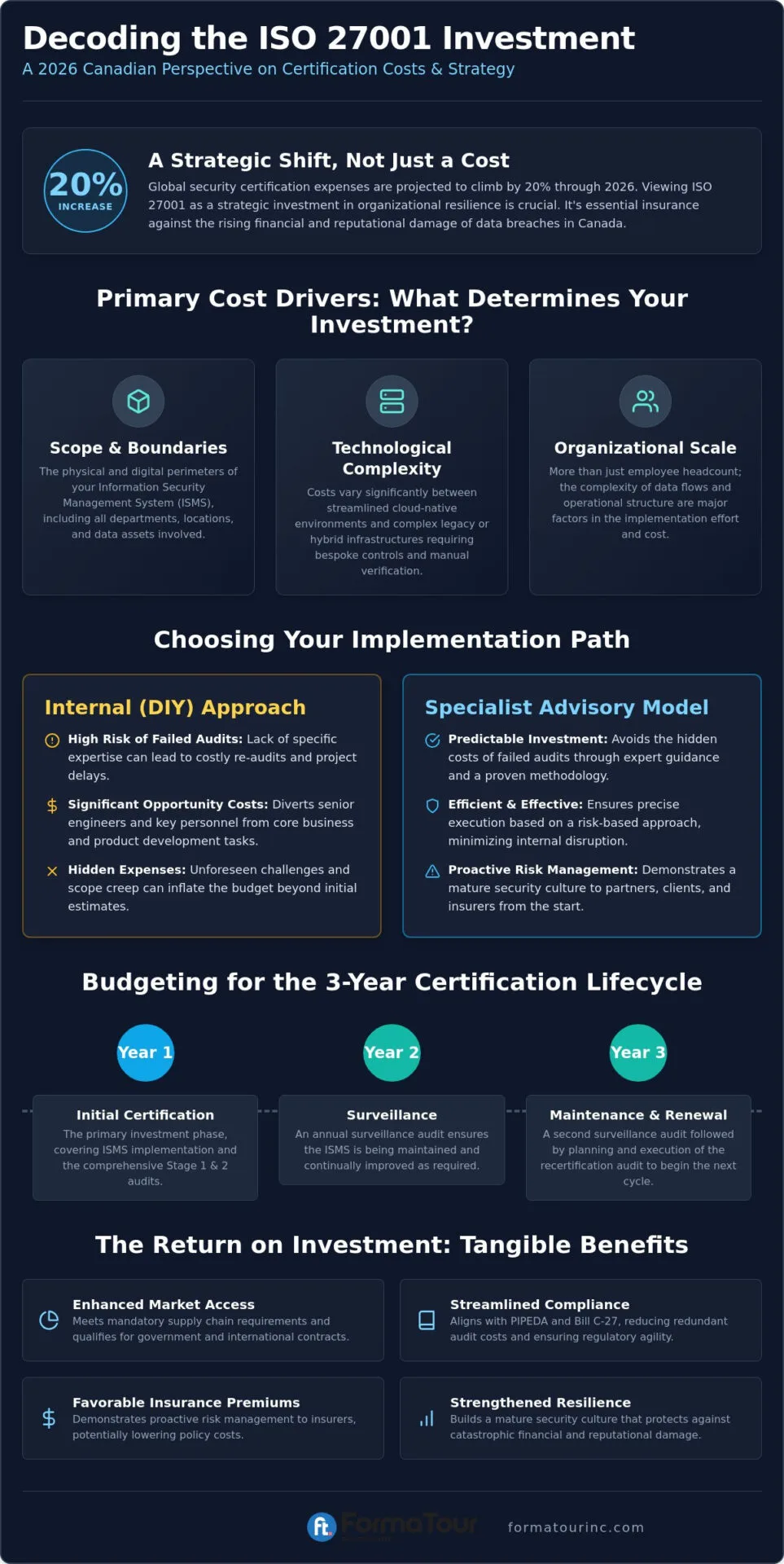
Technological complexity plays a decisive role in implementation effort. Cloud-native environments often benefit from automated compliance tools and standardized configurations, which can streamline the audit process. Conversely, legacy systems or hybrid infrastructures require bespoke control mapping and manual verification. IBM describes ISO 27001 as a leading globally recognized information security standard, emphasizing that its risk-based approach requires precise execution to be effective. When organizations attempt to manage this process entirely in-house, they often encounter the hidden cost of lost productivity. Diverting senior engineers from product development to documentation and control testing can result in significant opportunity costs that far outweigh the expense of professional guidance.
Determining Your ISMS Scope
Defining a lean scope is the most effective way to control initial certification expenses. By limiting the ISMS to a specific department or service line, you reduce the number of controls that require auditing. However, an overly narrow scope can backfire if your enterprise clients demand certification for your entire operation. Precision during the scoping phase ensures budget predictability and prevents expensive adjustments during the Stage 2 audit. If you’re uncertain about how your current infrastructure will impact your budget, consulting with a strategic partner can provide the necessary clarity.
Complexity Factors in the Canadian Tech Sector
Canadian SaaS and FinTech firms face unique challenges that influence their total investment. Data residency requirements are a primary concern, as maintaining data within Canadian borders often necessitates specific technical controls and localized hosting agreements. These requirements must be documented and tested within the ISMS framework. Additionally, high-growth tech firms should budget for specialized penetration testing. While not explicitly mandated by the standard, auditors in 2026 increasingly look for independent technical validation to confirm that your security controls are functioning as intended in a live environment.
Comparing Implementation Models: Internal Resources vs. Specialist Advisory
Choosing the right implementation model is a pivotal decision that directly impacts the total ISO 27001 certification cost Canada. Many organizations fall into the “DIY trap” by assuming that existing IT staff can manage the transition alongside their daily responsibilities. While internal teams understand your infrastructure intimately, they often lack the specific auditing perspective required for a successful assessment. A failed audit doesn’t just delay your certification; it necessitates expensive remedial work and additional auditor fees that quickly erode any perceived savings from a self-managed approach.
When selecting external support, executives generally choose between “Big Four” firms and boutique advisories. The Big Four provide a globally recognized brand but often operate with rigid, high-cost structures that may not suit the agility of a Canadian mid-market firm. In contrast, a boutique advisory offers a more intimate partnership, providing senior-level expertise without the administrative overhead of a global conglomerate. Modernizing security isn’t just about checkboxes; it requires digital transformation consulting that integrates security into the fabric of your organization. Microsoft notes that the standard formally specifies an Information Security Management System (ISMS), and leveraging automation tools can help maintain this structural rigor while reducing long-term manual labor costs.
The ROI of Specialist ISO 27001 Consulting
Specialized consultants ensure your organization doesn’t over-engineer controls, focusing resources where they provide the most significant risk reduction. A pre-audit gap analysis is perhaps the most valuable tool in your arsenal, as it identifies non-conformities before they become costly audit findings. By leveraging localized market insights and streamlined decision-making processes, boutique advisories typically reduce the implementation lifecycle by several months compared to the multi-layered approval chains of global consulting firms. This accelerated timeline allows you to capture market opportunities and meet contractual requirements sooner.
Empowering Internal Teams through Training
Sustainable compliance requires building internal capability to manage the system long after the consultants have finished their work. Budgeting for ISO 27001 lead auditor training empowers your team to conduct required internal audits and manage the ISMS with confidence. This investment in staff development ultimately lowers the long-term ISO 27001 certification cost Canada by reducing reliance on external contractors for annual maintenance. Transitioning from consultant-led implementation to internal management is the most effective way to foster a permanent “security-first” culture that protects your brand and your clients.
The Certification Lifecycle: Budgeting for Audits, Surveillance, and Recertification
Securing your initial certificate is a significant achievement, but it represents only the first phase of a perpetual three-year commitment. When calculating the long-term ISO 27001 certification cost Canada, executives must look beyond the initial implementation phase to account for the recurring expenses of maintaining a living system. The certification cycle is designed to ensure that your security controls evolve alongside new threats and organizational changes. Budgeting for this lifecycle with precision prevents financial surprises and ensures that your Information Security Management System (ISMS) remains a reliable asset for the duration of its validity.
The journey begins with a two-stage audit process. The Stage 1 Audit serves as a documentation review and readiness check; it ensures that your ISMS framework is properly designed before the formal assessment begins. Following this, the Stage 2 Audit evaluates the actual effectiveness of your controls through interviews, evidence collection, and technical observation. Once certified, your organization enters a surveillance phase. Annual surveillance audits in years one and two verify that the system is being maintained and that continuous improvement is taking place. In the third year, a full recertification audit is required to reset the cycle, which involves a more comprehensive review similar in depth to the original Stage 2 assessment.
Selecting a Certification Body in Canada
Choosing the right registrar is a strategic decision that affects both your budget and the perceived value of your certificate. It’s essential to select a body accredited by the Standards Council of Canada (SCC) to ensure global recognition of your credentials. While it’s tempting to select an auditor based solely on the lowest daily rate, the cheapest option often lacks the industry-specific expertise required to provide meaningful insights. An experienced auditor who understands your specific Canadian industry vertical can identify efficiencies that a generalist might miss, ultimately reducing the ISO 27001 certification cost Canada by preventing unnecessary control over-engineering. To receive a tailored assessment of your certification cycle requirements, speak with our strategic advisors today.
Transitioning to ISO/IEC 27001:2022
By 2026, the transition period from the 2013 version of the standard has officially concluded; the deadline of October 31, 2025, marked the point where all active certificates must align with the 2022 update. Organizations must now budget for the maintenance of the restructured Annex A controls, which focus on four distinct themes: organizational, people, physical, and technological. This shift requires an updated Statement of Applicability and a refined approach to risk treatment. If your organization is just beginning its journey in 2026, you’ll be working exclusively with the 2022 version, ensuring your security framework is built on the most current international benchmarks from day one.
Strategic Resilience: Why Formatour Incorporated is Your Premium Partner for ISO 27001 in Canada
Formatour Incorporated stands as a steady, expert hand for organizations managing the intricate demands of international standards. We bridge the gap between the high-level authority of global consulting firms and the inclusive, responsive agility of a premium Canadian advisory. Our methodology ensures that your ISO 27001 certification cost Canada is never viewed as a sunk expense but as a catalyst for structural integrity and long term growth. We don’t just implement technical controls; we co-develop solutions that integrate seamlessly into your unique daily operations, fostering a culture of security that feels both modern and deeply established.
Our multidisciplinary approach provides a holistic picture of organizational health that single-focus firms often miss. By aligning your security framework with ISO 9001 quality management and ISO 22301 business continuity, we create a unified governance structure. This integration prevents the silos that lead to redundant audit costs and operational friction. The track record of Formatour Incorporated in strategic transformation allows us to guide you through complex landscapes with unwavering reliability, ensuring your compliance efforts support sustainable development and global competitiveness.
Beyond the Certificate: Building a Resilient Future
We believe a certified system should drive measurable operational performance rather than just ticking boxes. Our consultants bring an executive leadership perspective that is essential for securing board-level buy-in and establishing true accountability across the enterprise. We focus on empowering your teams to view security as a vehicle for innovation. Formatour Incorporated transforms your security framework from a necessary cost centre into a powerful strategic asset that enhances market trust and provides a foundation for digital transformation.
Next Steps for Your Canadian Organization
The journey toward excellence begins with a clear understanding of your current security maturity. Requesting a tailored gap analysis allows you to define your specific ISO 27001 certification cost Canada with total precision, eliminating the anxiety of budget creep. Our multidisciplinary experts are ready to partner with you to design a resilience strategy that reflects your business objectives. Contact Formatour Incorporated today to begin your journey toward secure, sustainable growth and the assurance of long term success.
Securing Your Organizational Legacy through Strategic Compliance
Mastering the ISO 27001 certification cost Canada requires a shift from viewing security as a static line item to embracing it as a driver of market maturity. You’ve identified that scoping and complexity are the primary levers of your budget; a three-year lifecycle approach is essential for long-term predictability. By prioritizing specialist guidance over internal trial and error, your organization secures a faster path to certification while building a robust Information Security Management System that evolves with the 2026 threat landscape.
Formatour Incorporated provides the steady expertise needed to navigate these complex organizational landscapes. With over a decade of Canadian advisory experience, we combine the rigorous standards of global firms with the inclusive agility of a premium boutique partner. Our specialists integrate ISO 27001 with 9001 and 22301 frameworks to ensure your resilience strategy is both comprehensive and efficient. Partner with Formatour Incorporated for a Strategic ISO 27001 Roadmap and transform your compliance requirements into a foundation for sustainable growth. Your journey toward a more secure and reliable future starts with a single, strategic step.
Frequently Asked Questions
What is the average ISO 27001 certification cost for a mid-sized Canadian company?
A mid-sized Canadian organization with 51 to 250 employees typically faces an implementation range between CAD$40,000 and $80,000, supplemented by audit fees that vary based on scope. These figures represent the baseline for establishing a mature Information Security Management System (ISMS) in the 2026 market. Factors such as existing security maturity and the complexity of your digital infrastructure will ultimately determine where your organization falls within this spectrum.
Can we achieve ISO 27001 certification without hiring an external consultant?
While it’s technically possible to achieve certification using internal resources, most Canadian firms find the “DIY” approach leads to significant hidden expenses and a higher risk of audit failure. Internal teams often lack the specialized auditing perspective required to interpret the standard’s 93 controls effectively. Engaging a specialist ensures that your ISO 27001 certification cost Canada remains predictable by avoiding the need for expensive remedial work following a failed assessment.
How long does the ISO 27001 certification process typically take in Canada?
The certification process generally spans six to twelve months from the initial gap analysis to the final Stage 2 audit. This timeline depends heavily on your organization’s starting point and the availability of resources to implement necessary controls. Smaller, more agile firms may complete the journey faster, while larger enterprises with legacy systems often require a full year to ensure all operational pillars are fully aligned with the standard.
What are the most common hidden costs in an ISO 27001 implementation project?
Hidden costs frequently arise from employee training, specialized security software, and the temporary loss of productivity as staff adapt to new workflows. Organizations must also budget for the purchase of official standards documentation and potential hardware upgrades required to meet specific physical or technological controls. A comprehensive budget should account for these operational adjustments to ensure the project remains financially viable throughout the three-year cycle.
How does ISO 27001 certification cost compare to a SOC 2 audit in Canada?
ISO 27001 is an international certification valid for three years, whereas SOC 2 is an attestation report that typically requires annual renewal. While the initial ISO 27001 certification cost Canada may appear higher due to the implementation of a full management system, it often provides better long-term value for organizations seeking a globally recognized framework. Many Canadian businesses find that 60% to 80% of the controls overlap, allowing for a unified approach to both standards.
Is there government funding available in Canada for ISO 27001 certification?
Canadian organizations may access support through programs like the Canada Digital Adoption Program (CDAP) or specific provincial grants aimed at enhancing cybersecurity resilience. These initiatives often provide funding for specialized advisory services or the implementation of advanced digital technologies. It’s advisable to consult with a strategic partner to identify which current federal or provincial programs might offset your initial investment in security infrastructure.
What happens if we fail our ISO 27001 certification audit?
Failing an audit usually results in the identification of non-conformities that must be addressed before the certificate is issued. Minor non-conformities require an action plan for future correction, while major non-conformities necessitate a follow-up audit to verify that the gap has been closed. This remedial process can increase your total investment, highlighting the importance of a thorough pre-audit gap analysis to ensure readiness.
How often do we need to pay for surveillance audits?
Surveillance audits are required annually during the first and second years of your certification cycle. These assessments are less intensive than the initial Stage 2 audit and focus on ensuring that your ISMS remains effective and that your organization is pursuing continuous improvement. Budgeting for these yearly check-ins is essential for maintaining your certified status and demonstrating ongoing commitment to information security to your stakeholders.
