

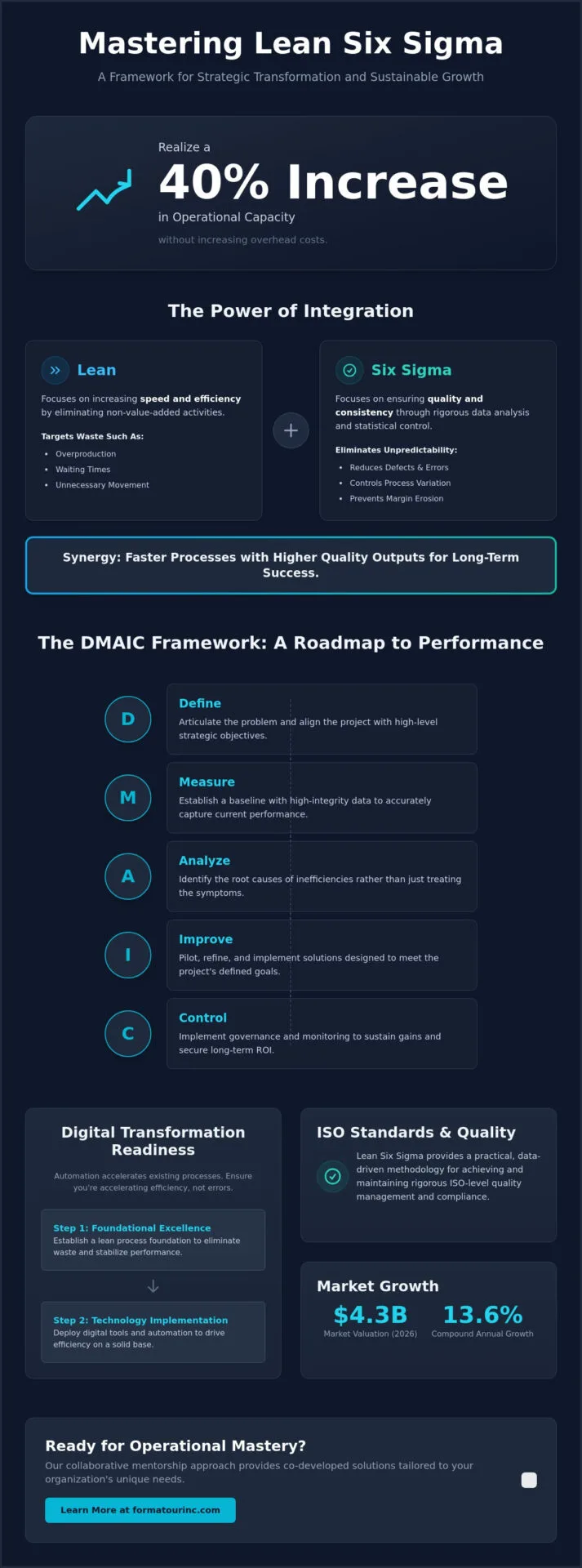
Organizations that successfully apply Lean Six Sigma methodologies can realize a 40% increase in operational capacity without adding a single dollar to their overhead. Despite this potential, many executive leaders find themselves battling persistent margin erosion caused by operational inefficiencies and a widening disconnect between high level strategy and floor level execution. It’s frustrating to watch complex global supply chains struggle with quality maintenance while strategic goals remain just out of reach. You likely recognize that true excellence requires more than just incremental changes; it demands a fundamental shift in how your organization functions.
This article empowers you to master the integration of Lean efficiency and Six Sigma precision to drive strategic transformation and sustainable growth. We’ll provide a clear framework for reducing waste and improving process predictability, ensuring your operational performance aligns seamlessly with your long term vision. We’ll explore how these methodologies serve as the engine for organizational resilience and ISO level compliance. This guide offers a methodical look at transforming your processes into a reliable foundation for global scalability and structural integrity.
Key Takeaways
- Learn how to balance operational speed with statistical precision to eliminate waste and stabilize performance across complex global supply chains.
- Discover the structured DMAIC roadmap that transforms high-level strategic goals into measurable, floor-level execution results.
- Understand the strategic intersection between Lean Six Sigma and ISO standards, providing a practical methodology for maintaining rigorous quality management.
- Explore why digital transformation requires a lean process foundation before automation to ensure technology drives efficiency rather than accelerating existing errors.
- Gain insights into a collaborative mentorship approach that replaces rigid templates with co-developed solutions tailored to your organization’s unique governance needs.
What is Lean Six Sigma? Defining Operational Excellence for 2026
Operational excellence isn’t a static destination; it’s a disciplined pursuit of structural integrity and sustainable growth. To understand the foundation of modern efficiency, one must ask: What is Lean Six Sigma? At its core, it’s a data-driven philosophy that combines waste reduction with rigorous variation control to create a resilient organizational framework. While its roots lie in the mid-20th-century factory floor, its application has transitioned into a cornerstone of executive leadership. In 2026, the methodology serves as a critical bridge between high-level strategy and floor-level execution.
This evolution is reflected in the global process improvement market, which reached a valuation of $4.3 billion in 2026 with a compound annual growth rate of 13.6%. Organizations no longer view these tools as isolated tactics for manufacturing. Instead, they’re integrated into the very fabric of digital transformation consulting and corporate governance. This hybrid approach is essential for modern organizational resilience, providing the stability needed to scale across global supply chains without sacrificing quality or margin.
The Core Philosophy: Customer-Centric Value
Lean Six Sigma serves as a strategic catalyst that translates executive vision into a predictable, high-performance reality.
Lean vs. Six Sigma: The Power of Integration
While often discussed together, Lean and Six Sigma address different operational challenges. Lean focuses on the removal of non-value-added activities, targeting waste such as overproduction, waiting times, and unnecessary movement. It streamlines the workflow to ensure that resources move through the system with maximum speed and minimum friction. This efficiency is the engine that drives operational capacity.
In contrast, Six Sigma reduces defects and errors through statistical process control. It identifies the root causes of variation, ensuring that every output meets a specific, high-quality standard. By applying rigorous data analysis, it eliminates the unpredictability that often leads to margin erosion and customer dissatisfaction. This precision provides the assurance of success that modern enterprises demand.
The DMAIC Framework: A Structured Roadmap for Performance
Strategic transformation requires a disciplined methodology to move beyond aspiration into tangible results. The DMAIC framework acts as the foundational roadmap for Lean Six Sigma initiatives, providing a rigorous five step cycle to optimize organizational health. It begins with Define, where leaders articulate the problem and align the project with high level strategic objectives. Next, the Measure phase establishes a baseline using high integrity data, ensuring performance is captured accurately before any changes occur. During the Analyze phase, teams identify the root causes of inefficiencies rather than merely treating symptoms. The Improve phase follows, where solutions are piloted and refined to ensure they meet the defined goals. Finally, the Control phase implements governance to sustain these gains and secure a long term return on investment. This structured approach ensures that every improvement initiative remains grounded in reality, providing the assurance of success that global enterprises require.
Identifying the 8 Wastes (DOWNTIME)
Optimizing a process requires a keen eye for what adds value and what merely adds cost. The DOWNTIME acronym helps leaders categorize waste to better understand where resources are being eroded:
- Defects: Correcting data entry errors in a CRM system.
- Overproduction: Generating complex weekly reports that go unread by stakeholders.
- Waiting: Delays in executive sign offs for critical project milestones.
- Non-utilized talent: Assigning senior analysts to manual data entry tasks that don’t leverage their expertise.
- Transportation: Unnecessary digital handoffs between disconnected software platforms.
- Inventory: A massive backlog of unprocessed customer support tickets or unread emails.
- Motion: Navigating through multiple software tabs or physical locations to complete a single transaction.
- Extra-processing: Requiring three separate signatures for a low value purchase order.
Eliminating these inefficiencies is a core component of ISO 14001 certification services, as reducing waste directly supports environmental sustainability and operational integrity. By identifying these areas, organizations can increase capacity without increasing overhead.
Data-Driven Decision Making for Executives
Modern leadership demands a shift from intuitive gut feelings to objective, evidence based management. Statistical evidence provided by the DMAIC cycle justifies strategic change and ensures resources are allocated where they’ll have the most significant impact. This commitment to data supports ISO 9001 quality management implementation by fostering a culture of continuous improvement and predictable excellence. Understanding the nuances of Lean Six Sigma and Operational Excellence allows executives to build a stable foundation for growth. If you’re ready to align your operational performance with your strategic vision, consider how a tailored consultation can accelerate your progress.
Lean Six Sigma and ISO Standards: The Strategic Intersection
ISO standards define the standards of excellence, but Lean Six Sigma provides the operational mechanics to achieve them. It’s the difference between having a map and having the engine to drive the route. Many organizations struggle with ISO certification because they treat it as a documentation exercise. By contrast, integrating LSS ensures that processes are lean and stable before they’re ever audited. This approach reduces the stress of certification and builds a culture of genuine quality management.
The synergy between the LSS DMAIC framework and the ISO Plan-Do-Check-Act (PDCA) cycle is profound. While PDCA offers a high level management loop, DMAIC provides the deep dive tools required to analyze root causes and implement statistically sound improvements. A university study explains the difference between Lean and Six Sigma, highlighting how these tools work in tandem to eliminate waste and reduce variation. This alignment makes passing rigorous ISO audits a natural byproduct of operational health rather than a separate, frantic effort. Organizations that embrace Lean Six Sigma achieve “Certification-Ready” status with a level of boutique agility that larger, more rigid firms often lack.
LSS as a Foundation for ISO 9001 and ISO 27001
Achieving compliance doesn’t have to mean sacrificing speed. Using LSS to streamline ISO 27001 implementation services ensures that information security protocols are both robust and efficient. Quality management systems should empower your team, not hinder them. By focusing on value added activities, you can ensure your governance structures remain agile and responsive. Explore our ISO Standards Implementation for comprehensive advisory on balancing compliance with performance.
Risk Management and Organizational Resilience
Process stability is the bedrock of long term survival. LSS identifies hidden risks within operational flows, allowing you to mitigate them before they escalate into systemic failures. This proactive stance is vital when integrating LSS with ISO 22301 business continuity consulting. When your processes are predictable, your organization becomes resilient against external shocks. This strategic foresight protects your margins and secures your place in the global market.
Implementing Lean Six Sigma in the Era of Digital Transformation
Many executives mistakenly believe Lean Six Sigma is confined to the factory floor. It actually provides the essential architecture for modern digital workflows. As organizations migrate to the cloud, “Digital Lean” has become a critical tool for identifying waste in software development cycles and cloud resource allocation. Over-provisioning of server capacity is a digital form of inventory waste; redundant code represents a form of defects. By applying these principles to tech stacks, organizations ensure their digital infrastructure remains lean and performant. This strategic application prevents the technical debt that often erodes digital margins.
Artificial intelligence and advanced data analytics significantly accelerate the DMAIC cycle. AI processes vast amounts of real-time data to identify root causes in seconds, a task that previously took weeks of manual analysis. This speed allows for more frequent iterations and faster realization of ROI. It transforms the methodology from a retrospective audit into a predictive management tool, allowing leaders to anticipate bottlenecks before they impact the customer experience. This evolution ensures that Lean Six Sigma remains a forward-thinking discipline in a rapidly changing technological landscape.
Lean Automation: Optimizing Before Digitizing
Automating an inefficient process is a strategic error that merely accelerates failure. Leaders often refer to this as “automating waste.” Before deploying a digital transformation strategy, executives must use LSS to map value streams and eliminate non-value-added steps. Consider IT service delivery as a practical example. A team might use LSS to reduce cycle times by identifying bottlenecks in ticketing before implementing an automated AI helpdesk. This sequence ensures technology serves a clear purpose rather than masking a broken system. It builds a foundation of stability that allows digital tools to perform at their peak capacity.
Leading Remote and Hybrid Teams with LSS
Managing decentralized teams requires a shift in how we observe and measure work. The traditional “Gemba walk”, which involves visiting the place where work happens, now occurs in virtual collaboration spaces and project management dashboards. Leaders must adapt these tools to maintain visibility without falling into the trap of micromanagement. Strategic leadership training for digital transformation empowers managers to use objective performance metrics to lead remote teams with quiet confidence. This transition ensures that quality remains consistent regardless of physical location. It fosters a culture of accountability and continuous improvement that spans global boundaries.
If your digital initiatives aren’t delivering the expected efficiency, contact our advisory team to align your technology with lean operational principles.
The Formatour Approach: Executive Mentorship for Operational Mastery
Formatour Incorporated offers a unique blend of boutique agility and big-firm consulting standards. While many global consultancies impose rigid, pre-packaged templates, we focus on the co-development of solutions that respect the specific nuances of your organizational culture. Our advisory services are designed to bridge the gap between high level strategic vision and the granular operational reality of your daily workflows. By integrating Lean Six Sigma principles into our mentorship, we ensure that your transformation is both theoretically sound and practically executable. This collaborative approach fosters a sense of security and trust, positioning us as a steady hand through complex transitions.
Building internal capability is the only way to ensure long term growth. We don’t just solve immediate problems; we empower your team through specialized executive education. This focus on human capital ensures that Lean Six Sigma becomes a permanent part of your organizational DNA rather than a temporary project. When your leaders master these tools, they gain the intelligence and foresight needed to navigate international benchmarks and shifting market demands. This investment in your people creates a foundation for structural integrity that outlasts any single consulting engagement.
Beyond Certification: Sustaining a Culture of Excellence
A successful transformation moves from a “project-based” mindset to a permanent culture of continuous improvement. It’s not enough to complete a single cycle of DMAIC; excellence requires ongoing vigilance and adaptation. Executive leadership plays a critical role here, acting as the primary champion for these initiatives and ensuring that resources remain aligned with quality goals. Formatour’s commitment to organizational resilience and strategic foresight helps you maintain this momentum. We help you build a framework where quality and efficiency are naturally integrated into every decision, ensuring sustainable development over hurried, superficial fixes.
Your Partner in Strategic Transformation
Your journey toward operational mastery begins with a comprehensive gap analysis. This initial step identifies the disconnects between your current performance and your long term strategic goals. We then integrate these findings with our broader executive leadership programs to create a holistic development roadmap. This ensures that your operational improvements are supported by a leadership team capable of managing change in a digital era. If you’re ready to redefine your operational performance and achieve predictable excellence, Partner with Formatour Incorporated to begin your strategic transformation.
Securing Strategic Resilience through Process Mastery
Mastering the integration of Lean efficiency and Six Sigma precision is no longer optional for organizations seeking global stability. We’ve explored how the DMAIC framework provides a structured roadmap for performance and how Lean Six Sigma serves as the operational engine for ISO level compliance. In an era of rapid digital transformation, the shift toward “Digital Lean” ensures that your technology drives value rather than automating waste. True excellence requires a fundamental alignment between your floor level execution and your high level strategic vision.
Formatour Incorporated brings over a decade of experience in strategic transformation and executive development to help you bridge this gap. We combine our expertise in global ISO standards with a unique boutique agility that delivers big firm consulting standards without the rigid templates. Our focus remains on co-developing solutions that empower your leadership and secure your organization’s long term growth. It’s time to transform your operational challenges into a sustainable competitive advantage.
Elevate your operational performance with Formatour advisory and build a future rooted in predictable excellence. Your path to structural integrity starts with a single, decisive step toward mastery.
Frequently Asked Questions
What is the primary difference between Lean and Six Sigma?
Lean focuses on speed and the elimination of waste, while Six Sigma prioritizes quality and the reduction of variation. Lean targets non-value-added activities to accelerate process velocity and improve efficiency. Six Sigma utilizes statistical tools to identify and remove the root causes of defects, ensuring consistent output. When integrated, they provide a comprehensive framework for achieving a high-performance organization that is both agile and precise.
How does Lean Six Sigma improve ROI for service-based organizations?
Service organizations improve their ROI by reducing the cycle time of deliverables and minimizing the costs associated with administrative errors. Lean Six Sigma identifies hidden inefficiencies in workflows that lead to margin erosion. By stabilizing these processes, firms can increase their operational capacity by up to 40% without adding overhead. This improved predictability ensures that strategic goals are met while protecting the bottom line through enhanced resource utilization.
Can Lean Six Sigma be integrated with ISO 9001 certification?
Integration is highly effective because LSS provides the tactical methodology needed to meet the continuous improvement requirements of ISO 9001. While the ISO standard defines the necessary governance framework, LSS offers the data-driven tools to execute process optimizations. This synergy ensures that your quality management system is a living engine for growth rather than just a compliant document. Using LSS data helps organizations pass rigorous audits with quiet confidence.
What are the 8 wastes of Lean in a modern office environment?
Office waste often manifests as DOWNTIME: defects in data entry, overproduction of unread reports, and waiting for executive approvals. It also includes non-utilized talent in manual tasks, unnecessary digital transportation of files, and excessive inventory in email backlogs. Motion waste occurs through navigating disjointed software, while extra-processing involves redundant sign-offs. Identifying these digital inefficiencies allows for the optimization of virtual workflows, ensuring that human capital is focused on high-value strategic initiatives.
How long does a typical Lean Six Sigma implementation take?
Individual process improvement projects typically span three to six months depending on the complexity of the data and the project scope. However, establishing a permanent culture of excellence is a multi-year strategic commitment. The initial phase involves a comprehensive gap analysis to align operational pillars with long-term goals. Sustainable results are achieved when the methodology is integrated into daily governance rather than treated as a one-time exercise for certification.
What is the role of executive leadership in a Lean Six Sigma project?
Executive leaders serve as the primary architects and champions of the transformation journey. Their role is to provide the necessary resources, remove organizational barriers, and ensure that every project aligns with the broader strategic vision. By demonstrating a commitment to data-driven decision-making, executives foster a sense of security and accountability across the organization. This high-level authority is essential for bridging the gap between strategic foresight and floor-level execution.
Is Lean Six Sigma still relevant in the age of AI and automation?
Lean Six Sigma remains vital because automating an inefficient process only accelerates failure. AI and automation should be applied to processes that are already lean and stable to maximize their impact. The methodology provides the foundational layer for “Lean Automation,” ensuring that digital tools are integrated into optimized value streams. In 2026, AI actually enhances LSS by accelerating data analysis and providing real-time insights into process variation.
How does Formatour Incorporated approach Lean Six Sigma advisory?
Formatour Incorporated utilizes a “boutique agility” approach that favors the co-development of solutions over the imposition of rigid templates. We act as a seasoned strategic mentor, guiding your leadership through the complexities of organizational development and international standards. Our advisory services focus on building internal capability through executive education, ensuring that transformation is sustainable. This partnership balances high-level authority with a supportive, results-oriented atmosphere to drive long-term growth and structural integrity.
