

What if your most significant operational vulnerability isn’t a market shift or a regulatory change, but the very framework you use to defend against them? In an environment where the Bank of Canada maintains a 2.25% policy interest rate and the British Columbia Business Practices and Consumer Protection Act introduces new thresholds this August, the margin for error has narrowed. Many Canadian leaders feel the strain of siloed data and the weight of increasing regulatory pressure. You aren’t alone in seeking a more cohesive approach to Risk Management that moves beyond reactive firefighting and toward structural integrity.
You can master the strategic methodologies required to transform organizational uncertainty into a sustainable competitive advantage. This article provides a sophisticated roadmap to achieving organizational resilience through seamless ISO compliance and enhanced decision-making clarity. We will explore how to protect your brand reputation and optimize resource allocation by integrating digital transformation consulting with established international standards. By the end of this guide, you’ll understand how to leverage executive leadership development and process automation to build a visionary architecture for growth.
Key Takeaways
- Reposition uncertainty as a catalyst for growth by shifting your strategic focus from loss mitigation to the active optimization of success.
- Utilize ISO standards as architectural blueprints for resilience, providing a structured approach to information security and operational quality.
- Strengthen organizational defense by categorizing internal and external threats, ensuring comprehensive protection that extends beyond basic insurance coverage.
- Cultivate a high-performance culture through a deliberate five-step implementation process that prioritizes executive commitment and organizational alignment.
- Master the frameworks of Risk Management to transform potential vulnerabilities into a sustainable and distinct competitive advantage.
Defining Risk Management as a Catalyst for Strategic Transformation
Effective Risk management isn’t merely a defensive posture; it’s the systematic stewardship of uncertainty to ensure an organization’s longevity. Historically, leaders viewed this discipline as a cost center focused on loss mitigation. In the current economic climate, that narrative is shifting toward the optimization of success. By 2026, the complexity of the Canadian market, influenced by a steady 2.25% policy interest rate and significant tax regulation changes, requires a more sophisticated approach. True organizational resilience serves as the ultimate metric of success, allowing firms to absorb shocks while maintaining a trajectory toward their strategic goals.
This transformation requires a move away from siloed data and toward an integrated model. When uncertainty is managed with precision, it becomes a source of intelligence. Organizations that treat risk as an architectural component of their growth strategy are better positioned to capitalize on opportunities that others might perceive as too volatile. This proactive stance is what separates market leaders from those who are perpetually caught in a cycle of crisis management.
The Evolution of Risk: From Defensive to Strategic
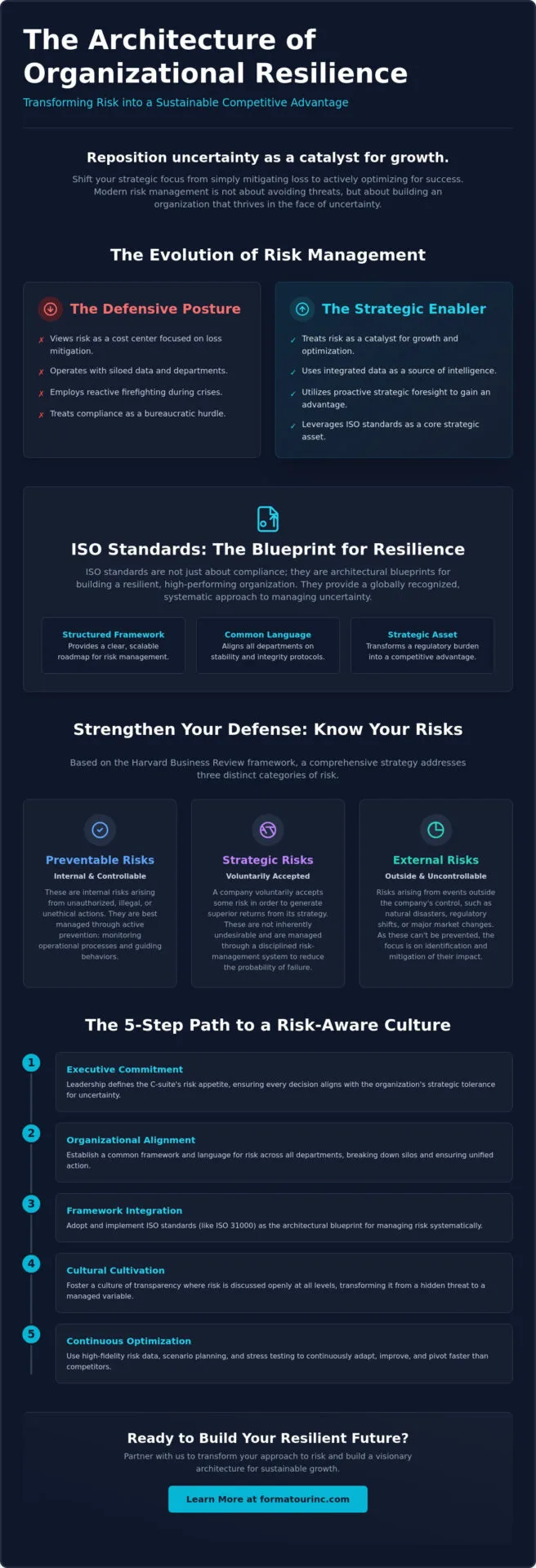
Modern firms no longer wait for a crisis to react. They use high-fidelity risk data to pivot faster than their competitors. This transition from reactive firefighting to proactive strategic foresight is driven by executive leadership. Leaders must define the risk appetite of the C-suite, ensuring that every department understands the boundaries of acceptable uncertainty. This alignment transforms risk from a hurdle into a tool for competitive advantage. By integrating strategic transformation consulting, businesses can ensure their growth isn’t just fast, but structurally sound.
Strategic foresight involves more than just predicting the future; it’s about preparing the organization to be agile regardless of the outcome. This requires a cultural shift where risk is discussed openly at the highest levels of governance. When the leadership team views risk as a variable to be optimized rather than a threat to be hidden, the entire organization becomes more transparent and efficient.
Risk vs. Uncertainty in the Modern Enterprise
It’s vital to distinguish between quantifiable risks and the unknown unknowns that define the 2026 landscape. While some variables are predictable, the 2026 review of the CUSMA and evolving digital dependencies introduce layers of uncertainty that rigid planning cannot address. Per ISO 31000, risk is the effect of uncertainty on objectives. Resilient architectures succeed where traditional plans fail because they’re built to adapt rather than just endure. This distinction is crucial for leaders who must allocate resources effectively in a market where the only constant is change.
Quantifiable risks can be modeled and mitigated through standard protocols. Uncertainty, however, requires a different set of tools, including scenario planning and stress testing. By building a foundation of resilience, Canadian businesses can navigate these “unknown unknowns” with confidence, turning potential disruptions into moments of strategic clarity.
The Architecture of Resilience: ISO Standards as Management Frameworks
ISO standards shouldn’t be viewed as bureaucratic hurdles or static checkboxes. They’re established blueprints for building a risk-resilient organization. While generic approaches to Risk Management often lack a standardized roadmap, ISO provides a globally recognized structure that scales with your business. This systematic approach aligns with Harvard Business Review’s risk management framework, which emphasizes the need for distinct processes to handle preventable, strategic, and external risks. By adopting these international benchmarks, Canadian firms transform compliance from a regulatory burden into a core strategic asset.
Implementing these frameworks creates a common language for stability across all departments. It ensures that every team member understands their role in protecting the organization’s integrity. When your management systems are built on these foundations, you gain a level of operational clarity that is difficult to achieve through ad hoc policies. This structural integrity is what allows a brand to maintain its reputation even during periods of intense market volatility.
ISO 27001: Managing the Digital Frontier
Digital transformation brings significant rewards but introduces complex vulnerabilities. An Information Security Management System (ISMS) provides the necessary oversight to mitigate cyber threats and protect sensitive data assets. Engaging in ISO 27001 implementation services allows firms to embed rigorous risk assessment into their daily IT operations. This isn’t just about software; it’s about governance and human capital. For organizations operating within the North American market, prioritizing ISO 27001 implementation in Canada ensures that data privacy meets both international benchmarks and local regulatory expectations, such as those found in evolving provincial privacy acts.
ISO 22301 and 9001: Operational and Continuity Synergy
Operational stability relies on the seamless integration of quality and continuity. While ISO 9001 quality management focuses on reducing the risk of process failure and ensuring consistent output, ISO 22301 addresses the “what if” scenarios of major disruptions. Utilizing ISO 22301 business continuity consulting helps prevent catastrophic downtime by establishing clear recovery protocols before a crisis occurs. This proactive planning ensures that your business remains functional even when faced with supply chain interruptions or technical failures.
Many sophisticated organizations now adopt an Integrated Management System (IMS). This approach combines multiple standards to improve efficiency and eliminate the redundancy of siloed data. It creates a holistic view of the organization’s health, allowing for more informed resource allocation. If you’re looking to unify your governance structures, it’s often beneficial to consult with a strategic advisor about how these frameworks can be tailored to your specific growth objectives.
Strategic vs. Operational Risk: Navigating Executive Complexity
Executive leadership often struggles to balance the immediate demands of internal processes with the long-term shifts of the global market. To manage this complexity, you must categorize your exposure into two distinct streams: strategic and operational. Strategic risks are external, high-level threats that could fundamentally alter your business model, while operational risks are internal, process-driven vulnerabilities that impact daily efficiency. A sophisticated Risk Management framework ensures that neither category is neglected, providing a holistic view of the organization’s health.
Operational Risk: Protecting the Core
Operational risk focuses on the internal mechanics that keep your business running. Common failures often stem from supply chain disruptions, human capital turnover, or process gaps that lead to inefficiency. By utilizing ISO 14001 certification services, firms can systematically mitigate environmental and regulatory risks, ensuring that sustainability is integrated into the core operational strategy. This standard provides a clear roadmap for managing compliance in a landscape where Canadian environmental regulations continue to tighten.
Process automation plays a critical role in reducing the human error that often plagues risk-prone environments. When you optimize your workflows through technology, you eliminate the variability that leads to operational failure. This structural integrity allows your team to focus on high-value tasks while the system handles the precision required for compliance. Protecting the core isn’t about avoiding change; it’s about building a foundation that makes change safe and predictable.
Strategic Risk: Capitalizing on Market Shifts
Strategic risk involves the broader threats associated with your competitive position and market relevance. As you refine your digital transformation strategy, the greatest danger is often inaction. In a rapidly evolving Canadian market, failing to adapt to technological shifts can be more costly than a failed project. Strategic foresight allows you to identify these emerging threats early, turning potential disruptions into opportunities for growth and differentiation.
Implementing a Risk-Aware Culture: From Compliance to Excellence
A sophisticated approach to Risk Management requires more than just policy documents; it demands a cultural shift that permeates every level of the organization. Building a high-performance risk culture ensures that uncertainty is handled with precision and collective intelligence. This transition from basic compliance to operational excellence follows a deliberate five-step progression designed to align your team with your strategic objectives.
- Step 1: Executive Commitment. Success begins at the top. The C-suite must define the organization’s risk appetite, establishing clear boundaries for acceptable uncertainty that guide every subsequent decision.
- Step 2: Risk Identification. Utilizing multidisciplinary audits allows firms to uncover hidden vulnerabilities that siloed departments might overlook. This broad perspective ensures that all potential threats are documented.
- Step 3: Assessment and Prioritization. By quantifying the impact versus the likelihood of identified risks, leaders can allocate resources where they’re most needed. This clarity prevents the inefficient distribution of mitigation efforts.
- Step 4: Mitigation and Treatment. Implementing ISO-aligned controls provides a standardized roadmap for addressing vulnerabilities. These controls act as the structural integrity of your defense strategy.
- Step 5: Monitoring and Continuous Improvement. The Plan-Do-Check-Act (PDCA) cycle ensures that your framework remains agile. Regular reviews allow you to adapt to new market shifts and refine your processes over time.
The Role of Executive Leadership in Risk Governance
Risk governance must be a top-down initiative to be truly effective. When the leadership team prioritizes resilience, it empowers middle management to own their specific areas of concern. Engaging in leadership training for digital transformation provides managers with the tools to identify emerging threats in a tech-driven market. Modern executive teams are increasingly adopting the “Risk Steward” role, where specific leaders are tasked with overseeing the integration of risk foresight into daily operations. This accountability ensures that stability isn’t sacrificed for short-term gains.
Audit as a Tool for Growth, Not Just Compliance
It’s helpful to reframe internal audits as strategic health checks rather than mere regulatory obligations. These assessments provide an objective view of your performance, highlighting areas where process optimization can drive efficiency. Third-party advisory services add significant value here by identifying blind spots that internal teams might miss due to proximity. Regular auditing doesn’t just satisfy auditors; it prepares your firm for international certification and builds the brand reputation necessary to compete on a global scale. If you’re ready to move beyond basic checklists, you can contact a Formatour advisor to schedule a comprehensive strategic audit of your current frameworks.
Partnering for Resilience: The Formatour Integrated Advisory Approach
Achieving structural integrity in a volatile market requires more than just adherence to standards; it demands a partnership built on precision and co-development. The methodology at Formatour Incorporated, characterized as “Boutique Agility with Big-Firm Standards,” provides a sophisticated alternative to the rigid, cookie-cutter templates often found in the industry. By focusing on the unique operational DNA of each client, we ensure that your Risk Management framework is an organic extension of your strategic goals rather than a superficial layer of compliance. This collaborative approach transforms the certification process into a catalyst for long-term operational performance.
Our multidisciplinary advisory model integrates various facets of organizational health, from information security to executive leadership development. This holistic perspective is essential in 2026, where Canadian businesses face a 2.25% policy interest rate and an increasingly complex regulatory landscape. We don’t just deliver a certificate; we co-develop solutions that optimize your probability of success. This transition from a defensive posture to a proactive, resilient architecture is what allows our partners to maintain a sustainable competitive advantage on the global stage.
Strategic Resilience Through Multidisciplinary Expertise
Formatour Incorporated bridges the critical gaps between IT security, quality management, and business continuity. This integration is vital for organizations that cannot afford siloed data or fragmented governance. As a Canadian-based partner, we provide the dual benefit of global standards and deep local market insight. Our experts understand the specific nuances of the Canadian federal government’s procurement policies and the evolving provincial tax regulations. We’ve guided numerous firms from an “at-risk” status to becoming industry leaders by aligning their internal processes with international benchmarks like ISO 27001 and ISO 9001. This alignment ensures that every department contributes to the organization’s overarching resilience.
Your Roadmap to a Resilient Future
The journey toward excellence begins with a comprehensive gap analysis and a strategic Risk Management assessment. This initial phase identifies the specific vulnerabilities within your current architecture and provides a clear roadmap for improvement. Following this, the implementation phase involves tailored training and rigorous internal auditing to ensure your team is fully equipped to own the new standards. We guide you through every step of the certification journey, ensuring that the final audit is a validation of your operational maturity. To begin your transformation and secure your organization’s longevity, Partner with Formatour Incorporated for Strategic Resilience and build a foundation that thrives on uncertainty.
Building a Foundation for Sustainable Growth
Transforming uncertainty into a competitive advantage requires a shift from reactive mitigation to a proactive, integrated architecture. You’ve explored how ISO standards serve as the essential blueprints for this resilience, bridging the gap between digital security and operational excellence. A robust Risk Management framework ensures your organization remains agile in the face of Canadian market volatility and shifting regulations. This structural integrity allows your brand to maintain its reputation while pursuing ambitious growth objectives.
Formatour brings over a decade of ISO implementation expertise to your strategic journey. As a premium Canadian multidisciplinary advisory, we specialize in the seamless integration of ISO 27001, ISO 9001, and ISO 22301. We don’t just provide generic templates; we co-develop the structural integrity your brand needs to thrive. The road to organizational resilience is a deliberate one, and having a seasoned mentor ensures your progress is both efficient and enduring.
Secure Your Organization’s Future with Formatour Advisory. Your vision for growth deserves a foundation built on precision and unwavering reliability.
Frequently Asked Questions
What is the difference between risk and uncertainty in business?
Risk involves situations where the potential outcomes and their probabilities are quantifiable through data and historical analysis. Uncertainty refers to “unknown unknowns” where the parameters of a situation aren’t yet defined or measurable. Effective Risk Management focuses on converting these uncertainties into manageable risks through systematic identification and strategic foresight.
How does ISO 27001 help with risk management?
ISO 27001 provides a structured framework for an Information Security Management System (ISMS) that identifies and treats data vulnerabilities. It ensures that security isn’t just an IT concern but a core governance priority integrated into every level of the organization. This standard protects your brand’s reputation and ensures compliance with evolving Canadian privacy regulations.
Is risk management only necessary for large corporations?
Stability and resilience are critical for organizations of all sizes. Small and medium businesses often face higher vulnerability to market shocks and regulatory changes because they have fewer resource buffers. Implementing a scalable framework allows smaller firms to protect their margins and build the structural integrity required for sustainable growth.
What are the four main types of risk management strategies?
The four primary strategies for handling identified threats are avoidance, reduction, sharing, and retention. Avoidance involves eliminating the activity that causes the risk; reduction focuses on mitigating the impact through controls; sharing typically involves insurance or outsourcing; and retention is the conscious decision to accept the risk when it aligns with the organization’s appetite.
How often should an organization conduct a risk assessment?
Organizations should conduct a comprehensive assessment at least annually or whenever significant internal or external changes occur. These triggers include digital shifts, new regulatory requirements, or major market volatility. Continuous monitoring through the Plan-Do-Check-Act cycle ensures your defensive architecture remains relevant and effective.
What is the role of digital transformation in modern risk management?
Digital transformation provides the analytical tools and real-time data necessary for more precise threat identification. While technology introduces new cyber vulnerabilities, it also enables process automation that reduces human error in high-stakes environments. A modern strategy leverages these digital assets to create a more transparent and responsive governance structure.
Can risk management actually drive revenue growth?
Strategic foresight drives revenue by protecting the organization from catastrophic downtime and brand erosion. When a business understands its risk appetite, leadership can make bolder, more informed decisions about market expansion and innovation. This clarity allows a firm to capitalize on opportunities that competitors might avoid due to perceived uncertainty.
How do I choose the right risk management framework for my business?
The selection process depends on your industry, regulatory environment, and long-term growth objectives. ISO standards like 9001, 27001, and 22301 are the gold standards for global credibility and operational health. Partnering with a multidisciplinary advisor can help you identify which framework provides the best architecture for your specific strategic needs.
