

The transition to ISO/IEC 27001:2022 is no longer a future milestone; it’s the mandatory baseline for any organization serious about global trust. For many leaders, the path to ISO 27001 compliance for SaaS companies Canada feels like a daunting drain on resources that competes with product innovation. You’ve likely experienced the tension of trying to satisfy enterprise security questionnaires while wondering if your current framework aligns with the newly introduced Bill C-36, the Protecting Privacy and Consumer Data Act. We understand that the complexity of international standards can feel at odds with the agility your business requires to scale.
This strategic guide empowers you to master these complexities to secure your platform and satisfy evolving Canadian privacy laws. You’ll gain the clarity needed to navigate the 2026 regulatory landscape and transform your security posture into a powerful engine for global growth. We will examine the specific requirements of the 2022 standard, the implications of Bill C-36, and the precise steps to achieve a certification that opens doors to the world’s largest enterprise contracts.
Key Takeaways
- Leverage ISO 27001 as a strategic differentiator to unlock global enterprise contracts and establish a position of trust in the international SaaS marketplace.
- Navigate the complexities of ISO 27001 compliance for SaaS companies Canada to ensure your platform meets the high standards of Bill C-36 and PIPEDA modernization.
- Identify and mitigate specific SaaS risks, including multi-tenant security and API vulnerabilities, through a modernized Information Security Management System (ISMS).
- Evaluate the strategic benefits of ISO 27001 versus SOC 2 to determine which framework best aligns with your organizational growth and international expansion goals.
- Implement a structured roadmap starting with comprehensive gap analysis and risk treatment to build a resilient foundation for sustainable digital transformation.
Why ISO 27001 is the Strategic Standard for Canadian SaaS in 2026
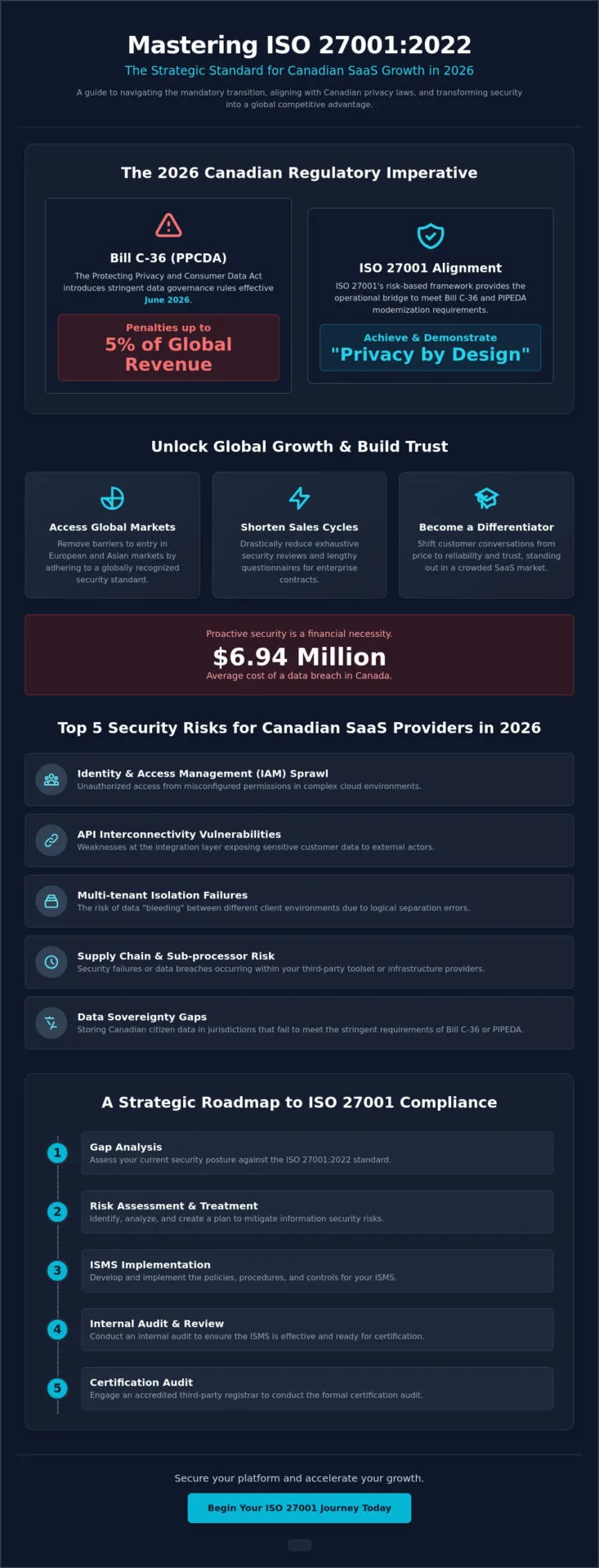
Security is no longer a peripheral concern for Canadian technology leaders; it’s the foundation of every enterprise transaction. ISO 27001 serves as the international standard for information security, providing a rigorous framework for an Information Security Management System (ISMS). Unlike reactive checklists, this risk-based approach ensures that protection is woven into the very fabric of your operations. For those pursuing ISO 27001 compliance for SaaS companies Canada, the goal isn’t just a certificate. It’s the establishment of organizational resilience that survives the scrutiny of the world’s largest procurement departments. With the average cost of a data breach in Canada reaching $6.94 million, the shift from a reactive security posture to a proactive, standardized system is a financial necessity.
The Competitive Advantage of Certification in Canada
Canadian SaaS firms often find themselves trapped in exhaustive security review cycles that can delay contracts by months. Certification drastically shortens these enterprise sales cycles by providing immediate, third-party validation of your security posture. It signals to international stakeholders that your platform adheres to a globally recognized framework, effectively removing barriers to entry in European and Asian markets. In a crowded domestic landscape, being a certified provider serves as a powerful differentiator that shifts the conversation from price to reliability. This strategic foresight allows your team to focus on scaling the product rather than answering the same 200 security questions for every new lead.
Regulatory Harmony: ISO 27001 and Canadian Privacy Laws
The introduction of Bill C-36, the Protecting Privacy and Consumer Data Act (PPCDA) in June 2026, has raised the stakes for data governance. Organizations must now demonstrate “Privacy by Design” and maintain transparent data handling practices or face penalties up to 5% of global revenue. ISO 27001 risk assessments align perfectly with these requirements by identifying where personal information resides and how it’s protected. By mapping ISMS controls to the requirements of the Consumer Privacy Protection Act (CPPA), you create a defensible audit trail for federal regulators. Achieving ISO 27001 compliance for SaaS companies Canada ensures your organization remains ahead of these legislative shifts while maintaining operational efficiency. ISO 27001 functions as the essential operational bridge that translates complex Canadian privacy mandates into a repeatable, high-performance security strategy.
SaaS-Specific Risks and the Modern Canadian ISMS
The architecture of modern SaaS demands a security framework that is as dynamic as the cloud itself. While traditional businesses might focus on physical perimeters, your risks live in API calls, container orchestration, and multi-tenant databases. Adopting ISO 27001 compliance for SaaS companies Canada allows your leadership to move beyond technical patchworks toward a holistic governance model. This international standard is widely considered transcendent for SaaS companies because it aligns technical controls with business objectives. Success in this area depends heavily on executive leadership. When security is treated as a core product feature rather than a hurdle, it fosters a culture that prioritizes the integrity of every customer interaction.
Identifying the top 5 security risks for Canadian SaaS providers in 2026 is the first step toward resilience:
- Identity and Access Management (IAM) Sprawl: Unauthorized access resulting from misconfigured permissions in complex cloud environments.
- API Interconnectivity Vulnerabilities: Weaknesses at the integration layer that expose sensitive customer data to external actors.
- Multi-tenant Isolation Failures: The risk of data “bleeding” between different client environments due to logical separation errors.
- Supply Chain and Sub-processor Risk: Security failures or data breaches occurring within your third-party toolset or infrastructure providers.
- Data Sovereignty Gaps: Storing Canadian citizen data in jurisdictions that fail to meet the stringent requirements of Bill C-36 or PIPEDA.
Cloud-Native Security and Data Residency
CI/CD Pipeline Integrity and DevOps Integration
Modern development requires security to be baked into the agile lifecycle. Integrating automated scanning for open-source dependencies ensures that ISO 27001 compliance for SaaS companies Canada doesn’t become a bottleneck for your engineering team. By treating security as code, you can automate evidence collection during every deployment. This proactive approach ensures that third-party library risks are mitigated before they ever reach production. If you need assistance mapping these technical workflows to international standards, reach out to our advisory team for a tailored consultation.
ISO 27001 vs. SOC 2: Choosing the Right Path for Canadian Tech
Canadian tech founders often reach a pivotal crossroads when deciding between ISO 27001 and SOC 2. While both frameworks aim to validate your security posture, they serve distinct strategic purposes and geographic markets. SOC 2 is an attestation report developed by the AICPA, primarily recognized within North American enterprise circles. In contrast, ISO 27001 is a globally recognized management system that governs how an organization handles information security holistically. For leaders seeking ISO 27001 compliance for SaaS companies Canada, the decision often hinges on international expansion goals. If your roadmap includes the European Union, the United Kingdom, or the Asia-Pacific region, ISO 27001 is typically the mandatory prerequisite for doing business.
The structural nature of these frameworks creates different operational outcomes. ISO 27001 requires the establishment of a continuous Information Security Management System (ISMS), focusing on risk management and governance. SOC 2 examines controls at a specific point in time or over a defined period. Business leaders frequently view these as essential ISO certifications for SaaS because they provide a standardized language for trust. While SOC 2 might satisfy a US-based venture firm, ISO 27001 builds the internal muscle required to maintain high-level security across every department, from HR to software engineering.
Global Reach vs. North American Dominance
ISO 27001 is the undisputed gold standard for Canadian SaaS firms entering international markets. While SOC 2 has a strong foothold in the United States, it often lacks the same level of recognition in Europe or Asia. A strategic decision framework should consider where your customers are located today and where they will be in 2028. Pursuing ISO 27001 compliance for SaaS companies Canada provides a portable credential that satisfies procurement officers worldwide, effectively future-proofing your sales pipeline against geographic limitations.
The Long-Term Impact on Operational Performance
Beyond the badge on your website, ISO 27001 builds a repeatable process for strategic transformation. It forces an organization to move away from ad-hoc security fixes toward a culture of continuous improvement. The audit frequency and maintenance requirements ensure that security remains a board-level priority rather than a one-time project. This disciplined approach often leads to better process automation and operational efficiency. If you are ready to begin this journey, our ISO 27001 Implementation Services provide the expert guidance needed to navigate the certification process with confidence and precision.
A Strategic Roadmap to ISO 27001 Compliance
Success in achieving ISO 27001 compliance for SaaS companies Canada depends on a methodical progression from high-level strategic vision to specific operational pillars. This journey isn’t merely a technical exercise; it’s a fundamental transformation of how your organization values and protects information. By following a structured roadmap, you can replace confusion with confidence and ensure that every action leads to a tangible security outcome. The process begins with a rigorous Gap Analysis and Scoping phase, where you define the boundaries of your SaaS environment. This step ensures that your production systems, support infrastructures, and remote workforce are accounted for without introducing unnecessary bureaucratic bloat.
Once the scope is established, the focus shifts to Risk Assessment and Treatment. This involves identifying the specific threats that matter most to your Canadian stakeholders, particularly in light of the Protecting Privacy and Consumer Data Act. Following this, you must develop Documentation and Controls that reflect your actual workflows rather than generic templates. A streamlined Information Security Management System (ISMS) remains agile, supporting your product releases while maintaining high-level governance. The final stages involve a thorough Internal Audit and Management Review to confirm readiness before engaging an accredited registrar for the Certification Audit.
Defining the ISMS Scope for SaaS Platforms
Defining your scope is a delicate balance between comprehensive protection and operational efficiency. You must include all production environments, customer support systems, and the infrastructure supporting your remote workforce to ensure no vulnerability is overlooked. A common pitfall is over-scoping, which often leads to audit failure or excessive implementation costs. By strategically aligning your security scope with your core business goals, you create a focused framework that protects your most valuable assets while remaining manageable for a growing team.
The Role of Internal Audit and Professional Development
Conducting a rigorous internal audit serves as the essential dress rehearsal for your official certification. This phase allows you to identify and remediate any control gaps in a low-stakes environment. You can empower your internal team to lead this process by investing in ISO 27001 lead auditor training, which bridges the gap between technical knowledge and international standards. Internal readiness is the #1 predictor of certification success. If you’re ready to transform your security posture with a partner who understands the unique needs of Canadian tech firms, schedule a consultation with our advisors today.
Partnering for Resilience: The Formatour Advantage for Canadian SaaS
Achieving international certification is a significant milestone, but the true value lies in the structural integrity it brings to your organization. Formatour Incorporated serves as a premium Canadian multidisciplinary advisory firm, dedicated to guiding technology leaders through the complexities of global governance. We recognize that for high-growth firms, ISO 27001 compliance for SaaS companies Canada must be more than a defensive measure. It’s a strategic investment in your platform’s scalability and market reputation. Our firm provides the quiet confidence and unwavering reliability required to transform rigorous compliance into a sustainable competitive advantage.
We operate with a philosophy of “Big Firm Standards, Boutique Agility.” While we maintain the high formality and precision expected of global auditors, we avoid the rigid bureaucracy that often stifles innovation in agile environments. Our experts work as active participants in your progress, ensuring that your Information Security Management System (ISMS) supports your product roadmap rather than hindering it. This collaborative approach allows us to deliver sophisticated solutions that feel both modern and deeply established, providing a steady hand through every stage of the certification journey.
Multidisciplinary Expertise for Modern Tech
The modern SaaS landscape requires a partner who understands the intersection of security, governance, and technology. By combining our deep ISO expertise with a comprehensive digital transformation strategy, we help you build a more resilient organization. Our advisory services extend beyond security to include process automation and optimization, ensuring that your compliance workflows are as efficient as your software. As a Canadian partner, we possess a nuanced understanding of both international benchmarks and domestic mandates like Bill C-36, allowing us to harmonize your global ambitions with local regulatory requirements.
A Collaborative Path to Sustainable Compliance
Our methodology focuses on the co-development of solutions that fit your unique culture and operational rhythm. We don’t believe in temporary fixes or superficial checklists. Instead, we empower your leadership through executive development and long-term support for ISMS maintenance. This ensures that your security posture remains robust long after the initial audit is complete. We’re committed to your long-term success, providing the strategic foresight needed to adapt as new threats and regulations emerge. If you’re ready to secure your platform and unlock new global opportunities, schedule a strategic consultation with Formatour Incorporated to begin your transformation.
Transforming Compliance into a Strategic Asset
Mastering the 2022 standard is no longer a technical option; it’s a fundamental requirement for Canadian tech firms aiming for the global stage. By aligning your Information Security Management System with international benchmarks, you move beyond mere checkboxes to build a culture of perpetual readiness. This approach ensures that ISO 27001 compliance for SaaS companies Canada becomes a catalyst for trust and a bridge to high-value enterprise contracts. You’ve seen how a structured roadmap and an understanding of the evolving legislative landscape, including Bill C-36, can turn security from a bottleneck into a differentiator.
Choosing the right partner is essential for navigating these complexities with precision and speed. Formatour Incorporated brings over a decade of experience in strategic transformation, offering the steady guidance of Canadian-based experts with global ISO certification authority. We combine big-firm standards with the boutique agility your fast-moving environment demands. Our multidisciplinary approach ensures your compliance journey drives real operational performance and long-term organizational resilience. Secure Your SaaS Future with Formatour Advisory Services. Your platform is ready for the world; we’re here to help you prove it.
Common Questions Regarding ISO 27001 in the Canadian SaaS Sector
How long does ISO 27001 certification take for a Canadian SaaS startup?
Most organizations achieve certification within six to twelve months. This duration depends on your existing security maturity and the availability of resources to document and implement the required controls. A startup with an agile culture can often accelerate this timeline by integrating compliance tasks directly into their development sprints.
Can we use ISO 27001 to satisfy PIPEDA and Bill C-27 requirements?
ISO 27001 provides a robust framework that aligns with the data protection principles of PIPEDA and the newly introduced Bill C-36. While the standard doesn’t replace legal advice, it establishes the “Privacy by Design” architecture required to meet Canadian regulatory standards. Implementing this system demonstrates a proactive commitment to the fundamental privacy rights recognized by the PPCDA.
What is the typical cost of ISO 27001 compliance for a SaaS company in Canada?
The investment for ISO 27001 compliance for SaaS companies Canada varies based on organizational size, infrastructure complexity, and the depth of existing documentation. Primary expenses include internal resource allocation, potential infrastructure upgrades to meet security controls, and the fees for an accredited certification body. Leaders should view these costs as a strategic investment that mitigates the average $6.94 million cost of a Canadian data breach.
Do we need ISO 27001 if we already have SOC 2 Type 2?
You likely need ISO 27001 if you plan to expand beyond the North American market. While SOC 2 is highly valued by US enterprise clients, ISO 27001 is the mandatory gold standard in the European Union, the UK, and parts of Asia. Many Canadian firms maintain both to maximize their global reach and satisfy diverse procurement requirements.
What are the most common Annex A controls that SaaS companies struggle with?
SaaS organizations frequently find the most challenge in A.8.28 (Secure Coding) and A.5.21 (Managing Information Security in the Supplier Relationship). Ensuring that every line of code follows security best practices and that third-party sub-processors meet your internal standards requires rigorous, repeatable processes. These controls are essential for maintaining the integrity of multi-tenant cloud environments.
How does ISO 27001 impact our DevOps and CI/CD processes?
ISO 27001 encourages a “shift left” approach where security controls are integrated directly into your CI/CD pipeline. This transformation allows for automated evidence collection and vulnerability scanning during the build process. Instead of slowing down releases, a modernized ISMS ensures that security becomes an automated, high-performance feature of your development lifecycle.
Is an internal auditor required for ISO 27001, or can we outsource it?
Clause 9.2 of the standard requires that you conduct internal audits at planned intervals. You don’t need a full-time employee dedicated to this role; many organizations choose to outsource this function to specialized advisors to ensure objectivity. Alternatively, you can train existing staff to perform these duties as part of their professional development.
What is the difference between an ISO 27001 implementation partner and a certification body?
An implementation partner acts as a strategic mentor to help you build and optimize your ISMS. In contrast, a certification body is an independent, accredited entity that conducts the final audit to issue your certificate. To maintain impartiality and audit integrity, the organization that helps you build the system cannot be the same one that certifies it.
