

A customer request gets delayed at the same handoff every week. The team can see where the problem occurs, but not how to turn that observation into a lasting fix. This is where continual improvement process examples help: they show how a specific workplace issue can lead to a tested, measured change rather than another vague initiative.
Improvement doesn’t have to mean a major overhaul or a new layer of bureaucracy. A focused change, backed by a clear measure and regular review, helps teams learn what works while keeping day-to-day operations on track. The key is to choose an approach that fits the problem and make effective changes repeatable.
This article covers seven practical examples across business functions, from reducing process delays to improving quality checks. You’ll see how PDCA, Kaizen, Lean, and 5 Whys can guide the work, how to choose a useful measure, and how to sustain a change once it proves effective. The goal is a straightforward improvement cycle your organization can apply with confidence.
Key Takeaways
- Use continual improvement process examples to see how teams can turn recurring workplace issues into focused, testable changes.
- Choose PDCA, Kaizen, or 5 Whys based on the problem and the kind of learning you need.
- Set a baseline and choose a relevant measure before changing a process, so you can assess whether the change helped.
- Review each test and use the results to decide whether to adopt, adjust, or stop the change.
- Connect improvement practices with process optimization and ISO 9001 quality management without treating improvement as a substitute for certification.
What Is a Continual Improvement Process? Meaning and Workplace Value
A continual improvement process is a repeatable way to identify a need, make a considered change, and review the evidence before deciding what to do next. For example, if a customer request passes through several teams before anyone responds, the organization might remove an unnecessary handoff and monitor whether requests move more clearly and reliably.
A continual improvement process turns an identified need into a change that can be reviewed, refined, and repeated. It isn’t a one-time project with a fixed finish line. Teams revisit how work is performing, use feedback and relevant information to find opportunities, and adjust based on what they learn. The continual improvement process is a broad approach that can inform work across different organizational settings.
Changes can be modest, such as clarifying a form, or larger, such as redesigning how information moves between departments. Whatever the scale, each change should address a defined need. The phrase continual improvement process examples is useful because real workplace situations make the approach easier to understand: improvement starts with a practical issue, not change for its own sake.
Continual Improvement Versus a One-Time Fix
A one-time correction resolves a specific problem as it appears. A recurring improvement practice also checks whether the process is still working and whether the correction had the intended effect. Consider an invoice returned because a required field is missing. Adding the field to the form may help, but reviewing returned invoices over time can show whether the change reduced errors or whether the instructions need further clarification.
Feedback guides the next decision. If the revised form is clearer and errors decline, the organization may keep the change. If staff still encounter the same issue, they can investigate and refine the process instead of assuming the first correction was enough.
What Organizations Can Improve
Improvement can apply to processes, services, products, information flows, and internal ways of working. A team might make a service update easier to understand, improve consistency in a product inspection, clarify which department owns a request, or reduce rework caused by incomplete instructions.
The objective depends on the need: better quality, greater reliability, clearer communication, or fewer repeated corrections. Not every improvement requires new technology or a large-scale redesign. A small, well-chosen change can address a specific source of friction; a wider adjustment may be appropriate when the issue spans teams or stages of work.
For organizations, the value lies in making improvement part of how work is managed. Regular review helps teams learn from actual performance, retain useful changes, and adapt when needs shift. This creates a practical foundation for stronger processes without treating change as an end in itself.
Continual Improvement Methods: When to Use PDCA, Kaizen, and 5 Whys
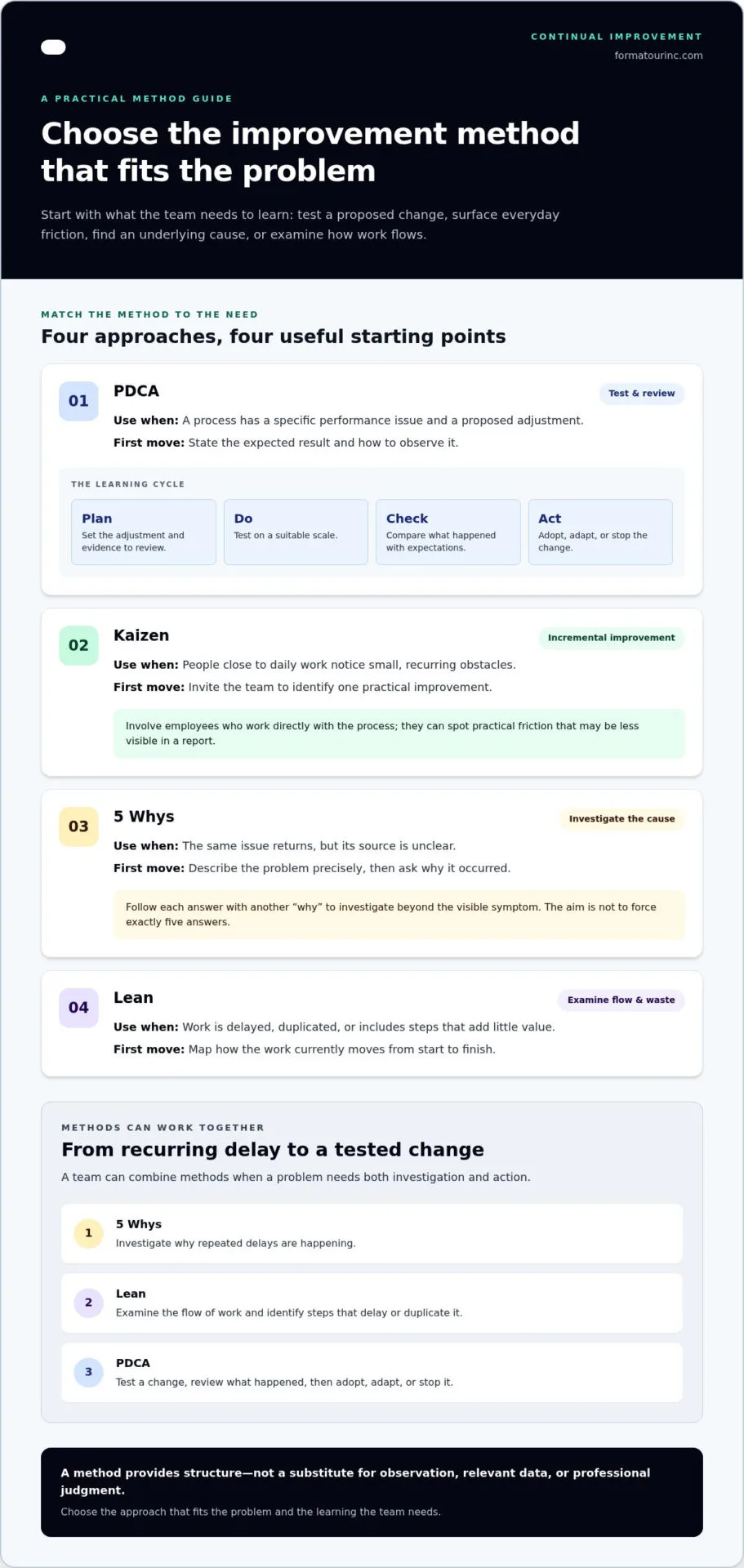
The right method depends on what the team needs to learn. A proposed change that needs a controlled test calls for a different approach than a recurring problem with an unclear cause or a steady stream of small frustrations. Use the comparison below to match a continual improvement method to the work at hand.
Method | Purpose | Suitable problem | First move
PDCA | Test and review a change | A process has a specific performance issue and a proposed adjustment | State the expected result and how to observe it
Kaizen | Encourage ongoing incremental improvement | People close to daily work see small, recurring obstacles | Invite the team to identify one practical improvement
5 Whys | Investigate a problem’s underlying cause | The same issue returns, but its source is unclear | Describe the problem precisely, then ask why it occurred
Lean | Examine process flow and waste | Work is delayed, duplicated, or involves steps that add little value | Map how the work currently moves from start to finish
These approaches can complement one another. A team might use 5 Whys to investigate repeated delays, Lean to examine the flow of work, and PDCA to test a change. A method provides structure, but it doesn’t replace observation, relevant data, or professional judgment.
PDCA and Kaizen for Testing Practical Changes
PDCA gives teams a clear cycle for testing a proposed change: Plan the adjustment and the evidence to review; Do the test on a suitable scale; Check what happened against the expectation; and Act by adopting, adapting, or stopping the change. The cycle makes learning part of the work rather than an assumption made after a change is introduced.
Kaizen focuses on involving people in ongoing, incremental improvements. Employees who work directly with a process can often identify practical friction that is less visible in a report. The size of a test should suit the process and context, whether that means trying a clearer instruction with one team or assessing a broader change across connected work.
5 Whys and Process-Focused Methods for Finding Causes
Use 5 Whys when a problem keeps returning and the visible symptom may not explain why. For example, if a report is repeatedly submitted late, asking why may reveal that a required input arrives late, then that the request for it is unclear. Each answer guides the next question. The aim isn’t to force exactly five answers; it’s to investigate beyond the first explanation and check that the proposed cause is supported by evidence.
Lean offers a broader process-focused lens: examine how work flows and where waiting, duplication, or unnecessary steps occur. Neither Lean nor 5 Whys should be used to assign blame or treat an initial explanation as fact. Confirm what is happening before choosing a response.
Teams connecting method selection with wider process optimization can explore organizational improvement support with Formatour Incorporated.
Continual Improvement Process Examples Across Everyday Business Work
The following are illustrative scenarios, not accounts of specific Formatour Incorporated clients. Each connects a defined problem with a practical change, an observable measure, and a decision based on what the team learns. That connection makes an example useful: a change becomes an improvement candidate when the team can observe how it affects the work.
These seven continual improvement process examples span customer service, administration, operations, and information workflows. The suggested measures are options, not promised results or universal benchmarks. Choose measures that reflect the issue and can be monitored consistently.
Customer Service and Administrative Process Examples
- Customer intake: Problem. Customers are asked to provide the same details more than once. Small change. Clarify the intake questions and indicate which information is needed at the start. Observation. Track how often staff request missing or repeated information and how long it takes to complete an intake. Next decision. If requests remain incomplete, refine the wording or identify a question that is being missed. If the process is clearer, retain the revised intake and continue reviewing it.
- Administrative handoffs: Problem. A request moves between teams, but responsibility or required information is unclear. Small change. Add a clear ownership field and a short transfer note at the handoff. Observation. Review elapsed time between handoffs, duplicate work, or requests returned for clarification. Next decision. Use the pattern to decide whether the handoff guidance needs adjustment or responsibilities need further clarification.
- Product inspection: Problem. Staff record inspection results in different ways, making it difficult to compare findings. Small change. Use consistent fields for the checks performed, results, and exceptions. Observation. Review incomplete records and how often findings need follow-up. Next decision. Keep the format if it captures the necessary information; revise it if staff interpret a field differently or important exceptions are missed.
Operations, Information Security, and Digital Workflow Examples
- Recurring operational check: Problem. Different staff complete the same check in different ways, making results harder to compare. Small change. Create a concise checklist that records the key steps and any exceptions. Observation. Review missed steps, incomplete records, or follow-up work across completed checks. Next decision. If the checklist captures the work clearly, maintain it. If it creates confusion or misses an important condition, revise it with input from the people completing the check.
- Access-request workflow: Problem. Requests for system access stall because staff aren’t sure who owns the next approval or action. Small change. Clarify the responsible role at each stage and make request status visible to the people handling it. Observation. Track time spent at each stage, incomplete submissions, and requests returned for clarification. Next decision. First confirm that responsibilities and steps are clear. Then assess whether automation could reduce manual handling without obscuring ownership or introducing another source of delay. Formatour Incorporated helps organizations connect process optimization with daily execution.
- Project status reporting: Problem. Teams spend time reconciling updates because reports use different definitions of progress. Small change. Agree on a common status format and define what each status means. Observation. Note how often updates need clarification and how long it takes to prepare a consolidated view. Next decision. Retain the format if it makes progress easier to understand; refine the definitions if teams continue to interpret them differently.
- Training scheduling: Problem. Sessions are frequently rescheduled because availability and constraints aren’t clear. Small change. Revise the booking request to capture preferred times and relevant scheduling constraints. Observation. Compare rescheduling frequency before and after the change. Next decision. Keep the revised request if it helps staff schedule sessions more reliably, or adjust it if key information is still missing.
Across all seven scenarios, the next decision follows the evidence rather than an assumption that every change worked. A team may keep a useful adjustment, refine it when the measure reveals a remaining obstacle, or stop it if it complicates the process. This keeps improvement grounded in the realities of daily work.
How to Start a Continual Improvement Process and Measure Progress
A practical improvement effort begins with a defined problem, not a broad instruction to “work better.” The following sequence helps teams make a focused change, gather useful evidence, and decide what to do next. These steps turn continual improvement process examples into a repeatable way of working.
Set a Focus, Baseline, and Clear Owner
- Select one recurring problem. Choose an issue that matters to customers, employees, or organizational priorities. Describe what happens, where it occurs, and who is affected. “Requests are often returned because information is missing” is more actionable than “the intake process is inefficient.”
- Define the intended purpose. State what the proposed change is meant to address, such as reducing incomplete requests or clarifying responsibility. Keep the purpose narrow enough to review.
- Choose a relevant measure and record the baseline. Before making a change, capture how the process currently performs. Depending on the issue, this could be the number of requests returned for missing information, the time taken to complete a process, or the frequency of rework. Use the same definition and collection approach during the test so the comparison is meaningful.
- Assign a coordinator and plan the test. Name someone to coordinate the work, gather observations, and share what the team learns. Agree on what will change, which part of the process is involved, and when the team will review the evidence. Include the people who perform or rely on the work.
- Run the change at a suitable scale. Keep the test proportionate to the process and any risks involved. Record whether the change was used as intended, along with relevant conditions or exceptions. This context helps explain results that might otherwise be misleading.
Review Results, Standardize, or Adjust
Compare the observations with the baseline and the purpose of the test. A process measure shows what happened, such as how long completion took or how often work was returned. On its own, a change in the measure doesn’t prove the new approach caused the difference. Consider whether the process was followed consistently, whether the comparison covers similar work, and whether other changes may have influenced the result.
A baseline, a defined test, and a review create a credible account of what changed and what the evidence supports. If the change appears useful and workable, document the updated practice, clarify responsibilities, and explain it to affected people. Continue monitoring the measure to see whether the change remains suitable as work continues.
Mixed or inconclusive evidence is still informative. The team can adjust the change, gather clearer observations, or revisit its understanding of the problem before expanding the test. Don’t scale a change simply because it was introduced; make the next decision based on what the review shows.
For support connecting process improvement with organizational priorities, discuss your improvement goals with Formatour Incorporated.
Connecting Continual Improvement to ISO 9001 and Organizational Advisory Support
The continual improvement process examples in this article show how teams can make focused changes and review what happens. In quality management, the same practice can connect day-to-day work with broader objectives, such as improving consistency, clarifying responsibilities, or addressing recurring process issues. Improvement is an ongoing management practice, not the same as achieving certification.
How Improvement Fits Within Quality Management
An organization can connect process reviews to its quality objectives by identifying which activities influence the outcomes it wants to manage. For example, if clear customer communication is a priority, a team might review how service requests are handled, who owns each step, and what feedback indicates that information is understood. Clear responsibilities help ensure observations lead to considered decisions rather than isolated suggestions.
Useful improvement depends on context and evidence. A measure that makes sense for one process may not show what matters in another, so teams should consider the work, the people involved, and the purpose of the change. ISO 9001 provides a quality management system context for organizing responsibilities and process review. Implementing the standard and achieving certification are distinct from making an individual improvement; neither should be treated as an automatic guarantee of better performance. Organizations exploring this connection can use an ISO 9001 quality management guide to understand how the standard relates to their management system.
When Strategic or Process Advisory Support Can Help
Advisory support can help when improvement priorities cross team boundaries, compete for attention, or need to align with wider organizational goals. Strategic Consulting and Support can help organizations consider priorities and direction, while process optimization focuses on how work is structured and performed. The aim is to connect practical changes with the organization’s operating context, not to prescribe one method for every challenge.
Digitalization and Organizational Intelligence may be relevant when a process review involves information systems, digital workflows, or the possibility of automation. Technology should follow a clear understanding of the process need; automating an unclear or unnecessary step can preserve the underlying problem rather than resolve it.
Formatour Incorporated brings over 10 years of experience across public and private sectors, with a tailored, practical approach focused on measurable, sustainable results. Its work includes strategic consulting and support, digitalization and organizational intelligence, process automation and optimization, and ISO 9001 quality management certification. As an accredited partner of PECB Canada, Formatour Incorporated also provides relevant certification and compliance support. These services help organizations consider how improvement practices fit their priorities without promising a particular outcome.
If your organization is deciding how to connect process improvement with quality objectives or operational priorities, discuss your organization’s improvement priorities with Formatour Incorporated.
Make the Next Improvement a Deliberate One
Choose one point of friction your team can observe, then give it a clear owner and a measure that reflects the work. That first test can show whether the issue is well understood, whether the change fits the process, and what the organization should learn before expanding its efforts. The value of continual improvement process examples lies not in copying a scenario exactly, but in adapting its logic to your own priorities.
Improvement can be modest and still lead to a stronger way of working. With practical, tailored support, Formatour helps organizations connect process optimization and strategic priorities to measurable, sustainable progress. Its experience across public and private sectors and its relationship as an accredited partner of PECB Canada inform this work.
Discuss your organization’s improvement priorities and identify a practical next step. A focused start can help your team build momentum with confidence.
Frequently Asked Questions
What is an example of a continual improvement process?
A useful example is refining how a team schedules employee training. If sessions are frequently rescheduled because availability is unclear, the team could revise its booking request to capture preferred times and constraints. It could then compare rescheduling frequency before and after the change. This illustrates how continual improvement process examples connect a recurring workplace issue with a focused adjustment and evidence that can inform the next decision.
What are the five steps of continual improvement?
A practical five-step cycle is to identify a recurring issue, investigate what contributes to it, choose a focused change, review relevant evidence, and decide whether to adopt or refine the change. For example, a team facing frequent approval delays could first map where requests pause, then clarify an approval responsibility. The sequence provides direction, but teams should adapt it to the scale, risk, and context of the process.
Is PDCA the same as continual improvement?
No. Continual improvement is the broader practice of making and reviewing changes over time; PDCA is one method teams can use to structure that work. Its Plan, Do, Check, Act stages help organize a test and the learning that follows. An organization can use PDCA repeatedly, but continual improvement can also involve other approaches or informal reviews suited to the issue and the organization’s management practices.
How can a team measure continual improvement?
A team can measure improvement by choosing indicators tied to the issue, such as the number of corrected records, missed appointments, or customer follow-up requests. Use a consistent definition so comparisons remain meaningful. Pair a performance measure with context, such as whether the new practice was actually used. A measure shows what changed; it doesn’t, by itself, establish that one adjustment caused the change.
Can continual improvement work in a small organization?
Yes. A small organization can use existing discussions and simple records rather than building a dedicated improvement department. For instance, a manager might record recurring scheduling conflicts, invite staff who manage bookings to suggest a change, and review whether the same issue persists. Keep the process proportionate: focus on work that affects service or organizational priorities, and document decisions clearly enough for others to follow.
What is the difference between continuous and continual improvement?
The terms are often used interchangeably. Some practitioners use “continuous” for ongoing, incremental adjustments to an existing process, while “continual” can refer more broadly to improvement that recurs over time, including larger changes. In practice, the distinction depends on the context and how an organization uses the terms. The important point is to make changes purposefully and review them, rather than treating improvement as a one-time event.
How does ISO 9001 relate to continual improvement?
ISO 9001 provides a quality management system framework in which organizations can manage processes, responsibilities, objectives, and performance reviews. Continual improvement can inform how an organization evaluates and develops that system. Improvement activity alone doesn’t mean an organization is certified, and certification doesn’t guarantee a particular result. Organizations can explore ISO 9001 implementation in relation to their processes, objectives, and quality management needs.
