

What if the best way to reduce management-system duplication is not to combine every requirement, but to integrate only what genuinely overlaps? Organizations integrating ISO 27001 with other management systems often share governance, document control, internal audit, and continual improvement processes. Information-security risks and controls, however, still need clear, dedicated attention.
Separate systems can mean repeated documentation, meetings, and audit preparation. The challenge is to decide which processes can be coordinated without blurring ownership or weakening standard-specific requirements. A well-designed integrated management system creates consistency across standards while keeping each system’s purpose and obligations visible.
This guide explains how to identify shared processes and distinct requirements, select an integration approach that fits your organization, and coordinate responsibilities, evidence, and audit activities. It also outlines how a gap analysis and phased implementation can turn integration decisions into practical processes, whether you’re aligning ISO 27001 with ISO 9001, ISO 22301, or ISO 14001.
Key Takeaways
- Integrating ISO 27001 with other management systems can reduce duplicated governance work while keeping security-specific risks, controls, and evidence distinct.
- Use the Harmonized Structure to identify processes that can be coordinated across standards, then retain clear accountability for each standard’s unique requirements.
- Choose an integration model and sequence that reflect your existing systems, priorities, and organizational scope.
- Build a practical roadmap around a baseline review, process mapping, assigned ownership, implementation, and ongoing evaluation.
- Formatour’s gap analysis and implementation support can help translate integration plans into coordinated practices across ISO 27001, ISO 9001, ISO 22301, and ISO 14001.
Why integrate ISO 27001 with other management systems?
Organizations often have processes for quality, business continuity, or environmental management when they introduce information security. Integrating ISO 27001 with other management systems can coordinate how leaders set objectives, assign responsibilities, review performance, manage documented information, and improve processes. Rather than asking teams to support disconnected systems, an integrated management system aligns relevant activities while keeping each standard’s requirements visible.
The case for integration is practical, not simply administrative. A quality team might conduct management reviews while information-security and continuity teams prepare separate risk updates and track corrective actions. Coordinating these activities gives leaders a clearer view of how operational decisions affect service quality, information security, and continuity. It can also make trade-offs easier to spot, such as a process change that improves speed but introduces new security exposure.
Integration is the coordinated management of distinct standards, not simply the possession of several certificates. The aim is to connect shared oversight and processes without treating every requirement as interchangeable. ISO 27001’s information-security scope, risk treatment, and controls need explicit ownership and evidence, even when activities across systems are coordinated.
What does an integrated management system mean in practice?
In practice, integration may involve a shared governance calendar, aligned objectives, coordinated internal audit planning, and a consistent approach to corrective actions. It is not a software platform or a single set of documents by itself. Tools can support the work, but leaders, process owners, and staff still need to define responsibilities and use the system in daily decisions.
Similar-looking policies do not necessarily mean systems are integrated. If separate teams maintain parallel reviews and records without shared oversight, the organization may still be operating separate systems. Integration can be partial or broad. An organization might coordinate management reviews first, then align selected documentation or audit activities once ownership and requirements are clear. The ISO/IEC 27000-series provides context on the information-security standards family and its relationship to other management-system standards.
Which organizational problems can integration address?
Separate systems can require teams to prepare similar evidence more than once, attend overlapping meetings, or maintain multiple action logs. Coordinated planning can reduce repeated effort by giving shared activities a common process and schedule. It can also reveal competing objectives. For example, an operational change intended to improve quality or efficiency may need review for its information-security implications.
These improvements depend on the organization’s scope, existing processes, and clarity of accountability. Integration doesn’t guarantee less work. Poorly defined ownership can make it harder to see who approves security decisions or maintains control evidence. A sound approach identifies what can be coordinated, assigns accountable owners, and preserves separate records wherever a standard-specific decision or result needs to remain clear. That balance turns integration from document consolidation into useful organizational oversight.
How ISO 27001 fits shared management-system structures
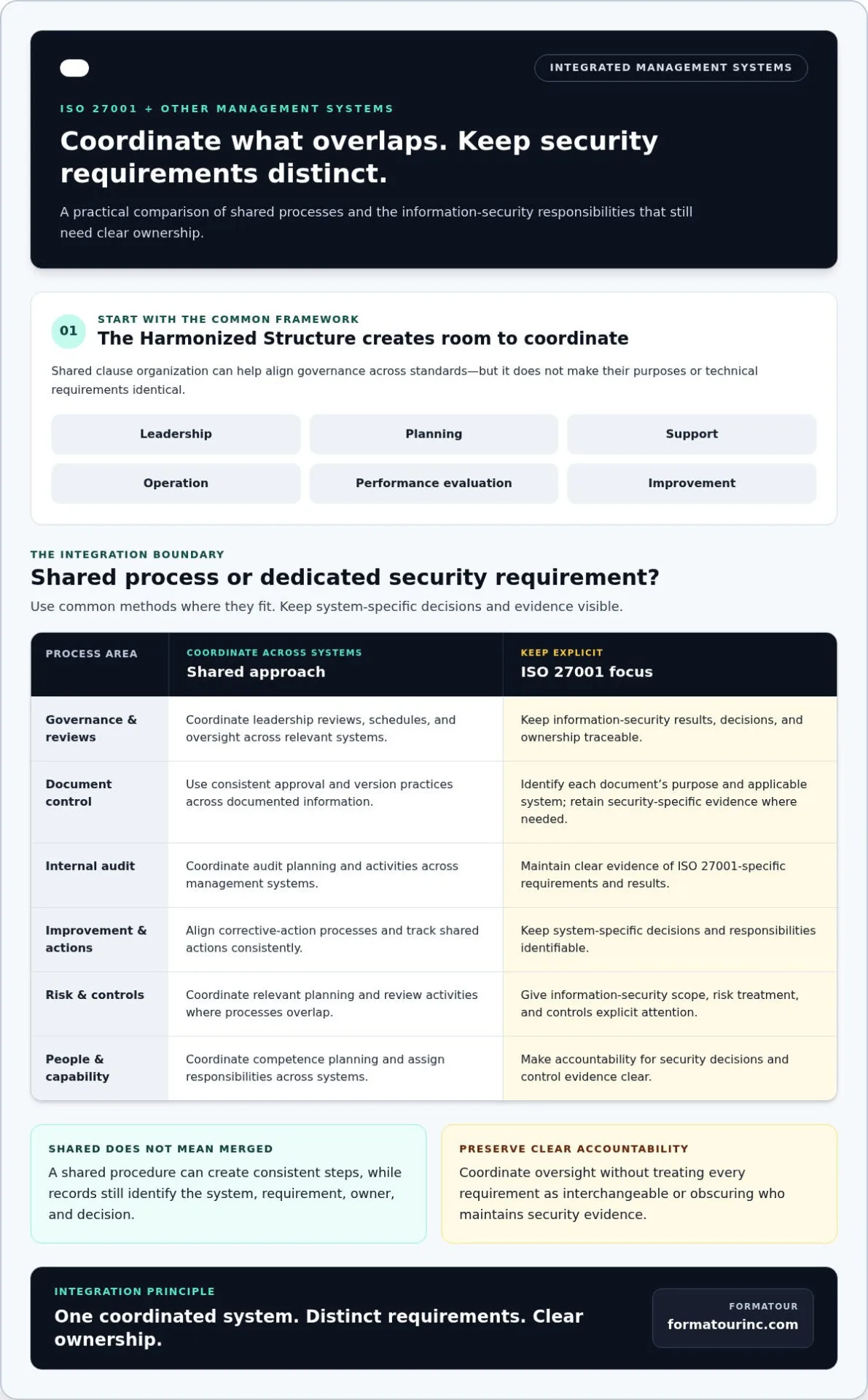
ISO management-system standards use a common framework to make coordinated governance more practical. The current term is the Harmonized Structure, which replaced “High-Level Structure” terminology in 2021. Shared clause organization and common requirements can help an organization align its approach to leadership, planning, support, operation, performance evaluation, and improvement. The framework creates opportunities to coordinate, but it doesn’t make the standards’ purposes or technical requirements identical.
For example, a leadership review can consider quality performance, continuity readiness, and information-security results in one coordinated cycle. The agenda may be shared, while evidence and decisions remain traceable to each management system. IBM’s overview of What is ISO 27001? explains its focus on managing information-security risk. That focus needs to remain explicit within any integrated arrangement.
Integration means shared governance with distinct ownership of each standard’s requirements. When integrating ISO 27001 with other management systems, align common processes without assuming that a shared procedure automatically addresses every standard-specific need.
What can organizations standardize across management systems?
Depending on their scope and existing arrangements, organizations may coordinate leadership reviews, document control, competence planning, and corrective action. A shared procedure can establish consistent steps, while records identify the system, requirement, owner, and decision each activity supports. This keeps governance coherent without forcing unrelated evidence into one undifferentiated file.
- Leadership review: Use a coordinated schedule, with system-specific inputs and decisions recorded clearly.
- Document control: Apply consistent approval and version practices, while identifying each document’s purpose and applicable system.
- Corrective action: Use a common tracking method, but record the issue’s origin, accountable owner, and relevant follow-up evidence.
These are alignment options, not a universal checklist. Confirm that each shared process covers the applicable requirements and preserves the evidence needed to show how each system operates.
Which ISO 27001 responsibilities should stay explicit?
Information-security decisions must remain identifiable, even when they sit within shared governance. Define the information-security management system’s scope, show how security risks are assessed and treated, and assign roles for approving decisions and maintaining evidence. A general enterprise risk register may support this work, but it should not obscure which risks relate to information security or how they are addressed.
- Link each identified security risk to its treatment decision and accountable owner.
- Connect selected controls to the relevant risk or requirement and retain evidence of implementation.
- Record review results, changes, and follow-up actions so decisions can be traced over time.
This structure lets leaders review shared priorities without diluting security accountability. Organizations defining these responsibilities can draw on Formatour’s ISO 27001 implementation support to translate integration decisions into coordinated practices.
Choosing an integration model for ISO 27001 and related standards
The right integration model depends on what your organization already manages and where coordination will add value. An organization with mature quality processes might align ISO 27001 with its existing review and corrective-action cycles. One focused on service resilience may prioritize coordination with ISO 22301. In either case, integrate shared governance first and retain distinct objectives, decisions, and evidence for each standard.
Use this comparison to identify possible areas of alignment. It does not mean the standards require identical risk assessments, controls, or audit evidence.
| Standard | Possible shared processes | Distinct purpose to preserve |
|---|---|---|
| ISO 27001 | Leadership review, document control, competence, corrective action | Information-security scope, risk treatment, controls, and security evidence |
| ISO 9001 | Process ownership, objectives, performance review, improvement | Quality management and evidence related to products, services, and customer requirements |
| ISO 22301 | Leadership oversight, risk review, preparedness exercises, improvement | Business continuity arrangements, disruption impacts, and continuity evidence |
| ISO 14001 | Objectives, competence, operational oversight, corrective action | Environmental aspects, impacts, and environmental performance |
| ISO 45001 | Leadership, worker competence, operational planning, improvement | Occupational health and safety risks, controls, and performance |
How does ISO 27001 align with ISO 9001 or ISO 22301?
ISO 9001 can provide established process governance, such as assigning owners, reviewing performance, and managing improvement actions. Those mechanisms can support ISO 27001, but quality objectives don’t replace information-security risk decisions or control responsibilities. Consult dedicated ISO 9001 and ISO 22301 guidance alongside the applicable standard for details on each standard’s purpose.
ISO 22301 offers a practical connection through resilience planning. Coordinated reviews can consider how disruptions affect continuity and information security, while each system retains its own analysis, actions, and evidence. Leadership commitment also matters: the UK National Cyber Security Centre’s NCSC Board Toolkit addresses board-level engagement with cyber security.
What changes when adding ISO 14001 or ISO 45001?
Environmental management and occupational health and safety introduce different subject matter, even where governance processes can be coordinated. A shared management review may provide oversight across these systems, but environmental aspects and impacts, workplace hazards, and information-security risks need their own assessment and accountable owners. Include standards that fit the organization’s scope and priorities.
To choose scope and sequencing, map current processes against the standards you intend to maintain. Start with established processes that have clear owners, then identify gaps requiring new expertise, decisions, or evidence. This makes integrating ISO 27001 with other management systems a deliberate design choice: coordinate where requirements and workflows genuinely align, and keep distinct requirements traceable.
A practical roadmap for integrating ISO 27001
A clear sequence helps teams move from separate management systems to coordinated practices without losing sight of security decisions. Treat integration as a governance project with defined scope, accountable owners, and review points, not as a document-merging exercise. Set the scope, assess the baseline, map processes, assign owners, deploy in stages, then evaluate and refine.
Map scope, existing processes, and integration priorities
Start by documenting which standards apply, the boundaries of each management system, and the teams responsible for its processes. Include organizational units, activities, services, and locations within the intended scope. Then compare existing procedures and records to identify duplication, dependencies, gaps, and potentially competing objectives. For instance, a common review schedule may be practical, while distinct security-risk decisions still need clear ownership.
Use the baseline to choose a manageable first phase. Prioritize processes that already have accountable owners and genuinely serve more than one system. Defer changes that depend on unresolved scope decisions or could obscure standard-specific responsibilities. This keeps the model aligned with organizational context rather than imposing a uniform design.
- Confirm scope: Record the standards in view, their boundaries, and key interfaces between teams or processes.
- Review the baseline: Gather current procedures, records, review schedules, and assigned responsibilities.
- Map processes: Mark activities that can be shared, those needing coordination, and those that must remain distinct.
- Set priorities: Select a practical sequence based on organizational objectives, dependencies, and available ownership.
- Deploy changes: Update procedures, communicate role changes, and introduce revised practices in planned stages.
- Evaluate: Review whether coordinated processes work as intended, retain traceable evidence, and address emerging gaps.
Coordinate implementation, review, and audit preparation
Leadership should approve priorities and resolve conflicts between objectives. Process owners can define how shared activities operate, while information-security leads retain responsibility for security scope, risk treatment, controls, and supporting evidence. Involve affected teams before changing workflows so the system reflects operational practice, not just its documented design.
For each shared process, identify its owner, participating standards, records produced, and review frequency. Use a common schedule where helpful, but organize evidence so reviewers can trace decisions to the relevant requirement. Coordinated audit preparation can align timing and reduce repeated requests, while the evidence should still demonstrate each standard’s distinct purpose. Revisit the process map when the organization changes its scope, responsibilities, or priorities.
For further implementation context, explore ISO 27001 implementation services. The linked implementation guide offers additional context for planning your organization’s next steps.
How Formatour supports coordinated ISO implementation
An integration plan becomes useful when it guides decisions, assigns responsibility, and shapes how teams work. Formatour supports organizations implementing ISO 27001, ISO 9001, ISO 22301, and ISO 14001. Its gap analysis and implementation support help translate integration priorities into practical management-system work, while keeping shared processes and distinct standard requirements in view.
Turn an integration plan into tailored implementation work
Formatour’s certified experts provide gap analysis and implementation support tailored to each organization. A gap analysis helps establish what is already in place, where existing processes may serve multiple standards, and where separate requirements need additional attention. This gives leaders and process owners a clearer basis for deciding what to coordinate, what to develop, and who will be accountable.
For example, an organization may want to align review schedules or corrective-action processes while keeping information-security risk decisions and supporting evidence clearly assigned. Implementation support can help turn those choices into defined responsibilities, documented processes, and workable practices across relevant teams. The aim is a management system shaped around organizational priorities, rather than a generic set of procedures.
Depending on the chosen scope, implementation work may include:
- Reviewing current processes and identifying gaps against applicable standards.
- Mapping shared governance activities and standard-specific responsibilities.
- Clarifying process ownership, evidence needs, and review arrangements.
- Supporting the development and implementation of practices suited to the organization’s context.
This approach focuses on management systems and coordinated implementation. It supports informed decisions about processes and accountability while leaving operational ownership with the organization.
Build confidence through relevant experience and a clear next step
Formatour brings over 10 years of experience across public and private sectors. In 2025, Formatour provided ISO 27001 certification support to SNEDAI. This example demonstrates ISO 27001 support, not that the engagement involved an integrated management system. Formatour is also an accredited partner of PECB Canada.
For organizations integrating ISO 27001 with other management systems, working through scope, gaps, and ownership can turn planning into coordinated implementation. Formatour’s support across ISO 27001, ISO 9001, ISO 22301, and ISO 14001 can help align project decisions with the selected standards and organizational priorities. Implementation support does not guarantee certification or a particular outcome; it provides structured assistance as the organization develops its system.
Explore the guide to ISO 27001 implementation services for related implementation context. To discuss your organization’s needs and integration priorities, contact Formatour about ISO integration.
Make integration a foundation for lasting progress
The value of integrating ISO 27001 with other management systems lies not only in coordinating today’s requirements, but also in establishing an approach that can adapt as priorities, processes, and organizational boundaries change. Treat the integrated system as a living governance framework. Reassess whether it supports leadership decisions, gives teams clear accountability, and keeps information security visible as the organization evolves.
A useful next step is to identify one integration decision with organization-wide impact, such as how leadership reviews cross-functional objectives or how process changes are assessed. Clarify the intended outcome, decision owner, and evidence needed before expanding the approach. This helps teams build confidence through deliberate implementation rather than pursuing integration as an end in itself.
With experienced guidance, your organization can shape an approach around its context and priorities. Plan your next ISO integration step with Formatour and move forward with a system designed to support security and organizational performance.
Frequently Asked Questions
Can ISO 27001 be integrated with ISO 9001?
Yes. An organization can coordinate ISO 27001 and ISO 9001 through shared planning and oversight while maintaining distinct security and quality requirements. For example, a change-control process could consider both service-quality impacts and information-security risks. The process should make clear which criteria apply to each decision, who approves it, and what records demonstrate the outcome. Integration aligns management practices, but quality evidence doesn’t replace security evidence.
Does an integrated management system mean one certification covers every ISO standard?
No. Integration refers to how an organization manages its systems, not to a single certificate automatically covering every standard. Certification is assessed against the specific standard and scope being pursued, so an organization seeking certification to multiple standards needs to address each applicable standard. For planning, list the intended standards and scopes separately, then coordinate shared implementation and audit preparation where practical. This helps distinguish an integrated operating model from certification status.
Can an organization integrate ISO 27001 with ISO 22301?
Yes. ISO 27001 and ISO 22301 can be coordinated, particularly where information security and continuity planning intersect. For example, a disruption scenario affecting access to critical information may be relevant to both security risk management and continuity planning. Teams can coordinate scenario discussions and leadership oversight while documenting each standard’s separate analysis, decisions, and follow-up. The integration should reflect the organization’s actual dependencies rather than treating every security incident as a continuity event.
Can one internal audit cover multiple ISO standards?
Yes, an internal audit may assess multiple standards during coordinated audit work if the audit scope, criteria, and auditor competence support that approach. A shared schedule does not mean every process needs to be assessed against every standard. For example, an audit of document control may consider applicable requirements from several systems, while a security-control review focuses on ISO 27001 criteria. Record findings against the relevant standard so corrective actions remain clear.
Does an integrated management system require a single manual?
No. A single manual isn’t necessary to integrate management systems. Organizations can use one overview document, separate standard-specific documents, or a combination, provided staff can identify current information and understand how processes connect. A practical arrangement might include a shared governance overview and dedicated security procedures for risk treatment and controls. Choose a document structure that supports access, version control, and clear links between system requirements and implementation records.
How can an organization preserve ISO 27001 security requirements during integration?
Keep security decisions identifiable in the integrated system. For each relevant risk, retain a clear connection to its treatment decision, accountable owner, applicable controls, and review evidence. If a shared risk register is used, label information-security risks so they can be filtered and reviewed without losing context. Also define who approves security-related changes. These practices help teams use shared governance without allowing general operational records to obscure information-security responsibilities.
Should an organization integrate all its ISO management systems at once?
Not necessarily. A phased approach can be more manageable, especially if different teams own the standards or processes are at different levels of maturity. An organization might first coordinate a review calendar, then align selected document-control or corrective-action practices after testing ownership and evidence flows. Before expanding, assess whether the initial changes are working and whether distinct requirements remain visible. The sequence should match priorities, dependencies, and the capacity of the people implementing it.
What is the first step in integrating ISO 27001 with another management system?
Begin with a baseline review of the existing system and the intended ISO 27001 scope. Identify the processes already in use, their owners, and the records they produce. Then compare those arrangements with the information-security activities the organization needs to establish or strengthen. This initial assessment helps distinguish reusable processes from genuine gaps and gives leaders a grounded basis for setting integration priorities, assigning responsibility, and planning the next phase.
