

A productive strategy session can still end with a familiar problem: plenty of ideas, but no clear priorities, owners, or next steps. Choosing a digital transformation consultant Toronto leaders can trust means looking beyond the workshop itself. The value lies in the decisions the process helps leaders make and whether those decisions carry through into execution.
An outside facilitator can bring structure and a fresh perspective. But transformation also requires leadership alignment on where to start, how to set priorities, and how to connect strategic choices to operational performance. Recommendations that overlook an organization’s capacity, dependencies, or accountability can be difficult to put into practice.
This practical buying framework will help you assess a strategic planning facilitator’s approach, experience, and ability to support follow-through. You’ll learn what to look for in the planning process, how to clarify decision-making and ownership, and how strategy, project management, process improvement, and leadership development can reinforce one another. The goal is a focused plan with measurable priorities and accountable owners that your leadership team can act on.
Key Takeaways
- Clarify how a strategic planning facilitator differs from a strategy consultant, project manager, or one-off workshop leader.
- Use strategic priorities to guide transformation scope, sequencing, governance, and resource decisions, not just technology selection.
- Compare a digital transformation consultant Toronto organizations may engage by examining discovery, stakeholder involvement, deliverables, and follow-through.
- Prepare leaders by defining the decision at hand, identifying stakeholders, gathering context, and setting measures of success.
- Explore how strategic transformation, operational performance, process automation, and project management can support a more connected approach to execution.
Why Toronto organizations bring in a strategic planning facilitator
Growth, shifting priorities, complex operations, and digital change can leave an executive team with competing views about what deserves attention first. A strategic planning facilitator provides a structured process for working through those differences. The facilitator guides the conversation and helps leaders reach and record decisions; executives remain responsible for the choices and the organization’s direction.
A strategic planning facilitator guides leaders toward shared priorities, records decisions, clarifies ownership, and establishes a path to follow-through. The role differs from strategy consulting, where an advisor may conduct analysis and recommend a direction; project management, which coordinates agreed work; and a one-off workshop, which may generate ideas without establishing a continuing decision process. These functions can complement one another, but they address different needs.
For example, a Toronto-area organization expanding into new markets might need to decide which capabilities to strengthen first. A business reviewing disconnected processes during digital change may need leaders to agree on the problem before selecting a solution. In either case, facilitation gives the team a disciplined way to examine options and trade-offs, rather than treating the first idea raised as the default priority.
When does an organization need external facilitation?
External facilitation can help when leadership discussions repeatedly revisit the same disagreements, teams describe priorities differently, or important initiatives stall between approval and action. These patterns may point to unresolved choices, unclear decision rights, or competing assumptions about resources and risk.
An outside facilitator brings structure without taking executive authority. They can encourage balanced participation, surface points of agreement and tension, and keep discussion focused on the decision at hand. For a hypothetical Toronto organization weighing process automation against other operational improvements, the facilitator can help leaders compare options against shared criteria. Executives still decide what to pursue, what to defer, and who is accountable.
What should a facilitator deliver beyond the meeting?
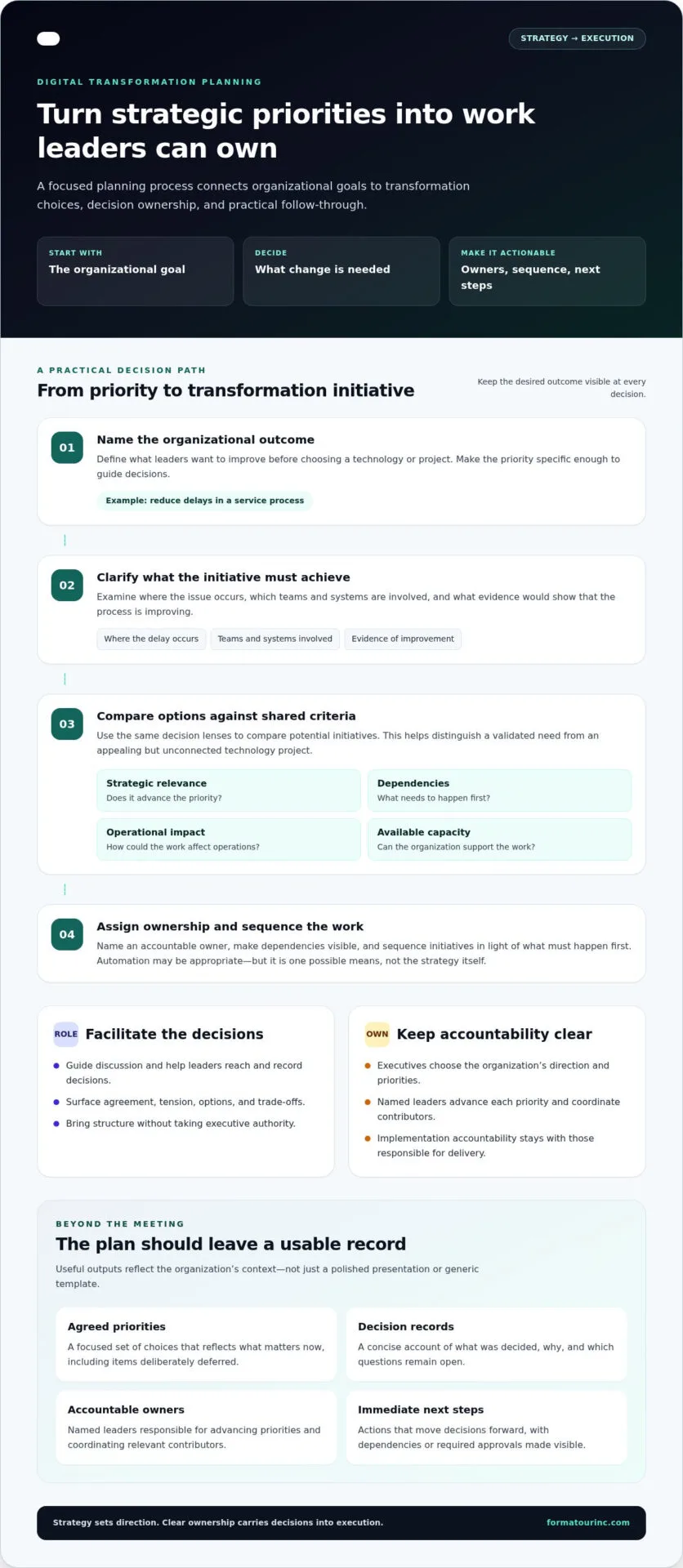
A useful engagement should leave leaders with more than a polished presentation or a collection of notes. Its outputs should capture the substance of decisions and make the next stage of work easier to organize:
- Agreed priorities: a focused set of choices that reflects what matters most now, including items deliberately deferred.
- Decision records: a concise account of what was decided, why, and which questions remain open.
- Accountable owners: named leaders responsible for advancing each priority and coordinating relevant contributors.
- Immediate next steps: actions that move decisions forward, with dependencies or required approvals made visible.
These outputs should reflect the organization’s context, not a generic planning template. When assessing a digital transformation consultant Toronto businesses might engage, distinguish the agreed strategic direction from later implementation planning. The planning process can establish desired outcomes and decision principles; subsequent work translates them into project plans, operational measures, governance, and progress reviews.
That distinction matters in digital change. Technology is one possible means, not the strategy itself. A shared understanding of What is Digital Transformation? can help frame the broader shift in how an organization creates value. Leaders then determine which processes and outcomes their priorities should improve. Facilitation connects that discussion to decisions and ownership, while implementation accountability remains with the people responsible for delivery.
How strategic planning facilitation connects to digital transformation
Digital transformation is easier to manage when leaders first define the organizational outcomes they want to improve. Strategic planning facilitation helps translate those priorities into decisions about scope, sequence, governance, and resources. It also helps distinguish necessary change from technology projects that may be appealing but don’t address a validated need.
Transformation initiatives need executive ownership and measurable objectives so teams can connect investment and change to outcomes the organization can assess. A digital transformation consultant Toronto organizations engage should help leaders keep that connection visible, from the initial priority through planning and review.
How can leaders turn strategic priorities into transformation initiatives?
Start with the organizational goal, then define what an initiative must achieve to advance it. If the priority is to reduce delays in a service process, examine where those delays occur, which teams and systems are involved, and what evidence would show that the process is improving. Automation may be appropriate, but first clarify the need and desired outcome.
How do governance and standards support transformation?
Governance turns priorities into a working decision system. It clarifies who approves scope changes, who resolves cross-functional dependencies, how risks are escalated, and when progress is reviewed. Regular reviews give leaders a chance to address barriers, adjust sequencing, and assess whether the work still supports its intended outcome. The Government Approach to Digital Transformation offers a public-sector reference point for considering how oversight and coordinated delivery can support transformation. Each organization should tailor governance to its own context.
Management standards can reinforce this structure when they address a real organizational need. ISO 9001 can inform attention to quality and consistent processes; ISO 27001 is relevant when information security is a priority; ISO 22301 can support a focus on business continuity. Standards don’t replace strategic choices, but they can help leaders formalize responsibilities and practices in areas that matter to the transformation.
Strategy-to-execution alignment depends on connecting the purpose of change to ownership, project management, and operational performance. A planning process can set direction and decision principles; implementation teams then develop the detailed plans and measures needed to deliver and evaluate the work. Organizations shaping that connection can explore a strategic transformation discussion with Formatour, whose services include transformation, process optimization, and project management.
How to compare strategic planning facilitators in Toronto
Compare the working method, the decisions it is designed to support, and its connection to execution. A polished presentation can create a strong first impression, but it doesn’t show whether the process accounts for your organization’s operating realities or helps leaders move from discussion to action.
Evaluate the method and outputs, not presentation polish alone. Apply the same criteria to each proposed engagement, then consider how well the approach connects strategic choices with process optimization, transformation planning, and project management.
Which capabilities matter in a strategic planning facilitator?
Look for executive facilitation that encourages balanced participation, structured analysis that makes trade-offs visible, and clear communication that records decisions accurately. Change awareness matters too: recommendations should account for operational dependencies, leadership capacity, and the people expected to carry out new initiatives.
What should a credible engagement approach explain?
A credible approach makes the sequence clear, from discovery and leadership alignment through facilitated decisions, documentation, and next steps. It should explain how relevant leaders participate, how organizational realities inform the discussion, and how unresolved questions are handled. If leadership capability is part of the decision, the leadership training for digital transformation guide can help frame that consideration.
| Dimension | Evidence to look for | Why it matters |
|---|---|---|
| Discovery | A plan to understand current priorities, constraints, initiatives, and key decisions. | Grounds the work in your organization rather than a generic template. |
| Stakeholder participation | Clear identification of decision-makers and relevant contributors, with a way to capture different perspectives. | Helps leaders surface dependencies and build shared understanding. |
| Facilitation approach | A defined method for exploring options, testing assumptions, and resolving competing priorities. | Keeps discussion focused on decisions, not presentation alone. |
| Deliverables | Decision records, agreed priorities, owners, and actionable next steps. | Creates a usable bridge from planning to execution. |
| Follow-through | An explanation of how outcomes connect to project management, process improvement, and review. | Shows how strategy can inform coordinated work and operational performance. |
Use the comparison to test fit, not to reward the longest proposal. An organization with several locations may need input from different operating teams; a business considering automation may need process analysis before selecting initiatives. These are possible Toronto-area contexts, not assumptions about every local organization. A sound process makes relevant realities explicit and adapts its discovery and participation accordingly.
Finally, examine whether the facilitator treats strategy, transformation, and implementation as connected but distinct stages. A planning engagement should establish direction and decision logic; project management and operational work then translate that direction into delivery. This digital transformation strategy guide offers further perspective on maintaining alignment from strategic intent to execution.
How to prepare your Toronto leadership team for a planning engagement
A focused planning engagement begins before the first session. Preparation helps executives spend their time on important decisions and gives the facilitator enough context to guide a grounded discussion. For a team working with a digital transformation consultant Toronto organizations can engage, this groundwork clarifies what leadership needs to decide and what evidence can inform those choices.
What should leaders agree before the first session?
Use this sequence to establish a clear brief for the engagement:
- Define the decision. State the central planning question and specify which decisions executives need to make. For example, clarify whether the team is setting transformation priorities, choosing which initiatives to sequence first, or resolving competing operational needs.
- Identify stakeholders. Name the decision-makers, subject-matter contributors, and groups likely to be affected by the resulting priorities. Include people who understand day-to-day operations as well as those accountable for strategic direction.
- Assemble organizational context. Gather the current strategy, active initiatives, relevant performance information, known constraints, dependencies, and unresolved choices. Note previous change efforts and what the organization learned from them.
- Set success measures. Agree what a useful planning outcome would mean. This could include clearer priorities, resolved decisions, defined ownership, or criteria for assessing proposed initiatives. Keep measures relevant to the decision, rather than treating activity completed as proof of value.
Preparation should also make room for different perspectives. Toronto-based and distributed stakeholders can participate through an agreed format, such as a shared in-person session, a virtual discussion, or a combination that suits the group. Establish how participants will contribute, how input will be captured, and how decision-makers will address differences. A practical format reflects people’s roles and working arrangements instead of assuming every stakeholder can participate in the same way.
Which information helps the facilitator build a grounded plan?
Provide enough material to show how formal priorities connect with current operations. A concise context pack might include existing strategic objectives, operational priorities, relevant performance reports, and a summary of active projects. Add known capacity constraints, dependencies between initiatives, and lessons from previous change efforts. The goal is useful context, not an exhaustive archive.
Separate evidence from assumptions. A reported process delay, for instance, may be supported by performance information, while its underlying cause remains uncertain. Mark both clearly so leaders can distinguish what they know from what needs testing. This prevents early assumptions from narrowing the discussion before the relevant people have examined them.
Before the engagement, executives can also list postponed choices and the constraints that shape them, such as competing commitments or interdependent work. This helps the facilitator direct attention to genuine trade-offs without prescribing a fixed timeline or promising an implementation result. To prepare your leadership team for strategic planning and transformation, discuss your planning engagement with Formatour.
How Formatour supports strategic planning and transformation
Strategic planning creates value when it informs the work that follows. Formatour provides strategic transformation and digital transformation consulting, alongside operational performance support, process automation and optimization, and project management. This multidisciplinary perspective helps leaders consider how priorities affect processes, responsibilities, and delivery, rather than treating planning as an isolated workshop or technology decision.
For organizations evaluating a digital transformation consultant Toronto leaders can engage, the relevant question is how advisory support connects direction to practical execution. Formatour combines boutique agility with big-firm consulting standards. Its work can be shaped around an organization’s priorities and operating context.
How can integrated advisory support strengthen follow-through?
Strategic direction can guide process optimization by identifying which workflows or outcomes require attention. Project management can then help organize approved initiatives, dependencies, responsibilities, and progress reviews. The disciplines reinforce one another: priorities inform the work, process improvement focuses it on operational needs, and project management supports coordinated delivery.
Leadership development can also be relevant when execution depends on leaders communicating priorities, making decisions across functions, and guiding change. It is a complementary capability, not a required part of every engagement. ISO expertise may also support specific priorities involving management systems, information security, quality, or continuity.
If information security is an explicit strategic priority, Formatour’s ISO 27001 implementation guide can help leaders consider how security management connects with organizational resilience. It’s an example of aligning a defined priority with relevant expertise, rather than adding a standard or workstream by default.
This integrated approach keeps strategy connected to operational realities while preserving clear distinctions between planning, initiative design, and implementation. Leaders establish the priorities and accountability; related capabilities can support the work where they fit the organization’s needs.
What should Toronto-area leaders bring to an initial discussion?
A concise outline is enough to make an initial conversation useful. Share the planning challenge, the decisions leadership needs to make, and the transformation priorities already under consideration. It also helps to identify key stakeholders, active initiatives, dependencies, and constraints that may shape the discussion.
These details provide a starting point for exploring how strategic planning, operational performance, and project management can work together. They also keep the conversation focused on the organization’s actual decisions, rather than a preselected solution or generic agenda.
Toronto-area leaders can discuss strategic planning needs with Formatour.
Turn strategic intent into your next decision
The next step doesn’t need to be a fully formed transformation roadmap. Begin with the decision leadership needs to make, the outcome it wants to advance, and the constraints that will shape action. That starting point can help your team focus its attention and make a planning engagement more productive.
For Toronto leaders considering a digital transformation consultant Toronto, a strategic partner should help connect executive priorities to organizational realities. Formatour is a Canadian advisory firm specializing in strategic transformation, operational performance, and organizational resilience. Its multidisciplinary expertise spans digital transformation, process automation, project management, executive development, and ISO standards, providing options to align advisory support with your organization’s priorities.
Bring your leadership team’s key question and the choices currently in front of it. A focused conversation can help clarify where planning support fits and what a constructive next step could look like.
Discuss your strategic planning needs with Formatour and move forward with greater clarity.
Frequently Asked Questions
What does a strategic planning facilitator do?
A strategic planning facilitator designs and guides discussions so leadership teams can work through complex decisions in a structured way. They may set an agenda around a defined planning question, draw out differing perspectives, clarify assumptions, and help the group record areas of agreement or disagreement. For example, if executives disagree about which business function should receive attention first, the facilitator can help them compare options against criteria the leaders have chosen.
How is a strategic planning facilitator different from a management consultant?
A facilitator primarily guides the decision-making process, while a management consultant may analyze an organizational challenge and provide expert recommendations. The distinction matters when leaders need to develop their own direction rather than receive a proposed answer. Some engagements combine facilitation with advisory expertise, but responsibilities should be clear: executives retain decision authority, and analysis or recommendations should be distinguished from the process of guiding discussion.
When should a Toronto organization hire a strategic planning facilitator?
A Toronto organization may benefit from facilitation when an upcoming decision affects multiple functions and leaders aren’t reaching a shared view. For instance, a growing organization could be weighing whether to standardize processes across teams or preserve local flexibility. A structured process can help executives identify missing evidence, whose input is needed, and which trade-offs require a leadership decision, especially when routine meetings keep postponing the choice.
Can a strategic planning facilitator help with digital transformation?
Yes. A facilitator can help leaders examine why transformation is needed, decide which organizational outcomes should guide it, and align decision-makers around the change. A digital transformation consultant Toronto leadership teams engage may also connect those priorities to process improvement, project planning, and operational performance. For example, before automating a workflow, leaders can agree on the underlying problem and how they’ll judge whether the changed process serves its purpose.
What should a strategic planning engagement deliver?
A planning engagement should produce decision-ready outputs leaders can use after the facilitated discussions end. Depending on its purpose, these may include a record of strategic choices, open questions requiring further analysis, decision criteria, and an executive review agenda. The value isn’t the volume of documentation; it’s whether leaders can use the outputs to communicate direction, make subsequent choices consistently, and keep strategic priorities visible as conditions change.
How do we prepare our leadership team for a planning session?
Prepare leaders by sharing the purpose of the session in advance and asking them to distinguish facts from assumptions about the issue. Invite participants to note the decisions they believe are urgent, the evidence informing their views, and which colleagues will be affected. This helps prevent the discussion from becoming a series of unstructured updates. A short pre-session reflection can also reveal where perspectives differ before the group meets.
How much does a strategic planning facilitator in Toronto cost?
The cost depends on the engagement’s scope and design, so there isn’t one useful figure for every organization. Factors include how much discovery is needed, the number and range of stakeholders involved, the complexity of the decisions, and whether support extends beyond facilitated planning. To compare proposals fairly, define the intended outcomes and look for clear scope, deliverables, and assumptions. Then assess the investment against the work described.
