

The assurance option that seems more familiar may not be the one your next buyer accepts. For Canadian organizations comparing ISO 27001 vs SOC 2 report Canada, the decision isn’t simply which carries more weight. It’s which evidence aligns with customer requirements, target markets, and security priorities.
Both approaches can build confidence, but they aren’t interchangeable. ISO 27001 certification assesses an organization’s Information Security Management System against an international standard. A SOC 2 report is an attestation issued by a licensed CPA firm, giving an opinion on controls related to one or more Trust Services Criteria. Their scope, evidence requirements, and outcomes differ, so pursuing both without a clear reason can create avoidable work.
This guide explains what Canadian buyers may expect, how the two assurance paths compare, and how to choose one or both based on your organization’s needs. You’ll also learn how to plan a credible program that supports security objectives without assuming either certification or report guarantees legal compliance. If your priorities align with an ISMS, a structured ISO 27001 readiness and implementation plan can connect security governance with day-to-day operations.
Key Takeaways
- Choose assurance based on the evidence customers and procurement teams request, rather than assuming one framework is universally preferred.
- Compare ISO 27001 and SOC 2 by scope, assessment approach, evidence, and deliverables.
- Separate contractual requests from regulatory duties and internal risk objectives before selecting an assurance path.
- Pursue both only when distinct customer or market requirements justify the additional effort.
- Build a practical ISO 27001 plan around leadership ownership, risk priorities, and integration with daily operations.
ISO 27001 vs. SOC 2 in Canada: What Each Assurance Outcome Means
ISO 27001 certifies an Information Security Management System (ISMS); SOC 2 results in an independent attestation report. Both examine security-related controls, but they use different criteria, follow different assessment processes, and produce different outcomes. For organizations weighing the ISO 27001 vs SOC 2 report Canada options, the distinction matters: one certifies a management system against a standard, while the other is a CPA firm’s opinion on controls within a defined engagement.
Neither outcome is blanket approval of an organization’s security, nor does either automatically establish compliance with every Canadian privacy or cybersecurity obligation. Organizations may need to consider applicable privacy laws, contractual commitments, and sector-specific duties separately. A certification or report can provide useful evidence, but its significance depends on what was assessed and which requirements it addresses.
In practical terms, certification confirms that an assessed ISMS meets applicable ISO/IEC requirements within a defined scope. An attestation report communicates an independent practitioner’s opinion about specified controls and criteria. Neither is a universal security badge or a substitute for assessing the obligations that apply to the organization.
What does ISO 27001 certification demonstrate?
An ISMS is the coordinated set of policies, responsibilities, processes, and controls an organization uses to manage information security. It works as a risk-based cycle: identify and assess risks, decide how to treat them, apply relevant controls, monitor performance, and improve the system as conditions change. ISO/IEC 27001:2022 sets requirements for establishing, maintaining, and continually improving that system. The ISO/IEC 27001 Wikipedia overview provides background on the standard and related concepts.
Certification follows an independent audit against applicable requirements, conducted by a certification body. The result applies to the audited scope, such as specified services, locations, or organizational functions, rather than automatically covering every activity under a company’s name. Certification shows that the ISMS met audit requirements within that scope. It doesn’t eliminate risk, guarantee that incidents won’t occur, or prove compliance with all laws.
What does a SOC 2 report communicate?
A SOC 2 engagement is an attestation based on applicable Trust Services Criteria: Security, Availability, Processing Integrity, Confidentiality, and Privacy. The engagement determines which criteria are included and which systems, services, controls, and boundaries are assessed. A licensed CPA firm issues the resulting report, communicating its opinion on the controls covered by the engagement.
A report is not a general security certification. Its conclusions apply to a defined scope and reporting period. A Type 1 report assesses control design at a point in time; a Type 2 report also examines operating effectiveness over a period. Access is typically controlled, and whether a report suits a recipient depends on the organization’s sharing arrangements and the recipient’s requirements. Review the report’s scope, criteria, period, and opinion rather than relying on the SOC 2 label alone.
How ISO 27001 and SOC 2 Assess Security: Scope, Evidence, and Results
The practical difference becomes clearer when you examine what each assessment covers and the evidence it considers. ISO 27001 evaluates an organization’s ISMS as a managed, risk-based system. A SOC 2 engagement examines controls for defined services or systems against selected Trust Services Criteria. In both cases, documented boundaries shape what the assessment can support.
| Comparison point | ISO 27001 | SOC 2 |
|---|---|---|
| Objective | Assess an ISMS against standard requirements. | Provide an attestation opinion on controls. |
| Criteria | ISO/IEC requirements, including risk management and continual improvement. | Selected Trust Services Criteria, such as Security or Availability. |
| Scope | Defined organizational boundaries, activities, locations, and information assets. | Specified systems, services, and related controls. |
| Assessment | Independent audit of the ISMS against applicable requirements. | CPA firm’s examination of control design and, for Type 2, operation over a period. |
| Deliverable | Certificate identifying the certified scope, subject to successful certification. | Attestation report describing scope, criteria, period, and opinion. |
| Typical audience | Customers and partners seeking evidence of a managed security system. | Customers or other authorized recipients reviewing controls for a service. |
Neither assessment has a universal workload. Effort depends on factors such as the scope, existing processes, systems involved, and available evidence. A focused service boundary may require different evidence and coordination than an enterprise-wide program.
How ISO 27001 scope and audit evidence work
ISMS scope defines which parts of the organization are included. Boundaries may reflect business functions, locations, services, technologies, and information assets. For example, a Canadian organization might define its scope around a cloud-hosted service and the teams and processes that support it, rather than all corporate operations. Exclusions and interfaces still need to be understood so the boundary is clear and credible.
Audit evidence can include risk assessments and treatment decisions, documented responsibilities, operating controls, monitoring records, and internal review findings. Together, these show how the ISMS works, not just what its policies say. If the independent audit supports certification, the certificate identifies the scope assessed. Canadian context matters too: BDO Canada’s ISO 27001 analysis discusses the standard’s relevance to local organizations.
How SOC 2 scope and report types differ
For SOC 2, the organization defines the system and services examined, including relevant processes, infrastructure, and relationships with service providers. The engagement applies selected Trust Services Criteria to that system. A Type 1 report assesses control design at a point in time; a Type 2 report also evaluates whether controls operated effectively throughout a stated period.
Read the report in context: confirm its system boundary, criteria, period, and opinion, then assess whether those details match the service and assurance needs under review. Organizations planning an ISMS can align its scope with operational priorities through ISO 27001 implementation planning, creating a deliberate assurance strategy instead of a broad, undefined evidence exercise.
Which Fits a Canadian Organization: ISO 27001, SOC 2, or Both?
The right choice depends on the assurance evidence stakeholders need and the security outcomes your organization wants to establish. Canadian operations alone don’t make ISO 27001 or SOC 2 the automatic choice. A Canadian technology company serving international customers may receive a direct request for a SOC 2 report, while another organization may prioritize an ISO 27001-certified management system to support broader governance and supplier assurance.
Start with the exact language in procurement questionnaires, contracts, and partner requirements. “ISO 27001 certified” and “provide a SOC 2 Type 2 report” call for different deliverables. Then consider your service model, target markets, scope, internal capacity, and whether you want a continuing ISMS improvement cycle. Make the ISO 27001 vs SOC 2 report Canada decision based on documented buyer requirements and organizational priorities, not assumptions about which badge carries more weight.
When ISO 27001 may align more closely with organizational goals
ISO 27001 may fit when leadership wants a formal, risk-based ISMS that connects security responsibilities, risk treatment, controls, and continual improvement. Its structured approach can support governance across business functions and provide a defined certificate for customers or suppliers seeking evidence of an independently audited system. It may also suit organizations serving varied markets where customer requirements aren’t limited to one report format.
Acceptance isn’t universal. A customer, procurement team, or partner may require evidence beyond a certificate or specify a different assurance outcome. Define the intended scope and use cases first, then assess whether certification advances security objectives as well as external assurance needs.
When a SOC 2 report may better match buyer requests
A SOC 2 engagement may be the closer fit for a service organization whose customers explicitly request a SOC 2 report. The request’s details matter: Type 1 or Type 2, selected criteria, system boundary, and reporting period can all affect whether the resulting report addresses the buyer’s concern. A report for one service shouldn’t be assumed to cover unrelated products or operations.
Some organizations pursue both when distinct stakeholders require different forms of evidence, or when an ISMS supports internal governance while a SOC 2 report answers a specific customer request. Complementary assurance can make sense, but map overlapping activities carefully to manage duplicated evidence work.
| Decision factor | Consider ISO 27001 when | Consider SOC 2 when | Legal or regulatory interpretation |
|---|---|---|---|
| Buyer language | Stakeholders request an ISO certificate or an ISMS. | Customers explicitly request a SOC 2 report or report type. | Verify contractual terms with the relevant parties. |
| Market and service model | A broader management system supports varied operations or markets. | Assurance is tied to defined services delivered to customers. | Applicability depends on the organization and its activities. |
| Internal objective | Leadership seeks structured, risk-based security improvement. | The priority is reporting on specified controls for a defined system. | Neither framework alone determines legal compliance. |
Keep assurance decisions separate from legal analysis. Privacy and cybersecurity duties depend on factors such as the organization’s activities, location, sector, and data handled. A framework may support governance, but it doesn’t replace an assessment of applicable obligations. Qualified legal or regulatory professionals can help determine how those requirements apply to your organization.
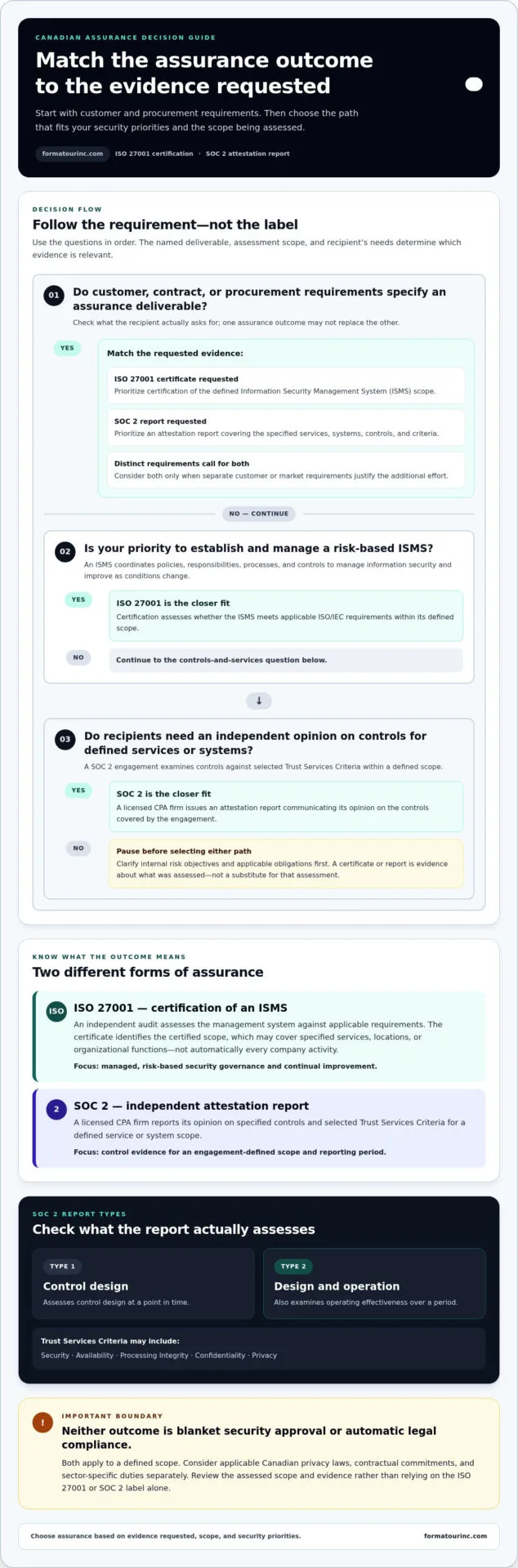
A Canadian Decision Framework for Comparing Assurance Requirements
A sound assurance decision starts with the evidence your organization must provide, then tests that need against its scope, obligations, and ability to maintain the program. Keep three categories distinct: contractual requests from customers, legal or regulatory duties that apply to your organization, and internal risk objectives. ISO 27001 or SOC 2 may support governance and assurance, but neither should be assumed to satisfy the other or replace a legal assessment.
- Collect buyer requirements. Review procurement questionnaires, contract clauses, target-market expectations, and customer requests. Record whether the request specifies ISO 27001 certification, a SOC 2 report, a report type, particular criteria, or a defined service.
- Map the scope. Identify the business functions, locations, services, systems, information assets, and suppliers that would fall within the assurance boundary. Compare that boundary with the services customers actually use.
- Assess applicable obligations. Separate contractual commitments from privacy and sector-specific duties. PIPEDA and provincial privacy laws may be relevant depending on the organization and its activities. Confirm current applicability with qualified legal or regulatory guidance.
- Evaluate capacity. Review existing controls, policies, risk processes, evidence, accountable leaders, and the resources available for ongoing ownership and review.
- Document the decision. Note the selected path, requirements it addresses, remaining gaps, decision owner, evidence needs, and conditions that would prompt a future review.
Map customer, contract, and Canadian privacy requirements
Build a requirements register rather than relying on informal recollection. For each customer or obligation, capture the source, exact wording, affected service, responsible owner, expected evidence, deadline, and intended audience. A procurement questionnaire may ask for a certificate, while a contract may name a specific report. Record those requests separately, even when they relate to the same security controls.
For Canadian privacy requirements, avoid assuming one rule applies to every organization. PIPEDA and provincial laws may have different relevance depending on location, activities, and the information handled. Qualified advice can help interpret current obligations; an assurance framework is not a substitute for that analysis.
Assess readiness, overlap, and maintenance capacity
Inventory what already exists: risk assessments, approved policies, control records, internal reviews, and named owners. Then map shared work, such as access management or incident procedures, against each framework’s distinct scope and assessment requirements. Reusing relevant evidence can reduce duplication, but it doesn’t establish that one assessment meets the other’s criteria.
For organizations pursuing an ISMS, discuss ISO 27001 readiness and implementation planning as part of a scoped assurance strategy.
Plan Your ISO 27001 Path in Canada with a Clear Assurance Strategy
Once you’ve compared assurance requirements, turn your decision into a scoped plan. Confirm which business activities the ISMS will cover, assign leadership ownership, and prioritize risks that matter to your services and operations. This keeps implementation connected to how the organization works and gives teams a clear basis for defining controls, responsibilities, and review practices.
Build an ISO 27001 plan around business operations
Begin with the intended scope and translate it into practical governance. Identify who approves security priorities, who owns risk treatment, and which teams operate relevant controls. For a Canadian service organization, that may mean coordinating responsibilities across technology, operations, human resources, and supplier management. The goal is a functioning management system, not a collection of documents prepared only for an audit.
Integrate information security into existing business processes where possible. Connect risk reviews to planning and change management, and ensure control owners understand the evidence they maintain as part of their regular work. A broader ISO 27001 implementation guide can help frame the ISMS roadmap, from defining scope and responsibilities to preparing for independent assessment.
Continuity planning may also be a priority. If resilience planning is part of your organization’s objectives, connect security risks with the plans and responsibilities used to maintain or restore important services. Business continuity consulting can complement this operational perspective without treating continuity and information security as the same program.
Formatour supports ISO 27001 implementation, auditing, and certification preparation in Canada. This advisory work can help organizations assess readiness, structure responsibilities, and align the ISMS with operational priorities. A clear roadmap should reflect the organization’s risk profile and capacity without assuming a particular audit outcome or timeline.
Move from comparison to a proportionate next step
Before committing resources, record the decision in a short assurance plan. Capture the selected framework or frameworks, the buyer requirements they address, unresolved questions, scope assumptions, accountable decision-makers, and the evidence each stakeholder expects. Note separately any legal or regulatory matters that require qualified interpretation. This record helps leadership understand why the path was chosen and what could trigger a review.
Then set a proportionate first step. An organization with a defined service boundary may begin by clarifying that scope and its related risks; a broader operation may first need leadership alignment and an inventory of processes and assets. Formatour’s ISO 27001 advisory can support readiness assessment, implementation planning, and certification preparation, with the work structured around the organization’s context.
Discuss an organization-specific ISO 27001 path with Formatour to turn your assurance decision into a practical plan for governance, risk priorities, and day-to-day operations.
Turn Your Assurance Choice into Sustained Progress
Make the assurance decision actionable by connecting leadership priorities, risk ownership, and operational change in a plan your teams can maintain. The right direction for ISO 27001 vs SOC 2 report Canada should support your organization’s growth, not become a separate exercise that loses momentum after an assessment.
Formatour is a Canadian advisory firm with national coverage, supporting ISO 27001 implementation, auditing, and certification preparation. Its wider focus on strategic transformation, operational performance, and organizational resilience helps connect information security planning with the broader needs of the organization.
Build the path around your scope, decision-makers, and the outcomes that matter to your business. Work with Formatour to shape your ISO 27001 assurance strategy and define a practical next step for your organization. A clear, well-owned plan can help turn security priorities into durable progress.
Frequently Asked Questions
Is ISO 27001 the same as a SOC 2 report?
No. ISO 27001 certification and a SOC 2 report are different assurance outcomes. Certification assesses an in-scope information security management system against applicable ISO requirements; a SOC 2 report records an independent attestation engagement against selected Trust Services Criteria. If a vendor questionnaire asks for “security certification,” clarify what evidence the requester expects before responding. The wording can determine whether a certificate, a report, or additional documentation is needed.
Can a Canadian company use ISO 27001 instead of SOC 2?
Only if the relevant customer or contract accepts it for the stated purpose. A buyer might accept an ISO certificate in a general security review but still require a SOC 2 report for a particular service or procurement process. Check the exact contract language, report type, and scope before choosing. For the ISO 27001 vs SOC 2 report Canada decision, don’t assume one assurance outcome automatically substitutes for the other or satisfies privacy obligations.
Which is better for a Canadian SaaS company, ISO 27001 or SOC 2?
Neither is automatically better for every SaaS company. Compare the assurance evidence customers request with the services and systems the company wants assessed. For example, a SaaS provider selling to customers that explicitly require SOC 2 may prioritize that report, while a company seeking a structured security management system may favour ISO 27001. Review actual procurement language, target markets, and applicable privacy obligations before setting priorities.
Does ISO 27001 certification guarantee compliance with Canadian privacy laws?
No. Certification doesn’t establish compliance with every Canadian privacy law, contract, or sector-specific duty. An organization should separately determine which requirements apply to its activities, locations, and handling of personal information. A certificate shouldn’t be treated as a substitute for reviewing privacy practices or assessing a specific legal obligation. Qualified legal guidance can help interpret applicable federal or provincial requirements for the organization’s circumstances.
Can an organization pursue ISO 27001 and SOC 2 at the same time?
Yes, an organization can pursue both when separate buyers or business objectives call for them. To coordinate the work, create a shared control inventory, then track each framework’s distinct evidence, scope, owners, and assessment needs. For example, an access-control record may support more than one assurance activity, but evidence requests and testing may differ. Sequence work around customer deadlines and the team’s capacity to maintain both programs.
What is the difference between a SOC 2 Type I and Type II report?
A Type I report assesses control design at a specified point in time. A Type II report also assesses whether controls operated effectively during a defined period. Before relying on either, check that the report covers the service under consideration, the relevant criteria, and a period that suits the review. Read any qualifications or exceptions in context rather than treating the report type alone as proof of suitability.
