

The fastest way to improve operations is rarely to change everything at once. A business process improvement consultant Vancouver organizations engage should first identify where work slows down, why handoffs fail, and who owns each step. From there, the consultant can help refine the workflow without disrupting essential day-to-day operations.
Recurring delays and unclear responsibilities can make it difficult to decide which problem to tackle first. You may also worry that recommendations will look sound on paper but prove difficult to implement or sustain. Effective improvement connects diagnosis to practical, measurable change and involves the people who run the process throughout.
This guide explains how to identify root causes, prioritize improvement opportunities, and assess consulting support. It also shows how process mapping, optimization, and automation can strengthen operations while maintaining continuity. Clear ownership and relevant performance measures help your organization track results and build the internal capability to sustain progress.
Key Takeaways
- Recurring delays, rework, and inconsistent service can signal process-level problems, such as unclear ownership or unreliable handoffs.
- Map how work actually happens, then use employee and stakeholder input to uncover issues that formal procedures may miss.
- When assessing a business process improvement consultant Vancouver organizations can work with, look for diagnostic depth, collaboration, implementation support, and outcome tracking.
- Prioritize a process by weighing its business impact, implementation effort, operational risk, and employee readiness.
- Connect process optimization with automation, digital transformation, and project management to turn priorities into coordinated operational change.
Why Vancouver Organizations Bring in a Business Process Improvement Consultant
A business process improvement consultant Vancouver organizations work with helps assess how tasks move across teams, systems, and decision points, then identifies practical ways to improve the workflow. The goal isn’t change for its own sake. It’s to understand where a process supports reliable delivery and where friction gets in the way.
Organizations may review workflows during growth, digital transformation, organizational change, or periods of operational pressure. As responsibilities and tools evolve, a process that once worked well can accumulate extra steps, unclear approvals, or gaps between teams. Business process management provides a broader framework for understanding and managing workflows; What is Business Process Management? offers a foundational overview.
Which process problems signal a need for outside support?
A missed handoff or service error may be isolated. Repeated delays between departments, duplicated data entry, recurring corrections, or inconsistent outcomes point to patterns worth investigating. The impact may show up in customer experience, employee workload, delivery reliability, or the time leaders spend resolving exceptions.
What does a business process improvement consultant do?
The work typically begins with discovery: clarifying the intended outcome, documenting how tasks move from start to finish, and gathering input from the people involved. Workflow analysis then compares the documented process with daily practice, including informal workarounds. Root-cause assessment helps distinguish underlying issues, such as unclear decision rights or unnecessary approvals, from visible symptoms like delays and rework.
Recommendations should connect findings to organizational objectives, whether the goal is to improve service consistency, support growth, or make better use of technology. A practical improvement plan also accounts for implementation and defines measures that can show whether the change is working.
Process improvement is a measured change to how work gets done, designed to address verified friction while preserving what already works. This principle helps organizations retain effective steps, focus on evidence-based causes, and make changes that support operational continuity.
How Process Improvement Moves from Vancouver Workflow Diagnosis to Lasting Change
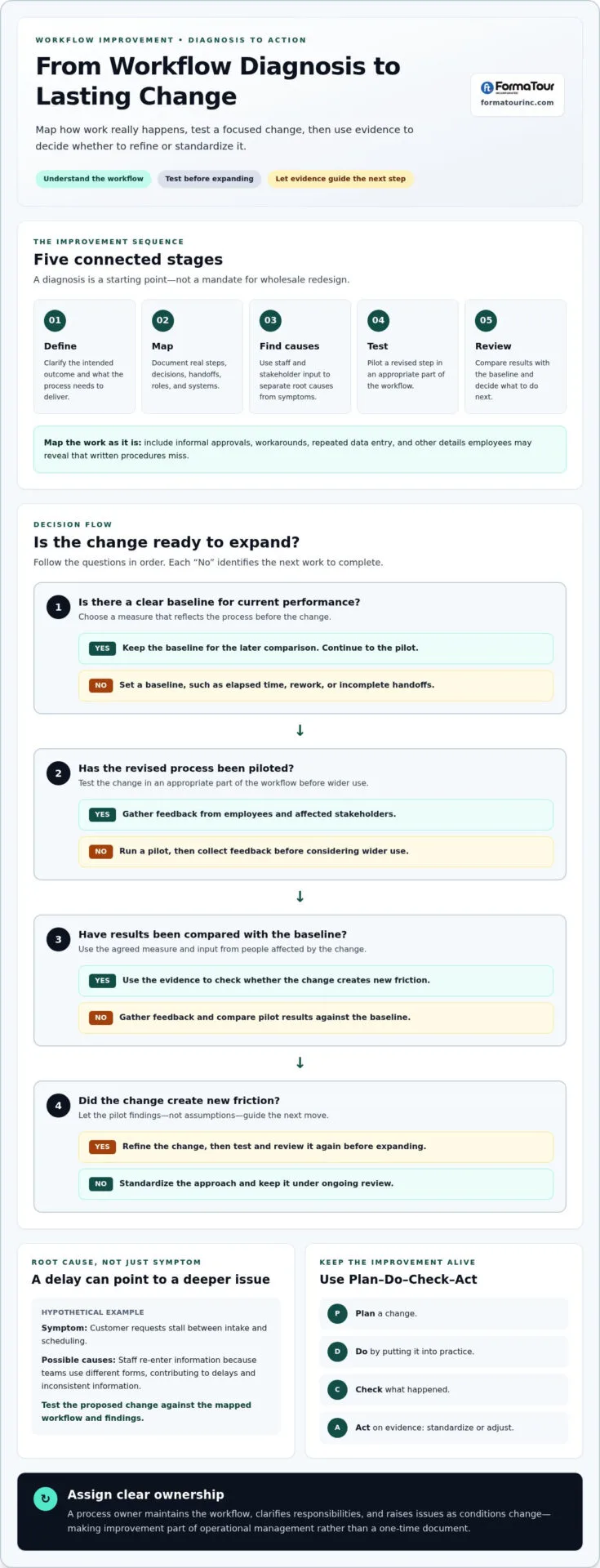
A useful improvement effort follows a disciplined sequence: define the outcome, map current work, identify causes, test a change, and review the results. A business process improvement consultant Vancouver organizations engage can guide this work with the people closest to the process, helping leaders make informed changes without treating a diagnosis as a mandate for wholesale redesign.
How do consultants map and assess a business process?
Process mapping documents the steps, decisions, handoffs, roles, and systems involved in completing a task. The map should reflect how employees actually work, not just how a procedure says they should work. Staff may reveal workarounds, repeated data entry, or informal approvals that written documentation doesn’t capture.
Value stream mapping traces how work and information move from request to outcome. It helps teams see where work waits, loops back, or adds effort without advancing the desired result. Comparing the map with employee and stakeholder input helps distinguish root causes from symptoms. For example, adding an approval might temporarily reduce errors, but if unclear criteria are causing them, clarifying those criteria may address the underlying issue. IBM’s overview of Understanding Process Improvement also describes common approaches to analyzing and refining work.
Hypothetical example: A Vancouver service organization finds that customer requests stall between intake and scheduling. Mapping the workflow might show that staff re-enter information because teams use different forms. The delay is the symptom; duplicated entry and inconsistent information may be contributing causes. Test any proposed change against those findings rather than assuming it will solve the problem.
How do teams test and sustain process changes?
Before making a wider change, agree on a baseline that reflects current performance, such as elapsed time, rework, or incomplete handoffs. Pilot the revised steps in an appropriate part of the workflow, gather feedback from employees and affected stakeholders, and compare the results with the baseline. If the change creates new friction, refine it before expanding its use.
Plan-Do-Check-Act supports ongoing review: plan a change, put it into practice, check what happened, then act on the evidence by standardizing or adjusting the approach. Assign a process owner to maintain the workflow, clarify responsibilities, and raise issues as conditions change. This makes improvement part of operational management rather than a one-time document.
To turn diagnosis into a practical, measured change, discuss your process improvement priorities.
How to Evaluate a Business Process Improvement Consultant in Vancouver
Choose an approach that connects diagnosis to implementation, rather than one that stops at a report. A business process improvement consultant Vancouver organizations engage should explain how the work will support defined priorities, involve the people affected, and track whether operational changes are effective.
Use these criteria to compare the proposed engagement:
| Evaluation area | What to look for |
|---|---|
| Diagnostic depth | Analysis of how work actually flows, including handoffs, decision points, systems, and root causes, rather than a list of visible symptoms. |
| Stakeholder involvement | Structured input from employees, leaders, and other stakeholders who understand the workflow and its constraints. |
| Implementation support | Practical actions, clear responsibilities, and support for putting agreed changes into operation. |
| Outcome tracking | Measures linked to an established baseline and the objectives the organization wants to advance. |
Useful consulting aligns process measures with defined business outcomes. For example, if the priority is more consistent service, choose a relevant measure of consistency rather than focusing only on reducing the number of process steps.
What should a consulting engagement make clear?
A well-structured engagement defines its scope, objectives, stakeholder roles, deliverables, and decision points. It should also explain how findings will become prioritized actions, with ownership assigned so recommendations don’t remain an unimplemented list. Formatour connects process optimization with strategic transformation and project management, aligning improvement work with organizational priorities and the practical needs of implementation.
How should Vancouver businesses compare improvement approaches?
Different methods serve different needs. Process mapping clarifies steps, handoffs, and decision points. Automation can reduce repetitive manual work once the process is understood and suitable for automation. A management-system approach can help establish consistent responsibilities, controls, and review practices. These methods can work together, but automation shouldn’t simply digitize an unclear or unnecessary workflow.
Sector familiarity can provide useful context, but the ability to understand an organization’s process complexity, constraints, and decision-making environment is also important. Consider whether the proposed method fits the problem and connects operational changes to strategic priorities. For a closer look at how optimization fits into broader operational improvement, explore Formatour’s process optimization and automation support.
A Practical Vancouver Roadmap for Prioritizing Process Improvements
Improvement priorities are easier to manage when leaders choose a focused starting point and define what success should look like before changing the workflow. A business process improvement consultant Vancouver organizations work with can help structure this assessment, while internal leaders and employees shape priorities and own operational decisions.
How can leaders choose which process to improve first?
Start with a process tied to a visible organizational priority or a recurring operational issue. It might affect service consistency, delivery, employee capacity, or the reliability of information used for decisions. Before selecting it, map dependencies: identify upstream inputs, downstream users, affected teams, and time-sensitive steps. This can reveal whether a change in one area might create new pressure elsewhere.
Next, document the current baseline and agree on a target outcome. Use evidence that fits the process, such as completion time, correction frequency, or service consistency, rather than choosing a measure simply because it’s easy to count. Assess the opportunity through four lenses, without relying on arbitrary scores:
- Business impact: How closely does improvement support a current organizational priority?
- Implementation effort: What changes to roles, systems, or procedures are involved?
- Operational risk: What could be affected if the workflow changes?
- Employee readiness: Do the people doing the work have the capacity, input, and guidance to adopt the change?
How can teams reduce disruption during implementation?
Stage the work so teams can understand and adapt to changes while maintaining essential operations. Explain why the change is being made, what will be different, and how employees can raise issues. Provide role-specific guidance, assign an owner for the updated process, and set review points to monitor service continuity and gather feedback. Use what the team learns to adjust the rollout instead of assuming the first version will suit every situation.
Choose supporting methods based on the improvement need. Automation may suit a stable, well-understood workflow with repetitive tasks. Project management can coordinate dependencies, decisions, and responsibilities across teams. A quality-management framework can support consistent procedures, defined accountability, and ongoing review. Organizations exploring this approach can read more about ISO 9001 quality management implementation. If the improvement is part of a broader organizational shift, digital transformation consulting can connect process changes with wider objectives.
For a structured discussion about selecting priorities and planning implementation, discuss your process improvement priorities.
How Formatour Supports Business Process Improvement for Vancouver Organizations
Process improvement works best when it supports a defined organizational priority and fits the conditions of day-to-day work. Formatour brings process optimization, automation, digital transformation, and project management together as connected advisory capabilities. For Vancouver organizations seeking business process improvement support, this approach considers both the workflow and the broader changes needed to implement it.
Where process optimization fits within wider organizational change
A process may need focused refinement, or it may be one part of a broader transformation. Formatour tailors its support to organizational priorities, process scope, and implementation context. Optimization can improve how work is structured; automation may support a suitable, well-understood workflow; and digital transformation can connect process changes to wider organizational objectives. Not every project requires automation or certification.
Clear process ownership helps sustain a revised workflow after implementation. Project management can coordinate responsibilities, decisions, and dependencies, while governance clarifies how progress is reviewed and issues are addressed. When consistent quality management is a priority, Formatour’s ISO 9001 implementation and auditing support can help align process practices with the organization’s quality objectives. The appropriate combination depends on the problem and intended outcome.
What to prepare before discussing a process improvement project
A focused initial discussion can start with a few practical details. You don’t need a complete process manual; the information you have can help define the priority and identify useful next steps.
- The workflow: Name the process and describe where it begins and ends.
- The business concern: Note the recurring delay, rework, service inconsistency, or other issue prompting a review.
- The people involved: Identify affected teams, process owners, and decision-makers.
- The desired outcome: Describe what the organization wants the process to support, such as more reliable delivery or clearer accountability.
- Existing evidence: Gather process documentation, performance information, or examples of where work gets held up, if available.
Bringing decision-makers and process owners into alignment early connects the operational concern to strategic priorities and helps establish clear next steps. Formatour can shape the engagement around that context, linking process optimization with project management or broader digital transformation where appropriate.
Ready to discuss a priority in your organization? Discuss a business process improvement engagement.
Turn Your Improvement Priorities into Lasting Progress
Effective process improvement starts by identifying where work slows down and prioritizing changes that address root causes and support organizational goals. A clear baseline, employee input, and defined ownership help teams assess whether changes are working while maintaining operational continuity.
Working with a business process improvement consultant Vancouver organizations can rely on can connect workflow priorities with broader operational needs. Formatour is a Canadian multidisciplinary advisory firm focused on strategic transformation and operational performance. Its capabilities include process optimization, automation, digital transformation, and project management. When quality management is central to the objective, Formatour also provides ISO 9001 implementation and auditing support.
You don’t need to have every process documented before taking a practical next step. Begin with the workflow causing concern, the outcome you want to improve, and the people responsible for the work. Discuss your business process improvement priorities with Formatour and explore an approach aligned with your organization’s needs. Clear priorities and shared ownership can turn an improvement into a foundation for sustained progress.
Frequently Asked Questions
How do I know if my Vancouver business needs process improvement consulting?
Consider process improvement consulting when recurring delays, rework, unclear responsibilities, or inconsistent service affect important business objectives. Outside support may also help when teams lack time to review a workflow or don’t share a clear understanding of how work crosses departments. Start by naming the process and describing its impact on customers, employees, or delivery. A focused concern gives leaders a practical basis for deciding what to examine.
How does a consultant improve a business process?
A consultant typically begins by clarifying the desired outcome and documenting how the process currently works. They gather input from people involved, analyze handoffs and bottlenecks, and distinguish underlying causes from visible symptoms. The consultant can then help prioritize changes, plan implementation, and review results against agreed measures. Employee feedback also matters because it can reveal practical obstacles or workarounds that performance data alone may not show.
How long does a business process improvement project take?
Project timing depends on the workflow’s scope, the number of teams involved, available information, and the complexity of implementation. A focused review of one process will differ from a multi-department transformation. Rather than assume a standard duration, define the scope, deliverables, and decision points with the project team. Early agreement on ownership and stakeholder access helps create a realistic plan and reduce delays caused by unresolved decisions.
What should I look for when choosing a business process improvement consultant?
Look for a clear diagnostic method, meaningful stakeholder involvement, practical implementation planning, and a way to track outcomes. The consultant should explain the proposed scope, objectives, roles, and deliverables, then show how findings will become prioritized actions with clear ownership. Assess whether the approach considers adoption as well as analysis. Recommendations create value when they fit organizational priorities and employees can apply and sustain the revised process.
Can process improvement and automation be done together?
How can a business measure whether process improvement worked?
Establish a baseline before implementation and select measures tied to the intended outcome. Depending on the workflow, useful indicators may include cycle time, error frequency, rework, service consistency, or stakeholder experience. Assign an owner and agree on review points so the team can assess performance information alongside employee feedback. Avoid relying on a single metric if it could overlook important effects on quality, service, or other operational priorities.
