

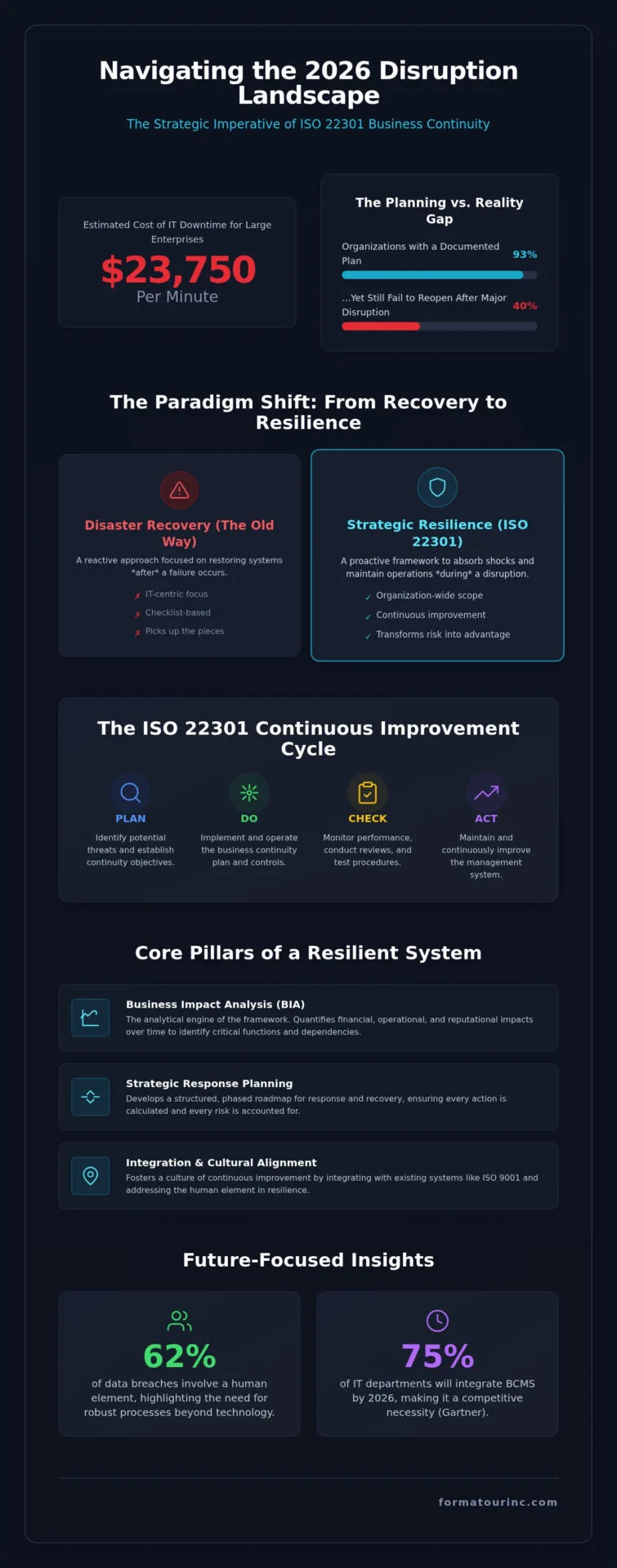
With the cost of IT downtime for large enterprises now exceeding $23,750 per minute, the margin for operational error has effectively vanished. You likely recognize that a traditional disaster recovery binder gathering dust on a shelf isn’t a viable defense against sophisticated ransomware or volatile climate events. Achieving true organizational resilience requires more than a checklist; it demands specialized ISO 22301 business continuity consulting to align international standards with the specific nuances of Canadian regulations. While 93% of organizations have documented plans, 40% still fail to reopen after a major disruption because their systems lack the agility to adapt in real time.
It’s frustrating when manual risk assessments and fragmented protocols leave your leadership team feeling exposed. We believe your continuity framework should be a source of confidence, not a source of bureaucracy. This guide explores how to transform organizational risk into a competitive advantage that wins high-value contracts. We’ll examine the latest 2024 climate amendments to the ISO 22301:2019 standard, the convergence of cyber-security and resilience, and the shift toward AI-driven proactive planning. By integrating these high-level concepts into your daily operations, you ensure your organization remains a steady, reliable leader in a complex global market.
Key Takeaways
- Understand the shift from reactive disaster recovery to proactive strategic resilience in response to 2026 risk factors like AI disruptions and climate volatility.
- Discover how expert ISO 22301 business continuity consulting identifies critical functions through high-impact Business Impact Analysis to protect your organization’s core value.
- Learn the advantages of boutique-level agility paired with big-firm standards when building a management system tailored to mid-market operational needs.
- Follow a structured, phased roadmap to certification that prioritizes executive alignment and integrates seamlessly with existing digital transformation goals.
- Identify the strategic synergy between business continuity and ISO 9001 Quality Management to foster a culture of continuous improvement and unwavering reliability.
The 2026 Disruption Landscape: Why Business Continuity is a Strategic Necessity
Organizations in 2026 face a risk environment that is both accelerated and unpredictable. The traditional safety nets of the past decade are no longer sufficient to protect complex operations. We see AI-driven social engineering and climate volatility disrupting global supply chains with unprecedented frequency. In this context, ISO 22301 stands as the definitive international benchmark for Business Continuity Management Systems (BCMS). It provides a structured methodology for maintaining operations when the unexpected occurs, ensuring that a crisis does not become a collapse.
Defining the ISO 22301 BCMS Framework
A BCMS is a proactive framework designed to identify potential threats and build organizational capacity to respond effectively to incidents. While disaster recovery focuses specifically on restoring IT infrastructure, business continuity encompasses every facet of the organization, from human capital to vendor relationships. The framework utilizes the Plan-Do-Check-Act (PDCA) cycle to ensure resilience is not a one-time project but a continuous process of refinement. This structured approach, as detailed on ISO 22301 Wikipedia, ensures that every response is calculated and every risk is accounted for. By 2026, Gartner predicts that 75% of IT departments will integrate these processes directly into their service management platforms, highlighting the shift toward a unified operational posture.
The Cost of Inaction in Modern Markets
The price of operational failure is staggering. For large enterprises, unplanned downtime now costs more than $23,750 per minute. Beyond the immediate financial loss, the reputational damage can be permanent. In a globalized economy, ISO 22301 business continuity consulting provides a pathway to certification that acts as a critical trust signal for partners and stakeholders. It demonstrates that your organization possesses the strategic foresight to protect its commitments regardless of external pressures. With 62% of data breaches involving a human element, a robust BCMS addresses the cultural and procedural vulnerabilities that technology alone cannot fix. Proactive management isn’t just a defensive measure; it’s a clear indicator of a high-performing, reliable enterprise.
Core Pillars of ISO 22301 Business Continuity Consulting
Strategic Business Impact Analysis (BIA)
The BIA is the analytical engine of the ISO 22301 framework. It functions by quantifying the financial, operational, and reputational impact of a disruption as it unfolds over time. A central component of this process is determining the Maximum Tolerable Period of Disruption (MTPD). This metric provides executives with a clear threshold of when an incident shifts from a manageable delay to a catastrophic failure. Expert consultants bring an outside perspective that is vital for identifying hidden dependencies. While internal departments often focus on their own silos, a consultant maps the interconnections between technology, human capital, and third-party vendors. As highlighted by the BSI Group on ISO 22301, this level of detail is essential for meeting the rigorous requirements of the standard and ensuring nothing is left to chance.
Developing the Continuity Strategy
Once the critical functions are identified, the focus shifts to designing a response that prioritizes speed and precision. We move away from generic, one-size-fits-all templates in favor of strategies that reflect the boutique agility of your organization. This phase establishes two non-negotiable targets:
- Recovery Time Objective (RTO): The maximum duration allowed for a business process to be restored after a disruption to avoid unacceptable consequences.
- Recovery Point Objective (RPO): The maximum age of files or data that must be recovered from backup storage for operations to resume without fatal loss.
A truly resilient strategy also integrates leadership development into the response framework. Plans are only as effective as the people who execute them; therefore, we ensure your team possesses the confidence and skills to lead through a crisis. If you want to transform these technical pillars into a cohesive shield for your organization, you might consider how to start a conversation with our advisory team today. We focus on creating a results-oriented atmosphere where compliance serves as a foundation for sustainable growth.
Boutique Agility vs. Big Firm Standards: The Formatour Advantage
Mid-market leaders often find that large consulting firms prioritize standardized volume over specific operational needs. While these firms provide recognized benchmarks, their rigid approach frequently results in systems that stifle growth rather than supporting it. Our approach to ISO 22301 business continuity consulting prioritizes boutique agility, ensuring that global standards are translated into practical, flexible solutions. We act as a seasoned strategic mentor, providing the quiet confidence necessary to guide your organization through complex transformations. You won’t find a factory-style model here; instead, you’ll experience a partnership dedicated to your long-term stability.
Premium Standards with Personalized Execution
Achieving compliance with the ISO 22301 standard is only the beginning. For resilience to be sustainable, it must be supported by executive education and a culture of continuous improvement. We pair big-firm standards with a personalized touch, architecting resilience plans that reflect your unique business objectives. This multidisciplinary approach ensures that leadership development is woven into the continuity framework, empowering your team to lead effectively during disruptions. You can explore our full range of strategic services on the Formatour homepage. It’s a method that balances high-level authority with an inclusive, accessible approach.
Multidisciplinary Synergy
True organizational resilience exists at the intersection of technology, process, and people. By integrating business continuity with ISO 27001 Information Security Management, we create a holistic security posture that addresses both data integrity and operational uptime. This synergy is crucial in 2026, where digital transformation initiatives often automate continuity processes through AI-driven analytics. As a Canadian partner with a global reach, we navigate local regulations while maintaining alignment with international benchmarks. This dual perspective allows us to co-develop solutions that are both locally compliant and globally competitive. It’s the steady, expert hand you need when seeking specialized ISO 22301 business continuity consulting to manage the complexities of modern governance.
The Roadmap to ISO 22301 Certification in 2026
Phase 1: Establishing the Resilience Baseline
The initial phase focuses on a comprehensive gap analysis to define the project scope and identify existing strengths and weaknesses. This baseline is essential for securing C-suite buy-in, as it allows for a clear presentation of the return on investment (ROI) associated with resilience. In 2026, where data breaches involve a human element in 62% of cases, demonstrating how a Business Continuity Management System (BCMS) mitigates these specific risks is vital for executive alignment. Once the governance structure is established, the project gains the authoritative mandate required to influence every level of the organization.
Following the baseline establishment, the roadmap moves through four critical stages of implementation and verification:
- Phase 2: BIA and Risk Assessment Implementation: Executing the analysis to quantify impact and prioritize resources based on the objectives established in previous strategic sessions.
- Phase 3: Documentation and Staff Awareness: Developing the necessary protocols and conducting training to ensure every employee understands their role during an incident.
- Phase 4: Internal Auditing and Management Review: Performing a rigorous self-assessment to identify any remaining non-conformities before the external auditors arrive.
- Phase 5: Final Certification Audit: Successfully completing the independent evaluation to verify that the BCMS meets all international requirements.
Sustaining Compliance through Training
Professional development for internal lead auditors is a critical component of sustaining the performance of your BCMS. Preparing for the stage 1 and stage 2 certification audits requires a deep understanding of both the standard and your organization’s specific operational nuances. Organizations that test their business continuity plans regularly experience 50% less unplanned downtime, which underscores the importance of moving from ‘certification’ to ‘continuous operational performance.’ This proactive approach ensures your resilience framework remains agile as new threats emerge in the global market.
If you’re ready to secure your organization’s future with a structured, expert-led approach, we invite you to book a certification roadmap consultation with our advisory team. Our multidisciplinary expertise provides the steady hand you need to achieve and maintain international standards of excellence.
Integrating ISO 22301 into Your Strategic Transformation
Business continuity is often viewed as a defensive posture, yet it serves as the foundational architecture for successful digital transformation. As organizations automate their processes and migrate to cloud-based infrastructures, the risk of technical failure or cyber-attacks increases. Specialized ISO 22301 business continuity consulting ensures that these modernization efforts don’t create new vulnerabilities. It builds a framework where digital growth and operational uptime exist in harmony. Leveraging process automation to enhance real-time response capabilities allows your organization to move from reactive recovery to proactive, strategic resilience.
There is a profound synergy between ISO 9001 Quality Management and ISO 22301. While quality management focuses on meeting customer requirements through consistent processes, business continuity ensures those processes remain available regardless of external disruptions. Together, they create a culture of sustainable excellence. This integrated approach closes the loop on organizational health, positioning resilience as a core component of your brand’s value proposition rather than a separate compliance exercise.
Resilience as a Competitive Differentiator
Possessing ISO 22301 certification is a powerful business development tool. It opens doors to high-security government and enterprise contracts where reliability is a non-negotiable prerequisite. This commitment to stability also supports your broader environmental goals, particularly when integrated with ISO 14001 Certification Services. By demonstrating that your organization can maintain performance during climate events or resource shortages, you position your firm as an unwavering partner in your own client relationships. By utilizing professional ISO 22301 business continuity consulting, you ensure that your resilience strategy is as sophisticated as the technologies you use. It’s a signal of quiet confidence that resonates in a volatile global market.
Next Steps with Formatour
Initiating a strategic resilience review is the first step toward transforming your risk profile. In an era where Gartner predicts 75% of IT departments will integrate continuity directly into their management platforms, the value of a multidisciplinary advisory partner is undeniable. We combine big-firm standards with boutique agility to co-develop solutions that fit your specific operational DNA. Our team acts as a steady, expert hand, guiding you through the complexities of governance and technological advancement. We invite you to contact Formatour for a strategic consultation to begin architecting your organization’s future. Together, we’ll ensure your business is not just built to last, but built to lead.
Architecting a Resilient Future for Your Organization
Operational stability in 2026 requires a shift from reactive recovery to proactive resilience. We’ve examined how a robust management system protects critical functions while transforming risk into a clear competitive advantage. By aligning your governance with international standards, you ensure your organization remains a reliable partner in an increasingly unpredictable global market. This transformation doesn’t happen in isolation; it requires a structured approach that integrates technology, process, and human capital.
Specialized ISO 22301 business continuity consulting provides the steady, expert hand needed to navigate these complex organizational landscapes. Our multidisciplinary approach combines big-firm standards with boutique agility, ensuring your resilience strategy is both sophisticated and practical. We focus on the co-development of solutions that include expert implementation of ISO standards and integrated leadership development. It’s time to move beyond simple compliance and toward sustainable operational excellence.
We’re ready to help you build a foundation of unwavering reliability. Secure Your Organization’s Future with Formatour Advisory and gain the strategic foresight your leadership team deserves. Your path to a more resilient, high-performing organization starts with a single conversation.
Frequently Asked Questions
What is the difference between ISO 22301 and a standard business continuity plan?
ISO 22301 is a comprehensive management system framework, while a standard business continuity plan is typically a single document or set of procedures. The international standard establishes a cycle of continuous improvement through the Plan-Do-Check-Act methodology. It ensures that resilience is embedded into the organizational culture and governance rather than existing as a static file. This systemized approach allows leaders to manage risks holistically rather than reacting to isolated incidents.
How long does it typically take to achieve ISO 22301 certification with consulting support?
Most organizations achieve certification within six to twelve months when supported by professional ISO 22301 business continuity consulting. This timeline depends on the organization’s existing maturity, size, and the complexity of its operations. A structured roadmap accelerates the process by identifying gaps early and streamlining documentation. Engaging an advisory partner ensures that the certification journey remains focused, avoiding the common delays associated with manual or fragmented implementation efforts.
Can ISO 22301 be integrated with ISO 27001 for cybersecurity resilience?
Integration is highly recommended because both standards share the Annex SL high-level structure, making them naturally compatible. While ISO 27001 focuses on protecting information assets, ISO 22301 ensures the continuity of entire business processes during any disruption. Combining these frameworks creates a unified security and resilience posture. This synergy allows organizations to streamline audits, reduce administrative overlap, and build a comprehensive defense against both data breaches and operational downtime.
What are the core requirements for an ISO 22301 compliant BCMS?
The core requirements involve establishing a context for the management system, securing leadership commitment, and conducting a rigorous Business Impact Analysis. Organizations must also implement proactive risk assessments and develop actionable response plans. Regular internal audits and management reviews are essential to verify that the system remains effective. These pillars ensure the organization can maintain critical functions at a predefined level during a disruption, meeting both international benchmarks and stakeholder expectations.
Is ISO 22301 consulting suitable for small to medium-sized boutique firms?
Specialized ISO 22301 business continuity consulting is exceptionally beneficial for boutique firms that require agility without the overhead of a massive internal compliance department. Professional advisory services tailor the framework to fit the specific operational scale of a mid-market leader. This approach ensures that small to medium-sized organizations gain the same level of resilience and market trust as large enterprises. It transforms complex international standards into a practical tool for sustainable growth.
How often should a Business Impact Analysis (BIA) be updated in 2026?
A BIA should be reviewed annually or whenever significant changes occur in the organization’s structure, technology, or market environment. In the volatile landscape of 2026, waiting longer than a year creates a risk of using outdated data to drive resilience decisions. Frequent updates ensure that the Maximum Tolerable Period of Disruption remains accurate. This proactive maintenance allows the management system to adapt to new threats, such as AI-driven disruptions or shifting supply chain dependencies.
What role does executive leadership play in the success of ISO 22301 implementation?
Executive leadership provides the authoritative mandate and resources necessary for a successful implementation. Beyond mere approval, leaders must champion a culture of resilience and integrate continuity goals into the organization’s broader strategic vision. Their active participation in management reviews ensures that the BCMS remains aligned with evolving business objectives. Without strong C-suite commitment, the system risks becoming a siloed IT project rather than a core driver of organizational performance and stability.
Does ISO 22301 certification help with insurance premiums or contract bids?
Certification serves as a powerful trust signal that can lead to lower insurance premiums and more successful contract bids. Many high-security government and enterprise clients now require ISO 22301 as a prerequisite for high-value contracts. It provides verifiable proof that your organization has the strategic foresight to protect commitments regardless of external pressures. This level of transparency reduces the perceived risk for insurers and partners, positioning your firm as a steady and reliable leader.
