

In a year where 46% of Canadians are already leveraging generative AI, the gap between organizations that simply adopt tools and those that actually transform has never been wider. Finding a business transformation consultant Canada trusts often means looking past surface-level digital hype to find a partner who understands the structural integrity of ISO standards. You likely feel the pressure to innovate rapidly while the weight of new regulations, such as the 2026 ISO 9001 revisions and the Supply Chains Act reporting, demands absolute precision. It’s a difficult balance to maintain when most advice feels like consultant fluff that fails to deliver a measurable return on investment.
We’ll show you how to move beyond temporary fixes by integrating digital agility with certified operational resilience and elite leadership development. This guide outlines a strategy for organizational change that prioritizes both technological advancement and human capital. You’ll discover how to build a scalable digital framework and a leadership team capable of sustaining growth long after the initial implementation phase concludes. By aligning international standards with modern innovation, your organization can achieve a state of permanent, structured excellence.
Key Takeaways
- Understand why 2026 necessitates a shift from digital-only tactics to a resilience-centric model that prioritizes regulatory compliance and structural integrity.
- Learn how embedding ISO 27001 and ISO 9001 provides the essential security and quality frameworks to support rapid digital scaling without increasing operational risk.
- Discover the specific criteria for selecting a business transformation consultant Canada organizations rely on to bridge the gap between high-level strategy and practical ISO implementation.
- Gain a practical 5-step roadmap that begins with a strategic gap analysis and focuses on building internal leadership capacity for sustainable change.
- Differentiate between superficial process automation and deep digital transformation to ensure your technology investments drive genuine, scalable organizational growth.
The Evolution of Business Transformation in Canada for 2026
Canadian enterprises are navigating a pivotal shift as they move through 2026. While previous years were defined by a frantic “digital-only” race, the current environment demands a resilience-centric approach. Global supply chain volatility has exposed the fragility of lean operational models, forcing leaders to prioritize structural integrity over mere speed. Engaging a business transformation consultant Canada trusts is no longer just about cloud migration; it’s about building a robust foundation that withstands market shocks while maintaining strict adherence to international standards.
Defining Strategic Transformation in a Volatile Economy
Business transformation has evolved from simple process automation into a holistic reimagining of the corporate ecosystem. It represents the critical intersection where human capital meets technological advancement. Strategic Transformation is the alignment of governance, technology, and leadership. Mid-market firms are increasingly outperforming industry giants by opting for boutique advisory over the rigid, one-size-fits-all frameworks typically offered by the Big Four. This agility allows for a multidisciplinary approach that integrates IT certifications directly with strategic executive goals, ensuring that every technological shift serves a broader business objective.
The Canadian Differentiator: Governance and Compliance
Canadian regulatory frameworks are now central to shaping corporate strategy rather than being an afterthought. With the Supply Chains Act reporting deadline of May 31, 2026, and new OSFI liquidity requirements that took effect in early May, compliance has become a tangible competitive edge. ISO standards provide the necessary structure to navigate these requirements. Specifically, ISO 14001 is seeing a surge in adoption as ESG principles increasingly dictate Canadian corporate valuations and investor confidence.
National operations also face unique geographic and provincial challenges. From managing remote logistics across vast distances to adapting to 2026 employment standard changes, such as the increased long-term illness leave in Alberta and Manitoba, the complexity is significant. Organizations that partner with experts like Formatour Incorporated find that a steady, expert hand is essential for managing these variables. This methodology ensures that growth isn’t just rapid, but sustainable and compliant with both local regulations and international benchmarks. By embedding these standards into the core of the transformation process, Canadian businesses create a resilient framework that supports long-term operational excellence.
Integrating ISO Standards: The Foundation of Resilient Change
Business transformation fails when it lacks a structural anchor. In 2026, ISO standards serve as this anchor, providing a rigorous framework that prevents “transformation drift” where projects lose focus or compromise security. The rapid expansion of Canada’s digital economy has created a landscape where security and quality cannot be afterthoughts. Organizations that engage a business transformation consultant Canada relies on find that these international benchmarks are the only way to modernize without introducing catastrophic risk. By embedding compliance into the change process, firms ensure that their evolution is both scalable and defensible on a global stage.
ISO 27001 and Digital Security as a Strategic Asset
Information security is the primary prerequisite for any digital initiative. Implementing a robust Information Security Management System (ISMS) is critical during large scale cloud migrations to protect sensitive intellectual property and customer data. Recent data indicates that 18% of Canadians have already fallen victim to successful cyberattacks; this reality makes security-by-design a non-negotiable requirement. Standardized auditing and certification processes reduce organizational risk by identifying vulnerabilities before they’re exploited. Comprehensive ISO 27001 Implementation Services provide the governance needed to maintain data integrity throughout the transition, turning compliance from a hurdle into a strategic competitive advantage.
Operational Excellence through ISO 9001 and 14001
Speed often comes at the expense of quality, but ISO 9001 ensures that quality management remains the heartbeat of the organization. With the 2026 revision of the ISO 9001 standard now in effect, businesses must evolve their processes to meet higher benchmarks for efficiency and customer satisfaction. Simultaneously, environmental management (ISO 14001) is no longer a peripheral concern. It’s now integrated into the core business model to satisfy both regulatory requirements and investor demands for sustainable operations. Professional ISO internal audit services play a vital role here, acting as a diagnostic tool to identify gaps in the transformation journey before they impact the bottom line.
Resilience is further bolstered by ISO 22301, which protects transformation initiatives from the disruption of global supply chain volatility or local operational shocks. These standards act as a universal language for Canadian firms looking to expand into international markets, signaling reliability and maturity to global partners. To determine how these standards can anchor your specific growth objectives, you might schedule a strategic consultation to explore a tailored compliance roadmap that aligns with your long term vision.
Digital Transformation vs. Process Automation: Finding the Balance
Many organizations mistake the implementation of a single software tool for a total business evolution. While process automation focuses on increasing the efficiency of specific tasks, deep digital transformation involves a holistic reimagining of the entire organizational architecture. A business transformation consultant Canada partners with ensures that technology serves the strategy, rather than the strategy being limited by the tools purchased. This distinction is critical; automating a flawed process only accelerates the generation of errors. True transformation requires a multidisciplinary approach that aligns technological shifts with long term corporate objectives and governance standards.
The “Formatour Approach” prioritizes this alignment by integrating IT certifications and international standards directly into the strategic roadmap. It’s easy to fall into the technology trap where trendy tools dictate the direction of the firm. Instead, the focus should remain on structural integrity and the co-development of solutions that address specific operational gaps. By treating technology as a facilitator rather than a driver, Canadian firms maintain the agility needed to pivot as market conditions evolve throughout 2026.
Strategic Project Management for Complex Initiatives
C-suite involvement remains the primary predictor of digital success. When the leadership team is actively engaged, the internal resistance to change diminishes and the vision for the future becomes clearer. Training internal teams is a vital component of this process, as it builds the capacity to sustain the transformation long after the external advisors have completed their work. Investing in professional development and specialized Leadership Training for Digital Transformation empowers executives to guide their teams through the complexities of modern governance. This commitment to human capital ensures that the organization possesses the internal intelligence to optimize its new digital framework and maintain its competitive edge in a global economy.
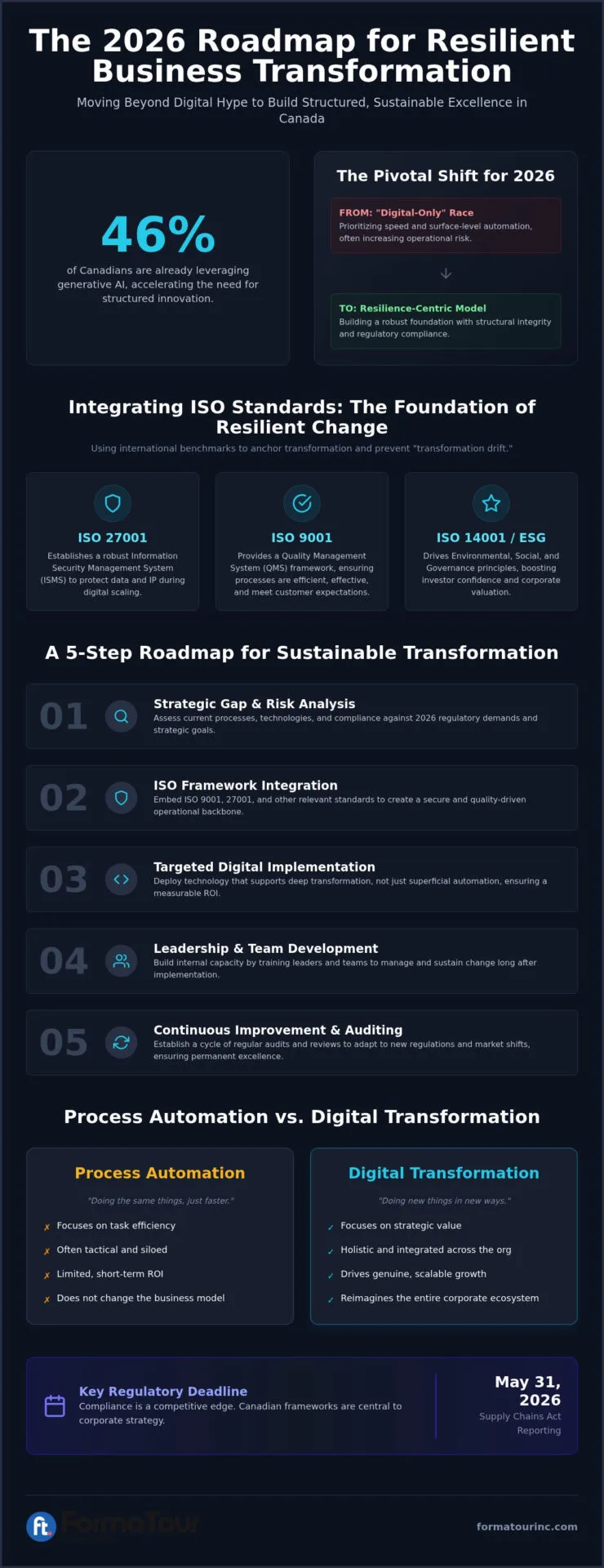
A 5-Step Roadmap for Canadian Business Transformation
Execution requires a disciplined framework to move from a conceptual vision to operational reality. For organizations seeking a business transformation consultant Canada offers several paths, but the most successful follow a rigorous, five-step progression. This roadmap ensures that every technological investment is anchored by structural integrity and leadership capacity. By following these phases, firms avoid the common pitfall of “initiative fatigue” and instead build a culture of permanent, scalable excellence.
- Step 1: Strategic Gap Analysis and Resilience Audit. This initial diagnostic identifies where current operations fall short of international benchmarks and regulatory requirements.
- Step 3: Process Optimization and ISO Integration. Before adding new technology, existing workflows must be optimized and aligned with ISO 9001 or ISO 27001 standards.
- Step 4: Digital Execution and Automation Deployment. Only after processes are refined does the organization deploy targeted automation and digital tools to enhance efficiency.
- Step 5: Sustained Monitoring and Continuous Improvement. The final step involves establishing governance structures that monitor performance and adapt to new market shifts.
Phase 1: Diagnosis and Strategic Vision
The journey begins with a comprehensive ISO gap analysis to identify organizational vulnerabilities. This isn’t a mere checklist; it’s a deep dive into the governance and security protocols that protect your intellectual property. With the May 31, 2026, Supply Chains Act reporting deadline approaching, this audit becomes a critical tool for ensuring compliance while crafting a transformation roadmap. We establish Key Performance Indicators (KPIs) that measure more than just financial output. These metrics evaluate operational resilience and the organization’s ability to maintain quality during rapid scaling.
Phase 2: Execution and Change Management
Successful implementation depends on the human element. Deploying specialized organizational leadership programs supports the transition by giving managers the tools to navigate internal resistance. Managing the cultural shift required for digital adoption is often the most challenging aspect of the roadmap. To broaden the strategic vision of your team, we utilize international business seminars that expose leaders to global best practices and emerging trends. This multidisciplinary approach ensures that your staff doesn’t just use new tools, but understands the strategic “why” behind them. If you’re ready to define your organization’s specific path forward, you can request a customized roadmap assessment to begin the diagnostic process.
Choosing the Right Business Transformation Consultant in Canada
Selecting a business transformation consultant Canada organizations can trust involves more than evaluating a brand name. It requires a careful assessment of how a partner balances global benchmarks with the specific nuances of the Canadian regulatory environment. While the “Big Four” offer vast resources, they often operate with a structural rigidity that doesn’t suit the fast-paced needs of mid-market firms. These larger entities typically assign junior staff to accounts, leading to a disconnect between high-level strategy and ground-level execution. A premium partner should act as a steady, expert hand, providing the senior-level foresight necessary to guide an organization through complex landscapes without the friction of excessive bureaucracy.
The Value of Boutique Advisory Agility
Formatour’s Multidisciplinary Advantage
Formatour Incorporated bridges the gap between big-firm expertise and boutique responsiveness. Our multidisciplinary approach is a unique differentiator, combining rigorous ISO certification support with high-level digital strategy and leadership seminars. We don’t treat compliance as a separate silo; instead, we embed ISO 27001 and ISO 9001 into the very fabric of your digital execution. This ensures that your growth is both secure and standardized according to international best practices. We focus on the co-development of solutions, positioning ourselves as an active participant in your progress rather than a distant observer.
Our “Global Citizen” mindset means we bring world-class insights from international seminars and professional development resources directly to your local operations. This perspective is essential for Canadian firms looking to compete on a global stage while remaining grounded in local compliance and structural integrity. By addressing your specific strategic gaps with precision and intelligence, we provide a foundation for long-term resilience and operational excellence. If you’re seeking a partner dedicated to collaborative success and a visionary approach to change, Contact Formatour Incorporated for a Strategic Consultation to align your 2026 vision with a proven execution framework.
Securing Your Competitive Advantage Through Structured Transformation
The landscape of 2026 demands a shift from reactive technology adoption to a resilience-first mindset. By embedding ISO standards into the core of your digital strategy, you ensure that organizational growth is both secure and scalable. Selecting the right business transformation consultant Canada offers involves finding a partner who bridges the gap between high-level governance and practical project execution. This integrated approach prevents the common pitfalls of initiative fatigue and ensures that every technological investment delivers a tangible return on investment.
Sustainable success is built on the foundation of internal leadership capacity and a disciplined roadmap. Formatour Incorporated provides the steady, expert hand required to navigate these complexities, offering a Canadian-owned multidisciplinary advisory that combines ISO 27001 and 9001 Lead Auditor expertise with elite executive leadership programs. We empower your team to maintain structural integrity while pursuing rapid innovation, ensuring your organization remains agile in a volatile global economy. Partner with Formatour Incorporated for Strategic Resilience to align your 2026 vision with a framework designed for long-term operational excellence. Your journey toward a more resilient, digitally agile future starts with a single strategic decision.
Frequently Asked Questions
What does a business transformation consultant actually do?
A business transformation consultant Canada organizations trust will align governance, technology, and leadership to achieve long term growth. They perform deep gap analyses, optimize workflows, and implement international standards like ISO 9001. These experts facilitate the co-development of solutions rather than simply delivering a static report. This multidisciplinary approach ensures that digital tools serve the strategic vision while building internal leadership capacity to sustain the changes effectively.
Why is ISO 27001 important for business transformation in Canada?
ISO 27001 provides the essential framework for Information Security Management, which is critical during digital shifts. As Canadian organizations adopt AI and cloud based systems, the risk of data breaches increases significantly. Implementing this standard ensures that security is built into the transformation process rather than added as an afterthought. It protects intellectual property and builds trust with global partners who require verifiable proof of a robust security posture.
How long does a typical business transformation project take?
Transformation timelines vary based on organizational complexity, but most comprehensive initiatives span six to eighteen months. Initial diagnostics and executive alignment typically take eight to twelve weeks. Implementing core changes and integrating ISO standards follows, with full cultural adoption requiring additional time. This phased approach ensures that changes are stable and measurable. Rushing the process often leads to transformation drift where the organization fails to achieve long term resilience.
What is the difference between digital transformation and business transformation?
Digital transformation focuses on leveraging technology to improve specific functions, while business transformation involves a holistic change to the entire organizational architecture. One is a subset of the other. Business transformation addresses the people, processes, and governance alongside the technology. It ensures that leadership development and quality standards like ISO 9001 are integrated. This prevents the technology trap where tools dictate strategy instead of serving the broader corporate vision.
How much does business transformation consulting cost in Canada?
What industries in Canada benefit most from transformation consulting?
Regulated industries such as finance, manufacturing, and healthcare see the most immediate benefits from structured transformation. These sectors face complex compliance requirements and rapid technological shifts that demand a steady, expert hand. Any mid market firm looking to scale can benefit from a business transformation consultant Canada relies on to align governance with international benchmarks. This multidisciplinary approach helps organizations bridge the gap between boutique agility and big firm expertise.
How do you measure the ROI of a transformation consultant?
ROI is measured through a combination of financial performance, operational efficiency, and risk mitigation. Key metrics include reduced process cycle times, lower compliance costs, and improved information security through ISO 27001 implementation. The growth of internal leadership capacity also serves as a qualitative but vital indicator of success. By establishing clear KPIs during the diagnostic phase, organizations can track how the transformation contributes to long term resilience and sustainable development.
