

An ISO 9001 certificate is no longer a guarantee of market leadership. In the 2026 landscape, it’s merely the price of entry for a global economy where customer experience, rather than simple satisfaction, dictates long term survival. Most executives understand that the ISO 9001 customer focus principle is the bedrock of quality management, yet many struggle to translate this requirement into measurable market share or sustainable growth.
You’ve likely experienced the friction of maintaining rigorous compliance while watching customer retention rates remain stubbornly flat. It’s frustrating when quality goals and business strategy move on separate tracks, leaving departments siloed and valuable data underutilized. This guide provides a clear framework to transform these challenges into a sophisticated architecture for organizational resilience. We’ll examine how to align the latest 2026 standards with your digital transformation goals, ensuring your next audit serves as a catalyst for brand reputation. By mastering this first principle of quality, you’ll bridge the gap between technical compliance and the high level strategic foresight required to exceed modern stakeholder expectations.
Key Takeaways
- Learn how to align organizational objectives with evolving market needs by deeply integrating the ISO 9001 customer focus principle into your core quality management system.
- Discover the specific strategic mechanisms that transform consistent quality delivery into enhanced brand reputation and measurable increases in customer lifetime value.
- Identify practical methods for operationalizing feedback loops to ensure that customer requirements directly influence every stage of your design and development phases.
- Establish a board level Quality Vision that empowers executive leadership to allocate resources for high impact process optimization and organizational resilience.
- Gain insights into a multidisciplinary advisory approach that combines boutique agility with the rigorous standards of global consulting to achieve operational excellence.
Understanding the ISO 9001 Customer Focus Principle
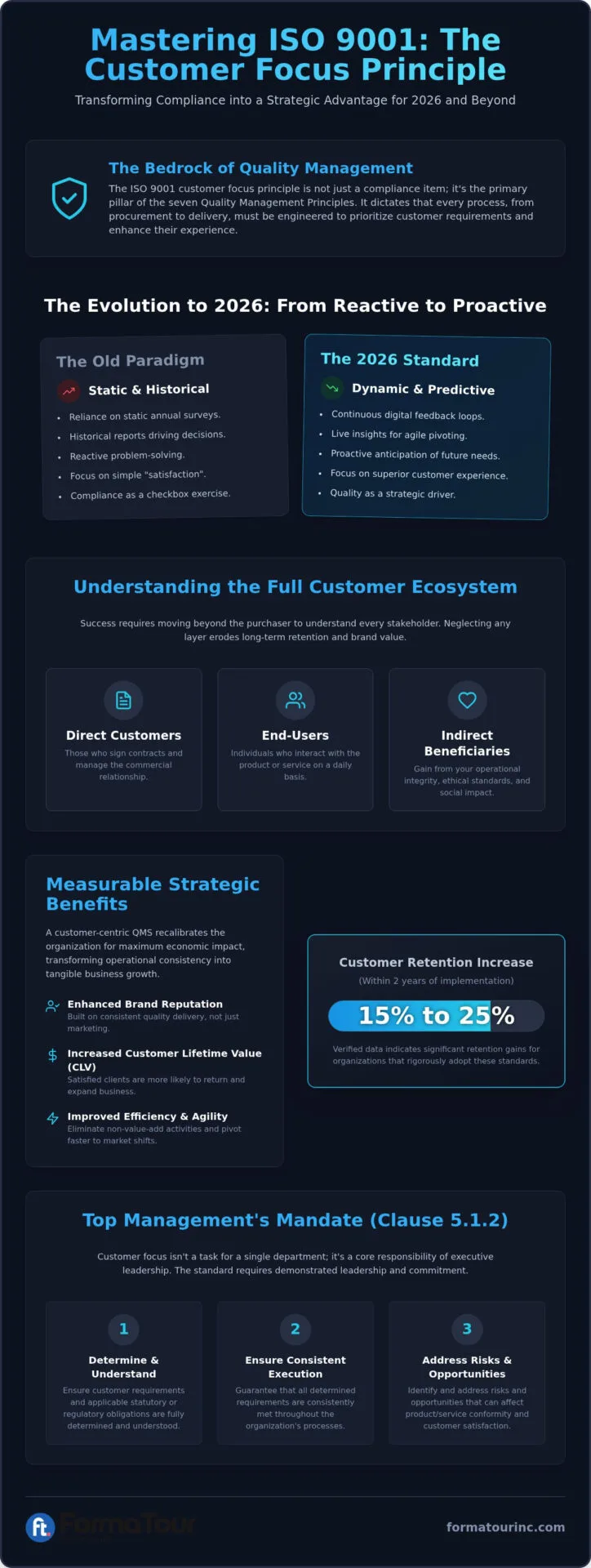
Sustainable growth begins with a precise alignment between what an organization delivers and what the market actually values. The ISO 9001 customer focus principle isn’t just a compliance checkbox; it’s the primary pillar of the seven Quality Management Principles. It dictates that every process, from procurement to delivery, must prioritize the requirements of those who receive the value. This principle is a cornerstone of the broader ISO 9000 family of standards, providing a framework that ensures quality isn’t accidental but engineered into the organizational DNA.
To lead effectively, you must distinguish between the various layers of the customer ecosystem. This includes:
- Direct customers who sign the contracts and manage the commercial relationship.
- End-users who interact with the product or service on a daily basis.
- Indirect beneficiaries who gain from your operational integrity and ethical standards.
Understanding these distinctions prevents the common trap of optimizing for the purchaser while neglecting the end-user experience, which ultimately erodes long-term retention. Success in 2026 requires moving beyond reactive satisfaction toward proactive anticipation of future needs.
The Evolution of Quality Management in 2026
Digital maturity has fundamentally altered what it means to be a satisfied customer. Today’s stakeholders expect seamless, personalized experiences driven by real-time data. Within the ISO 9001 framework, static annual surveys have become relics that fail to capture the velocity of modern commerce. High-performing organizations now leverage digital transformation consulting to build continuous feedback loops. These systems allow leaders to pivot based on live insights rather than historical reports. It’s no longer enough to look in the rearview mirror. You need a forward-looking quality culture that reacts to trends as they emerge.
Key Requirements of the Standard
Clause 5.1.2 places the burden of customer focus squarely on top management. Executives must demonstrate leadership by ensuring that customer requirements and applicable statutory or regulatory obligations are determined, understood, and consistently met. This isn’t a task to be delegated to a quality manager in isolation. It requires a holistic view of the business where leadership identifies and addresses risks that could threaten product or service conformity.
Leaders who don’t prioritize this level of oversight often find their certifications decoupled from their actual business performance. Beyond this, the 2026 updates emphasize the integration of organizational resilience into the quality framework. This alignment is what transforms the ISO 9001 customer focus principle from a theoretical concept into a powerful tool for operational excellence. By linking these requirements to governance, you ensure that the organization’s strategic direction remains anchored in customer reality.
The Strategic Benefits of a Customer-Centric QMS
Implementing the ISO 9001 customer focus principle does more than satisfy auditors; it recalibrates the organization for maximum economic impact. When quality goals align with customer needs, brand reputation is no longer a byproduct of marketing but a direct result of operational consistency. This alignment naturally increases customer lifetime value (CLV), as satisfied clients are far more likely to return. Verified data suggests that organizations adopting these standards can see customer retention increases of 15% to 25% within just two years of implementation.
Internal efficiency gains are equally significant. By viewing processes through the lens of customer value, leadership can identify and eliminate activities that don’t contribute to the final experience. This lean approach streamlines operations and improves organizational agility. When the market shifts, a customer centric Quality Management System (QMS) provides the sensory data needed to pivot rapidly without sacrificing structural integrity.
Driving Revenue Growth and Market Share
Adopting a rigorous approach to ISO 9001 Quality Management serves as a powerful competitive differentiator in saturated markets. Organizations that lead with quality often see a reduction in acquisition costs because satisfied clients act as brand ambassadors. Beyond individual relationships, certification is frequently a mandatory requirement for global tenders. It signals to international partners that your organization possesses the governance and reliability necessary for complex, high stakes collaborations. By meeting these benchmarks, you expand your addressable market and secure a seat at the table for premium contracts.
Building Organizational Resilience
A deep commitment to the ISO 9001 customer focus principle acts as a primary buffer during economic volatility. Loyal customers provide a stable revenue base when market conditions fluctuate. This principle also integrates seamlessly with ISO 22301 Business Continuity Consulting, ensuring that recovery strategies prioritize the most critical customer facing functions first.
Feedback loops established for quality management serve as early warning systems for risk. When customer sentiment changes, it often points to emerging market threats or internal process failures before they manifest in financial reports. This proactive detection allows for strategic adjustments that safeguard the organization’s future. If you’re looking to integrate these standards into a cohesive growth strategy, you might consider how a strategic consultation can align your quality goals with your long term business vision.
Operationalizing Customer Focus: Practical Implementation
Metrics like Net Promoter Score (NPS) and Customer Effort Score (CES) provide the quantitative backbone for your QMS. However, the qualitative data found in non conformities reported by customers offers the most significant opportunity for structural improvement. Managing these reports effectively requires a systematic approach to root cause analysis. Once a solution is implemented, closing the loop by communicating the specific improvement back to the customer base is vital. This transparency builds trust and demonstrates that the organization’s commitment to quality is active rather than performative.
Leveraging Digital Transformation
In 2026, manual data entry and siloed spreadsheets are significant liabilities for organizational resilience. Partnering with digital transformation strategy firms allows executives to automate feedback collection and centralize customer data. AI driven sentiment analysis now enables proactive expectation management by identifying shifts in customer mood before they result in lost business. This centralized approach eliminates operational silos, ensuring that the sales team, product developers, and quality managers all work from a single version of the truth. It’s a critical step in maintaining a modern, responsive ISO 9001 customer focus principle.
Finally, the most sophisticated systems fail without human alignment. Training programs must ensure every staff member understands their specific role in the customer journey. When a warehouse operator or a software engineer recognizes how their precision impacts the end user, quality becomes a shared cultural value rather than a top down mandate. This cultural shift is what ultimately drives operational excellence and long term brand stability.
The Roadmap for Executive Leadership and Governance
Governance of the ISO 9001 customer focus principle starts in the boardroom. Directors must define a “Quality Vision” that transcends simple compliance. This vision serves as the north star for resource allocation, ensuring that process optimization isn’t just about cutting costs but specifically enhancing the user journey. Leadership must ensure quality objectives aren’t vague aspirations. They need to be quantifiable metrics that align perfectly with the firm’s overarching strategic goals. When these objectives are measurable, they provide a clear roadmap for every department to follow. This alignment ensures that every dollar spent on infrastructure or personnel directly contributes to the value proposition promised to the client.
Executive Education and Cultural Shift
True transformation requires a sophisticated shift in mindset across the entire organization. Modern leadership training for digital transformation must integrate quality principles to be effective. Without this synergy, technological upgrades often fail to deliver tangible customer value. Executives must actively work to dismantle internal resistance. Siloed departments often guard their data or prioritize internal KPIs over external satisfaction. A customer-centric culture demands radical transparency and the co-development of solutions. Internal audits are a powerful tool here. They shouldn’t be feared as “gotcha” sessions; instead, use them to reinforce leadership’s commitment to excellence and verify that strategic goals are being met at every operational level.
Strategic Auditing and Certification
Preparing for a certification audit requires specific attention to Clause 5.1.2. External auditors look for evidence of top management’s “active involvement.” You can’t just point to a manual or a delegate. You must demonstrate how your executive decisions reflect the ISO 9001 customer focus principle in daily practice. This includes showing how you’ve identified and addressed risks that could impact service delivery or customer trust. Choosing the right partner for ISO 9001 quality management implementation is a critical strategic choice. You need an advisor who understands the complex intersection of international standards, technological advancement, and executive governance.
If you’re ready to align your leadership strategy with global quality standards, contact our advisory team to discuss a tailored implementation roadmap.
Achieving Operational Excellence with Formatour Advisory
Formatour Incorporated serves as a seasoned strategic mentor for organizations aiming to transcend basic certification. We adopt a multidisciplinary approach to the ISO 9001 customer focus principle, ensuring that quality management isn’t a siloed administrative task but a core driver of operational excellence. Our firm provides the boutique agility required for rapid pivots while maintaining the rigorous consulting standards expected by global enterprises. We specialize in co-developing customized roadmaps that seamlessly integrate quality, information security, and business resilience, positioning Canadian firms to compete effectively on the world stage.
Our methodology is rooted in the belief that compliance should empower, not restrict. By aligning high level concepts with daily operations, we help leadership teams build a foundation of quiet confidence and unwavering reliability. This strategic foresight is what allows our partners to maintain stability during periods of rapid growth or market volatility. We don’t just deliver a certificate; we co-develop a culture of success that resonates throughout every level of your organization.
Our ISO 9001 Implementation Services
We begin every engagement with a comprehensive gap analysis designed to identify specific deficiencies in how your current processes address the ISO 9001 customer focus principle. This isn’t a generic checklist; it’s a deep dive into your organizational DNA to ensure your quality vision aligns with actual customer expectations. Our consultants provide hands-on support for QMS documentation and process automation, replacing cumbersome manual systems with streamlined digital workflows that capture real-time data. To ensure long term sustainability, we offer internal auditor training that empowers your teams to maintain high standards independently. This multidisciplinary advisory approach ensures that your certification remains a living, breathing asset rather than a static document.
Strategic Transformation Beyond Compliance
Operational excellence requires a holistic view of risk and opportunity. We often guide clients through the integration of quality standards with ISO 27001 implementation services, creating a unified management system that protects both your reputation and your data integrity. Our executive leadership programs go beyond technical requirements, providing high level coaching that helps sustain a high-performance quality culture at the board level. With over a decade of experience in ISO standards, we understand the nuances of global benchmarks and their practical application in diverse industries. We act as a visionary architect for your growth, ensuring every concept is integrated into daily operations. If you’re ready to transform your quality management into a strategic advantage, contact us at Formatour Incorporated for a strategic consultation. We’ll help you navigate the complexities of international standards with the steady hand of an expert partner.
Architecting a Future of Operational Excellence
Leading an organization toward sustainable growth requires more than just technical compliance; it demands a sophisticated integration of quality standards into your strategic vision. By shifting from reactive satisfaction to proactive anticipation, you secure a competitive advantage that drives both revenue and resilience. This transition is anchored in the ISO 9001 customer focus principle, which serves as a blueprint for aligning board level objectives with the evolving needs of the global market.
Formatour Incorporated brings over a decade of ISO advisory expertise to this journey. As a Canadian based firm operating with global standards, we specialize in strategic transformation and organizational resilience. We don’t just help you pass an audit; we co-develop a culture of excellence that empowers your entire team through precise governance and digital maturity.
Partner with Formatour for Strategic ISO 9001 Implementation and redefine what quality means for your leadership. Your path to a high performance organization is within reach.
Frequently Asked Questions
What is the primary goal of the ISO 9001 customer focus principle?
The primary goal is to meet and exceed customer expectations to ensure long term organizational growth and resilience. By consistently delivering quality that aligns with market needs, you transform compliance into a strategic advantage. This principle ensures that every internal process, from design to delivery, is calibrated to provide maximum value. It’s about building a sustainable architecture where customer success and business profitability become mutually reinforcing objectives.
How does ISO 9001 define customer satisfaction?
ISO 9001 defines customer satisfaction as the customer’s perception of the degree to which their requirements have been fulfilled. This isn’t just about the absence of complaints; it’s a proactive measurement of perceived value. To meet the standard, you must establish systematic methods for monitoring this perception. High performing organizations use these insights to refine their quality management systems, ensuring they remain relevant in a rapidly changing global economy.
Can a small business effectively implement the customer focus principle?
What are the most common non-conformities related to customer focus?
Common non-conformities often stem from a lack of top management involvement or failing to address risks that affect product conformity. Auditors frequently find that organizations collect data but fail to analyze it or close the feedback loop. Another issue is neglecting to link customer requirements to statutory and regulatory obligations. Ensuring that leadership remains actively engaged in the quality vision is the most effective way to prevent these systemic failures.
How often should an organization measure customer satisfaction for ISO 9001?
The standard doesn’t mandate a specific frequency, but it requires the measurement process to be effective and consistent. In 2026, relying on annual surveys is no longer sufficient for maintaining organizational resilience. Modern quality systems leverage real-time data and automated feedback collection to monitor sentiment continuously. This approach allows leadership to identify emerging risks and opportunities immediately, ensuring the quality management system remains proactive rather than reactive.
Is customer focus the same as customer service?
Customer focus is a strategic governance principle, whereas customer service is a transactional function. While customer service handles direct interactions, the ISO 9001 customer focus principle ensures that the entire organizational architecture is designed around the recipient of value. It involves integrating customer needs into design, procurement, and leadership decisions. This structural alignment ensures that quality is a shared cultural value across every department, not just the front line.
How does customer focus impact the risk-based thinking approach in ISO 9001?
Customer focus provides the essential data points for an effective risk-based thinking approach. By understanding what customers value most, leadership can identify the specific risks that would most severely impact product conformity or brand trust. This alignment ensures that risk mitigation strategies are prioritized based on their potential effect on the customer experience. It transforms risk management from a technical exercise into a strategic tool for safeguarding long term market share.
